In 1999 David Rose bought Mach-Buster, a partially completed airplane whose design was based on high-speed aerodynamic research that had been performed at NASA Ames Research Center at Moffet Field, California.

After considerable time and effort to finish Mach-Buster, David, with Skip Holm and John Penney determined the design was not suitable for flight testing and abandoned the project. His mission is to step into an unlimited of his own design and compete.
The team then started from scratch and started developing a new design using computer modelling, analysis, and simulation methods. After mathematical modelling demonstrated their new technology would work, the team started cutting metal and welding.
Crew chief Jerry Baer and machinist Eric Hereth started by jigging up a fuselage that uses 1-3/8” diameter Chrome-Moly tube, TIG welded together. The highly triangulated fuselage weighs 180 pounds bare. They fabricated a simple landing gear system that uses an Oildyne hydraulic power unit. The nose and main gear fold forward as they stow. This makes emergency gear extensions foolproof as the air stream pulls them down and locked in the event of a hydraulic system failure. Retraction is a little less than two seconds.
The new design has an aluminum skin. The team fabricated aluminum bulkheads that bolt to the fuselage and create the curves that define the fuselage shape. 6061-T6 panels were cut and shaped to fit in sections. After trial-fitting with Cleco fasteners, the panels were riveted permanently in place, or screwed down in case access to the interior was needed.
The all-carbon fiber wings (David has two sets). He has a wing that was designed for high-speed flight. Additionally, he has a flapped aluminium wing that is specially built to provide optimum performance while banking around the course at Reno. Both wings are bolt-on, and their incidence to the fuselage can be optimized.
The tail feathers were designed to balance the needs of slow flight while reducing drag at speed. The horizontal stabilizer was mounted low on the tail cone to avoid the effects of wing turbulence when the aircraft is at high angles of attack, such as during the landing phase.
David initially brought home an F-16 canopy, but after a trial fit realized that it would be way too large for this fuselage. Fellow Reno racer Darryl Greenamyer paid a visit to the Renegade hanger one day and offered David one of his canopies that had been designed for his Unlimited racer, Shockwave. The new canopy still needed to be cut down, but fit perfectly after the trim job.
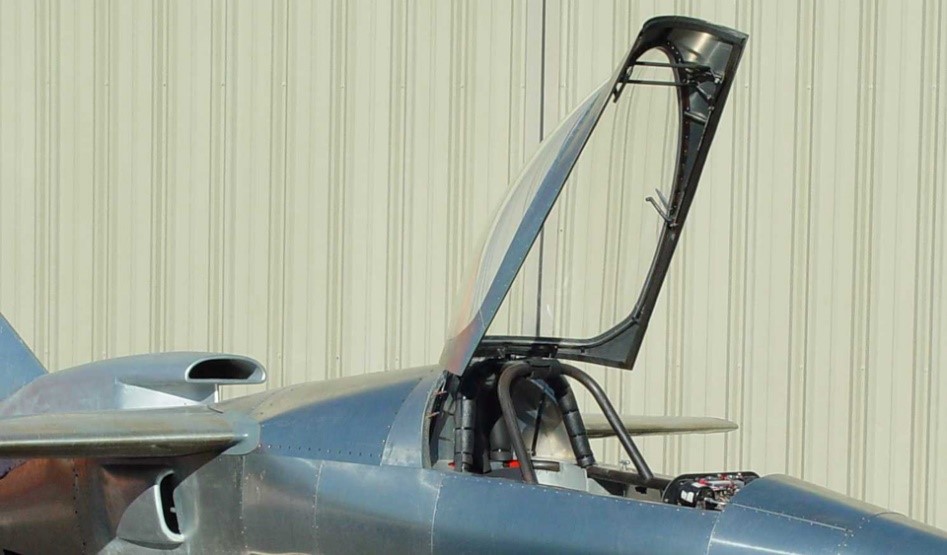
Renegade is not an aerobatic airplane, but high load banking and the occasional roll are necessary, so the team designed and built Renegade to handle positive 8 g’s and negative 4 g’s. The airframe loads were computer-analyzed using finite element analysis (FEA). Additionally, the wings were loaded using sand bags. They passed the test. Renegade’s empty weight came in at 2,300 pounds, with the gross weight topping out at 2,985 pounds.
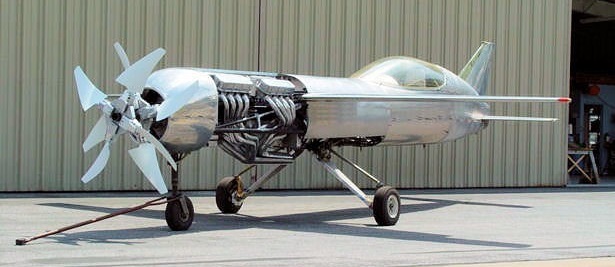
The powerplant is a Pro-Stock style DRCE V-8 with a cast-iron block and large-valve aluminum heads. It sports a forged crankshaft, pistons, and connecting rods. The normally aspirated engine displaces 550 cubic inches and has a 13:1 compression ratio. A Peterson dry-sump system keeps the engine lubricated, while the dry-sump oil pan allows the engine to be located low in the fuselage.
The intake manifold is a Kinsler unit with a computer-controlled, Electromotive integrated fuel injection/ignition system. The water pump and mechanical fuel pumps are part of an accessory case that is cam-driven. A lightweight starter spins an 8-pound steel flywheel, and a fluid damper controls crank torsional vibration. The big V-8 is liquid-cooled; fresh air enters through side scoops mounted underneath each wing. Inside, twin radiators are mounted in a “V” configuration.

The engine is capable of a 7800-rpm redline, but David set the Electromotive’s rev limiter to 6800 rpm. At this rpm, the engine will produce 1,230 hp and 950 feet/pound of torque. At max horsepower, the cylinder’s “brake mean effective pressure” is 261 pounds per square inch.
A splined coupler drives a 5-inch diameter, 51-inch long, carbon-fiber drive shaft originally designed for offshore boat racing. The drive shaft terminates at a bearing carrier where the pusher prop is mounted. The prop is a four-blade design, custom made of carbon-fiber, and has a 48-inch diameter. The pitch is ground-adjustable. The prop underwent extensive load and vibration testing under the auspices of vibration specialist Dr. Tom Trozera, who safely spin-tested the prop to 18000 rpm. This resulted in a 2.6:1 safety factor above the prop’s redline of 6800 rpm. With a 35-degree blade angle (79-inch pitch) optimized for flight tests less than 300 mph, the prop efficiency should be about 74 percent, producing 1,560 pounds of thrust and a tip speed of Mach 1.33.
David and the team have calculated Renegade’s flight performance and the results should make for an easy flier. They estimate the take-off roll to be about 2,000 feet, with rotation coming at 100 Kts. Once airborne, the climb should be 3500+ feet per minute. Leveling out, Renegade should easily accelerate to 300 Kts.
Renegade is designed to race at Reno and should be able to achieve 430 Kts (495 mph) once all systems are fine-tuned. Approaches are made with full flaps at 135 Kts. Once the runway is made, Renegade should touch down at 95 Kts. A speed brake is deployed to help scrub off speed until the brakes take over. Renegade carries 85 gallons of fuel as this V-8 burns 105 gallons per hour. Never intended to be a cross-country flier, Renegade can fly at race speeds for 45 minutes. It was designed to be trailerable—the wing can be detached in less than 30 minutes.
Renegade meets all the Reno National Air Races Unlimited class rules. Because Renegade was not seen as a traditional Unlimited racer, Reno Air Racing Association officials had concerns but felt that if complete flight tests were successful, David would be invited to attend Reno’s Pylon Racing School.
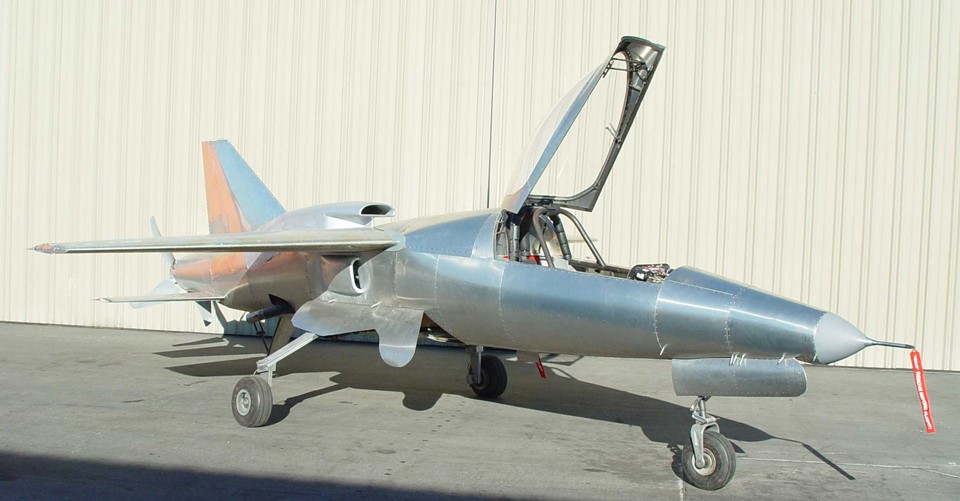
Their proof of concept, Renegade, was built in less than a year.
Engine: Olds DRCE V-8 550 cui, 1,230 hp
Torque: 950
Engine Redline: 6800 rpm
Wing Span: 17 ft
Wing Area: 70 sq.ft
Empty Weight: 2,300 lbs
Gross Weight: 2,985 lbs
Fuel Capacity: 85 USgal
Wing Loading: 42.6 psf
Fuel Burn (full throttle): 105 gph
Top Speed (est.): 495 mph
Rate of Climb (est.): 3,500+ fpm
Stall Speed (est.): 103 mph
Seats: 1