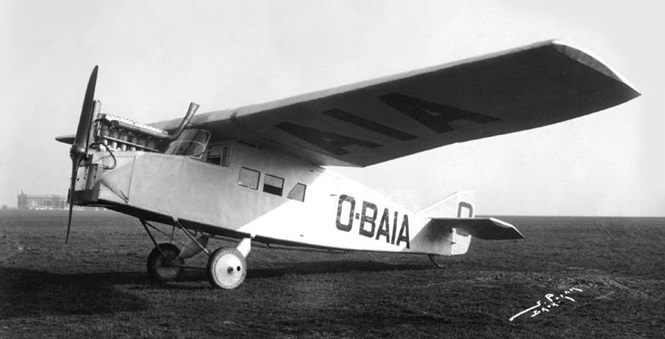
The SABCA S.2 was an airliner built in Belgium in 1926. It was a conventional, high-wing cantilever monoplane with fixed, tailskid undercarriage. The flight deck was open, but the passenger cabin was fully enclosed. Power was provided by a single 240 hp Siddeley Puma engine in the nose, driving a two-blade propeller, and whose exhaust was collected in a single stack that extended up over the wing. Metal was construction throughout, with corrugated skin. Only a single example was built, which served with SABENA.
Belgium Formed December 1920, SABCA had a close SABENA association and that airline used SABCA’s only S.2 single-engined monoplane transport. Built Handley Page 3-engined airliners for SABENA Belgian Congo service; also other private-owner prototypes.
At the end of 1920 the Société Anonyme Belge de Constructions Aéronautiques (SABCA) was created to ensure the construction, testing and overhaul of aeronautical equipment for the development of civil aviation and air transport (SABENA will be founded three years later). It will begin with the overhaul and overhaul of Belgian Military Aeronautics aircraft, before starting, in 1922, to build foreign aircraft under license. The first designs and new realizations will be due to members of the staff of SABCA, encouraged and supported by the company. Among others, the moto-aviette Jullien SJ-1 (in 1923), of Henri JULLIEN, engineer director of the design office of the SABCA, and the “Limousine” Demonty-Poncelet of Mathieu DEMONTY (technical director) and Paul PONCELET (head of the wood section) (in 1924).
On his own, but with the support of SABCA, Paul PONCELET designed and built the “Castar” in 1922-1923, then in 1923 the “Vivette”.
SABCA’s first project was a small aeroplane called the Sabca J1, which was powered by the engine of a FN motorcycle. The company also constructed “Sabca” 1500 with a 200 HP engine and some gliders. It later assembled the Handley-Page, Fokker F VII, and the Savoia-Marchetti used by Sabena. Held Breguet and Avia licences, and from 1927 directed attention to metal construction. Outcome was S-XI 20- passenger monoplane with three 500 hp engines, as well as similar S-XII 4-passenger monoplane with three 120 hp engines. Built under license Renard R.31 reconnaissance monoplane and Savoia-Marchetti S.73 transport.
In October 1937, the Belgian aircraft manufacturer Société Anonyme Belge de Constructions Aéronautiques (SABCA) made a marketing agreement with the Italian company Caproni, with SABCA selling some of Caproni’s military aircraft in certain markets, including the Caproni Ca.135, Ca.310 and the Ca.312, which were to be designated SABCA S.45bis, S.46 and S.48 respectively. As part of this agreement, Caproni were to develop a replacement for the Belgium Air Force’s Fairey Fox biplanes, which were used as two-seat fighters and reconnaissance aircraft, but were obsolete.
Built S.47 2-seat low-wing monoplane fighter of 1937 in collaboration with Caproni. Company revived in 1950s. In 1960s assembled, maintained, and repaired Republic F-84; also collaborated with Avions Fairey on Hawker Hunter and made Vautour components for Sud- Aviation. Much work of various kinds on Lockheed Starfighter, Dassault Mirage, and Breguet Atlantic; also missile and space activities. Dassault Aviation took 53 percent shareholding, while in 1998 Fokker’s shareholding was then reportedly being sold. Recent work has included weapon system integration, development of the cockpit front panel, final assembly, and flight testing of Belgian ArmyA-109 helicopters; update of F-5s; production and upgrading of F-16s; upgrade of Mirage 5s and F1s; production of servo actuators; and construction of subassemblies for Dassault, Boeing, Airbus, and Fokker aircraft.
Saab’s experience with the S340 commuter airliner turned its attention to the future needs of regional and ‘feeder’ carriers. Having forged a market with its smaller aircraft, Saab used the S340 as a baseline from which to develop a new, high-speed turboprop airliner which was to be called the Saab 2000, with a max payload of 5900 kg or up to 2 crew and 58 passengers. The go-ahead came with a launch order from Moritz Suter’s Crossair, already a firm Saab customer, which signed for 25 aircraft with a further 25 on option, on 15 December 1988.
By late 1989 project definition for the Saab 2000 had been completed, with the contracting out of major portions of the aircraft’s construction. CASA of Spain was responsible for the wing design and production, though Saab defined the basic airfoil structure. Valmet of Finland was to build the entire tail unit and elevators, while in England, Westland is responsible for the rear fuselage. For the cockpit, a Collins Proline 4 avionics suite was selected, while a radical reduction in cabin noise levels over existing aircraft was also promised. The concept of ‘hub bypass’ was central to Saab’s sales efforts for the aircraft. To achieve this, Saab planned to build an aircraft capable of 665km/h over a 1850km sector, a speed comparable with the BAe 146 (Avro RJ). A jet-like climb performance was also essential, with figures of 0-6096m in less than 11 minutes assured. The original choice of engine fell between General Electric’s GE38, then under development for the US Navy’s projected LRAACA maritime patrol aircraft, and the Pratt & Whitney PW300 turbofan. In the event, and in conjunction with Crossair, Saab opted for the Allison GMA 2100 turboprop, driving six-bladed, low-noise Dowty propellers. As part of the deal Allison was contracted to build the engine nacelles.
Production of the first prototype began at Linkoping in February 1990. Several European aerospace firms participated in the Saab 2000 manufacturing program including CASA, Westland and Valmet of Finland.
The prototype’s (SE-001) maiden flight occurred on 26 March 1992. A four-aircraft test programme was established with aircraft No. 2 (SE-002) involved in stability and control certification. Much of the high-temperature and adverse weather flying was undertaken by the No. 2 Saab 2000, which completed two visits to Spain. The first full production-standard aircraft was SE-003, with which all the systems certification was achieved, only the autopilot certification being outstanding in mid-1993. Certification in Europe was granted in March 1994 and by the FAA in April 1994. Functional reliability flights were undertaken by aircraft No.4 (SE-004), as part of the ongoing test programme which exceeded 1,200 hours across the fleet.
All Saab’s performance guarantees have been met or exceeded. Take-off and landing distances were bettered by 100-200m. Time from brake release to 6096m is less than eight minutes, and in proving this the Saab 2000 easily broke the existing time-to-climb record for an aircraft in its class (previously held by a Grumman E-2 at 10 minutes). Range and weights have all been better than expected on the production standard aircraft, and the promised cruise speed of 665km/h at 8534m is, on average, 15km/h better. In a dive the Saab 2000 has reached 794km/h with no ill effects. International noise requirements have been bettered by 9.1 decibels.
The fuselage diameter is 91 inches, allowing for a single row of passenger seats on the left side and double row on the right. The gear up limiting speed is 175 kt, with extension being 220 kts and a cruise speed of over 665km/h.
Reducing cabin noise was a cornerstone of the Saab 2000 design philosophy and Saab has developed a so-far unique anti-noise system that has been test flown on a Saab 340, ready for inclusion on its larger sibling. This involves a series of microphones, located around the interior, which monitor cabin noise and then re-broadcast an equal opposite; wave, thus effectively ‘switching off’ background noise and vibration.
August 1994 saw the first delivery to Crossair and September 1994 the first revenue service. Saab originally foresaw a market for 1,400 new 40- to 50-seat regional airliners by the end of the century, and sales of 400 Saab 2000s were anticipated. While the manufacturer held well over 100 paid options, only 36 firm orders had been received by July 1993. The seventh aircraft and the first for Deutsche BA (formerly Delta Air) flew on 24 June 1993.
Lack of sales and profitability forced Saab to cease the 2000 production with just 63 aircraft built. The last SAAB 2000 was delivered to Crossair in April 1999.
Engines: 2 x Allison AE2100A turboprop, 4152 shp / 3096kW Props: Dowty 6 blade Wingspan: 24.76 m / 81 ft 3 in Length: 27.03 m / 89 ft 8 in Height: 7.73 m / 25 ft 4 in Max take-off weight: 22000 kg / 48502 lb Loaded weight: 13500 kg / 29763 lb Max. speed: 680 km/h / 423 mph Cruise: 360 kt Ceiling: 9450 m / 31000 ft Range w/max.payload: 2557 km / 1589 miles Pax cap: 50-58
For several years, Saab-Scania had been working on a project known as Aircraft 108 (later renamed the Transporter), calculation and design work on the later versions of which (1083 and 1084) had advanced to the stage at which production was feasible. The scope of the project was such that the initial costs and the risks involved were substantial, added to which Saab-Scania had no recent experience in marketing an airliner. As a result SAAB sought a partner in the venture. Negotiations were initiated in 1979 with Fairchild Industries.
This resulted in a 65/35 co-operation agreement being signed on January 25 1980. In this agreement, Fairchild would manufacture the wing and tailplane surfaces and the engine housings at its Republic factory on Long Island, and Saab would manufacture the fuselage and be responsible for final assembly at its new plant in Linkoping, Sweden. SAAB was also responsible for the systems integration, and flight-testing.
Initial project name was ‘3000’ but in July 1980, it was officially named Saab-Fairchild SF-340. In June 1980 General Electric was selected as the engine supplier with its new CT-7 engine derived from the T-700 helicopter unit. Meanwhile Saab had placed a group of engineers with Fairchild to design the aircraft following 15 September 1980. Most of 1980 went to define the aircraft and build a wooden mock-up in Linkoping.
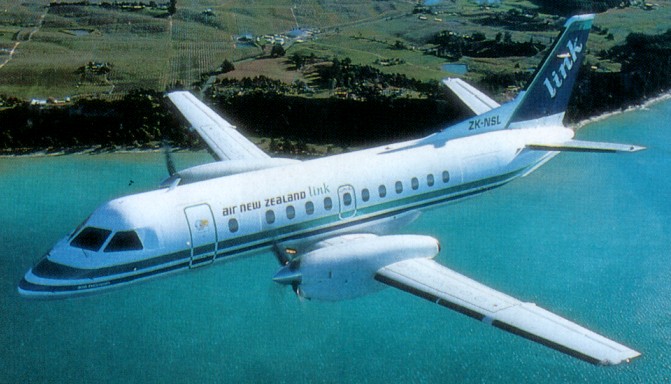
A cantilever low-wing monoplane of basic all-metal structure with the selective use of composite materials, the aircraft is of conventional configuration; it has a fail-safe pressurised fuselage structure, retractable tricycle landing gear with twin wheels on each unit, and is powered by two turboprop engines in wing-mounted nacelles.
The aircraft comprises a round-section fuselage seating up to 35 passengers with a flight attendant and two-person crew. The wing uses NASA-developed low-drag airfoil technology, and two General Electric CT7 turboprops were chosen as powerplants.
Marketing of the aircraft began immediately and early customers were Crossair in Switzerland, Swedair in Sweden and Comair and Air Midwest in USA. In late 1981 production began in the brand new facilities in Linkoping adjacent to the military factory, By early 1982 major sub-assemblies were finished and the first wing was lifted out of the jig in April. The fuselage and wing were mated in August. The rolling out the prototype came on 27 October 1982 in the presence of the Swedish King.
The first Saab-Fairchild 340 prototype (SE-ISF) flew on 25 January 1983, three years to the day after the agreement had been signed with Fairchild. This, plus a second prototype (SE-ISA) and the first production aircraft (SE-ISB flown on 25 August 1983) participated in the certification programme. After a flight test period lasting 16 months involving four aircraft, the SF-340 received its JAR type-certificate on May 30 1984 and FAA approval granted by 29 June 1984. The 340 was the first aircraft to be certified under the new JAR rules in which Belgiurn, Finland, France, Germany, Holland, Norway, Sweden, Switzerland and the UK participated. Australia followed on October 30. The prototype was subsequently mounted on a pole outside Linkoping when the city celebrated its 700 anniversary.
The second prototype has been retained for the subsequent flight-testing including the 340B certification. It was being used in preparation for the Saab 2000 flight test programme.
The third 340, was a pre-production aircraft. It was subsequently modified by Fairchild to incorporate an APU. It was later cut up, and various pieces used for the Saab 2000 programme. The last aircraft was the first production standard, and was later delivered to Comair.
The first production aircraft, s/n 003 SE-ISB, was flown on 25 August 1983.
SAAB SF340A s/n 005 was the first delivered, and it went to Crossair on 6 June 1984. This was placed into service on June 15 flying from Basle to Paris.
Initially two versions were on offer: the basic air transport configuration and an executive version. The first of these ‘biz-props’ was sold to Pittsburgh’s Mellon Bank. The type suffered a setback in 1984 when it was temporarily grounded, after Crossair suffered inflight engine shut downs, but these teething troubles were soon rectified and Saab pressed on with the next stage in the aircraft’s development. In 1985, at the Paris air show, Saab launched a 340 with uprated CT7 engines driving larger Dowty propellers. Maximum take-off weight was increased from the original 11,793kg to 12,872kg. Existing SF-340s were offered the improvement as a modification programme.
Saab attempted to sell the 340 as a corporate aircraft, but only sold four 340As. For this marketing campaign the Saab office in USA actually operated a corporate demonstrator (N340SF) during 1985 and 1986. As the sales-result could not warrant an exclusive demonstrator, it was sold and later converted to airliner standard for Comair.
Fairchild entered economic problems partly due to the increased costs of starting up the 340 programme and partly because of the cancelled T-46 programme. Fairchild withdrew from the aircraft business altogether. Swearingen in Texas was sold and an agreement was reached with Saab to withdraw from the 340 programme. As of 1 November 1985, Saab took over the responsibility for the 340 and renamed it the ‘Saab SF-340’. In 1987 it became simply the ‘Saab 340’ and the factory in Linkoping was expanded to take over the wing- and tail-production, completed in June 1986. SAAB initially retained the SF340 designation but later changed it to 340A.
Next version to be offered was the freighter S340QC which was a quick-change cargo aircraft, the first of which was delivered to Finnaviation in 1987. In that same year, as Saab severed its final links with Fairchild, the family was renamed the S340.
The 100th 340 was delivered in September 1987.
1987 saw the launch of the Saab 340B, first flying on April 21 1989, which features higher power output CT7-9B engines, a larger span tailplane, and a further increased maximum takeoff weight of 12,928kg. Crossair was again the launch customer for this version. From aircraft number 160, all 340s were ‘B’ models. The last SF340A, of 159, was delivered in August 1989. The SF340B has two 1750 shp (1 305 kW) GE CT7-9B turboprops for hot and high use.
Announced improvements to the Saab 340 will enhance the aircraft’s hot-and-high performance and short field capability, through a 0.6m wingtip extension. This increases the Saab 340’s takeoff weight by 544kg, equivalent to six/seven passengers. A third-generation cabin interior, common to the Saab 2000, was also being introduced, along with modifications to the APU and optional low-pressure tyres.
In 1987 and 1988 44 340s were sold each year. In 1989 Saab sold 123 aircraft, the 300 mark was reached in 1990. By mid-1993 Saab 340 orders had exceeded 400, with over 340 delivered, to 28 airlines and four corporate clients.
SF340AEW
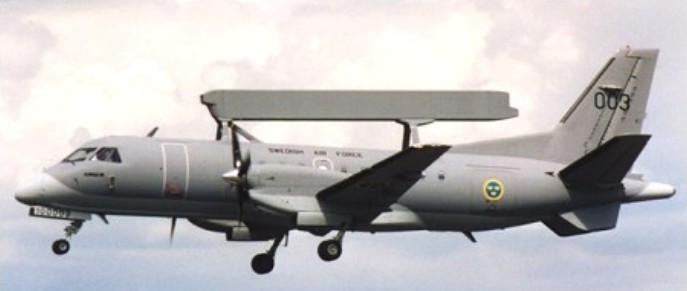
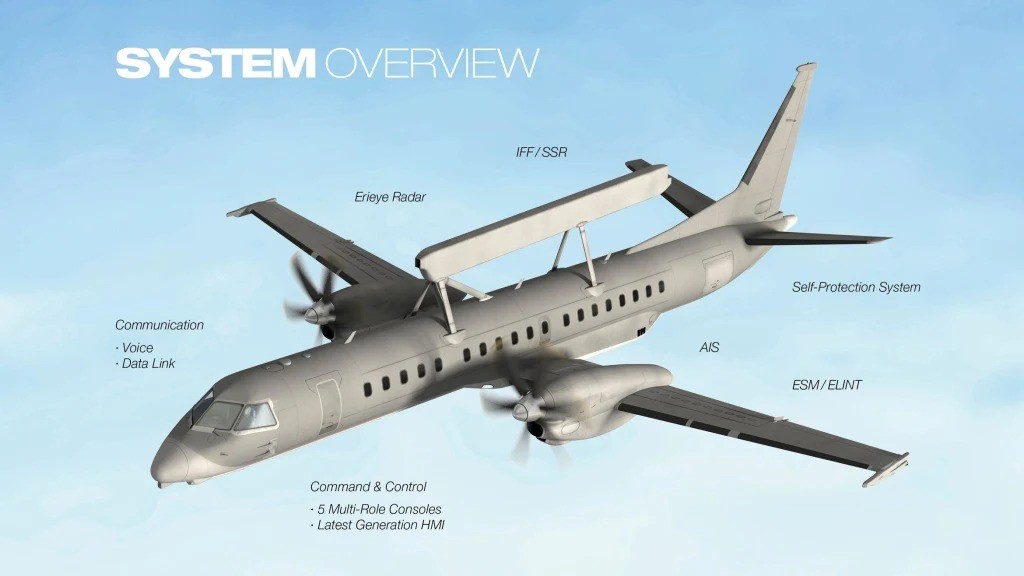
For the Swedish military the SAAB-340AEW Erieye airborne early warning version was developed, the contract for which was signed by the Swedish air force on 3 February 1993.
This version features an Ericsson phased array surveillance radar above the fuselage, with three operators in the cabin and a mission endurance of up to seven hours. Six aircraft were anticipated lor Swedish service with an initial in-service date of 1995.
Saab 2000 Erieye AEW&C
The last development of the 340 was the 340B Plus, that introduced changes developed for the larger SAAB 2000. The first 340B Plus was delivered in March 1994. Production of the 340 ended in 1999 with a total of 459 airframes built.
340A Engines: 2 x General Electric CT7-5A2, 1735 hp Accommodation: 30-37 Wing span: 21,44 m (70 ft 4 in) Wing area: 41.81 sq.m (450 sq.ft) Length: 19.72m (64ft 8in) Height: 6.87 m (22 ft 6 in) Max. t/o weight: 12400 kg / 27337 lb Max. land, weight: 27,200 lb Max. payload: 8,085 lb OEW: 17,6151b Typical cruis. speed: 275 kt Maximum/cruising speed: 507 kph / 315 mph Landing speed: 154 kph / 96 mph Range: 805 nm / 1500 km / 930 miles T/o field length: 3,900 ft Max, ceiling: 8500 m / 27890 ft Max, ceiling Exec. version: 25,000ft Max. SL cabin altitude: 3650 m / 11975 ft
340B Engines: 2 x General Electric CT7-9B, 1750 shp (1305 kW) Wing span: 21.44 m (70 ft 4 in) Wing area: 41.81 sq. m (450 sq. ft) Length: 19.73 m (64 ft 9 in) Height: 6.87 m (22 ft 6 in) Max. t/o weight: 13000 kg / 28660 lb Max. land. weight: 28, 000 lb Max. payload: 8,285 lb OEW: 8035 kg / 17714 lb Typical cruise speed: 285 kt / 522 km/h / 324 mph Range (35 pax): 980 nrn / 1807 km / 1123 miles T/o field length: 4,050ft Max ceiling: 25,000 ft / 7620 m Accommodation: 30-37
Not long after it had given a go-ahead for development and production of the Saab-32, the Swedish air force began to draw up its specification for a new single-seat fighter that would be able to intercept bombers flying in the transonic speed range. The new type was going to need supersonic speed capability, an unprecedented rate of climb, above, average range and endurance, and a considerable weapon load. It was required to have STOL (short take-off and landing) characteristics to allow for its deployment from a variety of dispersed sites.
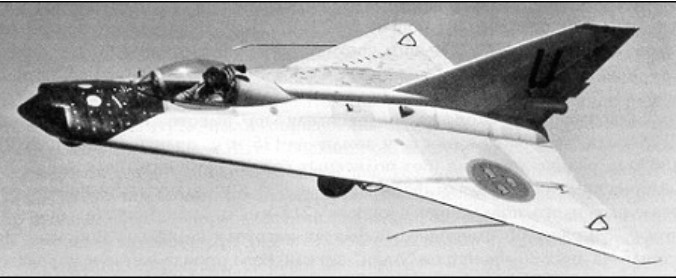
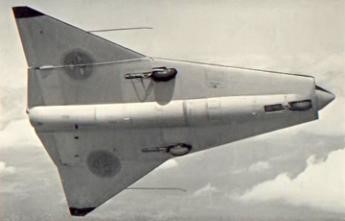
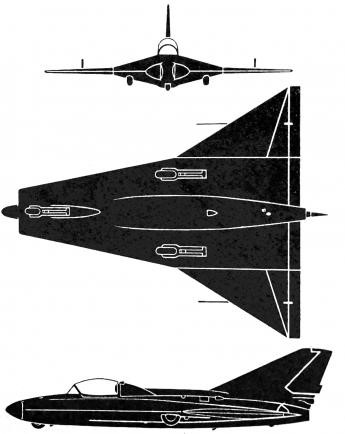
Saab began work on this requirement in August 1949, selecting a wing of double-delta configuration that promised great structural integrity with low weight and which, if it performed satisfactorily, would provide the volume needed for the equipment, fuel and weapons demanded by its primary role. The capability of such a wing was confirmed by wind tunnel testing of models and by the Saab-210 small-scale research aircraft, powered by a 476kg thrust Armstrong Siddeley Adder turbojet. First flown on 21 February 1952, the Saab-210 confirmed that there were no particular problems in the handling of the double-delta wing.
A double delta model, with wing sweep at 80o for the inner and 60o for the outer sections was demonstrated and led to a 1:7 scale aircraft being built. The project was launched in November 1950 and on December 7, 1951, the SAAB 210 began its taxi tests. Tests were carried out with ground contact speeds between 250 and 150 km / h.
The ‘Mini-Draken’ (otherwise the Saab 210) was completed and first flown on 21 January 1952, with Bengt Olow at the controls, nine months and SKr 1.7 million later. The landing gear was raised hydraulicly, the descent was by gravity.
Following a successful test flight, the Swedish Air Force ordered three full-scale J35 prototypes. The 210 flew a total of 887 flights and 286 flying hours.
210 Engine: Armstrong Siddley Adder ASA1, 475 kg Wingspan: 6.35 m Length: 8.80 m Height: 2.78 m Wing area: 24.20 m² Aspect ratio: 1.67 Sweepback: 60 – 77 ° Take-off Weight: 1775 Kg Wing loading: 77 kg / m² Rate of climb: 11 m/s Climb to 2000m: 4 min. Climb to 4000m: 8 min. Max speed 4000m: 540 km / h Landing roll: 300 m Landing roll with parachute: 200 m Take-off dist: 900 m Range: 280 km Takeoff speed: 180 km / h Landing Speed: 190 km / h
210A Engine: Armstrong Siddley Adder ASA1, 475 kg Wingspan: 6.35 m Length: 8.80 m Height: 2.78 m Wing area: 24.20 m² Aspect ratio: 1.67 Sweepback: 60 – 77 ° Wing loading: 77 kg / m² Maximum speed: 555 km / h Max speed 2000 m: 545 km / h Max speed 4000 m: 540 km / h Range: 280 km Takeoff speed: 180 km / h Landing Speed: 190 km / h Take-off dist: 900 m Climb to 2000m: 4 min. Climb to 4000m: 8 min.
210B Engine: Armstrong Siddley Adder ASA1, 475 kg Wingspan: 6.35 m Length: 9.12 m Height: 2.78 m Wing area: 23.00 m² Aspect ratio: 1.67 Sweepback: 60 – 77 ° Wing loading: 77 kg / m² Range: 280 km Takeoff speed: 180 km / h Landing Speed: 190 km / h Climb to 2000m: 4 min. Climb to 4000m: 8 min. Take-off dist: 900 m
Developed by Saab as a private venture, to add to its product line a lightweight turbojet-powered aircraft able to fulfil a number of civil and military roles, the Saab-105 entered the design stage in 1959. SAAB launched the Saab-105-project in April 1960. This shoulder-wing aircraft was originally engined by two French Turbomeca Aubisque turbofans. The project was company-funded and conducted by a design team under Ragnar Haerdmark.
On 16 December 1961, the Swedish government awarded SAAB a contract for a prototype of the SAAB 105 side-by-side two-seater and signed a letter of intent for at least a hundred production machines. In 1962, the Flygvapnet ordered 150 SAAB 105, designated Sk 60 (was to be Sk 55, but SAAB asked for number 60).
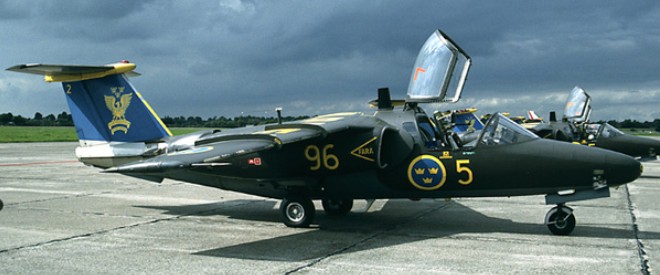
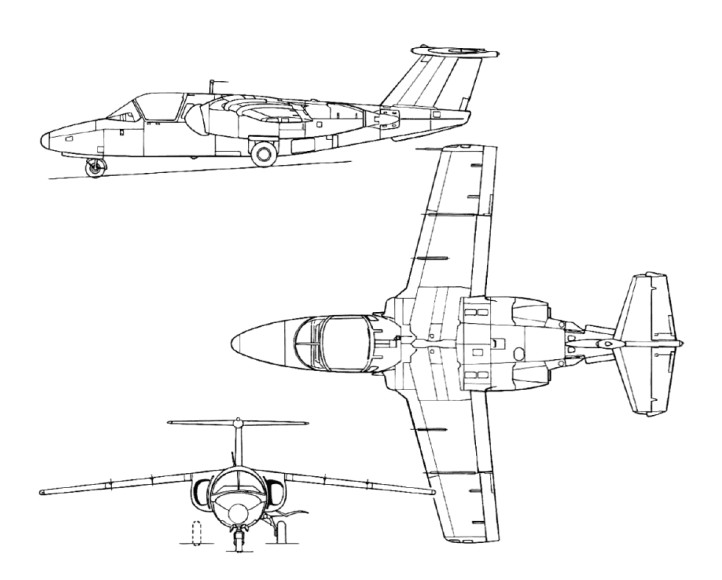
A cantilever-shoulder-wing monoplane with marked wing anhedral and high T-tail, it has retractable tricycle landing gear, is powered by two turbofans nacelle-mounted one on each side of the fuselage, and has an enclosed cockpit that accommodates two side-by-side on ejection seats. Alternative seating for four can be provided on fixed seats.
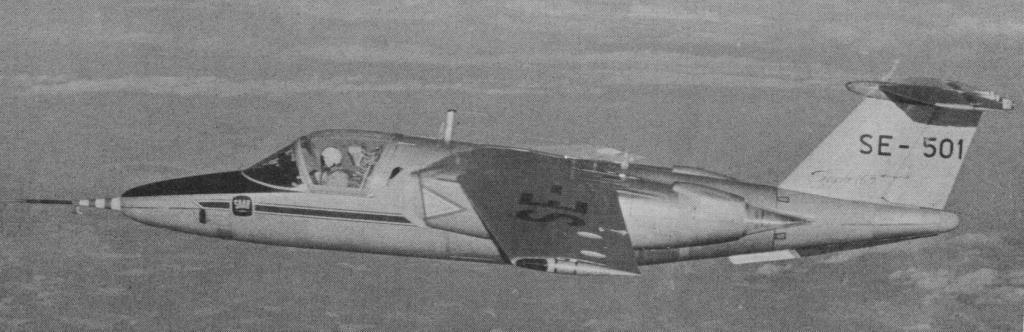
The initial test flight was delayed to find an appropriate engine, eventually found in the 745kg thrust Turbomeca Aubisque. The first SAAB 105 prototype, registered SE-501, was flown on 29 June 1963. A second prototype, SE-502, flew on 17 June 1964.
Following extensive testing of the prototypes the Flygvapen placed an initial order in early 1964 for 130 production aircraft, a figure that was amended later to 150. The first of them was the Sk 60A trainer/liaison aircraft, flown initially on 27 August 1965 with deliveries for optional deployment in an attack role. The first Sk 60A, Swedish Air Force 60001, was delivered to the F 5 at Ljungbyhed in 1966. By 1969, 149 Saab Sk 60A, were delivered to the Swedish Air Force and placed in service.
Next to the SAAB 105 for the Swedish Air Force, SAAB worked on a military export model, the SAAB 105XT, with “XT” standing for “Export Tropic”. This variant had more powerful General Electric J85-GE-17B turbojets and an improved wing structure. The second SAAB 105 prototype was modified and was flown first as Saab 105XT on 29 April 1967. It was registered SE-XBZ for use as a flying demonstrator. Austria ordered 40 SAAB 105XT machines with the designation of SAAB 105OE (“OE” for “Oesterreich”). Deliveries started in 1970 and the order was completed in 1972. The Saab 105OE is used in Austrian service for reconnaissance, support and air defence tasks.
The Saab 105 delivered to the Swedish Air Force as Sk 60A was an unarmed trainer. Starting in 1970, 46 Sk 60As were converted into Sk 60B standard, with three hardpoints beneath each wing enabling them to operate as a light ground attack aircraft.
Another 28 Sk 60A aircraft were modified to Sk 60C. The Sk 60C has a reconnaissance camera in the nose. The nose is longer and angular compared with the other versions of the aircraft. The Sk 60C prototype was the only new-build Sk 60C, when delivered to the Flygvapnet, making it the 150th and last new-build Sk 60 for the Swedish Air Force service.
In the mid-1970s, ten Sk 60A planes were configured as transports and given the designation of Sk 60D. A further development is the Sk 60E, which is equipped commercial-type instruments, including an instrument landing system. This variant has four seats, and consequently no rocket chairs. The Sk 60D and Sk 60E variants were also used for training of civil pilots. The Sk 60 has now gone trough a modernisation programme. The most important alteration was replacement of the Turbomeccas by the stronger William Rolls FJ 44 turbofans. The first Williams-powered Sk 60(W) was flown in August 1995. A total of about 115 conversions of Sk 60A, Sk 60B, and Sk 60C machines were performed in the late 1990s. In addition to its primary duty as a trainer, the Sk 60 is used as target aircraft, weather flying and liaison aircraft. A new variant, the Sk 60M, was developed to replace the Mitsubishi MU-2 target aircraft / target tug of Nyge Aero.
Surviving Swedish air force Sk 60s, of which there are four squadrons, have undergone a life extension programme at Saab.