Scaled Composites 311 Global Flyer

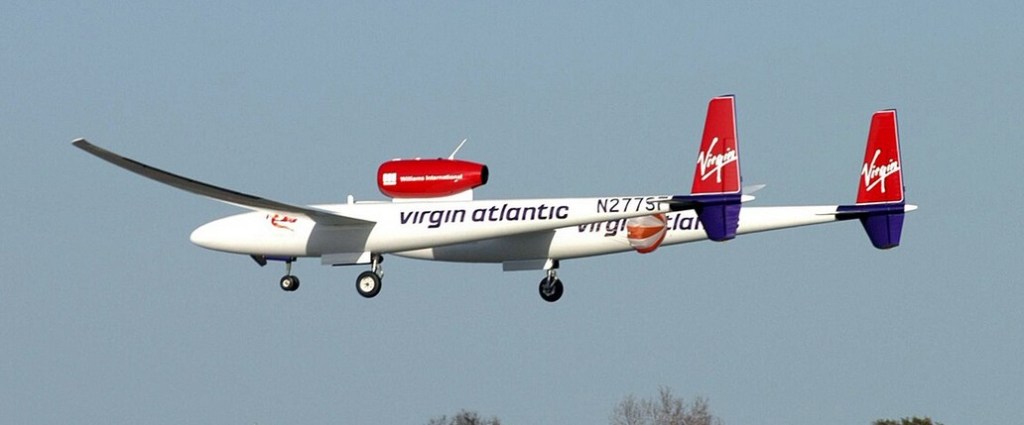
Test flying began in 2004 in the US on an aircraft designed to fly around the world by a single pilot and without refuelling. Known as the Global Flyer, or Scaled Composites Model 311, it made the first of several flights which tested its controls and systems, including its “drag chutes” used during descent and landing.

The GlobalFlyer is a single seat, turbofan powered airplane designed to fly around the world nonstop, unrefueled. It achieved this milestone for the first time on March 03, 2005 after 67 hours and one minute of flying time. With that, Pilot Steve Fossett set the record for fastest time around the world unrefueled. The GlobalFlyer took off and landed in Salina, Kansas.

The second world-record flight was completed on February 11, 2006 when Pilot Steve Fossett made an emergency landing at Bournemouth Airport in England. Kennedy Space Center was chosen for the takeoff, which took place on February 8. The flight had many stressful moments. Despite this, Steve was able to accomplish the goal of the “Ultimate Flight” by breaking the previous world distance record for an airplane, which was set by the Voyager in 1986 (24,987 miles), as well as the aviation long-distance record set by the Breitling Orbiter Balloon in 1999 (25,361 miles).

Aerodynamics are key to this aircraft, and its configuration is optimized for range and fuel efficiency. The aircraft’s shape has been designed using computational fluid dynamics to predict how the aircraft’s surfaces will behave in flight. The aircraft is so aerodynamically efficient that the only practical way to descend is using drag parachutes. As the aircraft is only required to land once, these aren’t detachable and take time to reset.

The aircraft is a trimaran-like construction with two huge external ‘booms’ which hold the landing gear, and 5,454 pounds of fuel on either side of the pilot’s cockpit in the center on top of which is the single Williams turbofan jet engine. The construction materials used for the structure of this aircraft are all graphite/epoxy. The stiffest carbon fibers are used in the construction of the wings, and the skin is a sandwich of graphite/epoxy and Aramid honeycomb.

The aircraft doesn’t have what is known as ‘deicing’ or ‘anti-ice’ measures. This means that it is not able to fly in ‘icing’ conditions. In addition, it does not cope with turbulence very well in the early part of the flight when the aircraft is heavy and structural margins low; so weather will be an important factor in choosing when and where to take off from.

The pilot sits in the main fuselage, the center pod, just behind the nose landing gear and below the engine. He also sits in front of the main fuel header tank which feeds the engine. Early on in the project, there were huge obstacles to overcome caused by engine noise levels, but those were quickly overcome with the addition of insulation. The cabin is pressurized because of the altitude which gives a ‘cabin altitude’ of 10,000 feet at the 45,000 feet the plane actually flys at.

There are thirteen fuel tanks all in all, and on take-off, it is expected that this aircraft will be 83% fuel by weight. Getting fuel to where it’s needed whilst maintaining the balance and stability of the aircraft is a feat that will require constant supervision and monitoring. The fuel itself is a special fuel that has a much lower freezing point than regular aviation fuel.

Wing Span: 114ft
Wing Area: 400 sq.ft
Length: 44.1ft
Height: 13.3ft
Gross Weight: 22,000 lbs
Empty Weight: 3,350 lbs

Scaled Composites 151 Ares

The ARES, Scaled Model 151, was designed initially in response to a U.S. Army request for a Low Cost Battlefield Attack Aircraft. A design study was performed by Rutan Aircraft Factory in 1981 for such an aircraft. The original LCBAA design was for a pusher turboprop aircraft, of generally the same aerodynamic configuration you see here. It also was designed around a 30mm chain gun. Its mission goals were low-altitude, close air support, with long endurance, and with adequate field performance to operate from roads. Its structure and systems were simple enough to be maintained and repaired in the field.

Scaled followed up with the concept, and ultimately decided to build a demonstrator aircraft with internal funds. By the time construction started in 1986, the design had evolved to the current configuration: a single Pratt and Whitney Canada JT15D-5 turbofan engine (same as in the Beechjet / T-1A Jayhawk), and a GAU-12/U 25mm gatling gun.

The ARES first flew on February 19, 1990, with Scaled test pilot Doug Shane at the controls. Since that first flight, the ARES has flown more than 250 hours, and demonstrated all of its design performance and handling qualities goals, including departure-free handling at full aft stick. During November of 1991, under a contract from the U.S. Air Force, initial ground and flight (air-air and air-ground) tests of the GAU-12/U gun system installed in ARES were performed, with outstanding results.

Movie buffs may also remember the ARES villainously portraying the secret ME-263 jet in the screen classic Iron Eagle III.

Scaled Composites 133 ATTT

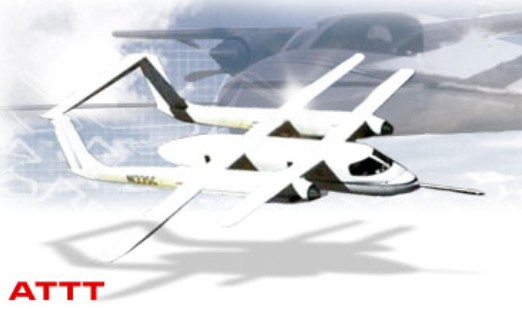
The Model 133-4.62 Advanced Technology Tactical Transport (ATTT) proof-of-concept demonstrator is a 62% scaled version of an airplane designed to challenging STOL and long range requirements. The ATTT was developed and test flown by Scaled Composites, Inc. under contract to DARPA. The initial flight test program consisted of 51 flights with the original cruciform tail configuration, measuring and refining performance, stability and control, and handling qualities. The results of the fabrication and test program were presented in a comprehensive report to DARPA .

In an effort to improve the aft loading capability of the aircraft and to correct aerodynamic deficiencies discovered during the test program, the ATTT aircraft was modified with a twin-boom tail whose general configuration was similar to that of the Rockwell OV-10 Bronco. This modified configuration is shown in the accompanying photograph. Pratt and Whitney of Canada PT6A-135A turboprop engines were attached to the twin booms in a tractor configuration. A simple fully mechanical flight control system was installed, with full control available from both seats. The Scaled-designed landing gear is actuated using electric motors.

The M-133 demonstrator used a unique flap system to enable its STOL performance. The high lift configuration consists of eight Fowler-type flaps, each of 43% chord. The flap system was designed to allow the initial takeoff roll to be performed with the flaps extended, but at low deflections to minimize takeoff drag. As rotation speed was neared, the flaps were quickly rotated to the maximum lift position via a separate pilot action. The ATTT was a key program for Scaled. It demonstrated our ability to perform a challenging aerodynamic and structural design, and to build, test, and deliver what amounted to two different manned research airplanes, including all design and flight test data, to DARPA for less than 3 million dollars, including all recurring and nonrecurring costs.

The Scaled ATTT (also seen as AT3) was flown in two different configurations. First as Model 133-3-62 with a conventional tail section with cruciform tailplanes. First flight 29 December 1987. Later in the test programme small endplates were added to the horizontal tail. During 1989 it few again as Model 133-4-62 with the twin tail booms. Engines were two 850hp P&WC PT6AS-135A end registration was N133SC.

In original form wingspan was 53.208ft, length 44.854ft and height 14.075ft. Internally the project was referred to as SMUT (Special Mission Utility Transport). It was an approx. 62% scale technology demonstrator for a planned ATTT -Advanced Technology Tactical Transport and some money may have come from DARPA – Defence Advanced Research Projects Agency.

The ATTT is in storage at the Air Force Flight Test Center Museum, at Edwards Air Force Base.

Scaled Composites

Scaled Composites was founded in 1982 by Burt Rutan as a research and development company, and located in Mojave, California, offering its services to those requiring specialist help in developing advanced aircraft projects. Undertook work on the NASAAD-1 oblique-wing research aircraft, a subscale demonstrator of the Fairchild NGT trainer (flown September 1981), a subscale demonstrator of the Beech Starship 1 business aircraft (at which time company bought by Beech, 1985, but sold back 1988), plus several other uniquely configured aircraft that included the Rutan 151 ARES agile response effective support combat jet (first flown February 1990). Latest aircraft is Proteus multipurpose, high-altitude and long-duration sensor platform, first flown as a proof-of-concept prototype in July 1998 and featuring rear-mounted main wings, large-span canards, twin tail booms, and a slender fuselage. Initial application is to be for Angel Technologies Corporation, which requires many for communications relay use.

Scaled Composites was acquired by Northrop Grumman in 2007 and is partially engaged in defense research.

2010: Scaled Composites
1624 Flight Line
Mojave, CA 93501
Phone: (661) 824-4541
Fax: (661) 824-4174

S.B.P.C.C. DS1 Papillon

Lebanon 1947

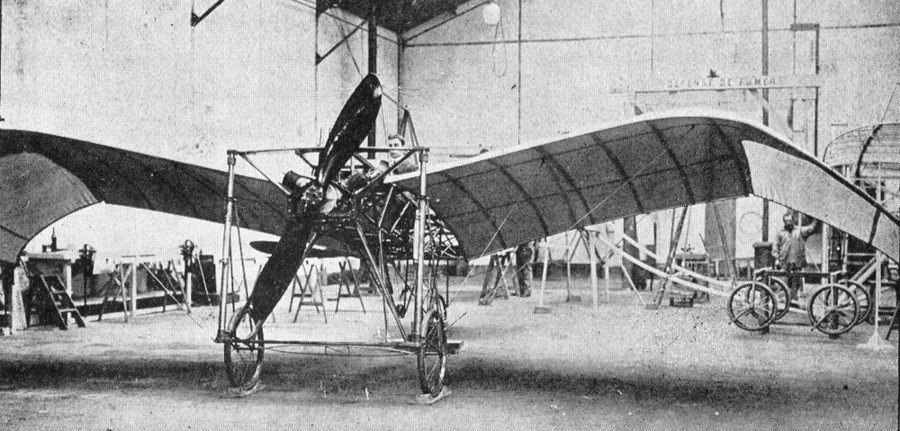
Air France personnel stationed in Damascus during the 1930s, mechanic at the Air France overhaul workshop in Damascus, and four of his work mates designed and built an amateur aircraft. Because of his five “fathers”, it was named S.B.P.C.C. DS1 “Papillon” (Moth).

The aircraft is a high-wing monoplane equipped with a 40 hp Salmson 9 Ad engine from a Klemm. The fuselage is made of molybdenum steel tubes, welded and crossed by piano strings with floor forming box. The front part is made of 0.6 mm duralumin and the rear part is clothed.

The wing is carried by a cabin in profiled and welded steel tubes and by nets in duralumin tubes profiled and covered. The wing is made of wood, consisting of a monospar forming a box with scythe spar to support the fins. The empennage is also made of wood. All the cover is in canvas.

The undercarriage is made of duralumin tubes triangulated by recoil legs. Bungee cords provide cushioning.

The tanks are made of sheet metal of welded aluminum and the controls in steel cables with torsion bar mounted on ball bearings. The aircraft is two-seater in tandem under an open cockpit.

Begun in September 1934, the aircraft flew on November 1, 1935 in Syria. It may never have been officially registered although there has been a pic sporting the S-YRIE registration.

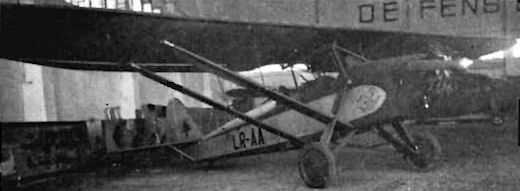
After WW2 it may have gone to Lebanon as the DS-1 Papillon with 1947 registration LR-AAP. It was damaged in the same year.

Engine: 40hp Salmson
Wingspan: 10,00 m
Length: 6,50 m
Height: 2.05 m
Wing area: 14 sq.m
Weight: 320 kg
Max speed: 140 kph at SL
Stall: 45 kph

Sayers SCW / CWS

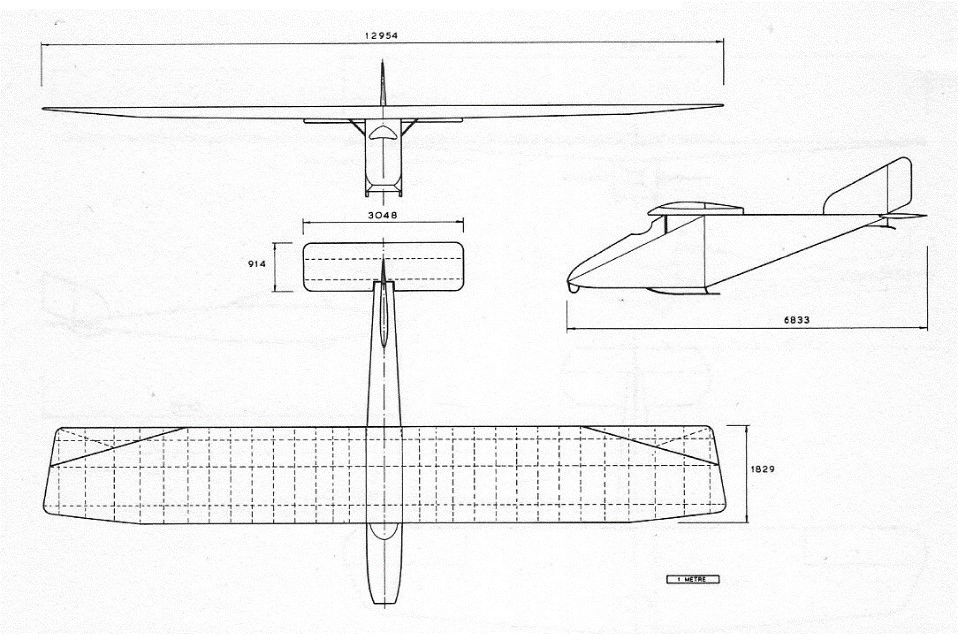
The Sayers SCW, also known as the Sayers CWS, was a single seat glider designed by Capt. W.H Sayers and built by The Central Aircraft Co, Kilburn, London, N.W.6, F.T. Courtney and Sqn Ldr M.E,A. Wright. The design was influenced by the Hannover Vampyr glider, the winner of the 1922 Wasserkuppe.

Of wooden construction, it was reported that the glider had been designed in 19 hours and built in 19 days.

The undercarriage was twin mainwheels of fixed centre, with nose bumpers, plus a tail skid. The cantilever wing had no airbrakes or flaps.

Only one was built, for the 1922 Itford competitions as No.17. After the competitions it carried out further test flying at Itford, in December, but was wrecked when a tent was blown down on top of the glider.

Wingspan: 12.95 m / 42 ft 6 in
Length: 6.83 m / 22 ft 5 in
Wing area: 21.83 m / 235 sq.ft
Aspect ratio: 7.7
Wing section: T.62 modified (an airscrew section)
Empty weight: 81.64 kg / 180 lb
AUW: 163.3 kg / 360 lb
Wing loading: 7.37 kg/sq.m / 1.53 lb/sq.ft