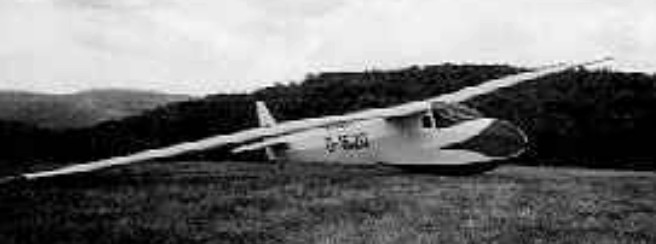
Scheibe Bergfalke Spatz / L-Spatz / Meteor SpA Costruzioni Aeronautiche MS SOL Passero (Sparrow) / Societe Avialsa Fauconnet A-60 (Falconet)

L-Spatz

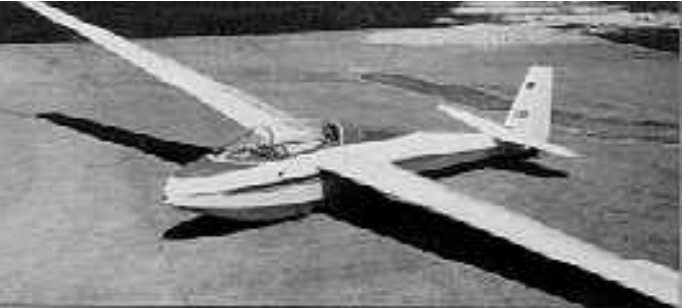
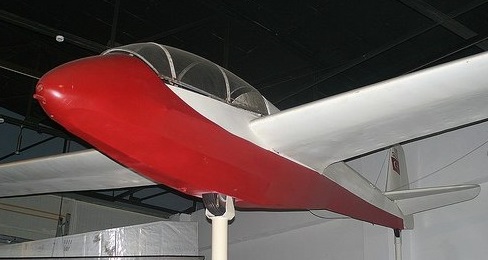
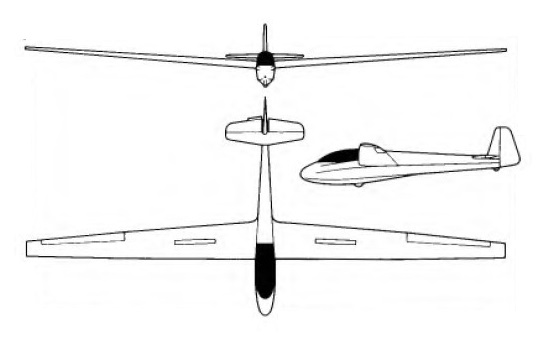
Second of the postwar Scheibe designs to go into production was the Spatz (or Sparrow) single-seater suitable for training or competition flying; this first flew on 12 March 1952 and in its initial form was a mid-wing monoplane. It was developed into the high wing Spatz-55 and L-Spatz-55, the latter differing from the Spatz-55 mainly in having a wing span increased to 15m (49 ft 2.5 in) to give a 10% improvement in performance, dive brakes and simple assembly. The Spatz had the usual Scheibe construction of fabric-covered steel tube fuselage and a wooden single-spar wing, which on the L-Spatz-55 had an area of 125.9 sq ft and an aspect ratio of 19.0.
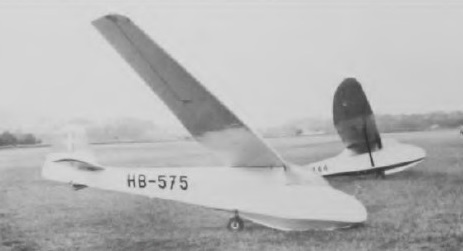
Scheibe L-Spatz-55

Next variant was the L-Spatz-III, which differed from the 55 version in having aerodynamic twist on the outer wings to improve the stalling characteristics, larger air brakes and tail surfaces, a shallower fuselage to improve the aerodynamics and appearance, a roomier cockpit and a Flettner trim tab in the elevators. The wing leading edge torsion box is plywood-covered, the remainder of the wing being fabric-covered. The fuselage is rectangular in section forward and of triangular section at the rear, the rear fuselage having fabric covering over wooden formers.
The nose is covered with a moulded glassfibre shell on the L-Spatz-III, and the cantilever tail unit is of wood. The landing gear normally consists of a monowheel and nose skid, but a longer skid can be fitted under the fuselage and a detachable ground handling trolley can replace the monowheel. The pilot sits under a one-piece blown Plexiglas canopy, and has adjustable rudder pedals.

The L-Spatz-55 was also built under licence in small numbers at Monfalcone by the Italian firm of Meteor SpA Costruzioni Aeronautiche, as the MS SOL Passero (or Sparrow), and in France by Societe Avialsa as the Fauconnet A-60 (or Falconet). The latter was a refined version of the L-Spatz-55 which first flew in prototype form in June 1960 and received its French C of A in 1961; it was produced at the rate of two or three a month both in standard form and in a special version with ‘super finished’ wings, and was also made available in kit form for amateur constructors, requiring only about 400 hours of work to assemble. The special ‘super finished’ version had a better best glide ratio (29.5:1) and minimum sinking speed (2.03ft/sec) than the standard one. A few L-Spatz-IIIs were also built under licence by the Spanish firm Stark Iberica SA.

Spatz
Length : 20.505 ft / 6.25 m
Wingspan : 43.307 ft / 13.2 m
Max take off weight : 540.2 lb / 245.0 kg
Max. speed : 94 kt / 175 km/h
Crew : 1

L-Spatz
Length : 20.505 ft / 6.25 m
Wingspan : 49.213 ft / 15.0 m
Max take off weight : 584.3 lb / 265.0 kg
Max. speed : 97 kt / 180 km/h
Crew : 1

L-Spatz 55
Wing span: 15m / 49.2ft
Wing area: 11.71sq.m / 126sq.ft
Empty Weight: 157kg / 346lb
Payload: 112kg / 246lb
Gross Weight: 269kg / 592lb
Wing Load: 22.97kg/sq.m / 4.71lb/sq.ft
Aspect ratio: 19
Airfoil: Mu 14%
MinSink:0.67 m/s /2.2 fps / 1.30 kt
L/DMax:29 @ 72 kph / 39 kt / 45 mph
Seats: 1
No. Built: 400
Structure: wood/ fabric wings and tail, steel-tube/ fabric fuselage

L-Spatz-lll
Span: 49 ft 2.5 in
Length: 20 ft 6 in
Height: 3 ft 11 in
Wing area: 125.9 sqft
Aspect ratio: 19.0
Empty weight: 353 lb
Max weight: 585 lb
Max speed: 112 mph
Max aero-tow speed: 78 mph
Min sinking speed: 2.20 ft/sec at 38.5 mph
Best glide ratio: 28:1
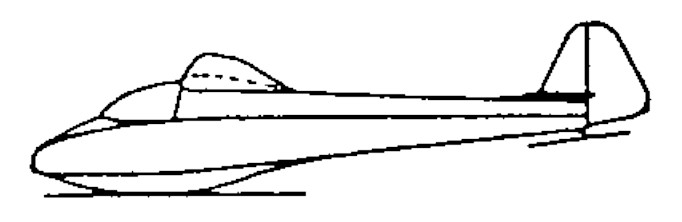
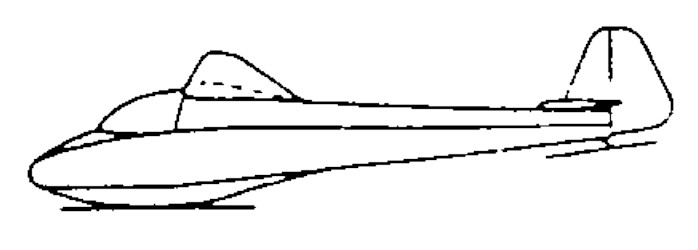
Spatz
L-Spatz

Scheibe Bergfalke 2 / Bergfalke 3 / Bergfalke 4

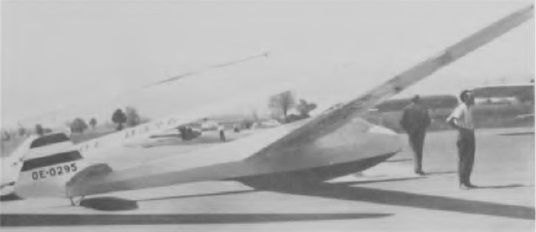
This tandem two-seater training and competition sailplane had its origins in the prototype Mü-13E Bergfalke I general purpose two-seater designed and built by Dipl-lng Egon Scheibe in Austria, and which made its first flight on 5 August 1951. At the end of that year the Scheibe Flugzeugbau GmbH was founded and the Bergfalke (or Mountain Falcon) was the first type to go into production at the new company’s works at Munich-Riem airport.

From the Mü-13E the Bergfalke II was developed with 4° forward sweep on the wings, and more than 250 of these two versions were built; the Mk II, dating from 1951, was succeeded by the Bergfalke II/55 two-seater which also had a fabric-covered steel tube fuselage and single-spar wooden wings of 54 ft 6 in span and 15.6 aspect ratio, these being of 14.5% Mü section, higher gross weight and payload.

A Bergfalke 2/55 has been modified with the addition of a retracting Nelson H-59 engine and two wheel landing gear.

(TC-PDJ)/5824 Scheibe Bergfalke II/55 (5824)

The II/55 was succeeded by the Bergfalke III with a more streamlined cockpit canopy, a redesigned and taller fin and rudder and 2° forward sweep on the wings of the same section, which have Schempp-Hirth air brakes; the monowheel is non-retractable as before, but a tail wheel replaces the II/55’s tailskid.

A few Bergfalke IIIs were built under licence by the Spanish firm Stark Iberica SA.

The -4 model was introduced in 1970 with 2 ft greater span (17.2 m./ 56.5 ft.) wing of Wortmann section and large Schempp-Hirth airbrakes. The Bergfalke IV aspect ratio of 17.4 gives improved performance, including a best glide ratio of 34:1 instead of 28:1 and a lower minimum sinking speed.

Bergfalke IV

Construction of the prototype Bergfalke IV began early in 1969 and the first flight was made a few months later, and a total of 70 of this version had been built by the beginning of 1978. The cantilever mid-wings are of all-wood construction with a fabric covered plywood skin; they have single laminated beechwood box spars joined at the fuselage centreline with a single vertical pin. The ailerons and Schempp-Hirth air brakes are also of wood. Like previous versions, the welded steel tube fuselage is fabric-covered, the nose section on the Mk IV being a moulded glassfibre shell. The tail unit is of wooden construction, the tailplane being mounted on the fuselage forward of the fin; there is a Flettner trim tab in the starboard elevator. The landing gear consists of a non-retractable monowheel and a tailwheel. The two pilots are seated under a blown Plexiglas canopy.

Bergfalke 4

A Bergfalke IV has been modified by the Flying Training School of the Detmold Aero Club into a motor glider, with one Lloyd LS-400 piston engine in the fuselage driving a pair of small two-bladed pusher propellers which rotate within cutouts in each wing near the trailing edge; there is a 12v battery for engine starting. In this form the Bergfalke IV is known as the LVD BF IV-BIMO, the letters LVD signifying Schulerfluggemeinschaft der Luftsportverein Detmold EV. Scheibe themselves were test flying another powered version of the Bergfalke IV
early in 1976 with a 52hp Hirth 0-28 flat twin engine mounted on a retractable pylon aft of the cockpit and driving a two-blade fixed-pitch tractor airscrew; the engine can be raised and lowered into the fuselage electrically in less than 20 seconds, retracting behind closed doors. This version was known as the Bergfalke IVM.

Bergfalke II

Bergfalke 3
Wing span: 16.6m / 54.5ft
Wing area: 17.9sq.m / 192.7sq.ft
Empty Weight: 275kg / 606lb
Payload: 190kg / 419lb
Gross Weight: 465kg / 1025lb
Wing Load: 25.98kg/sq.m / 5.32lb/sq.ft
Seats: 2
L/DMax: 28 @ 80kph / 43 kt / 50 mph
MinSink: 0.73 m/s / 2.4 fps / 1.42 kt
Aspect ratio: 15.6
Structure: wood/ fabric wings and tail, steel-tube/ fabric fuselage

Bergfalke IV
Span: 17.2 m / 56 ft 5.25 in
Length: 8.00 m / 26 ft 3 in
Height: 1.5 m / 4 ft 11 in
Wing area: 17.5 sq.m / 183 sq.ft
Aspect ratio: 17.4
Wing section: Wortmann SO2/SO2/1
Empty weight: 300 kg / 661 lb
Max weight: 505 kg / 1,102 lb
Water ballast: None
Max wing loading: 29.4 kg/sq.m / 6.02 lb/sq ft
Max speed: 124 mph / 108 kt / 200 km/h (in smooth air)
Max aero-tow speed: 87 mph / 92 kt / 170 km/h
Stalling speed: 35 kt / 65 km/h
Min sinking speed: 2.23 ft/sec / 0.68 m/sec at 47 mph / 40.5 kt / 75 km/h
Best glide ratio: 34:1 at 59 mph / 46 kt / 85 km/h

Bergfalke 4

Scheibe

Scheibe-Flugzeugbau GmbH

Egon Scheibe was a young German aircraft engineer, who designed and built some of the most successful gliders before WW2. After the war, he founded Scheibe Flugzeugbau and built a large number of successful gliders, most notably the Bergfalke tandem 2-seater.

Formed at Dachau, near Munich, in 1951 by Egon Scheibe, who at first built gliders designed by Scheibe in Austria. This company had some success with the Mü 13E Bergfalke 1 and then produced a number of conventional gliders. His Sperling two-seat light high-wing monoplane first flew August 1955, and was developed with new wing and tail as SF-23A and built in numbers until 1963. SF-24A Motorspatz built from 1959. SF-25 Motorfalke licencebuilt from 1970 by Slingsby Sailplanes Ltd in UK as Type 61 Falke. SF-28A Tandem-Falke tandem two-seat motorglider no longer offered. Available were the SF-25C Falke 2000 and Rotax-Falke two-seat motorgliders, and the SF-40 two-seat lightplane (first flown 1994), the latter originally offered in A and B versions with tailwheel undercarriages, but the latest version was the SF-40-C with a nosewheel undercarriage. SF-34B Delphin was produced in France as the S.N. Centrair Alliance 34 two-seat glider, while the SF-36 R two-seat motorglider was also expected to go into production in France.

The firm had produced more than 2300 machines by 1983 plus numerous kits for homebuilders.

1983-98: Scheibe Flugzeugbau GmbH, August Pfaltz-Strasse 23, Postfach 1829, D 8060 Dachau bei Mfinchen, West Germany.

Scheibe Flugzeugbau GMBH eventually closed its doors in 2006, partly because of the lack of a successor for Egon Scheibe, but probably also due to the increasingly difficult trading conditions after the boom of Ultralight/Microlight aircraft that have taken over a large portion of the market for fun, relatively cheap, and easy to fly recreational aircraft. The Motorfalke design was subsequently taken over by the newly formed Scheibe Aircraft GMBH based in Heubach (Germany), which has certified the Turbo-Rotax powered version with the glider towing market in mind.

Schuass-Lampman Sport

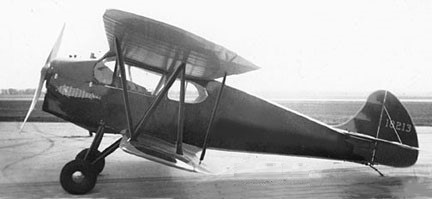
Schauss-Lampman Sport N18213

The 1935 Schauss-Lampman Sport was designed and built by Ed Lampman and Al Schauss as a two-place cabin biplane, powered by an 85hp Ford V-8 engine. Fitted with truss wing struts, it was registered N18213, the maximum speed was 120 mph and cruise was 105 mph.

There was a plan to put a few into production but the financial backer passed away and the plan stalled.

It was rebuilt in 1937 as a three-seater powered by an 85hp LeBlond engine.

It was destroyed in a fire by vandals.

Schuass 1931 Parasol monoplane

Designed and built by Al Schauss in 1931, the two place, open cockpit high wing monoplane was scratch-built with no prior knowledge or experience (even the hand-carved propeller).

This was also the parasol in which Schauss learned to fly (after its test flight by flight instructor Wally Neuman). Powered by a 120hp Salmson 9 engine and registered N10599, it was destroyed in a hangar fire.

Schad 1927 monoplane

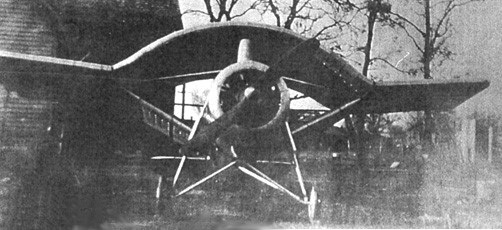
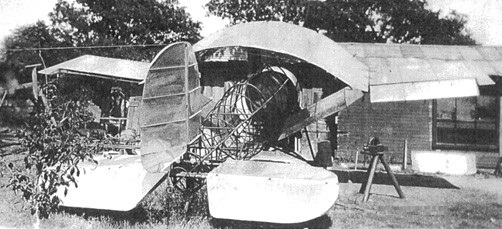
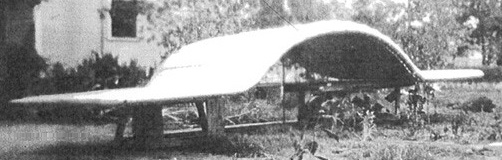
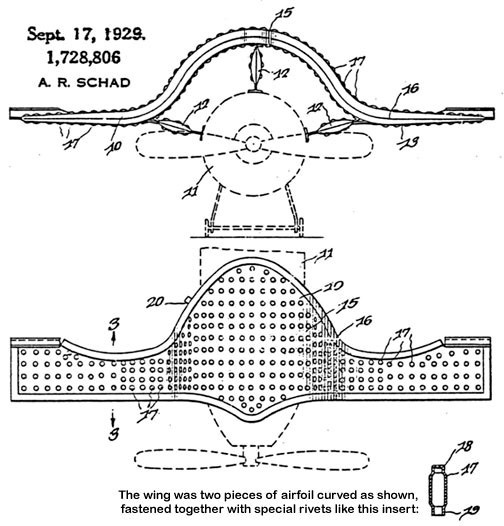
Built by German emigrate Schad, with partners Stacy Ashcraft, J C Bradley, Oscar Ford, Joe Kavecki, and (Mrs) A T Quattlebaum, to prove his unique, patented (#1,728,806) wing design based on Schad’s research, as a baker-turned-boilermaker, of tubular strengths.

Built circa 1927, the aircraft was a single-place with a steel-tube frame covered with dural, with a war-surplus 80hp Le Rhône rotary engine.

The construction site was Schad’s back yard and the date of the first flight is unknown, but the pilot was Cal Murray. It was flown successfully by Schad and others from Cleburne’s Bluebonnet golf course and, later, Meacham Field, where on its second flight there the tail was broken. Unable to afford a much-needed more powerful engine, no repair was made on the plane and it was stored on a farm, finally dismantled and sold for scrap in 1941.

In 1942 the US government purchased the 1929 patent for possible use in the war, but what if anything came from it is unknown, as are data and performance specs for the ship.