A 1980 twin-boom, single-place cabin mid-wing agricultural monoplane powered by a 680hp P&W PT6A-15AG pusher. It is unknown if it flew.
Aircraft
Schapel Aircraft Company
1973:
(Rodney E) Schapel Aircraft Co
Reno NV.
USA
Founded 1973. Produced S-525 Super Swat twin-boom and turboprop-powered agricultural aircraft 1980, followed by design of S-325 Mini-Swat conventionally configured agricultural aircraft, SA-882 Flying Wing tailless research aircraft 1985, and design for S-185 as lightweight single-seat attack aircraft.
The (Rodney E) Schapel Aircraft Co had a number of project but it is unknown if any flew.
Schafer Aircraft Modifications Inc
USA
Schafer Aircraft Modifications Inc was founded 1977, and from 1979 developed modifications for other aircraft. Included were installing turboprop engines to Piper Navajo as Schafer Comanchero, turboprop engines to Piper Chieftain as Comanchero 500, installing higher rated turboprops to Piper Cheyenne II as Comanchero 750, and developing turboprop conversion and fuselage stretch for DC-3 as DC-3-65TP Cargomaster.
Schädler Brothers Human-powered
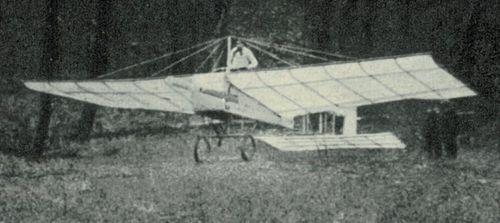
The three Schädler brothers in Landstuhl in Pfaltz had already in 1912 had begun the construction of a human powered aircraft. With the assistance of a teacher living locally, they began work began in their father’s carpentry workshop. The resulting machine was a light monoplane of 12.50m span and 5.50m length. The fuselage had a big nose, and a large propeller of approx. 1.8m, made of alder wood, driven by pedals connected to a gearbox. In the autumn of 1912, the first rolling tests, in order to test the traction of the propeller, were carried out. Since these proved satisfactory, they moved on to actual flight testing. The youngest of three brothers, Eugen Schädler, succeeded in making a flight at a height of approximately 1 – 1.50m above the ground, and flying for a distance of 70m. On landing, the right wheel of the undercarriage broke. According to reports by Anton Schädler, further tests were to be carried out, but the advent of the war meant those plans had to be cancelled. The first pilot of a human powered aircraft died as a soldier in France on 28.6.1916.
Scenic Air Lines
USA
Scenic Air Lines, in 1977, acquired from American Jet Industries engineering and manufacturing rights for turboprop conversions of Cessna Models 402 and 414, now known as Turbo Star 402 and Turbo Star Pressurized 414. Converted Twin Otters to have low-noise propellers and large windows in 1991.
Scheibe Sperber
The third postwar design of Scheibe-Flugzeugbau GmbH, following the Mu-13E Bergfalke and the Spatz, was the Specht (or Woodpecker) tandem two-seater training glider, which was completed in prototype form in March 1953.
This featured the usual Scheibe construction of fabric-covered steel tube fuselage and two-spar braced wooden wings, which had a span of 44 ft 3.5 in and an aspect ratio of 11.
The Specht was developed into the Sperber (or Sparrowhawk), also a two-seat trainer but with enclosed side-by-side instead of tandem seating, and this first flew on 7 March 1956, later going into small-scale production. It also had a fabric-covered steel tube fuselage and braced fabric-covered wooden wings of 14% Mȕ section. The landing gear consists of a fixed monowheel and a spring steel tailskid.
Span: 46 ft 7 in
Length: 24 ft 3 in
Height: 4 ft 7 in
Wing area: 187.3 sq ft
Aspect ratio: 11.6
Empty weight: 485 lb
Max weight: 882 lb
Max speed: 106 mph
Min sinking speed: 3.05 ft/sec
Best glide ratio: 19:1
Scheibe Uli II
Tandem two seat single engined high wing mono¬plane with conventional three axis control. Wing has unswept leading and trailing edges and constant chord; conventional tail. Pitch control by fully flying tail; yaw control by fully flying rudder; roll control by half span ailer¬ons; control inputs through stick for pitch/roll and pedals for yaw. Wing braced from above by kingpost and cables; wing profile double surface. Steel tube framework, with optional pod. Engine mounted below wing driving pusher propeller. Wings use two aluminium tubes as spars, with ribs in foam, capped top and bottom with wood; all flying surfaces covered in Ceconite.
This tandem two seater version of the Uli made its first flights in February 1983 and by 1983 two prototypes had been built, which were undergoing certification. The aircraft is fitted with the four cylinder Konig 570cc engine and uses either a two blade or a three blade design of 51 inch (1.30 m) dia¬meter.
Length overall 18.1ft, 5.52m
Wing span 35.4 ft, 10.80 m
Constant chord 4.4 ft, 1.33 m
Sweepback 0 deg
Tailplane span 7.2 ft, 2.20 m
Total wing area 161 sq.ft, 15.0 sq.m
Wing aspect ratio 7.8/1
Wheel track 4.6 ft, 1.40 m
Engine: Konig SD570, 28 hp at 4200 rpm
Propeller diameter 58 inch, 1.47 m. 2-blade
Belt reduction, ratio 1.8/1
Max static thrust 177 lb, 80 kg
Power per unit area 0. 17 hp/sq.ft, 1.9hp/sq.m
Fuel capacity 5.3 US gal, 4.4 Imp gal, 20.0 litre
Empty weight 221 lb, 100kg
Max take off weight 618 lb, 280kg
Payload 397 lb, 180kg
Max wing loading 3.81 lb/sq.ft, 18.7 kg/sq.m
Max power loading 22.1 lb/hp, 10.0kg/hp
Load factors; +6.0, 3.0 ultimate
Economic cruising speed 37 mph, 60 kph
Stalling speed 28 mph, 45 kph
Best glide ratio with power off: 9/1
Take off distance 260 ft, 80 m
Scheibe Uli I
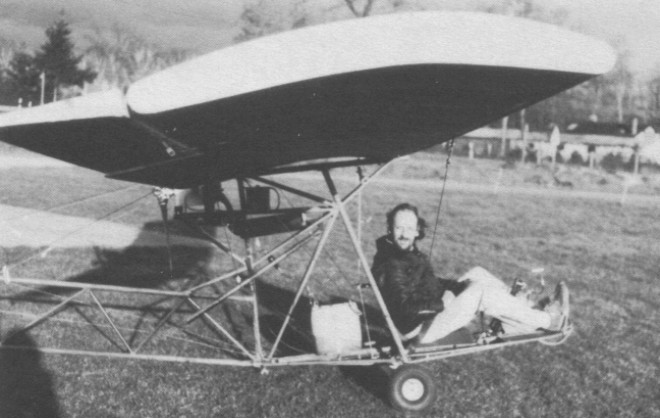
Single seat single engined high wing mono¬plane with conventional three axis control. Wing has unswept leading and trailing edges and constant chord; conventional tail. Pitch control by fully flying tail; yaw control by fully flying rudder; roll control by half span ailer¬ons; control inputs through stick for pitch/roll and pedals for yaw. Wing braced from above by kingpost and cables; wing profile double surface. Undercarriage has two wheels side by side with tailskid (three wheels in tricycle formation optional); glass fibre tails¬kid and glass fibre suspension on main wheels. No brakes. Steel tube framework, with optional pod. Engine mounted below wing driving pusher propeller. Wings use two aluminium tubes as spars, with ribs in foam, capped top and bottom with wood; all flying surfaces covered in Ceconite.
The prototype of the single seater Uli microlight flew for the first time at the end of 1982 and was shown at Aero 83 Salon at Friedrichshafen. At Aero 83 the Uli I was given a pod, as an option, and a tailwheel had replaced the tailskid. This machine uses welded steel tubes for the framework.
Length overall 18.0ft, 5.50m
Wing span 31.8 ft, 9.70 m
Constant chord 4.4 ft, 1.33 m
Sweepback 0 deg
Tailplane span 7.2 ft, 2.20 m
Total wing area 140 sq.ft, 13.0 sq.m
Wing aspect ratio 7.2/1
Wheel track 4.6 ft, 1.40 m
Engine: Hirth 383cc, 22 hp at 4000 rpm
Propeller diameter 51 inch, 1.30 m
Belt reduction, ratio 1.88/1
Power per unit area 0.16 hp/sq.ft, 1.7 hp/sq.m
Fuel capacity 5.3 US gal, 4.4 Imp gal, 20.0 litre
Empty weight 221 lb, 100kg
Max take off weight 442 lb, 200kg
Payload 221 lb, 100 kg
Max wing loading 3.25 lb/sq.ft, 15.9 kg/sq.m
Max power loading 20.1 lb/hp, 9.1kg/hp
Load factors; +6.0, 3.0 ultimate
Max level speed 50mph, 80kph
Never exceed speed 56mph, 90kph
Max cruising speed 37mph, 70kph
Economic cruising speed 30mph, 48kph
Stalling speed 27 mph, 43 kph
Max climb rate at sea level 400 ft/min, 2.0 m/s
Min sink rate 310 ft/min at 35 mph, 1.6 m/s at 56 kph
Best glide ratio with power off 9/1
Take-off distance 150ft, 45m
Landing dis¬tance 100 ft, 30 m
Range at average cruising speed 112 mile, 180km
Scheibe L-10 Libelle
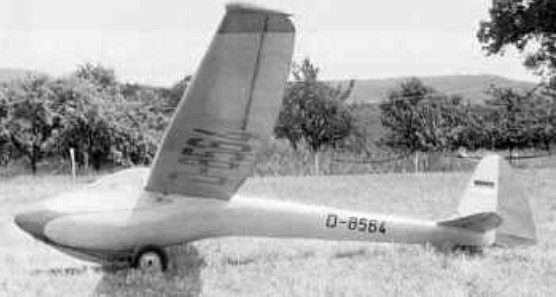
Designed by Bitz, Linner and Zoller.
Wing span: 13.28m
Wing area: 10.9sq.m / 102.25sq.ft
Empty Weight: 156kg
Gross Weight: 244kg
Wing Load: 22.4kg/sq.m
Aspect ratio: 16.18
Airfoil: Scheibe
Seats: 1
L/DMax: 28 @70 kph
No. Built: 1
MinSink: 0.65 m/s 65 kph
Scheibe SF-40
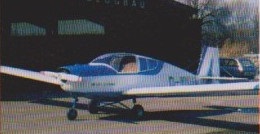
A side by side two seater with a spaceframe fuselage, the wings are constructed in wood.
The SF-40 two-seat lightplane (first flown 1994), the originally offered in A and B versions with tailwheel undercarriages, but the later version was the SF-40-C with a nosewheel undercarriage.
Engine: Sauer, 60 hp
Wing span: 10.8 m
Wing area: 13.4 sq.m
MAUW: 450 kg
Empty weight: 220 kg
Fuel capacity: 40 lt
Max speed: 170 kph
Cruise speed: 150 kph
Minimum speed: 55 kph
Climb rate: 3 m/s
Certification: VZ
Seats: 2
Fuel consumption: 13 lt/hr

