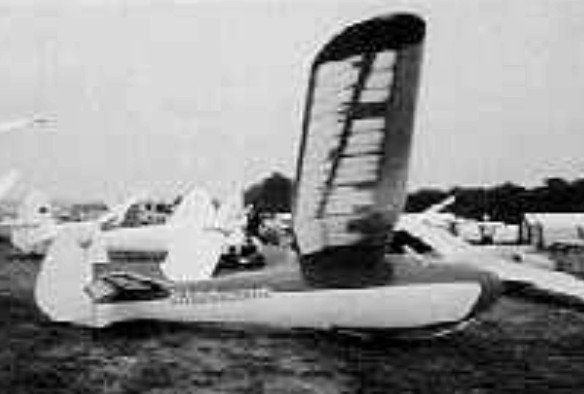
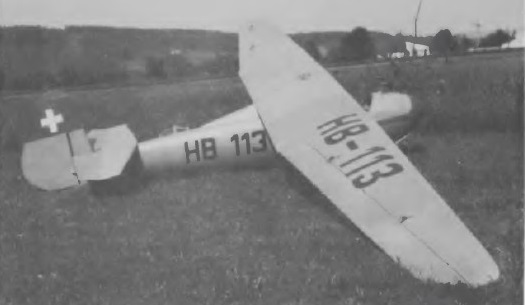
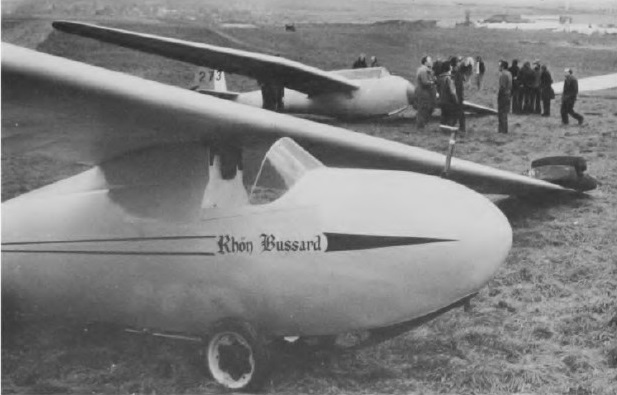
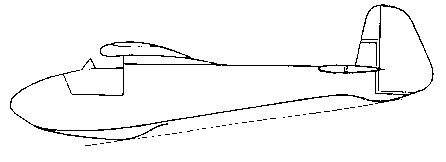
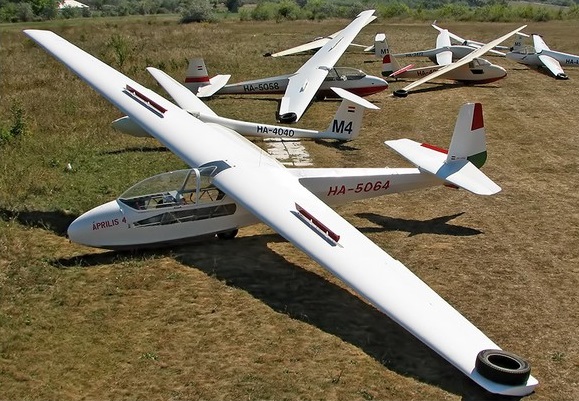
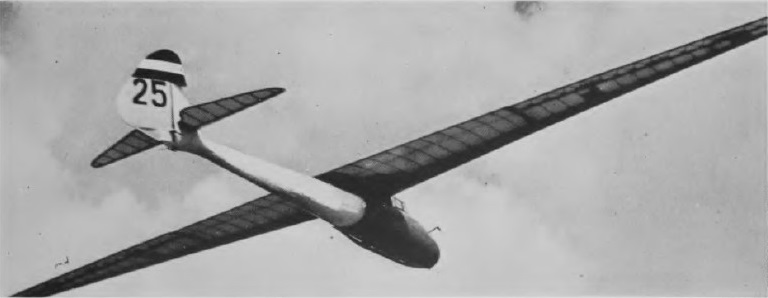
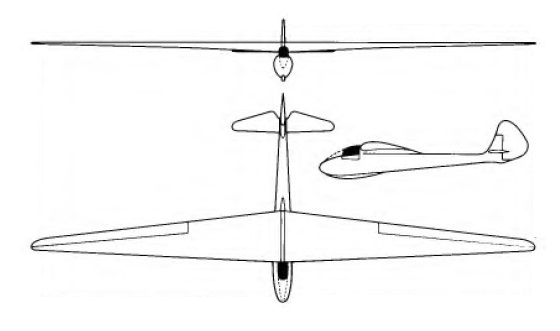
The Rhonbussard, designed by Hans Jacobs as a high performance type capable of cross-country flights of 200 or 300km (124 to 186 miles), first flew in 1933, coming in performance between the Grunau Baby and the high performance ships of the time.
Of conventional wood and fabric construction the Rhonbussard has cantilever two-piece high-set wings with a single spar and a leading edge torsion box and, as on the Rhonadler, the wings are secured to the fuselage by two conical bolts, so enabling rigging to be done quickly and easily. It lacks any spoilers, airbrakes or flaps for approach control. The long-span ailerons are operated by push-rods.
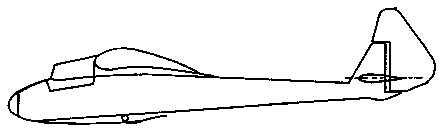
The pilot sits in an open cockpit under the wing leading edge, with a widescreen for protection, and the short oval section fuselage has a main skid for landing plus a tailskid, take-offs being made on a jettisonable double wheel. The tailplane is mounted on top of the fuselage forward of the rudder. One feature, which led to some notoriety, was the requirement for the wings to be joined together at the roots before being presented to the fuselage for attachment.
About 1931 the glider manufacturer Alexander Schleicher went to Hans Jacobs, then at the RRG (Rhön-Rossitten Gesellschaft) on the Wasserkuppe, for glider design that, like the RRG Fafnir designed by Alexander Lippisch, was capable making long cross country by travelling quickly between thermals but could be put into series production making it cheaper to build. Jacobs responded with the Rhönadler (in English, Rhön eagle), ready for the 1932 Rhön competition. The following year both Jacobs and Lippisch had to transfer to the state owned DFS (Deutsche Forschungsanstalt Für Segelflug) at Darmstadt, where Jacobs continued to refine the Rhönbussard, hence the DFS Rhönadler name.
The Rhönadler was a wood framed aircraft with plywood and fabric covering. In plan its high wing wings were straight tapered with a torsion resting D-box form by ply skin ahead of the single spar. Aft of the spar the wings were fabric covered. The Rhönadler wing root used a version of the thick Göttingen 652 section, modified by a reduction of its high camber; further outboard this turned into the progressively lower camber Göttingen 535 and Clark Y airfoils. Dihedral was constant, to avoid the constructional complication of the Fafnir’s gull wing. The ailerons were very long, occupying more than half the span. Though neither the prototype nor later production aircraft came with spoilers or airbrakes such devices, opening above the wing, were often retro-fitted.
The Rhönadler’s fuselage was quite slender and entirely ply covered, including the fin, the balancing part of the rudder and a small tail bumper. On the original version, even the cockpit canopy was a ply structure, with small, unglazed apertures for vision. This was progressively modified with increasing glazing into the 1935 variant’s multi-framed conventional canopy. To avoid the wing root aerodynamic interference that the Fafnir’s gull wing was intended to avoid, the Rhönadler’s wing was mounted just above the fuselage on a low, narrow neck or pedestal which placed the leading edge level with the top of the canopy. The high aspect ratio, all-moving horizontal tail was of similar construction to the wing, with most of the taper on the trailing edge where there was a deep cut-out at the root. The tailplane was low set on the prototype but raised just above the dorsal fuselage line on production aircraft. The broad chord, balanced rudder was also fabric covered. Landings were made on a sprung skid under the forward fuselage.
The Rhonadler (or Rhon Eagle) first flew in 1932; at this time the techniques of long distance soaring flight were beginning to be explored in earnest by sailplane pilots, and distance covered rather than time spent airborne was what pilots were aiming to achieve. At the 1932 Rhön the Rhönadler, flown by Peter Riedel, did not win but impressed enough to go into series production as the Rhönadler 32, with the prototype’s wing span slightly shortened, its vertical tail leading edge smoothed by a shorter rudder balance and its tailplane raised. This sold well, though production numbers are uncertain. The 1935 version’s alterations included a fully enclosed transparent canopy. Schleicher built sixty-five of them, making it the top selling German high performance glider; several were exported. A measure of the popularity of the Rhönadler is the number at the 1935 Rhön competition, twenty-three out of sixty contestants.
Production was undertaken by Schleicher at Poppenhausen. Sixty-five Rhönadler 35 were built. In the 1980s a new Rhönadler was built from original plans and flown. It is now in the Wasserkuppe museum.
Variants:
Rhönadler Prototype. Competed in the 1932 Rhön event. 18 m (59 ft 1 in) span. Ply fairing over cockpit with small oval openings for vision.
Rhönadler 32 First production version, with raised tailplane and simplified fin and rudder. Span reduced by 542 mm (21.3 in). Transparencies at the front of the cockpit.
Rhönadler 35 Second production version with full cockpit transparencies.
Seeadler Flying boat version with hull, markedly gulled wings and underwing stabilizing floats.
Specifications:
DFS Rhonadler Length: 23.622 ft / 7.2 m Wingspan: 57.087 ft / 17.4 m Crew: 1
Schleicher Rhönadler Span: 57 ft 1 in / 17.4 m Length: 23 ft 7.5 in / 7.2 m Wing area: 193.8 sq ft / 18.0 sq.m Aspect ratio: 16.8 Wing section: Gottingen 652 Empty weight: 375 lb / 170 kg Max weight: 551 lb / 250 kg Water ballast: None Max wing loading: 13.89 kg/sq.m / 2.84 lb/sq.ft Max speed: 80.5 mph / 70 kt / 130 km/h Stalling speed: 27 kt / 50 km/h Min sinking speed: 2.5 ft/sec / 0.75 m/sec Best glide ratio: 20:1
Rhönadler 35 Length: 7.20 m (23 ft 7 in) Wingspan: 17.40 m (57 ft 1 in) Wing area: 18.0 sqm (194 sq ft) Aspect ratio: 16.8 Airfoil: Root: modified Göttingen 652; mid-span: Göttingen 535; tip: Clark Y Empty weight: 170 kg (375 lb) Gross weight: 250 kg (551 lb) Maximum speed: 130 km/h (81 mph; 70 kn) Stall speed: 50 km/h (31 mph; 27 kn) Maximum glide ratio: 20:1 Rate of sink: 0.75 m/s (148 ft/min) minimum Wing loading: 13.6 kg/sqm (2.8 lb/sq ft) Crew: One
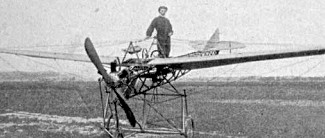
Robert Schlageter of Luzer, Switzerland, was born in 1887. He quit his technical studies in Burgdorf to devote himself to aviation. After first tests with gliders, he began to build, with the help of two friends, his first monoplane, with a triangular-section fuselage and an Anzani engine, in 1909. Then he built in four months, for a company in Mainz, another monoplane of the same type. His planes flew only in good wind conditions, but he won a prize at a fair in Chemnitz in 1911. He had to quit aviation for economic reasons, was forced to sell his planes and spare parts.
Paul Schill built circa 1914 about 2 landplanes and 2 “hydroaeroplanes” used for exhibitions around Long Island NY. One with innovative aluminum body and 15° sweptback wings.
Paul Schill, a well-known auto racer at the time, first designed and built an 80hp V-8 aviation engine in 1912 for Max Ames Machine Co, Mt Vernon NY. Studied aviation in Europe for five years, moved to Milton VT c.1920.
Circa 1922 Schill built a Motor-glider. It was destroyed before it ever flew when its hangar collapsed in a windstorm.
In 1922 Schill went to to form Vermont Air Transport Co with Alfred Henninger and John Burns at Schill Airport, Milton VT.
In 1917 Schiefer & Sons Aeroplane Co built the RS, designed by N B Robbins. A Pursuit trainer based somewhat on French V-strutted Nieuport design, it first flew on 9 December 1917.
The sole example was bought for a reported $11,000 and tested by the Army, but rejected as not being as good as Orenco or Thomas-Morse.
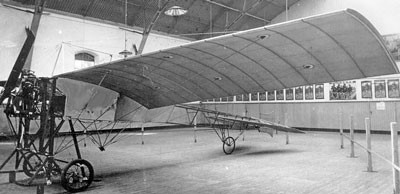
The Emile de Schepper and Hubert Hagens “Helpman I” monoplane was exhibited in the bicycle school of Fongers in Groningen (Netherlands) in May 1911. It had an open fuselage aft of the pilot seat and triangular-section fuselage and was powered by a 5-cylinder Anzani, rated at 50 hp. The monoplane was designed and built by Emile de Schepper and Hubert Hagens. Hagens was the mechanician of the famous Belgian flyer Jan Olieslagers and Emile de Schepper was the son of the Belgian E. J. de Schepper, who was a wealthy billiard manufacturer in Helpman (a separate village then, now a part of the town Groningen), hence the name “Helpman I”.