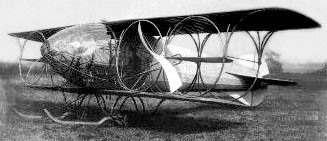
Schneider Henri-Paul S.3

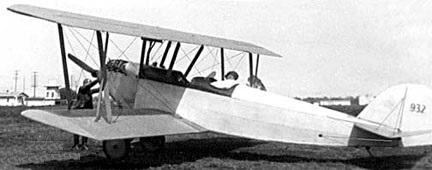
The Schneider Henri-Paul four-seater night bomber was built at Schneider’s Harfleur plant in France. A four-engine biplane with sails supported on steel spars and a grid of aluminum alloy ribs. Equal span, the wings had a central rectangular section and external panels in an arrow. The fuselage was formed by a beam of dural tubes 55 mm in diameter assembled by riveted steel fittings. The front part of the fuselage received a metallic coating, the rear part being simply covered, supporting a fabric empennage. The engines were mounted in pairs on each side of the fuselage, installed in tandem in interplanetary pods, driving four blade propellers of 3.60 m in diameter.
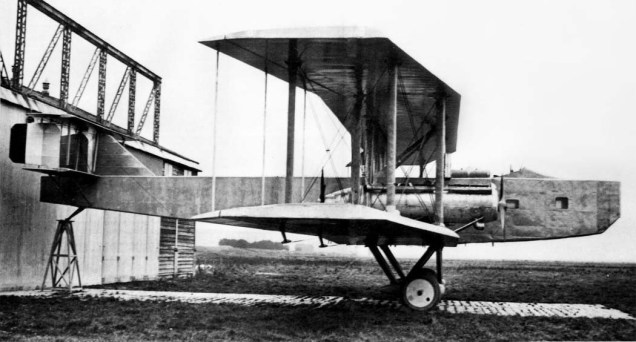
This aircraft made its first flight in September 1922 on the Le Havre-Bléville1 site. It was exhibited at the Grand Palais at the 8th Aviation Show in December 1922, but the program for which it was built had been abandoned.

Engines: 4 x Lorraine-Dietrich 12Da, 370 hp
Wingspan: 30,0 m
Length: 19.89 m
Height: 6.10 m
Wing area: 220.0 sq.m
Empty weight: 6500 kg
Maximum weight: 10,020 kg
Maximum speed: 160 kph
Ceiling: 5,000 m
Range: 750 km
Armament: 2 machine guns
Bombload: 120 kg
Crew: 5
Number built: 1
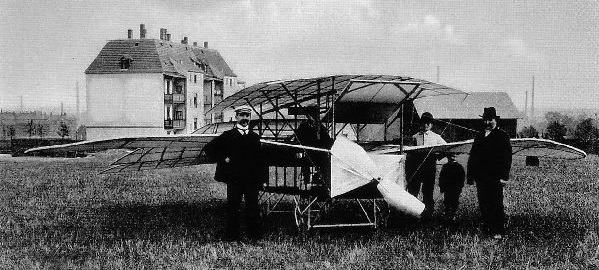
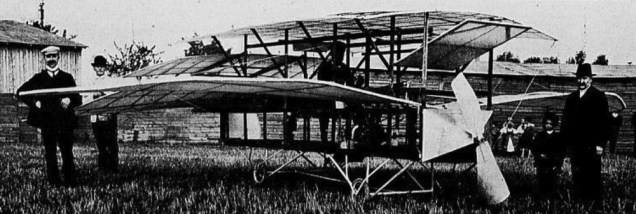
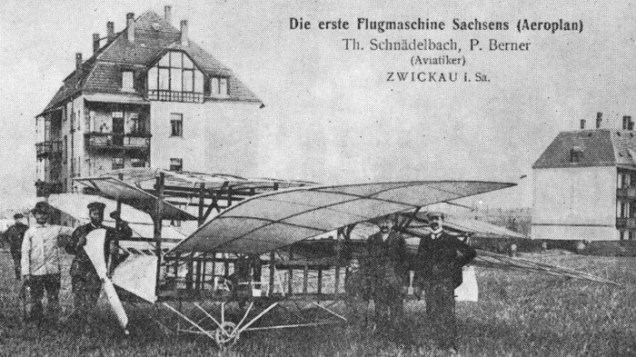
Schnädelbach-Berner 1909 Flugmaschine

The first Flugmaschine in Sachsen, Germany, in 1909. It was a mixed version of a Schwingenflieger and a Gleitflieger, as the wings could flap but there were also two (tandem) wings fitted above the open fuselage. The elevator in the front was an ‘all-flying’ construction and the rudder is at the back. Total wing area is 40,10 square meter. The engine of 10 hp (due to be upgraded to 25 hp) drove the propeller at the front of the fuselage. Total weight (empty) of the machine is 335 kg, span is 9 meter and length 7 meter. Height is 2,20 meter.

There are contradictory accounts as to its flying success.

Schmutzhart SCH-1

Berthold Schmutzhart’s SCH-1 homebuilt was designed to be small enough to be built in his Washingtion D.C. townhouse. The fuselage was made by bending the outside skin into a wooden jig and riveting the bulkheads and stringers to it from the inside, working through the open top which was then covered. The main wing spar center section was milled from a solid I-beam of 6061 T6 aluminum. The outer spars are of bent flat stock and angled extrusions. Ribs ahead of the spar were bandsawed from dense Styrofoam : aft of the spar they are of sheet aluminum hammered over formblocks. The T-tail was originally all moving, but later modified to have a conventional stabilizer. Approach control is by means of flaps, the setting of which are 0, +4, +45 and +70 degrees.

Wing span: 13.41 m / 44 ft
Wing area: 9.29 sq.m / 100 sq.ft
Aspect ratio: 18
Airfoil: Nickel 17%
Empty Weight: 180 kg / 398 lb
Payload: 80 kg / 175 lb
Gross Weight: 160 kg / 573 lb
Wing Load: 27.98 kg/sq.m / 5.73 lb/sq.ft
L/DMax: 30 80 kph / 43 kt / 50 m
MinSink: 0.56 m/s / 1.85 fps / 1.10 kt
Seats: 1
No. Built: 1

Schmitt Monoplane / Biplane

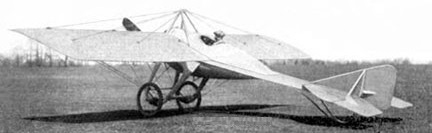
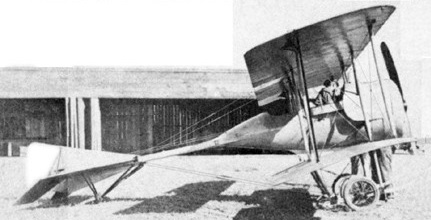
Designed by Etienne Dormoy and brought from France to the USA by Maximilian Schmid, this fully monocoque fuselage design was first of its kind in USA. Built for competitions, it won the $1,000 NY Times Race on 4 July 1914 at Governor’s Island NY (piloted by Harold Kantner), as well as several more subsequent races.

It was then converted into a biplane with a 100hp LeRhône for military trials at North Island, San Diego. It and three other entrants were rejected for not meeting certain requirements specified by the Army.

Monoplane
Engine: 50hp LeRhône
Speed: 70 mph
Seats: 1

Schmidt / U S Aerial Navigation Co 1911 Biplane

A large, rounded, startlingly modern fuselage for its day, using what appears to be almost geodesic construction, with chain-driven twin tractor propellers.

During 1910 and 1911 this aircraft was built in a shop adjacent to Mineola Field NJ. The design was basically sound and the plane performed well beyond expectations. In Jan 1912, US Patent #596448 was granted to the aeroplane per notification from Munn & Co, Patent Attorneys, NYC.