
The Drachenflieger was built by Siegfried Schütz in Germany in 1910. With a 50 hp Argus engine and an elevator in front; it did not fly.
The Drachenflieger was built by Siegfried Schütz in Germany in 1910. With a 50 hp Argus engine and an elevator in front; it did not fly.
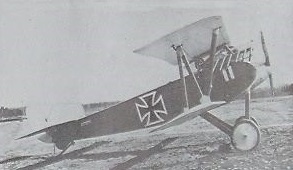
160 hp Mercedes 1916
Luftschifflan Schutte-Lanz
Schütte-Lanz Luftfahrzeugbau
In 1909 Luftschifflan Schutte-Lanz was established to build airships. This company’s Luftfahrzeugbau was founded in 1915 at Zeesen, near Konigswusterhausen, Brandenburg, in recognition of the fact that airships must be supplemented by aeroplanes. The C-1 of 1915 had an unconventional engine installation; D-III built in 1916 was a single-seat fighter. Company built the Ago-Flugzeugwerke two-seat C.IV in quantity. Had studied ‘giant’ aircraft and was included in 1916 R-plane ‘giant’ programme. Contract awarded for six Staaken bombers. R.27-29 delivered late 1917 and became operational; three other Staaken machines (R.84- 86) unfinished at Armistice. Company also made special equipment (e.g. bomb gear and engine-room telegraphs) for other builders of giants, but own ambitious twin-boom project of 1917 remained unrealised. After aircraft work ended company remained as plywood manufacturer.
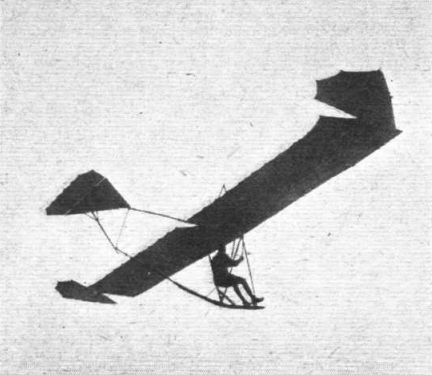
The F.S.3 sailplane was designed and built by Ferdinand Schulz, and also bore the nickname “broomstick”. The high-wing has a two-slatted wing with a modified Joukowski profile by Schulz. The roof beams are formed by two spars. The F.S.3 was exclusively made of fir and door hinges, the cover consisting of old army bed covers. The control was by two flaps at the wing tips.

Klaus Heyn built the original FS3, supported by Erich Kristan, 1924 technical assistant with F. Schulz. In 1924 the F.S.3 was not allowed by the Technical Commission (Teko) at the Rhönwettbewerb because of lack of construction strength.
Although of classic formula (horizontal and vertical empennage) the tail plates are fixed. The steering and roll controls are controlled by two triangles at the end of the wing, operated by two independent handles. The structure is wood (round section), in the form of “N”.
The glider was tested in secret. On May 11, 1924, Ferdinand Schulz remained in the air during the second German coastal flight competition on the Curonian Spit near Rossitten with his “Broomstick” 8 hours and 42 minutes by using the slope upwind, thus setting a world record.

Length: 4,8 m
Wing span: 12,5 m
Wing area: 18,4 m²
Aspect ratio: 9,8
Empty weight: 47,3 kg
TO weight: 123 kg
Maximum pilot weight: 80 kg
Wing loading: 7,2 kg/m²
Seats: 1


The Nucleon designed by Art Schultz, which first flew in 1954, has a wing bult of Styrofoam around a spar and convered with a fiberglass shell. To save weight, struts were used with cuffs at both ends. It has full span flaps, with drooping ailerons, and a horizontal tail which folds up for trailing.
The structure was I-strut braced all-wood wings, steel-tube/ fabric wings and braced tail.
Wing span: 14 m / 46 ft
Wing area: 12.17 sq.m / 131 sq.ft
Aspect ratio: 16
Airfoil: NACA 65 (2)-415
Empty Weight: 156 kg / 345 lb
Payload: 86 kg / 190 lb
Gross Weight: 242 kg / 535 lb
Wing Load: 19.88 kg/sq.m / 4.1 lb/sq.ft
L/DMax: 22 76 kph / 41 kt / 47 mph
MinSink: 1.00 m/s / 3.3 fps / 1.96 kt
Seats: 1

The ABC, an Art Schultz development of the simpler, shorter span Midwest MU-1 designed three years earlier, won the 1937 Eaton design competition. The result was due largely to its design and ease of construction, while the much higher performing Ross-Stephens RS-1 Zanonia placed second due to complicated construction and emphasis on ground tow capability. The first all-metal Schweizer sailplane, the SGU-1-6, was third.
The structure was steel tube fuselage and tail, two-spar two-strut wood wing, all fabric coverd. The ABC was offered in plan form and a few were built prior to World War II. After the outbreak of war, one was used as the TG-16 at the USAAC glider training school in Mobile, Alabama.
Wing span: 14.78 m / 48.5 ft
Wing area: 16.26 sq.m / 175 sq.ft
Aspect ratio: 13.2
Airfoil: NACA 6212
Empty Weight: 136 kg / 300 lb
Payload: 77 kg / 170 lb
Gross Weight: 213 kg / 470 lb
Wing Load: 13.1 kg/sq.m / 2.69 lb/sq.ft
L/DMax: 18
MinSink: 0.85 m/s / 2.8 fps / 1.66 kt
Seats: 1
Number built: 4
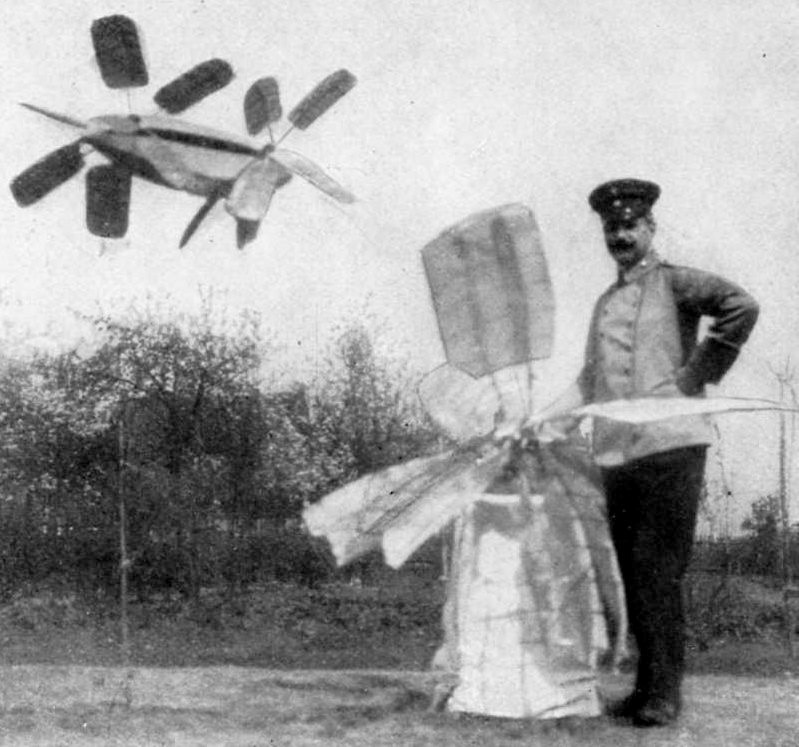
This machine with two four-blade propellers but no wings was the subject of a detailed article in Flugsport and patents in several countries. It was constructed by Ingenieur Julius Schülke of Jena, Germany, in 1909 together with his son Oberleutnant Schülke. Nothing is known of tests, but it looks very unlikely that they would have led anywhere.
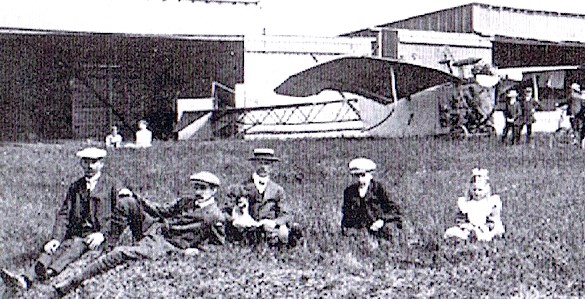
Walter Schudeisky tried his luck with Rumpler before building a monoplane on his own in Bremen. Trials were made, piloted by Adolf Renzel, in 1911.
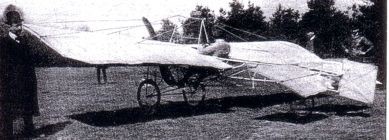
Built at the Mars cycles factory in Nürnberg by E.D.Schroth and flown at Brunn (near Nürnberg).

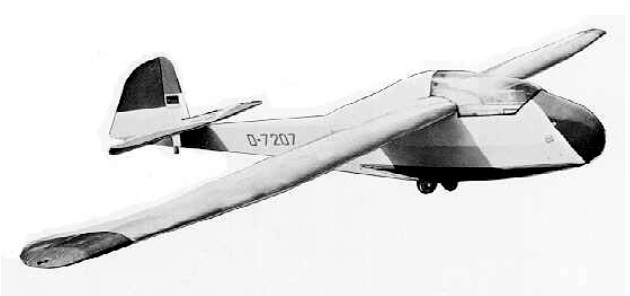
Designed by J. Schroder and H. Peters.
Wing span: 10 m
Wing area: 9.9 sq.m
Aspect ratio: 10.1
Empty Weight: 145 kg
Gross Weight: 255 kg
Wing Load: 25.8 kg/sq.m
L/DMax: 20 80 kph
MinSink: 0.90 m/s 70 kph
Seats: 1

