Formed January 1937, incorporating Breguet and Loire-Nieuport establishments. Made series of Loire 46 gull-wing single-seat fighters, some of which went to Spain and fought in Civil War; also Loire-Nieuport LN 41 single-seat cranked-wing dive-bombers, a few of which saw action against advancing Germans in 1940. New company had associations also with Loire 210 central-float fighter seaplane of 1939; Loire 130 flying-boat for shipboard catapult launch; and Loire 70 three-engined reconnaissance flying-boat.
Aircraft
Societe Industrielle Detolerie Pour L’aeronautique Et Materiel Roulant GY100
GY100 was four-seat tourer or aerobatic two-seater, production of which began September 1968.
Societe Industrielle Detolerie Pour L’aeronautique Et Materiel Roulant
Produced, like a number of French contemporaries, designs by Yves Gardan. In late 1960s these included the GY90,100 and, 110. GY100 was four-seat tourer or aerobatic two-seater, production of which began September 1968.
SFCA Lignel 10 Foudre / Lightning
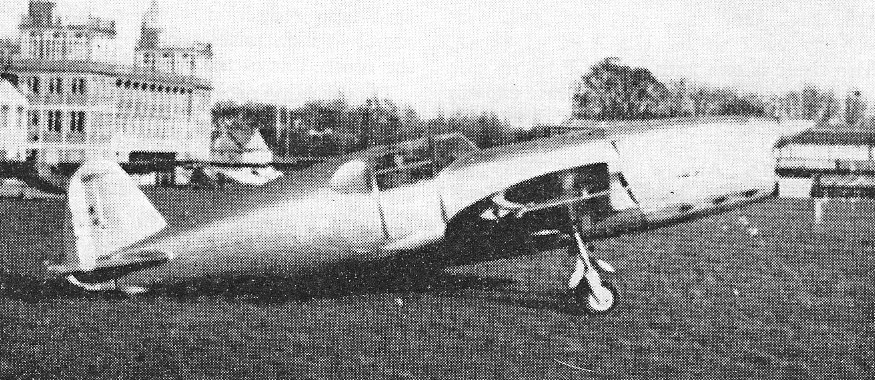
The Lignel 10 Foudre / Lightning first flew in March 1938, from Villacoublay, piloted by Colonel Rozanoff.
The Lignel 10 was only produced in prototype form.
A two-seat version, the Lignel 16, was developed from the Foudre.
Engine: 220 hp Renault 6 Q-03
Wingspan: 10.3 m
Length: 7.7 m
Height: 2.85 m
MAUW: 1200 kg
Max speed: 370 kph
Range: 3200 km
Crew: 1
SFCA Lignel 20
Lignel 20 was 1/2-seat light monoplane with retractable landing gear.
SFCA Maillet 20
First production model was SFCA Maillet 20, an unusual 3-seat cabin monoplane of very clean design, though with raised pilot’s cockpit. SFCA
Societe Francaise De Constructions Aeronautiques / SFCA
Formed July 1934 to build light aircraft. First production model was SFCA Maillet 20, an unusual 3-seat cabin monoplane of very clean design, though with raised pilot’s cockpit. SFCA Lignel 20 was 1/2-seat light monoplane with retractable landing gear. Company also had license for Peyret “tandem monoplane,” renamed and developed asTaupin.
Societe Francaise Deviation Nouvelle SFAN 5
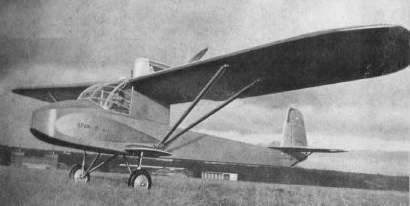
The two-seat SFAN 5 was a one-off enclosed variant of the earlier SFAN 4, first flying in 1936.
Engine: 1 × Train 4T, 45 kW (60 hp)
Propeller: 2-bladed fixed-pitch pusher
Wingspan: 12.5 m (41 ft 0 in) (10.3 m (34 ft))
Wing area: 18 m2 (190 sq ft) (16.2 m2 (174 sq ft))
Length: 7.05 m (23 ft 2 in)
Empty weight: 285 kg (628 lb)
Gross weight: 500 kg (1,102 lb)
Maximum speed: 115 km/h (71 mph, 62 kn)
Cruise speed: 120 km/h (75 mph, 65 kn)
Landing speed: 45 km/h (28 mph; 24 kn)
Range: 450 km (280 mi, 240 nmi)
Time to altitude: 1,000 m (3,300 ft) in 6 minutes
Wing loading: 30.8 kg/m2 (6.3 lb/sq ft)
Power/mass: 11.17 kg/kW (18.37 lb/hp)
Crew: 2
Societe Francaise Deviation Nouvelle SFAN 2 / SFAN 4
Licensed for British BAC Drone 1935; modified to suit French requirements as the single seat SFAN 2, powered by a 25 hp Ava engine.
A larger, two-seat side-by-side model to same formula was SFAN 4, powered by a 35 hp Mengin engine. Only two SFAN 4 were built.
It was reported that the French Air Ministry ordered forty Drones from the French company.
The SFAN 5 was a one-off enclosed variant of the earlier SFAN 4.
Societe Francaise Deviation Nouvelle
Formed 1935 by M. Chasseris, a director of Nieuport for 25 years. Made light airplanes and gliders. Licensed for British BAC Drone 1935; modified to suit French requirements as SFAN 2. Larger two-seat model to same formula was SFAN 4.

