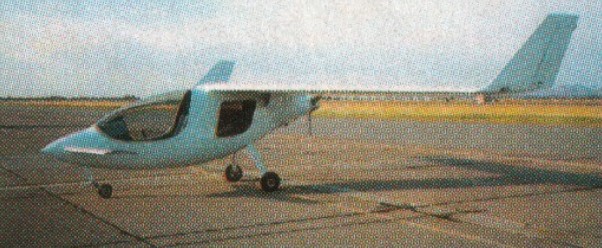
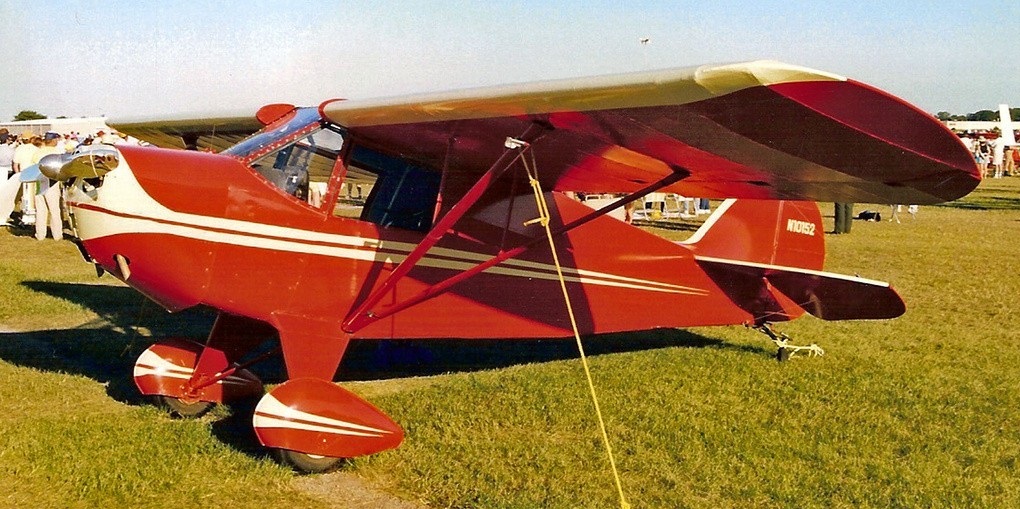
Single seat single engined high wing monoplane with conventional three axis control. Wing has swept back leading and trailing edges, and constant chord; conventional tail. Pitch control by elevator on tail; yaw control by fin mounted rudder; roll control by three-quarter span ailerons; control inputs through stick for pitch/roll and pedals for yaw. Wing braced from below by struts; wing profile double surface. Undercarriage has three wheels in tricycle formation; bungee suspension on all wheels. Push right go right nosewheel steering connected to yaw control. No brakes. Aluminium tube framework, with optional pod or full enclosure. Engine mounted at wing height driving pusher propeller.
Since a prototype, the aircraft has been changed considerably. It features almost full span ailerons of 10.0 ft (3.05 m) length, which should give very powerful roll control. Another change has been the inclusion of an optional pod, which can be extended as a further option to become a full cockpit enclosure, rather in the manner of a Birdman Chinook.
Spectrum says that the Beaver takes 30 hr to assemble from kit. Construction is of double surface, strut braced, high wing with aluminium spars and ribs. Stressed to + 7.5 G’s and – 3 G’s. Mylar reinforced leading edge for smooth air flow. Conventional 3-axis controls, centre mounted joy stick, rudder pedals, tricycle undercarriage (with castering nosewheel) and tail skid. Independent shock absorbers give excellent rough field capabilities.
In 1993, ASAP began providing parts and service for the existing Beaver RX550, RX28 and RX35 all aircraft manufactured by a company no longer operating. The demand to continue offering the Beaver aircraft as a kit was high and so in 1996 ASAP introduced the new Beaver RX 550 Plus with new wings, new tail, stronger shock system, better performance but still keeping with its famous docile easy flight of the original Beaver.
The ASAP Single seat Beaver SS standard kit includes: Beaver SS Airframe, Rotax 447 Engine – 40 hp pull-start, Engine accessories, Basic Instrument Package (EGT, CHT, RPM, Airspeed), GSC – 2 blade, 60″ TECH2 prop (ground adjustable, wooden blades w/composite leading edge, Single colour primer and paint package (Endura, 2 part catalyzed polyurethane), Ceconite covering material and edge tape, 3M Latex adhesive, Azusa Tires, nose wheel brakes.
The Beaver SS offers a high useful load with a maximum gross take-off weight of 650 pounds and a typical empty weight of 340 pounds, the Beaver offers more than 300 pounds of useful load. The Beaver SS has a newly designed and cleaner wing, and full span ailerons. Pre-cut, pre-drilled components combined with a modern Assembly Manual (light on cad drawings, heavy on photos) makes for easy assembly even for first time builders.
Cenconite fabric is attached to the structure using a 3M, water-based latex glue before being “shrunk to fit” with a simple home iron. The standard kit includes an educational video to show how. The Beaver kit even includes a high end, catylized polyurethane primer and paint package by Endura incorporating UV protection, flex agent, and instructions. The Standard Beaver SS kit includes everything needed to assemble the aircraft. Everything is jig drilled at the factory with all of the difficult work done.
Complete kit includes airframe, engine, engine accessories, 3 Bld GA prop, paint package, front brake, standard wheels, upright engine mount, instruments steerable nosewheel, ceconite fabric, adapts to floats and skis. Price 2009: US$13150
The Beaver SS first flew in 2000. In 2007 10 were built.
ASAP marketed in kit form the Beaver RX-550 tandem two-seat microlight (as a variant of Spectrum Beaver RX-550), the Beaver RX-28 two-seat training model, and the Chinook Plus 2 tandem two-seat microlight.
Engine: Rotax 277 (268cc) 28 hp
Static thrust: 210 lb
Prop: 127cm x 71 cm pitch
Empty wt: 252 lb
Max wt: 524 lb
Wing span: 31ft
Wing area: 148 sq.ft
Height: 5’8”
Length: 17’8”
Fuel cap: 5 USG
Construction: Aluminium: Dacron
Wing loading: 3.54 lbs/sq.ft
Power loading: 18.71 lbs/hp
Max speed: 72 mph
Cruise: 50 mph
Stall: 24 mph
Vne: 75 mph
Climb rate: 800 fpm @ 50 mph
Design limits: +7.5, -3g
Glide ratio: 8-1
Seats: 1
Beaver SS
Engine: Rotax 447, 40 hp
Engine range: 40-50 hp
Empty wt: 340 lbs
MTOW: 650 lb
Wingspan: 31 ft
Length: 17.6 ft
Wing area: 138 sq.ft
Fuel cap: 5 USG
Cruise: 67 mph
Stall: 30 mph
ROC: 800 fpm
Seats: 1
To dist: 90 ft
Ldg dist: 65 ft
Cockpit width: 39 inch
Aircraft Sales and Parts Ltd (ASAP)
Beaver SS-single place
Stall: 26 kt / 30 mph / 48 kmh
Cruise: 58 kt / 67 mph / 108 kmh
VNE: 78 kt / 90 mph / 145 kmh
Empty Weight: 154 kg / 340 lbs
MTOW Weight: 295 kg / 650 lbs
Climb Ratio: 850 ft/min / 4 m/s
Glide Ratio: 7:1
Take-off distance (50ft obstacle): 90 ft / 27 m
Landing distance (50ft obstacle): 75 ft / 23 m