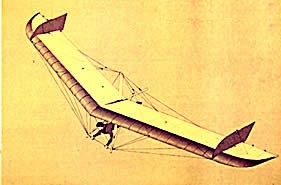
Stinson

Stinson Aeroplane Syndicate
Stinson Airplane Corporation
Stinson Aircraft Division of Vultee Aircraft Inc
1919: (Edward) Stinson Airplane Syndicate, Detroit MI.

In 1926 the Stinson Aeroplane Syndicate, West Detroit, Michigan, founded by E. A. Stinson, made Detroiter four passenger biplane designed jointly by Stinson and F. Verville. Name Detroiter was confusingly retained for later monoplanes. Three Detroiter biplanes acquired in 1926 by Northwest Airways Inc, at which time manufacturing company renamed Stinson Airplane Corporation.
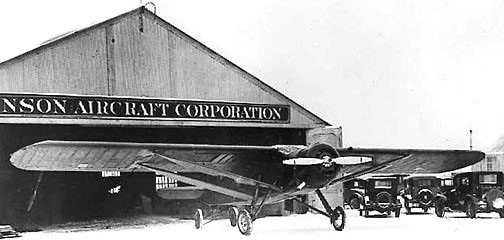
Stinson 1927

1927: Stinson Aircraft Corp, Northville MI.

Detroiters of several forms used widely by commercial and private operators; e.g. flew first regular airmail service in China. Detroiter monoplanes much developed, though general type was claimed as first U.S. aircraft with soundproofed and heated cabin, engine starter and wheel brakes.

Detroiter Junior of 1928 was scaled-down version for private and executive work. Detroiters established several records, including 174 hr airborne, July 1929.

1929: Wayne MI. 1931: Merger with E L Cord Corp.

About 1933 new tapered wing form adopted for Reliant single-engined series, which succeeded Detroiter line. Reliant series was especially successful and built in great quantities, 500 being transferred to Royal Navy under Lend-Lease. Voyager was later two-seat high-wing monoplane. Sentinel liaison type very widely used under Vultee name.

1940: Stinson Aircraft Div, Vultee-AVCO, Wayne.
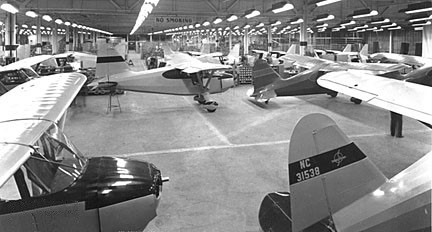
Stinson factory and 10-As, 6 March 1941

1946: Stinson Aircraft Div, Convair.

By the end of 1947, Stinson Aircraft had built over 5200 Voyagers, including a Station agon version, but by then the boom had ended and 200 unsold Voyagers were parked at Willow Run Airport.

In July 1948 the Stinson factory was closed and five month later Convair sold Stinson Aircraft to Piper Aircraft. The company that Eddie Stinson had founded 22 years earlier had built over 12,000 aircraft.

1962: Inventory and rights sold by Piper to Univair, Aurora CO.
Stiles Dragon Fly / Dragon Fly Aircraft Co Dragon Fly NAF-1

Built in 1927, the Stiles Aircraft Dragon Fly was a two-place, open cockpit high-wing monoplane powered by an 80hp Detroit Air Cat or Anzani engine. Designed by Russell C Mossman, it had optional folding wings and sold for $1,985.

At least two were built; N4193 and N5737 with Anzani engines.

One appears in a 1929 register as Velie-powered Dragon Fly NAF-1 N7600, with manufacturing credit to Dragon Fly Aircraft Co, 1807 Foster St, Chicago IL.

Engine: 80hp Detroit Air Cat or Anzani
Wing span: 36’0″
Length: 23’11”
Useful load: 537 lb
Max speed: 105 mph
Cruise: 85 mph
Stall: 38 mph
Range: 450 mi
Seats: 2

Stickel URSA 1 / URSA 2

URSA 1

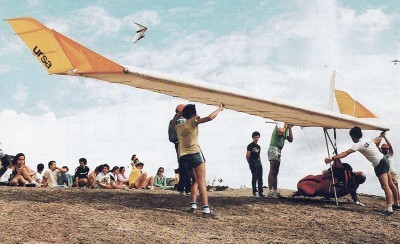
The Ursa is the result of the desire of Roberto Stickel to improve the Fledges.

The tensioning of the drag cables takes place automatically when the rear mast cable is installed. The marginal edges are tensioned thanks to a lever that does not require push pin or bolt. The lower tensioning tension is also made by a lever located at the top of the trapezium and intended to lower the trapezoid, thus straining the cable ties.

URSA 2

Stewart Texas Bluebird

The 1946 Stewart Texas Bluebird was a rebuild of the Welch OW-6M with changes in dihedral, control cables, and powerplant, built by Walter E Stewart.

A two-place cabin, high wing monoplane, the aircraft first flew on 16 December 1946 (possibly earlier), piloted by L G Welch.

Planned production never occurred, but ship was slated to sell for about $2,000.

Engines: 65hp Lycoming
Wing span: 34’5″
Length: 20’6″
Useful load: 435 lb
Max speed: 105 mph
Cruise: 85 mph
Stall: 35 mph
Range: 250 mi
Seats: 2

Steward-Davis Jet-Packet 3400

Jet-Pak 3402 equipped C-119

The 1962 Jet-Packet 3400 was a Steward-Davis Jet-Packet 1600 Fairchild C-82A with a single 3250 lb Westinghouse J34-WE-34 or 3400 lb WE-36 jet-pak. At least four were converted.

The Jet-Packet II involved airframe weight reduction to increase cargo weights. With two P&W R-2800CB-16 engines, the application was applied to Jet-Packet 1600 or 3400. At least three were converted, including TWA C-82A Ontos N9701F.

In 1967 Stewart-Davis completed a new version of its C-119 STOLmaster with a Jet-Pak 3402 detachable jet engine under each wing and provision for a third above the fuselage, supplementing the two R-3350-89a piston engines. Each Jet-Pak contains a 3400 lb thrust Westinghouse J34 engine.

Steward-Davis Jet-Packet 1600

The 1956 Steward-Davis Jet-Packet 1600 was a civil conversion of Fairchild C-82A with a jet-pod added to upper fuselage. At least three were converted including N6887C and N6985C,

The Jet-Packet II involved airframe weight reduction to increase cargo weights. With two P&W R-2800CB-16 engines, the application was applied to Jet-Packet 1600 or 3400. At least three were converted, including TWA C-82A Ontos N9701F.

Engines: 2 x 2100hp P&W R-2800-85 and 1 x 1600 lb Westinghouse J30-W jet-pak
Max take-off wt: 54,000 lb