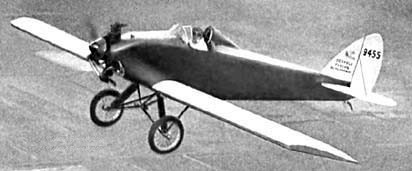
Szekely Flying Dutchman

N9455

In 1930, at Holland, Michigan, Szekely Corp made small single-seat low-wing cantilever monoplane called Flying Dutchman.

Priced at $2,200, three were built, registered NX4448, N9455, and N910.

An open cockpit, low wing monoplane powered by a 150hp Hisso A, one was built for W C Williams of San Antonio TX (N910). It crashed in October 1927 as a reported “total washout.”

Engine: 40hp Szekely SR-3
Wingspan: 26’0″
Length: 18’6″
Useful load: 215 lb
Max speed: 80 mph
Cruise: 70 mph
Stall: 25 mph
Range: c.300 mi
Seats: 1

Székely IV

The Székely IV Parasol of 1913 was designed and built by the Hungarian Mihály Székely (Hungary then part of the K.u.k – Austro-Hungary). A typical parasol wing machine with the pilot and passenger sitting in a nacelle beneath the wing-tractor configuration, with the engine high before the wing and petrol tanks above.

1913 Szekely IV 2-seater “parasol” monoplane received 2nd altitude prize achieving 610 meters.

Span: 36’1″
Length: 28’11”
Weight empty: 521 lbs
Speed: 44 mph

SZD IS-2 Mucha

The SZD-22 Mucha Standard Standard Class single-seater had its origins in the IS-2 Mucha (or Fly) intermediate single-seater of 1948, which was produced in several versions and used in some numbers by the Polish gliding clubs; the Mucha-ter set up several national records for altitude and distance, and the type achieved several Diamond C flights. The IS-2 Mucha had a single-spar high wing with an aspect ratio of 15, and was fitted with dive brakes and spoilers; the fuselage was of elliptical cross-section. The Mucha-ter was developed into the SZD-12 Mucha 100 of 1953, this single-seater being used for training. It was of all-wood construction, the cantilever high wings having a single main spar and an oblique auxiliary spar, with a plywood-covered leading edge torsion box; air brakes were fitted and the ailerons were aerodynamically and mass balanced. The oval-section fuselage was plywood-covered and the pilot sat under a onepiece Plexiglas canopy. Landing gear consisted of a monowheel and short front and rear skids sprung with rudder pads.

Szaraz SDS-1A Daphne / SD-1A Daphne

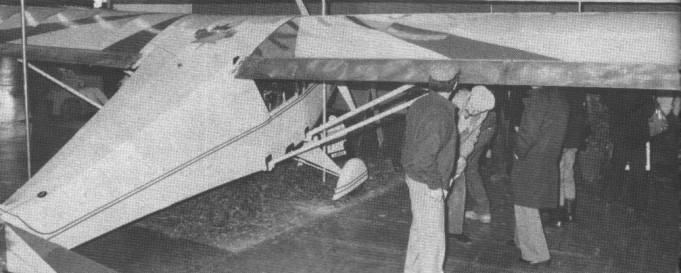
Evolved from the Vidervol-Szaraz VS-1, the Szaraz SD-1A Daphne is a homebuilt aircraft that was designed by Art Szaraz and Bernie Darmstadt for efficiency competitions.

The Daphne is a two place side-by-side configuration strut-braced high-wing, conventional landing gear equipped homebuilt. The fuselage uses welded steel tubing with aircraft fabric covering. The wings are wood, with one-piece plywood ribs. Both ailerons and flaperons have been installed on the design.

The first three examples were built on the same jigs at Art Szaraz’s workshop. At least fifteen were built. At least 26 were under construction by Jan 1970.

Known examples:
N960Z (c/n 1) built by Arpad Szaraz, ff: 1963
N962Z built by Nick Stanich, ff: 2/28/65
N961Z built by B D Darmstadt, ff: 6/18/65

SD-1A Daphne
Engine: 1 × Continental C-85-12F, 85 hp (63 kW)
Propeller: 2-blade
Wingspan: 26 ft (7.9 m)
Wing area: 130 sq ft (12 sq.m)
Airfoil: NACA 4412
Length: 19 ft 7 in (5.97 m)
Empty weight: 820 lb (372 kg)
Gross weight: 1,300 lb (590 kg)
Maximum speed: 130 kn; 241 km/h (150 mph)
Cruise speed: 104 kn; 193 km/h (120 mph)
Stall speed: 35 kn; 64 km/h (40 mph)
Never exceed speed: 148 kn; 274 km/h (170 mph)
Service ceiling: 14,500 ft (4,400 m)
Rate of climb: 1,000 ft/min (5.1 m/s)
Capacity: 2

SDS-1A Daphne
Engine: 90hp Continental
Wingspan: 26’0″
Length: 19’0″
Useful load: 520 lb
Cruise: 125 mph
Stall: 40 mph
Range: 400 nm