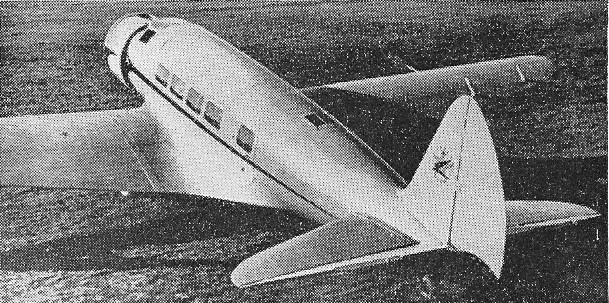
Designed by V.K. Tairov, the OKO-1 had a 750 hp M-25 giving a max speed of 230 mph with an AUW of 7293 lb. Span: 50 ft 6 in
Designed by V.K. Tairov, the OKO-1 had a 750 hp M-25 giving a max speed of 230 mph with an AUW of 7293 lb. Span: 50 ft 6 in
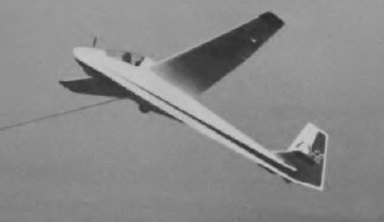
Also known by the manufucturers’ designation F5, the TN-1 single-seater was designed by Yukio Tanaka and construction of the prototype began in August 1974; this made its first flight in December 1976. The Japan Civil Airworthiness Board was conducting certification trials in the spring of 1978 and it was hoped to begin production in the summer of that year.
Of conventional wood and fabric construction very similar to the Mita III, the TN-1 had cantilever single-spar high wings of spruce and plywood, with fabric covering and a forward sweep of 2″ 4′ at the quarter-chord line; the wooden ailerons are ply-covered and there are Schempp-Hirth air brakes. The steel tube fuselage framework has fabric covering over wooden stringers, and the nose is of glassfibre. The wooden tail unit has fabric covered elevators and rudder, and there is a trim tab in the starboard elevator. There is a non-retractable unsprung monowheel mounted at the cg with a band brake, plus a tailskid.
Span: 50 ft 10.5 in
Length: 25 ft 0.75 in
Height: 7 ft 2.75 in
Wing area: 172.0 sqft
Aspect ratio: 15.03
Empty weight: 595 lb
Max weight: 837 1b
Max speed: 81 mph (in smooth air)
Max aero-tow speed: 81 mph
Min sinking speed: 2.59 ft/sec
Best glide ratio: 26:1 at 49 mph
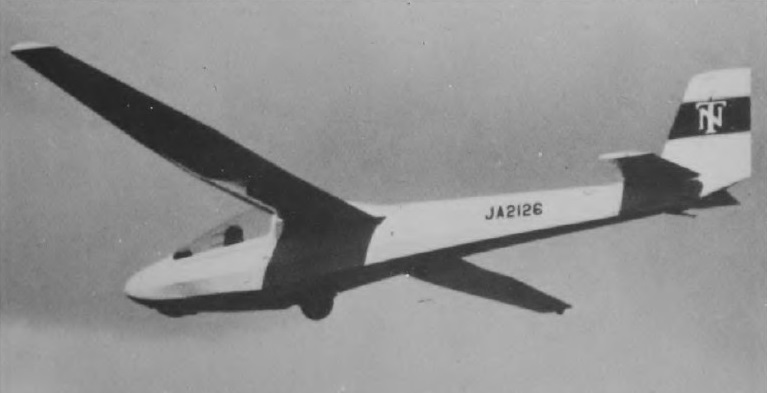
Japanese sailplanes of indigenous design often represent, as does the Mita III tandem two-seater training and sporting glider, an essentially conventional design philosophy. The Mita was built by LADCO – the Light Aircraft Development Co of Tokyo, whose designer was Mr Asahi Miyahara, and its production has been continued under licence by the Tainan Industry Co Ltd (Tainan Kogyo KK) after the latter took over the manufacture of sailplanes from LADCO; by 1 January 1979 a total of 37 Mita IIIs had been built.
Of conventional wood and fabric construction, the Mita has cantilever shoulder wings of constant chord centre section with tapered outer panels, of all-wood single box spar construction with plywood covering. The ailerons are fabric-covered and there are Schempp-Hirth air brakes in the wing upper surfaces. The fuselage is a steel tube framework with wooden stringers and fabric covering; the nose and forward section are of glassfibre, and there is an aero-tow release in the nose as well as a winch release at the cg. The wooden tail unit has a fabric covered rudder and elevators, and the landing gear consists of a rubber-sprung non-retractable monowheel with brake, plus a tailskid. The pilots sit under a flush-fitting two-piece blown canopy that hinges sideways to starboard for entry and exit.
Mita 3
Span: 16.0 m / 52 ft 5 in
Length: 7.96 m / 26 ft 1.5 in
Height: 1.28 m / 4 ft 2.5 in
Wing area: 15.87 sq.m / 170.82 sq.ft
Aspect ratio: 16.13
Wing section: NACA 633/618
Empty weight: 300 kg / 661 lb
Max weight: 450 kg / 992 lb
Water ballast: None
Max wing loading: 28.4 kg/sq.m / 5.81 lb/sq.ft
Max speed: 118 mph / 103 kt / 190 km/h (in smooth air)
Max aero-tow speed: 81 mph
Stalling speed: 33.5 kt / 62 km/h
Min sinking speed: 0.72 m/sec / 2.36 ft/sec at 47 mph / 40.5 kt / 75 km/h
Best glide ratio: 30:1 at 51 mph / 44 kt / 82 km/h
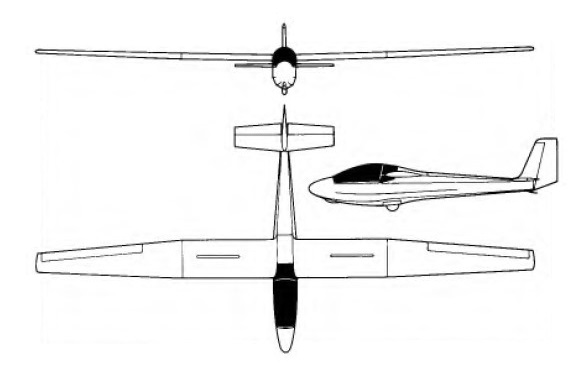
The Mid-wing was built in 1968, registered N930MB.
Paradise CA.
USA
Circa 1968 built a mid-wing
Ta-Ho-Ma built the model B three place open cockpit biplane in 1929. Power was from a 100hp Siemens-Halske SH-12, or optional 180hp Hisso E.
The price was $4275. A total of four model A and B were built, registered NC475, NC536, NC537, and NC538.
Engine: 100hp Siemens-Halske SH-12
Wing span: 30’0″
Length: 21’0″
Useful load: 874 lb
Max speed: 115 mph
Cruise speed: 105 mph
Stall speed: 33 mph
Range: 425 mi
In 1929 Ta-Ho-Ma was selling the model A, three place open cockpit biplane.
Power was the 150hp Hisso E, or optional 90hp Curtiss OX-5. The model A sold for $3,750, or $2,500 less motor.
A total of four model A and B were built, registered NC475, NC536, NC537, and NC538.
Engine: 150hp Hisso E
Wingspan: 32’0″
Length: 21’8″
Usful load: 795 lb
Max speed: 135 mph
Cruise speed: 115 mph
Stall speed: 35 mph
Range: 575 mi
Ta-Ho-Ma Airplane & Motor Co
pres: B H Vanderveld
64 W Randolph St, Chicago IL. USA
Circa 1929 built aircraft
In 1932 Taft built a seaplane, N13159 c/n A1, with a 90hp LeBlond. The registration was cancelled on 30 July 1934.
Built in 1928 the sole Taft Kingfisher, N368, was a 3 place open cockpit biplane flying boat.
First flying on 6 Feb 1928, the Kingfisher became the Whittelsey Amphib.
Engine: 110hp LeBlond 7DF pusher
Wingspan (upper): 37’0″
Wingspan (lower): 18’0″
Length: 28’9″
Useful load: 600 lb
Max speed: 90 mph
Cruise speed: 65 mph

