Two of the 1930 American Eagle Eaglet 130 were built; N281N and N294N.
Aircraft
American Eagle E-430
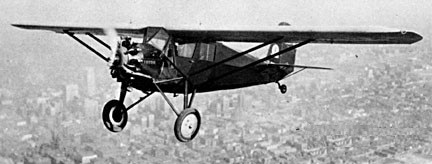
Five of the 1931 American Eagle E-430 (ATC 302) were built, including one modified from A-430.
A four-place cabin monoplane powered by a 165hp Continental A-70 engine.

Scaled Composites 437 Vanguard
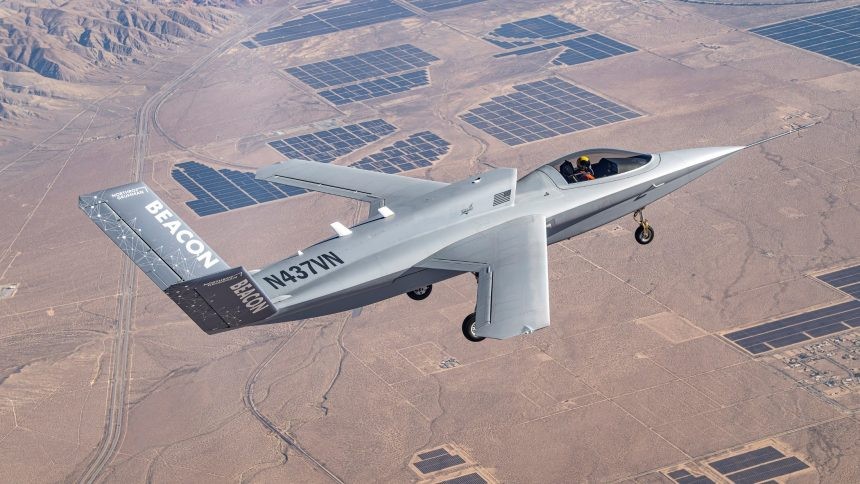
The Model 437 Vanguard was originally conceived as an unmanned loyal wingman concept in 2021, designed to operate alongside crewed aircraft in attritable roles. Renderings at the time depicted an uncrewed platform with a range of around 3,000 nautical miles, a cruise speed near Mach 0.8, and payload options including AIM-120 AMRAAMs or side-looking radar systems.
Its first flight in August 2024 revealed a cockpit, making the Vanguard an optionally piloted aircraft. As we reported on that occasion, the Vanguard is powered by a single Pratt & Whitney PW535 turbofan engine producing 3,400 pounds of thrust, and features a wingspan of 41 ft (12.5 m), gross takeoff weight of 10,000 lb (4,536 kg), and endurance of six hours.
Northrop Grumman contributed to the program through its Digital Pathfinder initiative, using advanced digital engineering methods to design and build the Model 437’s wings. The process, the company said, reduced rework to less than one percent compared to the 15–20% typical of conventional design programs, drawing directly on lessons from the B-21 Raider stealth bomber program.
The Model 437 Vanguard resumed flight testing at Mojave Air and Space Port, , announced by Scaled Composites on Sep. 20, 2025, comes after extensive modifications to the airframe for its new role since its first flight in August 2024.
The company reported updates to the hydraulic system, cockpit integration of new pilot interfaces, and the incorporation of autonomy subsystems developed by Northrop Grumman for Beacon. These upgrades pave the way for the Model 437 to serve as a versatile airborne platform for experimentation with autonomy and artificial intelligence-driven mission software.
“We had the challenge of taking an airplane that has only flown once and converting it into a versatile autonomous testbed, which demonstrates Scaled’s agility and flexibility in achieving new test objectives,” said project engineer Yuto Shinagawa, highlighting the integration of flight safety protections for autonomous operations. As an example, he mentioned the introduction of protections in the flight control system to assure flight safety when engaging the autonomous system.
As Scaled Composites resumes envelope expansion flights, the focus will be on validating the integration of Beacon’s autonomy ecosystem and ensuring safe transitions between crewed and autonomous modes. The aircraft’s optional manned capability allows safety pilots to supervise tests while gradually handing over control to autonomy software, reducing risks in early phases.
Parson 1913 Biplane
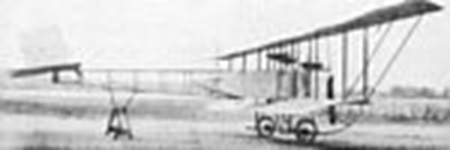
The 1913 Parsons biplane was designed and built by J. G. Parsons and P. M. Muller in the UK
Span: top 39’6″ bottom 25′
Length: 26’4″
Anderson Special
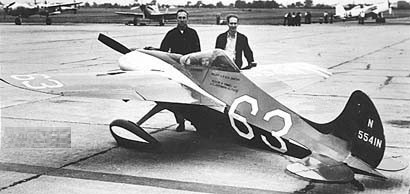
The 1948 Anderson Special was a single-place low wing 85hp Continental C-85 powered midget racer with a diamond-shaped fuselage cross-section. Raced by Bruce Raymond as Ace of Diamonds and Beetle Bomb, registered N5541N, it was modified as mid-wing in 1949.
The Special crashed in racing in 1950 and the wings were salvaged for use on the 1953 Pitt Yellow Jacket.
Anderson Propeller Co
(Alvin E) Anderson Propeller Co
Elmhurst IL.
USA
Built the Anderson Special in 1948.
Turkish Aerospace Industries / TAI Hurjet

Hurjet is a state-of-the-art jet for the training of sixth-generation aircraft pilots. At a conceptual stage in 2025, sixth-generation jets are expected to become operational in the 2030s. These have extensive use of AI. It’s all indigenous, except for the engine.
Hurjet, which means free jet in English, made its maiden flight in 2023 and is evolving from a purely trainer jet into a multi-role platform capable of providing close air support, air policing, and even limited strike missions in asymmetric conflicts.
Fiat CR.41
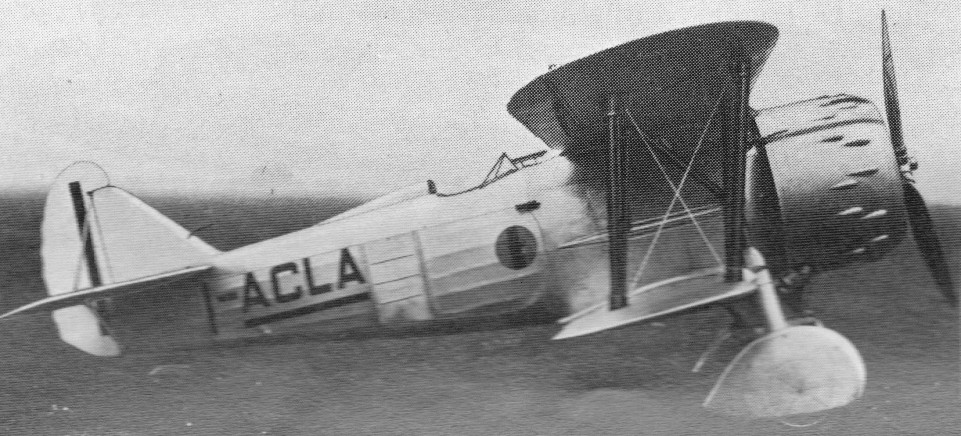
Retaining the gull-wing upper mainplane centre section or the CR.30, but possessing larger overall dimensions, a heavier armament and a more powerful engine, the CR.41 was first flown on 30 March 1935 with a 730 hp Gnome-Rhone 14Kfs Mistral Major 14-cylinder air cooled radial. Armament comprised two fuselage-mounted 12.7mm and two wing-mounted 7.7mm guns, and various two- and three-blade variable-pith propellers were ested on the sole prototype during a protracted flight test programme, and in the course of which alternative armament installations were evaluated, including one comprising two 20 mm cannon and another consisting of four 12.7mm machine guns.
Further development was discontinued in favour of the CR.42
Engine: 730 hp Gnome-Rhone 14Kfs Mistral Major
Max speed: 252 mph / 405 kph
Endurance: 1 hr 45 min
Empty weight: 2888 lb / 1310 kg
Loaded weight: 4156 lb / 1885 kg
Wingspan: 31 ft 8 in / 9.65 m
Length: 24 ft 4 in / 7.42 m
Height: 8 ft 8 in / 2.64 m
Wing area: 243.59 sq.ft / 22.63 sq.m
Fiat CR.40

Evolved in parallel with the CR.33 but completed and flown earlier owing to engine availability, the CR.40 was powered by a radial air-cooled engine, unlike the preceding Fiat fighters.
The prototype CR.40 was flown in March 1934 with a 550 hp Alfa Romeo-built Bristol Mercury I engine. Provision was made for two synchronised 12.7mm machine guns and the structure was of steel and light alloy with fabric skinning.
The CR.40 attained a maximum speed of 234 mph / 377 kph and reached an altitude of 9840 ft / 3000 m in 6.83 minutes, but climbing qualities and stability proved inferior to those of the CR.32.

A second prototype, the CR.40bis, also tested in 1934, differed only in having a Fiat A 59 R (a licence-built P&W Hornet) engine rated at 690 hp at 6560 ft / 2000 m and driving a flight-variable two-pitch propeller.
The CR.40 indirectly led to the production CR.42.
CR.40bis
Engine: Fiat A 59 R, 690 hp
Wingspan: 30 ft 6 in / 9.30 m
Length: 22 ft 10 in / 6.96 m
Height: 8 ft 6 in / 2.60 m
Wing area: 224.97 sq.ft / 20.90 sq.m
Empty weight: 2645 lb / 1200 kg
Loaded weight: 3748 lb / 1700 kg
Max speed: 241 mph / 388 kph at 6560 ft / 2000 m
Endurance: 1.83 hr
Fiat CR.33

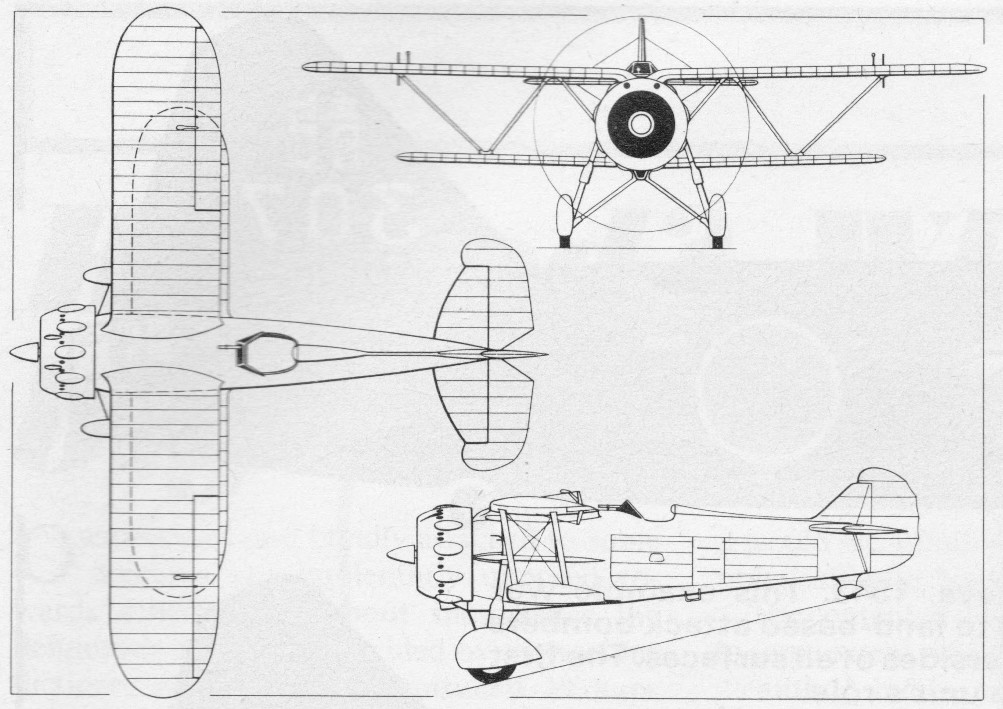
A derivative of the CR.32 designed to take the 690 hp A 33 RC 35 supercharged engine, the CR.33 differed little externally from its predecessor but had marginally larger overall dimensions and was fitted with a ground-adjustable three-blade propeller. Armament comprised two fuselage-mounted 12.7mm guns and two wing-mounted 7.7mm weapons, and an internal bay could accommodate either 12 x 4.4 lb / 3 kg anti-personnel bombs or camera equipment. Although the Fiat A 33 RC 35 engine was completed in 1935, difficulties with this engine delayed prototype trials of the CR.33 until 1937, by which time the air-cooled radial engines were officially favoured for fighter installation, and the development programme was restricted to three prototypes.
Engine: 690 hp A 33 RC 35
Span: 32 ft 2 in / 9.80 m
Length: 24 ft 9.5 in / 7.56 m
Height: 8 ft 6 in / 2.60 m
Wing area: 241.11 sq.ft / 22.40 sq.m
Empty weight: 2998 lb / 1360 kg
Loaded weight: 4211 lb / 1910 kg
Max speed: 262 mph / 422 kph
Max range: 435 mi / 700 km
 All Aero