Syracuse NY.
USA
Built the New Standard D-31 in 1941
Syracuse NY.
USA
Built the New Standard D-31 in 1941
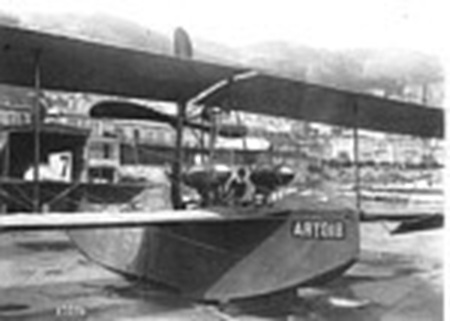
The 1913 D’Artois flying boat was designed and built by Chantiers d’Artois in France
Span: 32’10”
Length: 26’3″
Weight: 942 lb empty
The 1913 Daimler-Lutskoy No. 3 monoplane was designed by B. G. Luskoy (Russian) Built by Daimler
Speed: 85 mph

The 1913 Curtiss G Scout biplane featured side-by-side seats.
Span: 38’4″
Length: 24′

The Boffin Coffin was a man-powered aircraft designed by Mr Donald Walther of Christchurch, New Zealand, to be an entrant in the man-powered aircraft competition announced by British Industrialist, Henry Kremer, for the first human-powered aircraft to complete a figure-of-eight course covering a distance of 1.6 km (1 mile), the course to include a 3.048 m (10 ft) pole that the aircraft had to fly over at the beginning and conclusion of the flight.
Work commenced in 1982 and it soon became known as the Boffin Coffin. Construction was of resin-laminated aluminium-alloy sheet and EPS, covered with Melinex. The undercarriage was quite tall, being 0.91 m (3 ft) long. The pilot was in a prone position, head first, operating pedals driving a propeller. The aircraft had a shock absorber in the drive between the rear-wheel and the propeller.
Flight trials commenced at RNZAF Base Wigram near Christchurch by a motor-vehicle towing the machine, Mr Walther initially being the pilot. Early testing was successful, Mr Walther stating “when I took my eyes off the tiller and looked down I was looking down on the roof of the car. The aircraft came down very lightly, but I could hardly call it a controlled flight. It is a mystery just how much control there is with these ailerons on the front wing, how much they contributed to my safe landing and how much was pure luck”. Although the first flight was successful, the aircraft suffered some damage on its second flight when it landed tail-first.
In 1987 testing began with pilots Steven Preest and Trent Hiles, at this time the aircraft being fitted with pedals for the pilot to operate. However, it was found the easterly breezes over the military airbase became unsuitable for human-powered flight. In fact, even in the hangar when stored the aircraft was blown into the hangar wall, causing considerable damage. It also received damage in the hangar by people unaware of the delicate nature of the aircraft.
In July 1988 work on the project was abandoned and it was placed in storage.
Wingspan: 13.7 m (45 ft)
Forward wing area: 13 sq.m (140 sq ft)
Rear wing area: 11 m² (120 sq ft)
Weight: 57 kg (126 lb)
The 1933 Barclay Monoplane was a two-place open cockpit powered by a 65hp LeBlond engine and registered N13602 c/n 2001.
Bloomington IL.
USA
Built a monoplane in 1933
Built during 1917-18, the single-place, open biplane was a wood and fabric design described as being influenced by Caudron G.3. Employing a two-control (rudder and elevator) system adapted from 1910 Voisin system, it had a small podlike fuselage with twin booms, fabric covered for lateral stability, and two-bay wings that were fairly standard biplane style but minus ailerons.
Possibly powered by a 50-60hp Anzani engine, it reportedly underwent Army evaluation but was rejected and stored away in a barn.
Discovered c.1961 and was undergoing restoration when it was destroyed in a shop fire.
(Basil or Louis) Bancroft Airplane Co,
E Hartford CT.
USA
Built a biplane in 1917-8.
The 1913 Crawford pusher biplane was a two-seater designed and built by Harvey and William Crawford in the USA.
Span: 31′
 All Aero