Aircraft first flown August 1956
Aircraft
UTVA
UTVA, Fabrica Aviona
Jugoslavia / Serbia
Utva Aircraft Industry (commonly known as UTVA) is a manufacturer of general aviation aircraft, located in Pančevo, Serbia. Utva in Serbian is the Ruddy Shelduck.
Utva was founded on 5 June 1937 in Zemun (a small town in former Austrohungarian empire), and produced simple gliders. In 1939 Utva began manufacturing light piston engine aircraft.
Four out of five Yugoslav aircraft plants were in close proximity to each other, built in and around Belgrade: Ikarus, Rogožarski, Zmaj and Utva. The fifth one was DFA (Državna Fabrika Aviona – State Aircraft Factory) which was located in Kraljevo. The plant was relocated to Pančevo (a town a few kilometers away from Belgrade, in Vojvodina autonomous province) in 1940. Until the April war, it mainly produced light gliders but it also produced 148 Bucker Jungmann Bu-131D-2 training planes and one acrobatic Bucker Jungmaister Bu-133. The plant escaped the devastation of the other aircraft plants (Ikarus, Rogožarski and Zmaj) and began producing it’s prewar gliders Čavka (Daw) and Ždral (Crane – the bird) and school airplanes Trojka (Three) and Aero 3. Utva also built a lot of Ikarus designs, notably the 212 and 213 models.
Utva produced light utility aircraft, including the Utva 56 four-seater, first flown in 1956, and thereafter developed through a number of U60 air-taxi/tourer/freight/agricultural/ ambulance and floatplane versions. The Utva 65 was originally an agricultural aircraft, developed as the U66 to serve various utility roles and including the armed U66V version. The Utva 75 two-seat trainer/glider-tug/agricultural aircraft entered production in late 1970s. Lasta 1 tandem two-seat piston-engined trainer first flew September 1985 but was superseded before production by the design of the refined Lasta 2. Development started of Utva 95 agricultural aircraft, probably based on Utva 75. Formerly fabricated components for the IAR-93/J-22 Orao and Super Galeb programmes, and produced items for various Boeing airliners.
During the NATO bombing of Yugoslavia in 1999, the factory was bombed several times and severely damaged.
The factory was heavily bombarded in 1999 and certain parts of it were still off limits due to the unexploded ordnance in 2012. All five original lasta 95 prototypes were destroyed in the factory and the only existing Supergaleb G4MD prototype was lightly damaged. 2012 was back to the basics for Utva. The plant produced Lasta 95 basic trainer and was developing Kobac (sparrow hawk) light COIN aircraft (first flight is expected in 2013).
In 2011, Utva Pančevo was a public company with the headquaters in Pančevo, Serbia, serving 301 employees.
US Light Aircraft Hornet
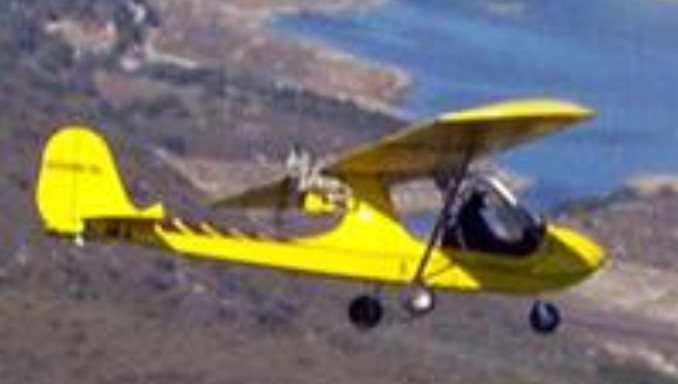
The entire airframe is completed by the factory, assembled in precise factory jigs, with over 7,000 rivets.
The Hornet components are manufactured by computer automated equipment, especially designed by U.S.L.A.C. to produce the most precise, highest-quality aircraft possible. 2009 Price: 18950 US$
The Hornet has pneumatic suspension on all three wheels, electrically actuated flaps and horizontal staliser. First flown in 1993. The Hornet qualifies under the 51% rule.
Engine: Hirth, 55 hp
HP range: 55-70
Fuel cap: 10 USG
Weight empty: 490 lbs
Gross: 454 kg / 1000 lbs
Height: 6 ft
Length: 20ft
Wing span: 27.5 ft
Wing area: 137 sq.ft
VNE: 104 kt / 120 mph / 193 kmh
Cruise: 61 kt / 70 mph / 113 kmh
Range: 400 sm
Stall: 35 mph
ROC: 700 fpm
Glide Ratio: 9:1
Take-off distance: 175 ft / 53 m
Landing distance: 150 ft / 46 m
Service ceiling: 12,000 ft
Seats: 2
Landing gear: Nose wheel
US Aviation CAVU

Designed and manufactured by AeroDreams LLC, the FAR Pt 103 CAVU first flew in 1997.
Engine: Zenoah G-25, 22 hp
HP range: 20-30
Empty weight: 220 lb
Gross weight: 520 lb
Cruise: 52 mph
Stall: 27 mph
Rate of climb: 500 fpm
Seats: 1
Landing gear: nosewheel
US Aviation SuperFloater / Wind Walker Aircraft Co Super Floater

A remake of Klaus Hill’s design of the 1970’s primary glider. Designed by Klaus Hill and Larry Hall. An ultalight sailplane, the Super Floater is designed to accommodate a ballistic recovery emergency parachute and comply with U.S. FAA part 103 rules. It has full span ailerons which, as an option, can be configured as flaperons.
Price (1998) US$9995
US Aviation SuperFloater Article

The Super Floater was produced by US Aviation initially and later by Wind Walker Aircraft Co.
Span: 11.6m / 38ft
Area: 15.5 sq.m / 168sq.ft
Height: 5 ft
Length: 20 ft
Empty Weight: 81kg / 179lb
Payload: 100kg / 221lb
Gross Weight: 182kg / 400lb
Wing Load: 11.74kg/sq.m 2.38lb/sq.ft
L/DMax: 15 56 kph / 30 kt / 35 mph
Speed max: 60 mph
Cruise: 55 mph
Stall: 23 mph
MinSink: 0.9 m/s / 3.0 fps / 1.78 kt
Water Ballast: 0
Aspect ratio: 8.4
L/D: 15-1
Seats: 1
Landing gear: single main wheel
US Aviation Cumulus
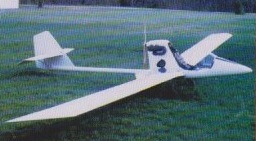
The Cumulus has a foldable cantilever wing in riveted sheet dural, dacron covered, and a welded steel spaceframe fuselage and a composite cockpit.
In 1998 the Cumulus returned to the market after and inflight failure of the spar involving the designer.
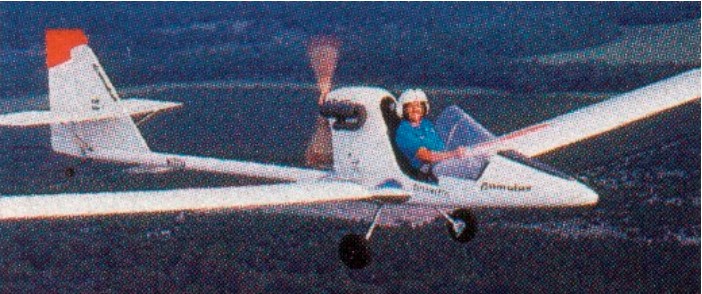
An Ultralight / Microlight Motorglider Construction is steel and fabric, first flown in 1995. Was available as a kit manufactured by AeroDreams, for $9995. 2009 Price: 7995 US$ airframe only.
Engine: Rotax 277, 28 hp
HP range: 28-35
Height: 4.5 ft
Length: 20.5 ft
Wing span: 43 ft
Wing area: 141 sq.ft
Fuel cap: 5 USG
Weight empty: 320 lbs
Gross: 560 lbs
Speed max: 90 mph
Cruise: 82 mph
Range: 275 sm
Stall: 27 mph
ROC: 600 fpm
Take-off dist: 120 ft
Landing dist: 170 ft
Service ceiling: 15,000 ft
Seats: 1
Landing gear: tail wheel
Glide: 20:1@ 43 mph
Sink: 195 fpm @ 30 mph
Fuel: 1 USG/h.
Engine: Rotax 447, 28 hp
HP range: 28-40
Height: 4.5 ft
Length: 20.5 ft
Wing span: 43 ft
Wing area: 140 sq.ft
Fuel capacity: 5 USG
Empty weight: 163 kg / 360 lbs
Gross weight: 290 kg / 640 lb
Top speed: 90 mph
Cruise: 56 kt / 65 mph / 105 kmh
Stall: 29 mph
VNE: 78 kt / 90 mph / 145 kmh
Aspect ratio: 13-1 sm
L/D: 20-1 fpm
Landing dist: 250 ft
Service ceiling: 15,000 ft
Seats: 1
Landing gear: tailwheel
ROC: 800 ft/min / 4 m/s
Range: 275 sm
Glide Ratio: 20.1
Take-off distance: 170 ft / 52 m
LSA: yes
Engine: Rotax 447, 42 hp
Wing span: 13.1 m
Wing area: 12.7 sq.m
MAUW: 291 kg
Empty weight: 164 kg
Fuel capacity: 19 lt
Max speed: 144 kph
Cruise speed: 97 kph
Minimum speed: 55 kph
Climb rate: 5 m/s
Seats: 1
Fuel consumption: 6 lt/hr
Kit price (1998): $7995
U S Airplane Co C-1 / C-2
The U S Airplane Co 1929 C-1 and C-2 were the same as the three seat, open cockpit U S Flyer, but powered by a 100hp Hisso engine.
Two were built, registered N3502 c/n 12 and N880H c/n 13.
U S Airplane Co U S Flyer
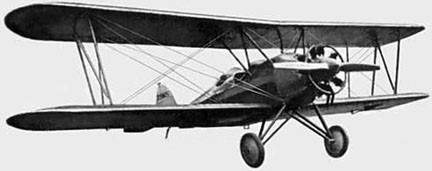
Built by the U S Airplane Co in 1928, the U S Flyer prototype NX6605 c/n11 was designed by L B Coombs and priced at $2,250-6,500. Originally powered by a 110 hp Anzani engine, the only one built was later powered with 90hp Curtiss OX-5 and Wright Whirlwind.
Engine: 110hp Anzani
Wingspan: 33’0″
Length: 24’0″
Useful load: 400 lb
Max speed: 100 mph
Cruise speed: 88 mph
Stall: 35 mph
Range: 425 mi
Seats: 3
U S Airplane Co
3670 Milwaukee Ave,
Chicago IL.
USA
Airplane builder 1928-9.
US Aircraft A-67 Dragon
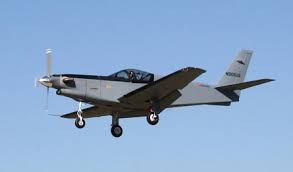
Start-up US Aircraft changed direction in its plans to develop a low-cost counter-insurgency aircraft for use in Afghanistan, Iraq and elsewhere. After funding design of the A-67 Dragon by US warbird restoration specialist Golden Aviation, it began working with Brazil’s Geometra on an aircraft based on a design by Josef Kovacs, former chief designer of Embraer’s EMB-312 Tucano trainer.
The original A-67 made its only flight in October 2006 in Missouri. The aircraft flew from Cassville, Missouri to Golden’s base at Monett Municipal Airport, ending with a landing gear collapse.
The Ohio-based company planed to base its A-67 on a scaled-up version of Kovacs’ K52, a general-aviation aircraft strongly resembling the Tucano, after testing a Brazilian-built prototype. US Aircraft planned to combine features from both designs, but where the original A-67 had side-by-side seating, the new design uses a tandem set-up.
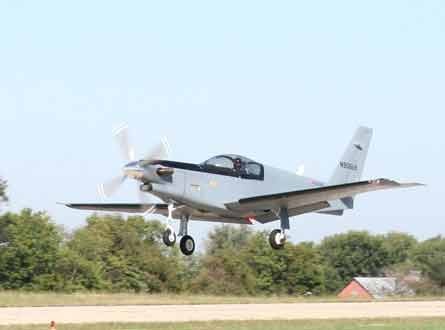
Powered by a 1,250shp (930kW) Pratt & Whitney Canada PT6A-68 turboprop, the 4,620kg (10,200lb) gross-weight A-67 has an estimated maximum cruise speed of 381kt (706km/h) at 20,000ft (6,100m). Endurance will be 10h and external payload 1,620kg.
A subsidiary of US Technology, which produces the plastic media used for stripping paint from aircraft, US Aircraft was funding design work on the A-67, but sought private investors to complete development and begin production.
A-67 prototype
Engine: 1 × Pratt & Whitney PT6A-67 turboprop, 1,250 shp (930kW)
Prop: four-blade
Wingspan: 38 ft (11.6 m)
Wing area: 211 ft² (19.6 m²)
Empty weight: 4,800 lb (2,200 kg)
Max. takeoff weight: 10,200 lb (4,640 kg)
Maximum speed: 371 knots (427 mph, 687 km/h) at 20,000 ft
Range: 1,880 mi (3,008 km)
Service ceiling: 35,000 ft (11,000 m)
Rate of climb: 4,882 ft/min (1,488 m/min)
Wing loading: 35.1 lb/sq ft
Crew: 2

