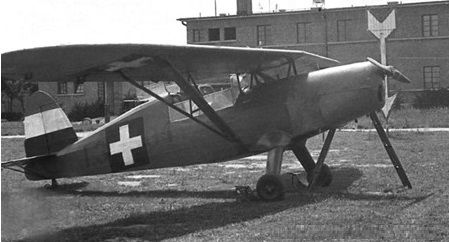
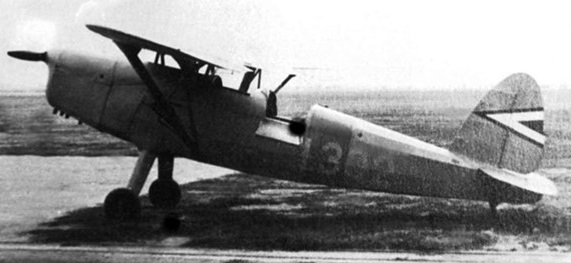
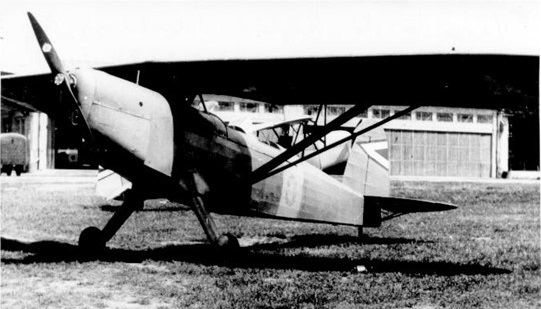
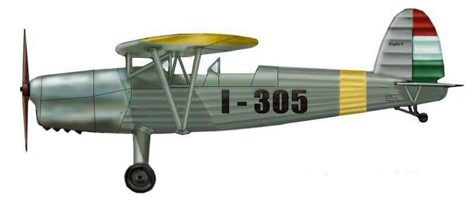
Varga “Káplár” was designed in the 1930’s by a team of engineers led by Laszlo Varga. Not departing from the general principles of the time the plane was a parasol monoplane with a double-open cockpit and Hirth HM-504\A2 engine. The aircraft to be used as a liaison and training.
The first flight of the prototype Varga “Kaplar” made in 1940.
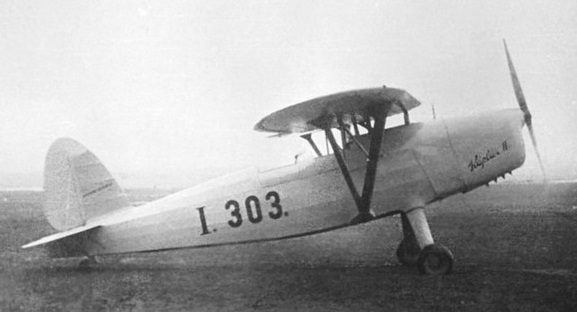
The Hungarian Air Force have expressed some interest in “Kaplar”, ordering a trial batch of aircraft to conduct evaluation tests. The contract for the construction of these machines were given to Aero-Ever and Szekesfehevar-Sosto, for four aircraft. Szekesfehevar-Sosto aircraft were designated “Kaplar I” and received a registrations I.301 – I.302. The remaining three aircraft – I.303, I.304 and I.305, are called “Káplár II”.
In general, this were simple enough to use, but the performance characteristics were not up to par. In the end, the Hungarian Air Force opted for serial production of Fabian “Levente”, which served until 1945. Although officially “Káplár” were not taken during the war, they were used for some time for auxiliary purposes.
Engine: Hirth HM-504 \ A2 Wingspan: 10.51 m Length: 6.8 m Height: 2.5 m Maximum speed: 180 km \ h Crew: 2 Armament: none
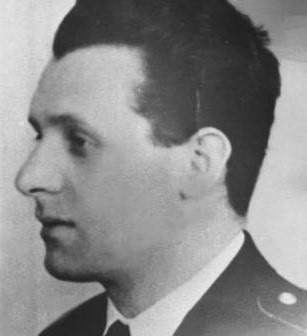
Aircraft were primarily (but not exclusively) designed for RMI by László Varga. As a result, RMI designs are often given the Varga name (in some cases, even when he was not a major designer).
In 1948 Ibbs “Dutch” Vantuil built a single place cabin, low wing monoplane midget racer registered N7E. Originally named Jezebel, it appeared at Cleveland in 1948 but did not fly.
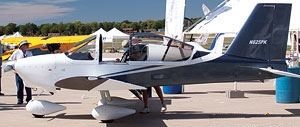
The RV-12 is a two-seat all-metal side-by-side airplane with a large cabin that seats the occupants ahead of the wing spar for maximum room and superb visibility. The RV-12 meets the certification standards of the Light Sport Aircraft category.
The wings are quickly and easily removable. Two people can have the wings off an RV-12 in less than five minutes, making the airplane easy to transport on a trailer and keep off-airport. Pull a pair of pins behind the seats and the wings come off in a few seconds. All control and wiring connections are automatic and an ignition interlock prevents the engine from starting if the wings are not properly installed.
It is powered by a Rotax 912ULS 100 hp engine, equipped with a Sensenich wood/composite propeller. The empty weight allows a useful load of two 210 lb people, 20 gallons of fuel and 50 lbs of baggage.
Vans Aircraft produced the RV-12 as an E-LSA kit and later as an S-LSA. The first 12 Signature Edition versions sold well with 60 more buyers lined up at US$115,000.
The RV-10 will carry four FAA standard people, full fuel and sixty pounds of baggage. The cabin accommodates four full-sized adults. Both front and back seats will hold people 6’4″ tall and provide them with truly comfortable leg and headroom. Composite gull-wing doors let occupants board from both sides.
The RV-10 is designed to fly well on various versions of the six-cylinder Lycoming O-540 engine, developing between 235 and 260 hp. The prototype was powered by a fuel injected 260 hp Lycoming IO-540. The RV-10 will cruise just under 200 mph.
Cruise speeds at 50-55% power are 175 mph. Even at gross weight, the RV-10 can operate out of very short runways and climb well at high density altitudes. The generous wing area, big slotted flaps and steel rod landing gear allow the RV-10 to land at virtually any small airport — grass, gravel or pavement. The composite cabin top provides roll-over protection. The cabin interior is designed around Oregon Aero seats and seat cushions, (provided in the kit) which provide the best available impact mitigation and comfort.
The baggage compartment will accept 100 lbs of “stuff” loaded through the baggage door on the left side. If fewer than four people are traveling, the rear seat backs may be removed in a couple of minutes for extra baggage space.
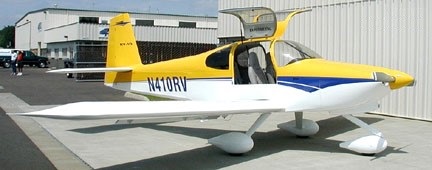
Van’s RV-10 N410RV
The RV-10 was first flow in May 2003, piloted by VanGrunsven.
RV-10 Engine: 210 hp Span: 31 ft 9in. Length: 24 ft 5 in. Height: 8 ft 8 in Wing Area: 148 sq ft Wing Loading: 18.6 lb/sq ft Power Loading: 13.5 – 10.4 lb/hp Engine: 210-260 hp Propeller: Hartzell C/S Fuel Capacity: 60 US gal Baggage: 100 lbs Gross Weight: 2700 lbs Empty Weight: 1,520 lbs Top Speed: 197 mph Cruise 75% @ 8000 ft: 186 mph Cruise 55% @ 8000 ft: 166 mph Stall Speed: 63 mph Takeoff Distance: 686 ft Landing Distance: 650 ft Rate of Climb: 1150 fpm Range 75% @ 8000 ft: 951 sm Range 55% @ 8000 ft: 1,153 sm
RV-10 Engine: 260 hp Span: 31 ft 9in. Length: 24 ft 5 in. Height: 8 ft 8 in Wing Area: 148 sq ft Wing Loading: 18.6 lb/sq ft Power Loading: 13.5 – 10.4 lb/hp Engine: 210-260 hp Propeller: Hartzell C/S Fuel Capacity: 60 US gal Baggage: 100 lbs Gross Weight: 2700 lbs Empty Weight: 1,600 lbs Top Speed: 208 mph Cruise 75% @ 8000 ft: 197 mph Cruise 55% @ 8000 ft: 176 mph Stall Speed: 63 mph Takeoff Distance: 500 ft Landing Distance: 650 ft Rate of Climb: 1,450 fpm Range 75% @ 8000 ft: 825 sm Range 55% @ 8000 ft: 1000 sm
RV-10 Engine: Lycoming O-540, 260 hp Span: 31 ft 9in Length: 24 ft 5 in. Useful load: 1100 lb Max speed: 208 mph Cruise: 197mph Stall: 63 mph Ceiling: 27,000 ft Land/take-off dist: 650 ft Seats: 4
The RV-9/9A wing is longer and narrower than the wings of the RV-4/6/8 series, and uses a new Roncz airfoil. The increased span allows it to climb well on low power and glide a long way. The flaps are a long span, slotted, high lift design that allows the airplane to land slower than many primary trainers. A simplified constant-chord horizontal tail and large vertical tail are proportioned to work with the longer wing. The fuselage and cabin are identical to the RV-7/7A and there are the same sliding/tip-up canopy and trigear/tailwheel landing gear options.
The RV-9/9A uses a 118 hp Lycoming (taken from a Cessna 152) to power the prototype. The result was an efficient airplane with respectable short field capability, excellent cruise speed (165 mph). The airframe is engineered to accept the 160 hp Lycoming O-320.
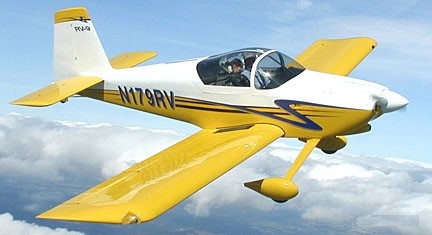
Van’s RV-9 N179RV
The RV-9 first flew on 15 June 2000, piloted by VanGrunsven. The RV-9A, a tail wheel version of the RV-9, made its maiden flight on 4 March 2002, also piloted by VanGrunsven.
RV-9 Engine: 118 hp Span: 28 ft Length: 20 ft 5 in Height: 6 ft Wing Area: 124 sq ft Empty Weight: 1015 – 1057 lbs Gross Weight: 1600 – 1750 lbs Wing Loading: 12.9 – 14.1lb/sq ft Power Loading: 13.6 – 10.9 lb/hp Engine: 118 -160 hp Propeller: Fixed or C/S Fuel Capacity: 36 US gal Baggage: 75 lbs Top Speed: 172 mph Cruise 75% @ 8000 ft: 166 mph Cruise 55% @ 8000 ft: 150 mph Stall Speed: 48 mph Takeoff Distance: 525 ft Landing Distance: 355 ft Rate of Climb: 1,000 fpm Ceiling: 14,500 ft Range 75% @ 8000 ft: 875 sm Range 55% @ 8000 ft: 1,035 sm
RV-9 Engine: 135 hp Span: 28 ft Length: 20 ft 5 in Height: 6 ft Wing Area: 124 sq ft Empty Weight: 1015 – 1057 lbs Gross Weight: 1600 – 1750 lbs Wing Loading: 12.9 – 14.1lb/sq ft Power Loading: 13.6 – 10.9 lb/hp Engine: 118 -160 hp Propeller: Fixed or C/S Fuel Capacity: 36 US gal Baggage: 75 lbs Top Speed: 178 mph Cruise 75% @ 8000 ft: 174 mph Cruise 55% @ 8000 ft: 157 mph Stall Speed: 49 mph Takeoff Distance: 500 ft Landing Distance: 410 ft Rate of Climb: 1,150 fpm Ceiling: 16,000 ft Range 75% @ 8000 ft: 745 sm Range 55% @ 8000 ft: 910 sm
RV-9 Engine: 160 hp Span: 28 ft Length: 20 ft 5 in Height: 6 ft Wing Area: 124 sq ft Empty Weight: 1015 – 1057 lbs Gross Weight: 1600 – 1750 lbs Wing Loading: 12.9 – 14.1lb/sq ft Power Loading: 13.6 – 10.9 lb/hp Engine: 118 -160 hp Propeller: Fixed or C/S Fuel Capacity: 36 US gal Baggage: 75 lbs Top Speed: 196 mph Cruise 75% @ 8000 ft: 188 mph Cruise 55% @ 8000 ft: 168 mph Stall Speed: 50 mph Takeoff Distance: 475 ft Landing Distance: 450 ft Rate of Climb: 1,400 fpm Ceiling: 19,000 ft Range 75% @ 8000 ft: 710 sm Range 55% @ 8000 ft: 860 sm
RV-9A Engine: 118 hp Span: 28 ft Length: 20 ft 5 in Height: 7 ft 10 in Wing Area: 124 sq ft Empty Weight: 1028 – 1075 lbs Gross Weight: 1600 – 1750 lbs Wing Loading: 12.9 – 14.1 lb/sq ft Power Loading: 13.6 -10.9 lb/hp Engine: 118 -160 hp Propeller: Fixed or C/S Fuel Capacity: 36 US gal Baggage: 75 lbs Top Speed: 170 mph Cruise 75% @ 8000 ft: 164 mph Cruise 55% @ 8000 ft: 148 mph Stall Speed: 48 mph Takeoff Distance: 525 ft Landing Distance: 375 ft Rate of Climb: 950 fpm Ceiling: 14,000 ft Range 75% @ 8000 ft: 865 sm Range 55% @ 8000 ft: 1025 sm
RV-9A Engine: 135 hp Span: 28 ft Length: 20 ft 5 in Height: 7 ft 10 in Wing Area: 124 sq ft Empty Weight: 1028 – 1075 lbs Gross Weight: 1600 – 1750 lbs Wing Loading: 12.9 – 14.1 lb/sq ft Power Loading: 13.6 -10.9 lb/hp Engine: 118 -160 hp Propeller: Fixed or C/S Fuel Capacity: 36 US gal Baggage: 75 lbs Top Speed: 176 mph Cruise 75% @ 8000 ft: 172 mph Cruise 55% @ 8000 ft: 155 mph Stall Speed: 49 mph Takeoff Distance: 500 ft Landing Distance: 410 ft Rate of Climb: 1,100 fpm Ceiling: 15,500 ft Range 75% @ 8000 ft: 735 sm Range 55% @ 8000 ft: 900 sm
RV-9A Engine: 160 hp Span: 28 ft Length: 20 ft 5 in Height: 7 ft 10 in Wing Area: 124 sq ft Empty Weight: 1028 – 1075 lbs Gross Weight: 1600 – 1750 lbs Wing Loading: 12.9 – 14.1 lb/sq ft Power Loading: 13.6 -10.9 lb/hp Engine: 118 -160 hp Propeller: Fixed or C/S Fuel Capacity: 36 US gal Baggage: 75 lbs Top Speed: 194 mph Cruise 75% @ 8000 ft: 186 mph Cruise 55% @ 8000 ft: 166 mph Stall Speed: 50 mph Takeoff Distance: 475 ft Landing Distance: 450 ft Rate of Climb: 1,400 fpm Ceiling: 18,500 ft Range 75% @ 8000 ft: 700 sm Range 55% @ 8000 ft: 850 sm
In 1995, Van’s decided to re-visit the tandem seating concept. Even though the side-by-side RV-6/6A had become the most popular homebuilt design ever, there was still a significant percentage of pilots who really wanted centerline seating. The consensus seemed to be that a roomier tandem airplane with better cross-country capability would be popular. A one-of-a-kind demonstrator was built and introduced at Oshkosh in 1995. The response left no doubt about the desire for an airplane like the RV-8. The RV-8 went on the market in 1996 and complete kits were available by the end of 1998. In short order, it was followed by the kit for the tricycle gear RV-8A. The RV-8/8A retains the fighter-like feel of centerline seating, but the wider fuselage contains cockpits that accommodate large people in comfort. Two baggage compartments, one forward and one aft, keep even large amounts of luggage well within the weight and balance envelope. Pilots up to 6’7″ fit in the front. A Tall Pilot option is available. (It was used by one successful builder who describes himself as 6’ 10″, although we think he might be taller). Factory demo pilots have flown demo rides with passengers up to 6’9″ and 260 lbs in the back. The large 42 gallon fuel capacity long range and high cruise speeds. At the aerobatic gross weight of 1600 lbs., the RV-8/8A complies with the +6/-3G standards of the FAA’s Aerobatic Category and can still carry two people, making it possible for a new pilot to get aerobatic instruction before he or she starts rolling and looping. The sliding canopy is built around a sturdy steel roll bar and fixed windshield. It must remain closed in flight, but the standard fresh air ducts provide plenty of fresh air to both seats. The RV-8/8A is designed to be flown from the front seat, although a rear stick is provided and a rear throttle and rudder pedals are optional. The RV-8/8A was designed to accept the 200 horsepower IO-360 Lycoming. The prototype with this engine demonstrated really remarkable performance. With a single occupant, it would take off in 250’ and climb out at 2600 fpm. The fact that the RV-8 can accept a large engine doesn’t mean that it needs it. The traditional engine options – 150-180 hp Lycomings – have been retained (probably the majority of flying RV-8/8As are powered by a 180 hp engine) and with these lighter engines, performance is still exciting – and the handling even better.
Kits sold for $14,770-14,995, and a quick-build for $21,750-21,995.
The change that allowed the change in aerobatic gross weight is the use of longer and heavier spar caps and heavier carry-through bulkhead bars. Other parts also needed to be changed to accommodate the larger pieces. The kit serial numbers are issued when a customer gets their tail kit. This means that a low serial number may have the 1600 lb aerobatic gross wing and centre section, while a higher serial number may have the 1550 lb aerobatic gross wing and centre section. Check the packing list for the wing kit and if it says “1” after the spar and centre section, then it’s the 1600 lb gross version. If no ‘1’ then it’s the 1550 lb gross.


 All Aero