Two brothers named Wilson and Harvey Doyle were 1925 graduates of Harvard and Yale respectively and left their home town of Charlotte, North Carolina, for Detroit, Michigan. After some time spent working for others and trying to obtain financial backing, they moved to Portsmouth, Ohio, where they came in contact with William Burke of the Vulcan Last Company. Burke backed their plan to build a two-place, tandem, open-cockpit parasol sportplane and the Vulcan Aircraft Division began in 1928 design work in a rented second floor room and construction in a former street car barn in Portsmouth.
Designed by Harvey Doyle, Dwight Huntington, and Jan Pavlecka, the result was the Vulcan “American Moth” NX4243 two-seat lightweight sporting aircraft. Burke chose the name in order to take advantage of the popularity of the British de Havilland “Moth.” A publicity tour of Florida ensued in which a parachutist, Benny Martinez, jumped from the Moth carrying a set of Vulcan golf clubs.
Priced at $2,500, it was later re-powered with 90hp LeBlond.
The plane was a hit, but the relationship among the principles was deteriorating and the Doyle brothers left to start their own Doyle Aircraft Company in Baltimore.
Engine: 60 hp Detroit Air-Cat Wingspan: 30’9″ Length: 18’0″ Useful load: 540 lb Max speed: 115 mph Cruise: 96 mph Stall: 43 mph Range: 400 mi Seats: 2
Two brothers named Wilson and Harvey Doyle were 1925 graduates of Harvard and Yale respectively and left their home town of Charlotte, North Carolina, for Detroit, Michigan, then a center of aviation activity. After some time spent working for others and trying to obtain financial backing, they moved to Portsmouth, Ohio, where they came in contact with William Burke of the Vulcan Last Company. Burke backed their plan to build a two-place, tandem, open-cockpit parasol sportplane and the Vulcan Aircraft Division began in 1928 design work in a rented second floor room and construction in a former street car barn in Portsmouth.
Vulcan Aircraft Co, Portsmouth OH USA fdrs: William Burke, Harvey & Wilson Doyle, Dwight Hungtinton, Jan Pavleka
The result was the Vulcan “American Moth” two-seat lightweight sporting aircraft. The plane was a hit, but the relationship among the principles was deteriorating and the Doyle brothers left to start their own Doyle Aircraft Company in Baltimore.
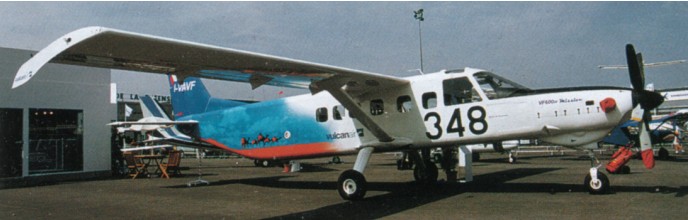
Vulcanair was the owner of the former Partenavia group and at Paris 2003 exhibited its VF600W Mission, a utility design which resembles Cessna’s Caravan. The prototype, I-VAVF, first flew in Januarv 2001 and had accumulated 30hr flying to date. Powered by a single Czech built 777shp Walter M601F 11 turboprop driving a five blad¬ed propeller, the design was aiming for cer¬tification in March 2004. This cargo/passenger aircraft has a fuselage shape which allows palletised cargo.
Engine: 1 x Walter M601 turboprop, 777 shp Payload: 1600 kg or 11 pax Crew: 1
Established 1989, and in 1996 was purchased by a new holding group to develop aircraft manufacturing, maintenance, airtransport, and other aviation related tasks, plus a flying school for commercial crews. Has taken over the SF600A Canguro multipurpose transport from SIAI-Marchetti (first flown 1978) and in 1998 purchased rights and tooling for former Partenavia’s P 68 series of transport aircraft (P 68, Observer 2 and Viator). Vulcanair took over the bankrupt Partenavia and continued to produce the VF600M.
Single seat single engined high wing mono¬plane with two axis control. Wing has swept back leading and trailing edges, and tapering chord; no tail, canard wing. Pitch control by fully flying canard; yaw control by tip rud¬ders; no separate roll control, control inputs through stick for pitch/yaw. Wing braced from above by kingpost and cables, from below by cables; wing profile; double ¬surface. Undercarriage has three wheels in tricycle formation; suspension on nose¬wheel and glass fibre suspension on main wheels. Push right go left nosewheel steering independent from yaw control. Brake on nosewheel. Aluminium tube framework, without pod. Engine mounted below wing driving pusher propeller. These aircraft are Germa¬nisations of the Fledgling designed by Klaus Hill. The Vulcan uses the Fledge in conjunction with a canard. This company, however, has instead of using a one piece canard, the Traveler uses two mobile surfaces articulated separately from the aircraft’s two main horizontal tubes. Acting as elevators, these two surfaces are operated from the stick via a push rod. The frame has been completely redesigned by Vulcan. The wings used are Fledge II or Fledge III, but Vulcan modifies them by adding trapezoidal vertical surfaces acting as winglets, to reduce tip vortices. Travelers are available under the name of Traveller II or Traveller III, depending upon the wing used, deli-vered built but without power pack. This is either a Lloyd 22 hp or the Cuyuna 430R 30hp. Two propellers were on offer, one a fixed pitch two blade and the other a three blade ground adjustable pitch. Only 20 examples had been produced by March 1983 and sold purely in West Germany.
Traveller II Height overall 6.4ft, 1.95m Wing span 32.5ft, 9.90m Chord at root 5.5ft, 1.68m Chord at tip 4.5ft, 1.37 m Nose angle 144 deg Main wing area 163 sq.ft, 15.1 sq.m Wing aspect ratio 6.5/1 Engine: Lloyd LS400, 22 hp at 5500 rpm Propeller diameter 36 inch, 0.91 m Max static thrust 177 lb, 80kg Power per unit area 0.13hp/sq.ft, 1.45hp/sq.m Fuel capacity 5.3 US gal, 4.4 Imp gal, 20.0 litre Empty weight 137 lb, 62 kg Max take off weight 442 lb, 200 kg Payload 305 lb, 138 kg Max wing loading 2.71 lb/sq.ft, 13.2 kg/sq.m Max power loading 20.1 lb/hp, 9.1kg/hp Never exceed speed 56mph, 90kph Max cruising speed 47mph, 75kph Economic cruising speed 35 mph, 56 kph Stalling speed 22 mph, 35 kph Max climb rate at sea level 680 ft/min, 3.5 m/s Best glide ratio with power off 9/1 Take off distance 100ft, 30 m Landing dis¬tance 65 ft, 20 m Range at average cruising speed 124 mile, 200 km
Traveller III Height overall 6.4ft, 1.95m Wing span 32.5ft, 9.90m Nose angle 144 deg Main wing area 157 sq.ft, 14.6 sq.m Wing aspect ratio 6.7/1 Engine: Lloyd LS400, 22 hp at 5500 rpm Propeller diameter 36 inch, 0.91 m Max static thrust 177 lb, 80kg Power per unit area 0.14hp/sq.ft, 1.50hp/sq.m Fuel capacity 5.3 US gal, 4.4 Imp gal, 20.0 litre Empty weight 143 lb, 65 kg Max take off weight 468 lb, 220 kg Payload 342 lb, 155 kg Max wing loading 3.10 lb/sq.ft, 15.1 kg/sq.m Max power loading 22.1 lb/hp, 10.0kg/hp Never exceed speed 56mph, 90kph Max cruising speed 44mph, 70kph Economic cruising speed 32 mph, 52 kph Stalling speed 19 mph, 30 kph Max climb rate at sea level 790 ft/min, 4.0 m/s Best glide ratio with power off 10/1 Take off distance 100ft, 30 m Landing dis¬tance 65 ft, 20 m Range at average cruising speed 124 mile, 200 km
Later Vuia aircraft, al¬though more conventional for their time and (in the case of the No 2 design) fitted with a more reliable engine, did not achieve flights of any great length compared with others of their day.
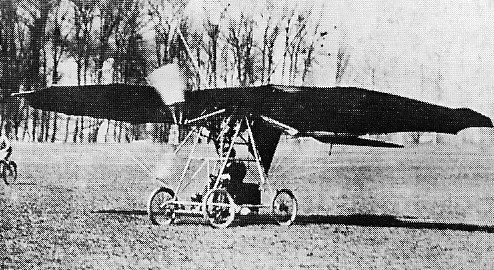
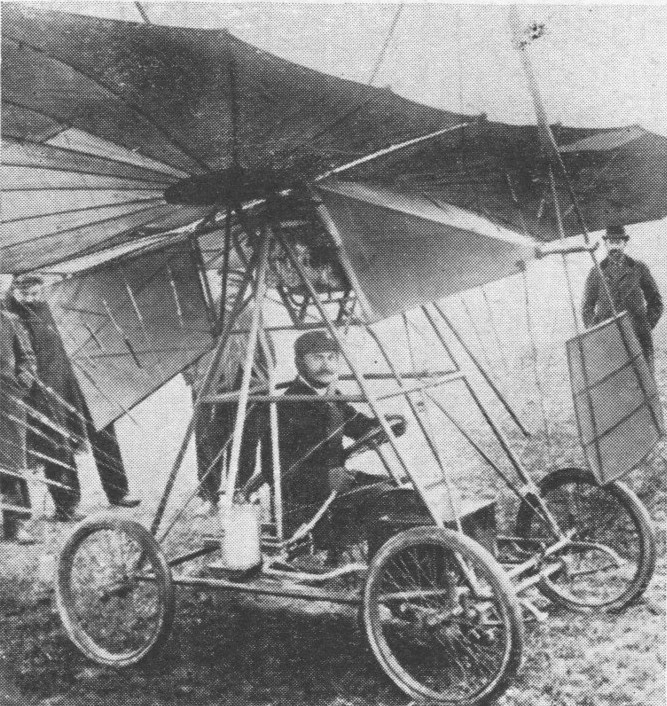
Designed and built by Romanian pioneer Traian Vuia in 1907, the No.2 was claimed to be a rebuilt Vuia 1.
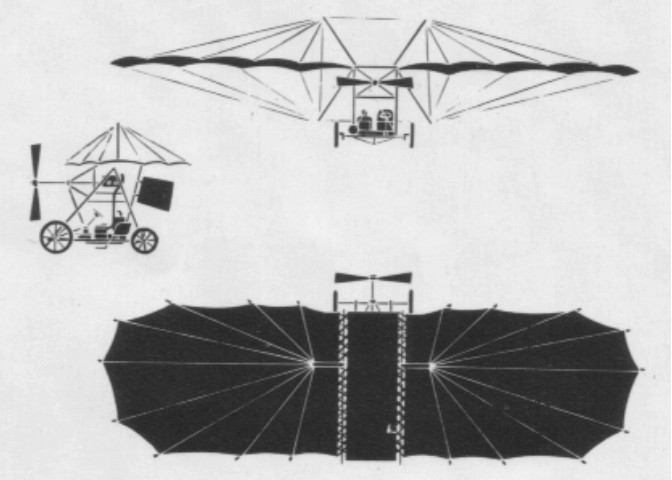
The compact airframe and folded wings are distinctive features of this design which was powered by a 25 hp Antoinette motor.
One of the first Europeans to make a powered flight (18 March 1906) in his own aeroplane. Traian Vuia is claimed as Romania’s first aviator, although at the time of his early flights he was resident in Paris and his birthplace was then apart of the Austro-Hungarian empire. His first aeroplane, built with the assistance of Frenchman Victor Tatin, travelled no more than 78.75 ft (24 m) on its longest hop-flight, but had several novel features, including a variable incidence wing and an undercarriage with pneumatic tyres.
The endurance of the motor was only three minutes.
Engine: modified Serpollet carbonic acid gas engine, 20 hp Prop: 7 ft 2.5 in (2.20 m) dia two blade Wing span: 22 ft 11.5 in (7.00 m) Length: 10 ft 6 in (3.20 m) Wing area: 204.5 sq.ft. (19,00 sq.m) Gross weight: 531 lb (241 kg) Seats: 1
The Trener is a modified version of the LIBIS-18 single-seater Standard Class sailplane which first flew on 20 October 1964 and was designed by the Letalski Institut Branko Ivanus, Slovenija – LIBIS. Of wooden construction with cantilever shoulder mounted wings with tapered outer panels, the LIBIS-18 did not go into production.
The VTC Trener differs from it chiefly in having the all-moving tailplane mounted slightly higher on the sweptback fin and rudder, and an improved cockpit layout, the pilot sitting under a flush-fitting one-piece cockpit canopy. The Trener is also of all-wood construction, using beech and Swedish plywood, and has Wortmann wing sections giving a thickness/chord ratio of 18% at the root. The fuselage is a wooden monocoque with a non-retractable monowheel with a brake, andatailskid. An initial batch of 50 Treners is believed to have been ordered by the Yugoslav Aero Club, these being built by VTC at Vrsac.
Span: 49 ft 2.5 in Length: 22 ft 7.75 in Wing area: 139.6 sqft Aspect ratio: 17.35 Max speed: 136.5 mph (in smooth air) Max aero-tow speed: 93 mph Min sinking speed: 2.36 ft/sec at 48.5 mph Best glide ratio: 31:1 at 53 mph
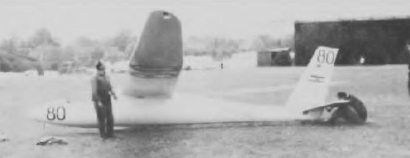
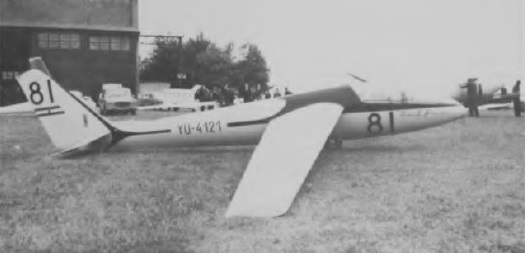
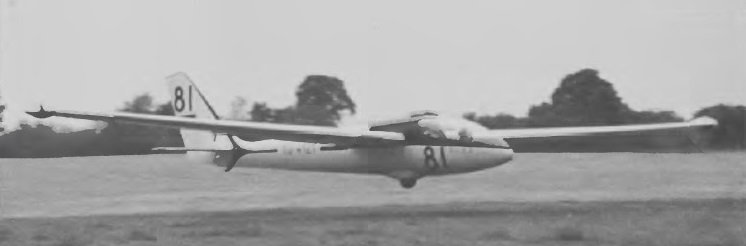
This Yugoslav single-seater high performance Standard Class sailplane was designed by T.Dragovic and Z. Gabrijel, two young engineers at the Faculte des Siences Mathematiques in Belgrade, and the prototype, known as the Delfin 1, made its first flight in December 1963. It made its public debut at the 1965 World Championships at South Cerney in Gloucestershire, and went into production as the Delfin 2 at the Vrsac works of VTC – Vazduhoplovno Tehnicki Centar (Aeronautical Technical Centre).
The Mk 2, which first flew on 26 April 1965, differed from the prototype in having the plywood fuselage covering extended to cover the nose, a smaller sideways opening canopy, a rubber-sprung nose skid added and wooden instead of metal ailerons, and 27 of this version were built, four of which were later converted to Delfin 3s. The Delfin 2 achieved its first real competition success when it came 1st and 2nd in the Polish National Championships of 1966, no mean feat in view of the strength of opposition from the indigenous SZD designs.
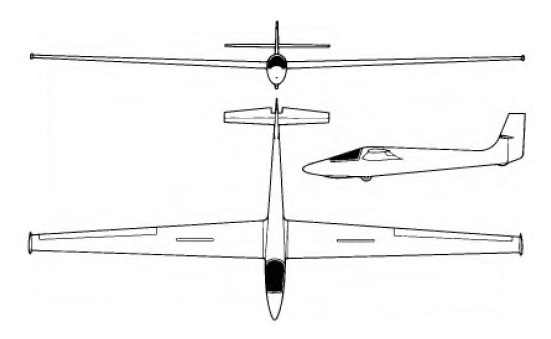
The Delfin 3 first flew on 29 July 1968 and has a conventional tailplane instead of an all moving one, reduced fin sweepback and increased rudder area. It is of plywood-covered wooden construction; the cantilever shoulder wings have plywood-covered leading edges and fabric-covered rear portions, and wing tip ‘salmon’ fairings are fitted. There are metal Schempp-Hirth air brakes above and below the wing surfaces at 60% of the chord. The fuselage is a monocoque structure with a small cross-section made possible by putting the pilot in a semi-reclining position under a one-piece curved flush fitting cockpit canopy that opens sideways to starboard for entry and exit. The swept back fin is integral with the fuselage, and the fixed tailplane has a trim tab in the starboard elevator. Landing gear consists of a non-retractable unsprung monowheel with a mechanical brake and a rubber-sprung nose skid, plus a tail bumper.
Delfin 3 Span: 49 ft 2.5 in / 15.0 m Length: 22 ft 5.5 in / 6.85 m Height: 5 ft 3 in Wing area: 138 sqft / 12.82 sq.m Aspect ratio: 17.55 Wing section: NACA 633 618 Empty weight: 492 lb / 223 kg Max weight: 717 lb / 325 kg Water ballast: None Max wing loading 25.3 kg/sq.m / 5.18 lb/sq ft Max speed: 155 mph / 135 kt / 250 km/h (in smooth air) Max rough air speed: 78 kt / 145 km/h Stalling speed: 32.5 kt / 60 km/h Min sinking speed: 2.13 ft/sec / 0.65 m/sec at 46.5 mph / 40.5 kt / 75 km/h Best glide ratio: 31:1 at 54 mph / 47 kt / 87 km/h



 All Aero