The 1941 Vultee-Stinson V-76 NX27772 was a modified Stinson 105 with a 185hp Lycoming O-435 engine. Designed by A P Fontaine, it was first flown on 28 June 1941, piloted by Al Schramm, it was equipped with full-span slots, which created a problem during testing with near-fatal results.
With modification to half-span slots and enlarged tail surfaces it became final prototype for the Stinson L-5.
The 1942 XBT-16 was BT-13A 41-9777 rebuilt with a plastic-impregnated plywood (Duramold) fuselage, tail section, and wing sections by Universal Products Corp, Bristol VA (aka Vidal Research Corp). A wartime experiment to replace vital aluminum with a less expensive material that didn’t prove too successful. It reportedly ended up heavier than the original metal-clad ship. Only one was built.
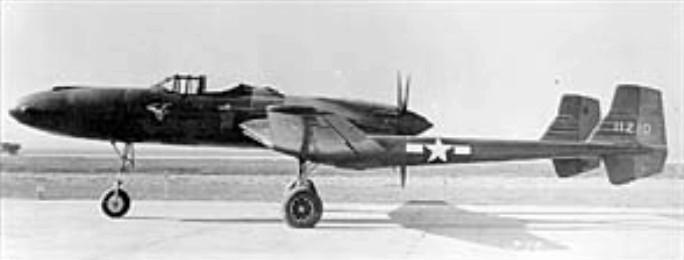
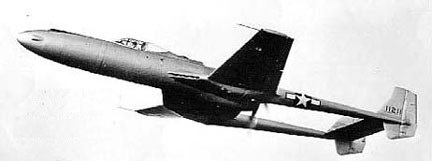
The XP-54, Vultee Model 70, was designed as a fast interceptor using the Pratt & Whitney X-1800-4AG engine. When the engine program was canceled, the aircraft was redesigned for the Lycoming XH-2470 and redesignated Vultee Model 84. With a pressurized cockpit, a pilot emergency ejection was downward, through a hole in the floor.
The first of two XP-54s built (S/N 41-1210) made its initial flight on 15 January 1943, piloted by Frank Davis, and flew 86 times before it was grounded by engine problems. The second aircraft (S/N 41-1211) flew only once, on 24 May 1944.
Vultee XP-54 – The only flight of 41-1211
The XP-54 nose section had a very unusual design feature. It tilted slightly upwards when firing its 37mm cannon to increase the firing range while the .50-cal. machine guns were tilted down at the same time. All had compensating gunsights.
Both were eventually scrapped.
XP-54 Span: 53 ft. 10 in. Length: 54 ft. 9 in. Height: 13 ft. 0 in. Weight: 15,262 lbs. empty/18,233 lbs. gross Armament: Two 37mm cannon and two .50-cal. machine guns Engine: Lycoming XH-2470 of 2,200 hp. Maximum speed: 381 mph. at 28,500 ft. Service ceiling: 37,000 ft. Range: 500 miles
The Vultee A-31 Vengeance dive-bomber was designed led by Richard Palmer to meet French air force requirements.
The RA-31 (Model V-72) export model (as prototype V-85) first flew on 30 March 1941 piloted by Vance Breese. There was a second prototype with twin tails, but pilot Vance Breese refused to fly after finding dangerous tendencies during taxi tests, and it was quickly modified with a single tail. It first flew (as Vengeance I) on 30 November 1941, piloted by Moye Stephens.
400 went to the RAF as Vengeance I/IA, subcontracted to Northrop Corp for production during 1941-42, of which 99 went to the RAAF, plus 300 to the USAAF as RA-31 in a special Restricted classification (41-30848 – 41-31047, and 41-31048 – 41-31147), the last batch of 100 built by Northrop; 300 to RAF as Vengeance II, plus 243 to USAAF with type re-designation as model 85 in 1942; 100 as Vengeance III, becoming Army A-31C, with subsequent production as A-35.
Vultee RA-31
The 1942 V-86 was a single place version of the A-31.
The XA-31A Model 85 of 1942 (42-35824) was a test-bed for the 3000hp P&W XR-4360 engine. It was re-designated XA-31B Model 86 for flight tests.
The A-31C of 1942 was t first production of the Vengeance III. One hundred were built; 41-30148 – 41-31147.
The XA-31C of 1942 was a test-bed for the 2200hp Wright R-3350 engine.
Five YA-31C were built in 1942 and went to Wright Field for testing of four-bladed props in the B-29 development program.
The A-35 Vengeance (Model 88) were A-31 for the USAAF, with similar data, but improved armament.
Vultee A-35A 41-31166
The 1942 A-35A were the second production of Vengeance III. Ninety-nine were built; 41-31148 – 42-31246.
781 A-35B of 1942 were built; 41-31247 – 41-31447, 42-94149 – 42-94548, and 42-101236 – 42-101465. Contradicting factory records show 831 A-35Bs built, with 562 going to the RAF and RAAF as Vengeance IV, and 29 to Brazil AF. (67 A-35A and -35B were supplied to the Free French, but it is unclear whether these were culled or a separate production.)
Vultee A-35B
All models were powered by Wright R-2600 Cyclone engine.
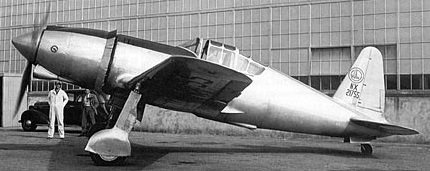
The Vultee P-66, P-48, V-48/-61 Vanguard (Models 48, 61) incorporated design elements from the Hughes H-1 racer and detachable outer wing panels for storage.
Vultee V-61 Prototype NX21755
Designed by Dick Palmer as a company demonstrator, the V-48 NX21755 c/n 142 first flew on 9 September 1939, piloted by Vance Breese. The V-48 was powered by a P&W R-1830-S Twin Wasp with an extended propshaft in an elongated low-drag cowling. The original proposal included two rear-firing guns aimed with mirrors. The prototype, NX21755 c/n 142, was later re-designated V-61, then P-48X.
The 1940 P-48X was a redesign of the V-61 with a conventional R-1830-S1 engine because of cooling problems. First flown on 11 February 1940, piloted by Vance Breese, and it crash-landed on May 9 after colliding with a camera plane.
Vultee P-48X NX21755
The 1940 V-48C was the V48-X rebuilt and repowered with a R-1830-S2 engine for export to Sweden’s Flygvapen as the J.10. First flown on 6 September 1940, it was re-registered NX19999 c/n 501, and followed by one production prototype, NX28300 c/n 502.
Vultee V-48C / P-48C NX28300
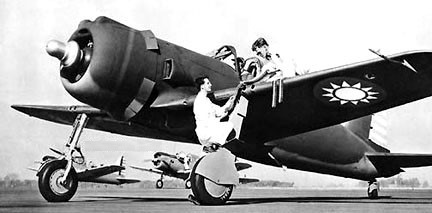
One-hundred and forty-four were built for Sweden (42-6832 to 42-6975), but diverted to the RCAF, who in turn released 129 of them after the outbreak of WW2 as Lend-Lease to China as P-66, and so marked with US insignia. Of the total about 50 were impressed for Army stateside assignment, and 12 transferred to 23 Fighter Group in China.
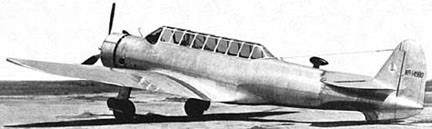
The BC-3 (Model 51 aka BC-51) Army basic combat trainer first flew on 24 March 1939 (piloted by Eddie Allen). The only one built, 39-720, was tested by the Army, who purchased the test model for upgrading as BC-3, one of the only three BC classifications (the other two were North Americans).
Vultee BC-3 39-720
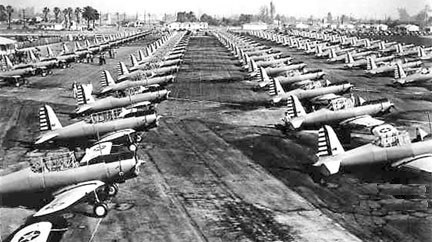
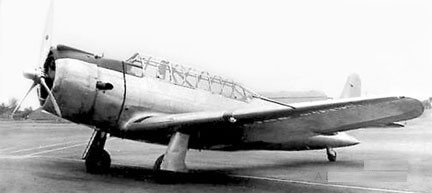
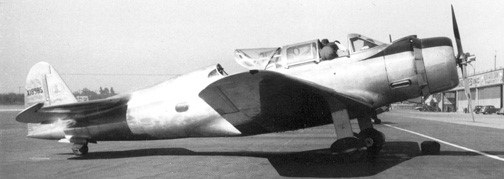
Following 1939 tests with the BC-3 variant with retractable landing gear and a 447-kW (600-hp) Pratt & Whitney R-1320-45 radial, the army opted for the lower-powered Model 54 with fixed landing gear. Designed by Richard Palmer, Walt Hite, and others, the initial contract called for 300 aircraft (40-810-1109).
Vultee BT-13
The 1939 V54 (Model 51D) was a retractable-gear export model demonstrator with a 600hp R-1340-S1 engine. The one prototype built, NX21753 c/n 140, first flew on 15 November 1939 piloted by Gil Clark), but crashed on 16 November 1939.
Vultee V-54 / 51D NX21753
The 1940 V54-A NX21754 c/n 141 was a faired, fixed gear, 450hp R-985-AN-1 powered prototype of the BT-13. It first flew on 28 July 1940.
Vultee V54-A NX21754
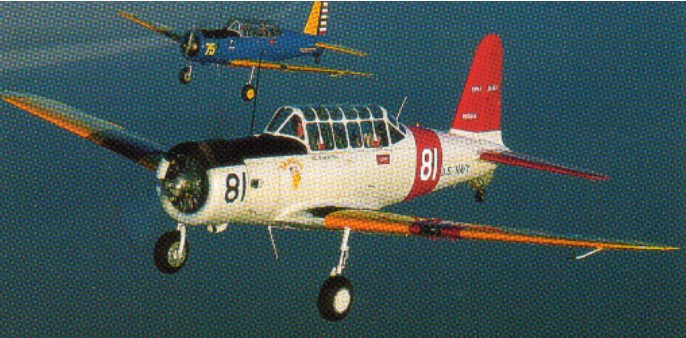
The BT-13s were followed by orders for no fewer than 6,407 BT-l3As and 1,125 BT-l3Bs with a 24- rather than 12-volt electrical system.
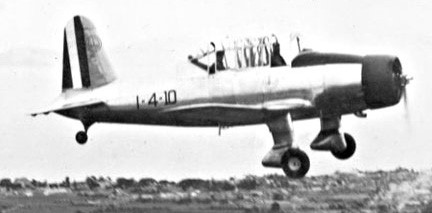
The 1940 BT-13A was powered by a 450hp R-985-AN-1 engine. Gear fairings were deleted in 1941. A total of 7,037 were built: 41-1211-1710, 41-9587-9979, 41-10410-11586, 41-21162-23161, 42-1164-1743, 42-42201-43257, and 42-88674-89573, plus 430 (41-09980-10409) to the USN and USCG as SNV-1, and 12 to the Peruvian AF.
Vultee BT-13A
Vultee 54 Peru export with fairings
The 1941 BT-13B featured a 24v electrical system. 1,125 were built (42-89574-90698, and 44-31511-32160), with the last batch of 650 transferred to USN as SNV-2. Totals of all models include Lend-Lease exports to China, France, Haiti, Indonesia, Israel, the Philippines, and South American nations.
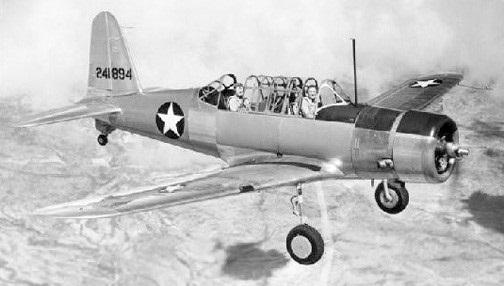
Demand far outstripped engine supplies, however, and in 1941 the USAAF ordered the BT-15 variant with the 336-kW (450-hp) Wright R-975-11 radial, and production of this model totalled 1,263. (41-9980-10409, 42-1744-2063, and 42-41258-42200)
Vultee BT-15 42-41894
The US Navy procurement began with the 1940 US Navy SNV-1, the same as BT-13A. 1,125 (02983-03182, 05675-05874, and 12492-12991) (USN serials total 1,350, but is unexplained—perhaps includes a cancelled batch), with 2 (V222 and V223) to USCG, plus 450 (34135-34584) transferred from USAAF (44-31511-32160, et al) aircraft were retired soon after the war.
Vultee SNV-1 N56319
These were followed by 650 SNV-2s, equivalent to the BT-13B, in 1944. They were BT-13B transferred from the USAAF (44-31511-32010 became 52050-52549, and 32011-32160 became 44038-44187).
Circa 1950 of 3 Vultee BT-13s at Puente Sky Ranch
When production ceased in 1944, 11,537 had been built.
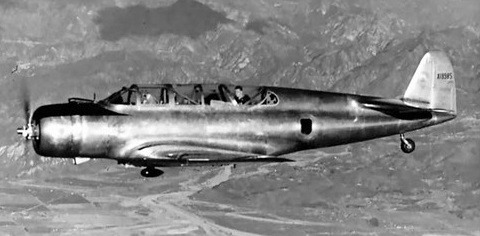
A later development of the Vultee V-11 was the V-12, a streamlined alternative to the largely unsuccessful type. First flown on 13 September 1938, the prototype aircraft (NX18985) was sold to Pratt and Whitney aircraft as a test bed until scrapped in 1950.
The 1939 export designation for the AB-2 (Model V-12) first flew (as V-12C) in February 1940. The single prototype was registered NX28367.
Vultee V-12D
An order from China for 26 V-12C (with 1100hp Wright R-1820) and 52 V-12D (with 1600hp Wright R-2600) resulted in shipment of one each, the rest were delivered in parts for assembly overseas.
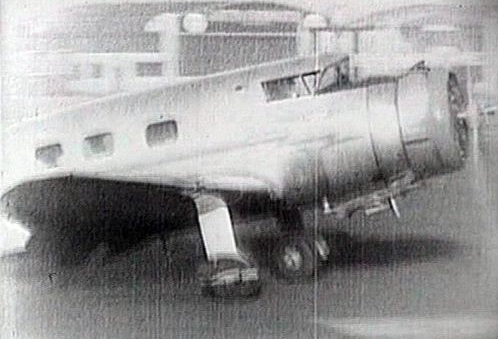
The prototype Vultee V-11 Army attack bomber NX14999 c/n 28 first flew on 17 September 1935, piloted by T C Van Stone. It crashed on take-off for its second flight the next day, killing Van Stone and project engineer Duald L Blue.
Vultee V-11 NX14999
The second V11 prototype, but with 1800hp P&W R-2800 Double Wasp and three-blade prop, NX/NR/NC14980 c/n 29, first flew on 9 October 1935 as a demonstrator for the South America market.
Vultee V-11A NR14980
The second V11 prototype, built first as a V-11A, it was later modified as the fixed-gear V-11T for Pratt & Whitney’s use in engine testing, first flying on 21 January 1940.
Vultee V-11T NC14980
Ultimately refitted with 2000hp R-2800, it was destroyed in a crash on 20 March 1945.
The V-11G and -11GB were versions with a 1000hp Wright SGR-1820-G2 Cyclone. The V-11G was a two-seater, and -11GB sat three (pilot, bombardier, gunner) with a retractable ventral gun position. One was built as a company test hack on wheels (NX/NR17327) and seven with a 1200hp P&W R-1830-17 went to the USAAC in 1939 for field testing as YA-19 (38-549 to 38-555).
Vultee V-11GB Ventral gun station
China ordered 30 two-seat Vultee V-11Gs in 1937-38 and then more Vultee V-12s (a more powerful variant) which they were planning to assemble from kits (25 were finished)
At the end of June 1935, information reached Moscow about the new American Vultee V-11 attack and bomber aircraft. In a report to Defense Commissar Kliment Efremovich Voroshilov on the acquisition of aircraft production licenses in the United States, the chief of staff of the VVS RKKA VK Lavrov placed special emphasis on the excellent characteristics of the V-11 in terms of speed and range. In fairness compared to the obsolete R-5Sh and R-5SSS the approach was valid.
As a consequence, the Vultee V-11 was part of the purchase of production licenses approved by the Labor and Defense Committee (STO) on April 11, 1935.
On September 7, 1936, the Soviet foreign trade company “ Amtorg ” signed a contract with the American firm “ Airplane Development Corporation”, to which Vultee belonged at that time . The content of the negotiation stipulated the granting of a license to the Main Directorate of the Aeronautical Industry (GUAP) of the People’s Committee for Heavy Industry (NKTP) for the construction of the V-11 in two variants: V-11G as attack aircraft and V-11GB as a light bomber. This latest version incorporated a third member of the crew serving as navigator-bomber.
In 1937 two examples were received in flight condition and another two unarmed, which were thoroughly studied by the TsAGI and the NII VVS. The four -11GB were NR17328-17329 and 2 unregistered, along with some EDO sets to transform them into -11GBS seaplane and -11GBF floatplane attack bombers.
In the USSR in 1937
The North American counterpart delivered the plans with detailed engineering, the specifications, instructions and description of the processes, documentation on the jobs and the technological processes, as well as the technical data of the ground and flight tests of the model, as well as the obtained in tests in wind tunnels; resistance calculations and more than 300 photographs of details and aggregates. The purchase of several copies, parts and pieces was also considered to facilitate the start of series production. An interesting detail was the request from the USSR to modify all the schematics and plans of the model under the international metric system.
The Vultee firm delivered two fully assembled examples to be used as a basis for comparison, both with a Wright SR-1820-G2 engine and full armament and without a radio. The first, with number “ 32 ”, left the production workshops on December 22 , 1936 . It was planned to be sent to the USSR in January 1937, but the appearance of small defects delayed the decision. This first example took flight on January 31, 1937 and was tested by pilot SA Levanievsky on February 2 with the mechanic Chiechin. Levanievsky rated the aircraft positively in terms of maneuverability, stability and ease of flight.
The tests were carried out until mid-February 1937 and the chief of technical supply of the VVS Bazienkov and the director of the TsAGI Jarlamov participated as observers. It was flown from the Vultee factory airfield and from the military base in Long Beach. Tests were carried out over the ocean of weapons firing and bomb drops. The “ 32 ” was tested as an attack aircraft version and as a light bomber. A second specimen with number ” 33 ” flew for the first time on February 26. The Soviet delegation received the first issue in March and the second in April. Two other copies ” 34 ” and ” 35″ were delivered” in parts and without engine.
Upon arrival in the USSR the planes were studied in depth. The “ 33 ” plane was sent directly to the NII VVS to carry out the state tests, keeping the American equipment and weapons. In the first half of 1937 the V-11GB was studied in detail at the TsAGI and the NII VVS. The test pilot designated to lead the tests was Captain AK Dolgov, but the plane was flown by a large number of pilots, including the head of the institute NN Bazhenkov and the experienced test pilots Stefanovski, Fedrov, Niuxtikov.
The tests of the ” 33 ” contemplated the complete range, including its air combat simulation, completing a total of 70 flight hours. Test results were conflicting. On the one hand, the NII VVS concluded that due to its weapons and equipment capacity, the V-11 could be used as an attack and bomber aircraft. However, due to its speed and turnaround time, it was already obsolete. With a similarly underpowered engine, the Nieman R-10 bested the V-11 by 30 km/h and reached 5000 meters 5.6 minutes earlier. In the parameters of takeoff and landing characteristics, the R-10 was also superior.
The V-11’s armament was also considered obsolete. The rear firing point had a poor operating angle and did not guarantee the protection of the plane against the attack of the fighters. The absence of a lower turret (which was removed from the aircraft delivered to the USSR ) left all that area exposed to enemy attack. During simulated combats with I-16 Type 4 it was demonstrated that the V-11 was unable to escape before the attack of the fighters and to defend against their attack. Another conclusion established the absence of capacity to carry containers of chemical weapons (at that time in the USSR great importance was given to this type of armament). The bomb racks were not designed to allow the attachment of Soviet containers. Finally the Vultee V-11 was not prepared to work in the harsh Russian winter.
On the other hand, the Vultee V-11 showed the Soviet builders many new aspects. The construction technology, the materials used, many construction details and technological solutions were carefully studied and documented in order to introduce them into the productive process of the Soviet aeronautical industry.
High value was given to the comfort of the cockpit and the excellent visibility, the effective amortization system of the landing gear and brakes. The retraction system of the landing gear units was studied in detail. The measures taken to reduce the vibrations transmitted by the engine to the fuselage structure were highly valued.
The aircraft was easy to assemble and disassemble, and the designers provided easy access to all vital mechanisms and accessories for maintenance and repairs.
From the point of view of the flight, the stability in flight, the excellent work of all the mechanisms and the reliability of the engine were highly valued.
After evaluating the positive and negative aspects of the V-11G, it was decided to proceed to mass production of the model under the name BSh-1, its production being assigned to the OKB-1 led by S. A Kochierigin. In the issued documents it is clear that the fundamental reason was not to assess the possibilities of the model, but the possibility of becoming familiar with the new technological processes used in the construction of this aircraft. The production of the V-11G was considered to be the first step towards the development of a modern and effective bomber and attack aircraft for Soviet aviation.
Forty -11GB went to Turkey redesignated -11GBT, and 26 -11GB to Brazil in 1938-39 as -11GB2, the last of which was modified with EDO floats as 11GB2F for the Brazilian Navy, as also was prototype NX21719 in hopes of civil sales, which didn’t occur.
Vultee V-11GB2F
The three-place A-19 attack bomber from the V-11GB was all-metal except for the tail control surfaces. The YA-19 (Model V-11GB) first flew on 27 January 1939 and of the seven, three were converted from V-11G and repowered as XA-19 series.
Out of the five Vultee YA-19 (Pratt & Whitney Twin Wasp R-1830-17 radials) three-seat attack bombers delivered to the USAAF in 1939, three underwent engine changes to become the XA-19A (Lycoming); XA-19B (P&W Double Wasp R-2800-1) and XA-19C (P&W Twin Wasp R-1839-51).
The XA-19A served as a flying testbed for the 12-cylinder, liquid cooled XO-1230-1, with 1200 hp for take-off. To compensate for the increased side area and fuselage length (increased by 5in to 38ft 3in) the Gerald Vultee fin was altered to give more area. Despite the improved frontal area streamlining, the XA-19A improved the maximum speed by only 2 mph, to 232 mph. The span was 50 ft.
Vultee YA-19
The 1940 XA-19A (Model V-11) featured an enlarged, triangular fin and 1200hp Lycoming O-1230-1 engine. The one was converted from a YA-19 and first flew on 22 May 1940. It later became a XA-19C.
Vultee XA-19A
YA-19 38-550 was converted to the XA-19B in 1939, powered by an 1800hp P&W R-2800-1 engine.
Vultee XA-19C 38-555
Converted from XA-19A 38-555, the 1939 XA-19C 1939 was powered by a 1200hp P&W R-1830-1/-51.
The aircraft had limited combat success with the Chinese, and a Brazilian Vultee V-11 made an attack on a submarine, damaging itself in the process. Later developments would have a rear facing gunner at the back of the cockpit plus a rear-facing ventral gun position protruding from the bottom. Most were later used as high speed liaison and transport aircraft.
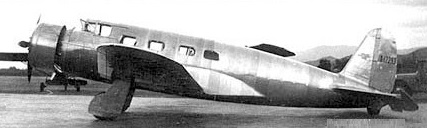
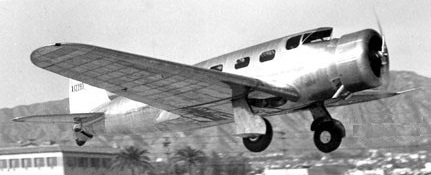
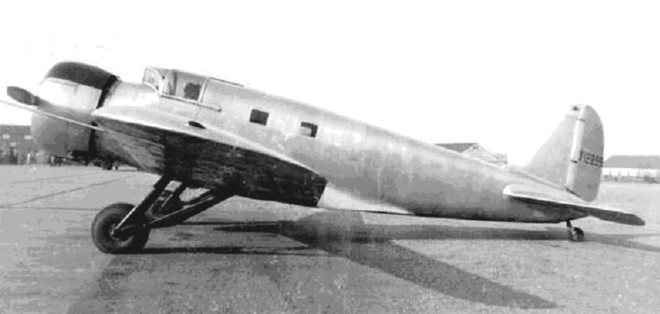
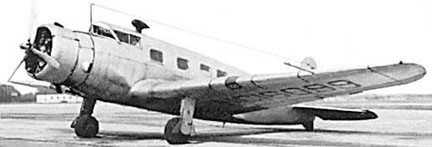
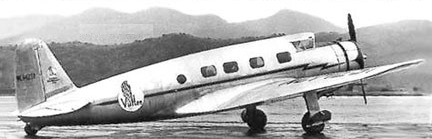
The 1933 Vultee V-1 was designed by Gerard Vultee and Vance Breese as an eight-passenger monoplane. Built in backer E L Cord’s Glendale hangar, it is sometimes seen as Cord-Vultee V-1, the prototype first flew on 19 February 1933, piloted by Marshall Headle.
Vultee V-1 Prototype NX12293
The V-1 prototype, as V-1A, went to American Airways/Airlines registered NX12293. It was sold to Spain in 1937 and registered F-AQAP. The French registration was political camouflage.
Sixteen V1-A and V1-AD were built as V1A-A from 1934 (ATC 545) priced at $35,000; NC4249, NC13764-NC13774, NC16000, NC16099, NC17326, and C-FAWQ, included 10 to American Airlines, and 8 as six-place V-1AD “deluxe” executive models with 850hp SR-1820-G2 engines (NC14248 – NC14256).
Vultee V-1A NC14251
NC16099 was repowered with a 1000hp SR-1820-G5 as the six-place V-1AD Special for Hearst newspapers. NC13770 was used in setting a transcontinental speed record on 1/14-15 January 1935, piloted by James Doolittle, and a record first round-trip transatlantic flight was made in September 1936 as Lady Peace, piloted by Dick Merrill.
Vultee V-1A NC16099
Fifteen V-1As were acquired from American Airlines and others in 1937 and went to Spain where they were converted as bombers and recon aircraft.
Vultee V-1A American Airlines
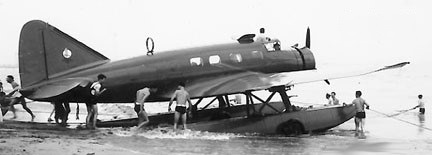
The 1936 V-1AS Special (ATC 2-539) was a twin-EDO float version built for the Soviet government for a 10,000-mile Santa Monica-Moscow flight, via Alaska and Siberia, in Aug-Sep 1936. Registered URSS-N208, the aircraft was piloted by Sigismund Levanevski and Victor Levchenko. It featured added fuel tanks in the cabin, enlarged tail group, and special cold-weather cowl. Additionally, manufacturing rights were sold to the USSR in October 1936, but none were produced there.
1923: Acquisition by Reuben H Fleet of Gallaudet and Dayton-Wright interests 1924: Buffalo NY. Vultee entered aircraft manufacturing in mid-1930s, having formed in 1932 the Airplane Development Corporation, which two years later was acquired by the Aviation Manufacturing Corporation-AVCO, Downey CA (old Emsco plant). A Vultee Aircraft Division of the latter company was formed in 1936, becoming (Gerard Freebairn) Vultee Aircraft Inc. when it acquired the parent corporation’s assets in 1939.
First product was the V-1 eight-passenger monoplane, but became better known for its military aircraft, of which most notable were the V-11 two/three-seat attack monoplane, built for Brazil, China, and Turkey, and a license sold to the USSR; the improved V-12 for China; more than 11,000 BT-13/BT-15 and SNV Valiant two-seat basic trainers for the USAAF and USN between 1940 and 1944; V- 48 Vanguard single-seat fighters for China and USAAF: and V-72 Vengeance dive-bombers for the RAF, USAAF and Brazil between 1941 -1942.
Gerard Vultee was killed in a crash of his personal Stinson in 1938; Richard Palmer as president.
1940: Vultee Aircraft Inc, on acqusition of Barkley-Grow and Stinson Divisions of AVCO. 1940: Nashville (TN) Div.
Vultee purchased Stinson Aircraft Division of the Aviation Manufacturing Corporation in 1940, producing Stinson Model 74s for the USAAF as L-1 Vigilant during Second World War. In December 1941 Vultee bought a 34 percent controlling interest in another subsidiary of The Aviation Corporation, Consolidated Aircraft Inc, with which it merged in 1943 to form the Consolidated Vultee Aircraft Corporation.
1942: Name changed to Convair.
Except only for V-1, V-11, V-12, V-72, and V-77, the prefix was not used at the factory or design levels, and was most likely the doing of media scribes who presumed a “V” for Vultee would follow other manufacturers’ styles—”NA” for North American, “L” for Lockheed, etc.
















 All Aero