Waco 4 / Weaver 4

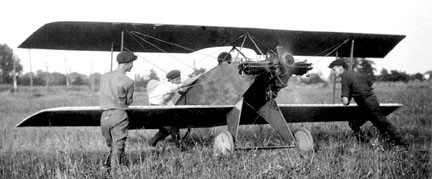
The WACO partners persevered, designing a practical three-seat biplane, the WACO 4, and building it out of parts left over from the Cootie and other biplane efforts. The team continued to assemble airplanes from parts salvaged from surplus World War I Curtiss Jennys, continuously tinkering with their designs and making improvements.

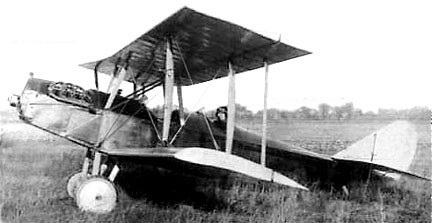
The 1921 Weaver 4 used many Curtiss JN-4 parts with new interchangeable wing panels and powered by a 90 hp (67 kW) Curtiss OX-5.

Selling for $4,000, the model 4 was the company’s first public sale and the last of the all-wood Wacos.

One appearing in early registers as Waco 4 (NABCW) was actually a modified Hisso-Curtiss JN-4 Canuck with Brukner “high-lift” wings.

Engine: 90hp Curtiss OX-5
Wingspan: 28’0″
Length: 23’0″
Useful load: 890 lb
Max speed: 84 mph
Stall: 33 mph
Seats: 3-4

Waco 2 Cootie Biplane

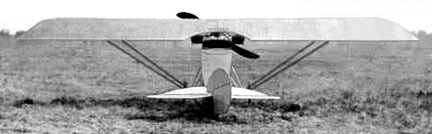
The Weaver 2 Cootie Biplane of 1920 was a single place open cockpit biplane rebuild of the Cootie #1 with a larger tail area and a beefed-up landing gear.

First flown on 14 June 1920, piloted by G Weaver, it eventually crashed in April 1923 having cost $1,500.

A 30hp hydroplane version was begun, but never completed because of funding problems.

Empty weight: approx 340 lb
Speed: 62 mph

Waco Cootie

Bruckner and Junkin actually began designing aircraft in 1919 with a flawed plan for a floating airplane that never flew. Meyers, too, had already designed an aircraft with Weaver and the pair approached Bruckner and Junkin, asking them to join their construction efforts on a parasol wing, plywood fuselage, single-seat monoplane named the “Cootie.”

Costing $1,200, unfortunately, Weaver crash-landed the Cootie during its first flight attempt in 1920 and suffered extensive injuries in the crash. It was rebuilt.

Engine: 28hp Lawrance
Wingspan: 22’0″
Length: 16’0″
Useful load: 200 lb
Max speed: 65 mph
Stall: 35 mph
Seats: 1

Waco 1 / Baby Flying Boat / DJB Air Boat

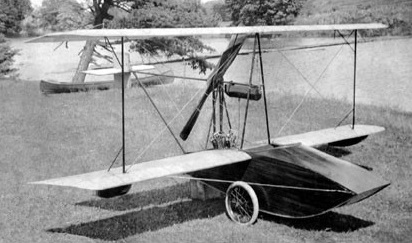
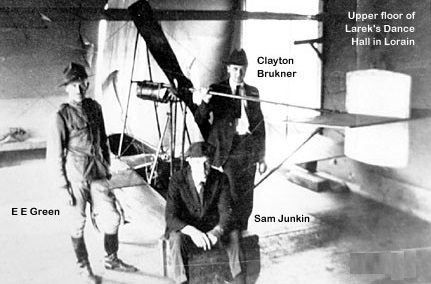
The “Model 1” designation was more symbolic as the ship was built before there was a Waco Company. Designed by Elwood J Junkin and Clayton J Brukner, the 1919 Baby Flying Boat had a mahogany veneer hull, demountable wheels for beaching, and a 6′ propeller.

Notably underpowered, with motor vibrations shaking the craft to an alarming degree, it would not unstick from the Lake Erie, so was retired to its room above a dance hall in Lorain OH, and none of the principals recalls its ultimate fate.

This effort led to the formation of DJB Aeroplane Co which was basis for Weaver Co the following year.

Engine: 15hp Hendee
Wingspan: 18’0″
Seats: 1

Waco / Weaver Aircraft Co

Weaver Aircraft Co
Advanced Aircraft Co
Waco Aircraft Co

Weaver Aircraft Co was formed by George “Buck” Weaver, Elwood “Sam” Junkin, Clayton “Clayt” Bruckner and Charles “Charlie” William Meyers at Loraine, Ohio, in 1919. Waco built Cootie parasol-wing aircraft.

Bruckner and Junkin actually began designing aircraft in 1919 with a flawed plan for a floating airplane that never flew. Meyers, too, had already designed an aircraft with Weaver and the pair approached Bruckner and Junkin, asking them to join their construction efforts on a single-seat monoplane named the “Cootie.” Unfortunately, Weaver crash-landed the Cootie during its first flight attempt and suffered extensive injuries in the crash.

The WACO partners persevered, designing a practical three-seat biplane, the WACO 4, and building it out of parts left over from the Cootie and other biplane efforts. The team continued to assemble airplanes from parts salvaged from surplus World War I Curtiss Jennys, continuously tinkering with their designs and making improvements. Eventually, they sold two WACO 5 biplanes.

From Medina, Ohio, in 1921, reorganized as Advance Aircraft Company in 1923 at Troy, Ohio, although the aircraft retained the WACO designation. The first Troy-built model, the WACO 6, was soon being marketed. Following Buck Weaver’s death in 1924, Clayton Bruckner and Sam Junkin reorganized the business and soon introduced the company’s popular Model 9 (or Nine) in 1925.

First really successful venture was three-seat Model 9 of 1924. Developed long and successful line of cabin biplanes, sporting, racing, and military airplanes. The Waco series of four-seat cabin biplanes were initiated in 1931 and were produced continuously in progressively refined models until 1939. WACO continued to refine the aircraft design and accessories on an annual basis, but retained the basic configuration to maintain quality and avoid the high costs of wholesale redesign; as a result, selling prices remained stable and affordable.

By 1936 was largest constructor of commercial aircraft in USA.

Production of WACO civil aircraft was suspended in 1942 after U.S. entry into World War II. The company contributed to the war effort by building assemblies for a variety of military aircraft and manufactured the well-known CG4-A troop-carrying gliders.

After war developed a new monoplane, the Aristocraft (see O’Neill), but abandoned it in 1947. Company went out of business. Waco production ceased and the company went into contract manufacturing.

Between 1919 and 1947, the company produced sixty-two different aircraft models and led all its competitors in number of aircraft registered.

In 1963 it became Waco Division of Allied Aero Industries (Franklin and Jacobs motors, Omega helicopters).

In 1969 rights sold to SIAI-Marchetti (Italy) for production of new Waco Meteor, Minerva, Sirius, Vega, and Vela.

Early Waco designs were given numbers to designate types but later models gained letter designations. The first letter denoted which engine was used, the second gave the wing design and the third the airframe model. From 1934, the first letter still gave the engine make and horsepower, the second gave the design and the third, the series.

Waco Coding System
Wackett, Lawrence J.

Broadsmith won the 1924 Low-Powered Aeroplane Competition with his design and the second prize was won by L. J. Wackett with his Warbler aircraft, powered by the Wizard engine, also designed by Wackett.
Lawrence J. Wackett (later Sir Lawrence) started his career in the Australian Flying Corps in the First World War and saw service in Egypt; when the R.A.A.F. was formed in 1921 Wackett decided to move into aircraft design and development and, after a short professional training period, persuaded the then Defence Minister, R. K. Bowden, to set up a R.A.A.F. Experimental Aircraft Station at Randwick, in order to develop aircraft suitable for Australian conditions.
The first design was the Widgeon 1, a flying boat, followed by a much larger amphibian, the Widgeon 11, powered by a 440 hp A.S. Jaguar engine. In 1927, the Widgeon 11 undertook a 9,000 mile flight around Australia.
Two other aircraft were developed at Randwick to the prototype stage: Warrigal I (a trainer) and Warrigal II a single seat fighter. As a result of a government-sponsored report, the Randwick Station was closed in 1931: Wackett resigned from the R.A.A.F. and transferred, with some personnel and equipment to Cockatoo Dockyard. He continued working for the R.A.A.F. but also undertook several civilian projects including the Codock, a six passenger twin engined airliner, commissioned by Sir Charles Kingsford-Smith.
In 1934, Wackett and some of his staff moved again, to the Tugan Aircraft Company at Mascot, where the Codock design was developed into the Gannett a six/seven passenger airliner, which provided service with the R.A.A.F. and with small airlines in N.S.W. Eight Gannetts were completed when the Tugan Company was taken over to form the nucleus of the Commonwealth Aircraft Corporation in Melbourne.

Wabash WA-250X

A 1928 five place low wing cabin monoplane powered by a 260hp Salmson “superposed radial”. First flown on 20 April 1928 as NC5246 c/n 51-C, the aircraft was put into storage in Oct 1920 at (Frank) O’Neal Aircraft Co, Vincennes IN, USA.

It was then acquired by O’Neal in a court sale on 2 October 1933 to satisfy a storage bill. It was sold on 15 October 1934 to Peter Soderling Jr, of Petersburg IN, who installed a 360hp Salmson and converted it to three place. The CAA cancelled the registration on 15 November 1937.

Only the one was ever built.

Wing span: 39’0″
Length: 27’5″