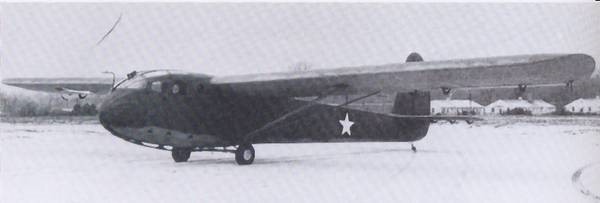
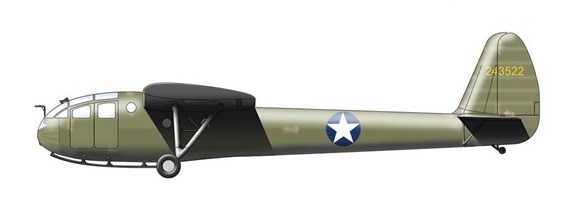
The CG-3A was the United States Army Air Force’s first production troop-carrying glider. First flown in early February 1942, 300 CG-3A 9-place gliders were initially ordered, but 200 of these were cancelled. A few of the 100 built by Commonwealth Aircraft (formerly Rearwin Aircraft) were used as trainers for the improved CG-4A, but most remained in their shipping crates in storage.
The production CG-3A was developed from the experimental XCG-3 which was the only one built by Waco and given Army Air Forces Serial No. 41-29617. Unit cost: approx $24,000.
The CG-3A became obsolete with the development of the much improved Waco designed CG-4A 15-place glider with its alternate load of military equipment. The CG-3A did not see any combat and several were used in limited training roles.
Variants XCG-3 Prototype 8-seat glider. One built 1942.
CG-3A Production 9-seat glider. 100 built by Commonwealth Aircraft.
Specifications: CG-3A Wingspan: 73 ft 1 in (22.28 m) Length: 43 ft 4 in (13.21 m) Empty weight: 2,044 lb (927 kg) Max takeoff weight: 4,400 lb (1,996 kg) Maximum speed: 120 mph (193 km/h; 104 kn) (under tow) Normal tow speed: 100 mph (87 kn; 161 km/h) Minimum control speed: 38 mph (33 kn; 61 km/h) Crew: 2 Capacity: 7 troops
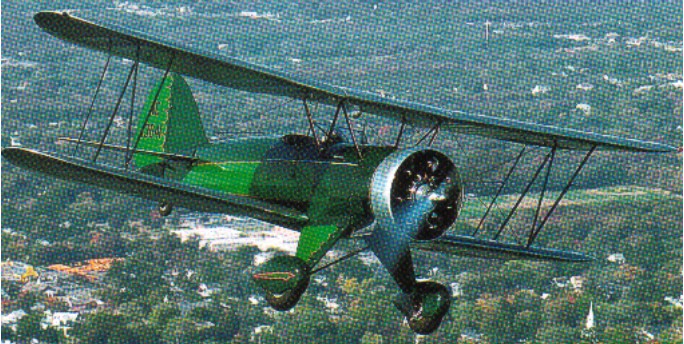
The Waco A series is a range of light American-built twin side-by-side seater sporting biplanes introduced in 1932 as an affordable private-owner aircraft with cross-country range and baggage capacity and a more sporting image than the larger Waco F series. The A series offered a number of engine options which had varying sub-designations. The power range lay between the KBA with a 100 hp (75 kW) Kinner engine and the later UBA with a 210 hp (157 kW) Continental powerplant.
Waco RBA
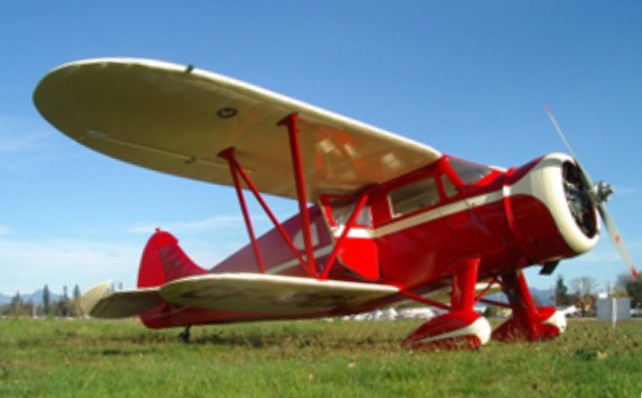
The PLA “Sportsman” of 1933 (ATC 502) introduced a longer wider fuselage and a higher useful load and had a 170 hp (127 kW) Jacobs LA-1 radial engine. With a side-by-side cockpit with sliding canopy, four were built; NC13067, NC13073, NC13401, and NC13410, priced at $4,285.
Waco PLA NC13401
The last model in the series was the ULA, also of 1933, with a 210 hp (157 kW) engine.
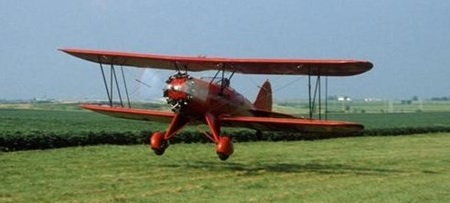
1932 Waco RBA, N12444, C/N: 3593
Relatively few were produced and the type survives in small numbers in 2009.
Waco PBA
The 1932 Waco BBA was powered by a 165hp Wright J-5 and featured an enclosed, side-by-side cockpit. Possibly there was only one conversion for motor installation tests since there is no record of actual production.
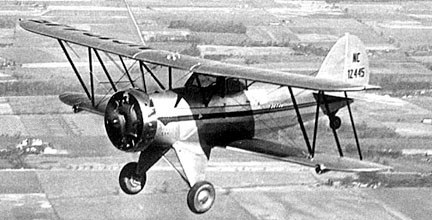
The 1932 Waco IBA (ATC 465) featured a two place side-by-side canopied cockpit. Priced at $4,059, three were built; NC12435, NC12446, and NC12453.
Waco IBA NC12453
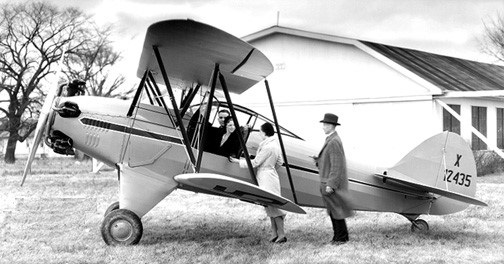
The 1932 Waco KBA (ATC 460) built was registered NX/NC12435 and sold for $3,585. Featuring a two place side-by-side canopied cockpit and became the Waco IBA with an engine upgrade.
Waco KBA NX12435
The 1932 PBA (ATC 464) featured a side-by-side canopied cockpit and was priced at $4,285. Six were built; NC12435, NC12445, NC12448, NC12466, NC13038, and NC13054.
Waco PBA NC12445
The 1932 RBA (ATC 466) carried two side-by-side with a canopied cockpit. Priced at $4,195, four were built; NC12435, NC12442, NC12444, and NC13401. Higher speeds were reached with rerated 125hp Warner and cowling.
Waco RBA
The 1932 three seat Waco RCA sold for $4,195.
The 1932 TBA (ATC 474) featured a side-by-side cockpit with an optional canopy. They were available for $4,490 but none was produced. The three place open cockpit TCA was available for $4,285 but there was no actual production. The three place open cockpit UCA was a planned project (for $4,895), but produced as the UBA.
At least six 1932 Waco UBA (ATC 479) were built, priced at $4,895, with side-by-side cockpit and optional canopy.
Waco UBA NC13041
Waco ULA NC14300
One 1933 ULA Sportsman (ATC 511) was built, NC14300, featuring a side-by-side cockpit with sliding canopy. The price was $4,895.
Variants:
BBA Engine: 1 × 165 hp (123 kW) Wright J-5
KBA Engine: 1 × 100 hp (75 kW) Kinner K-5 Wingspan: 27′ 5″ Length: 21′ 11″ Max speed: 101 mph Cruise speed: 86 mph Stall: 40 mph Useful load: 726 lb Range: 380 mi Seats: 2 1 built
IBA Engine: 1 × 125 hp (93 kW) Kinner B-5 Wingspan: 27’5″ Length: 21’11” Useful load: 683 lb Max speed: 110 mph Crise speed: 93 mph Stall: 39 mph Range: 450 mi Seats: 2 side by side Canopy optional 3 built
RBA Engine: 1 × 110 hp (82 kW) later 125 hp (93 kW) Warner Scarab 4 built
RBA Engine: 1 × Warner Scarab SS40&50, 125 hp Length: 21 ft 0 in Wingspan: 29 ft 6 in Height: 8 ft 8 in Empty weight: 1,250 lb Gross weight: 1,949 lb Maximum speed: 104 mph Cruise speed: 91 mph Range: 400 miles Service ceiling: 12,800 ft Rate of climb: 500 ft/min Crew: 1 Capacity: 1 passenger
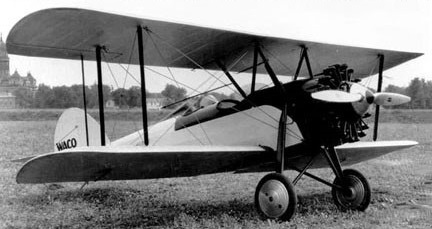
Designed by Charles Meyers, the Waco 10 was a larger span development of the Waco 9, both single-engined three-seat single-bay biplanes constructed around steel-tube frames. The wing covering was fabric, and both upper and lower planes carried ailerons, which were strut linked. The two passengers sat side by side in a cockpit under the upper wing and ahead of the pilot, who had a separate cockpit. It had a split-axle fixed undercarriage and a tailwheel. The main undercarriage was fitted with hydraulic shock absorbers, unusual at the time on a light aircraft. The fin could be trimmed on the ground to offset engine torque, and the tailplane could be trimmed in flight. Initially it was powered by a Curtiss OX-5 water-cooled 90° V-8 engine producing 90 hp (67 kW).
Its first flight was in 1927. The improved WACO Model 10 replaced the Nine in 1927, featuring a larger wing area, bigger cockpit, an adjustable stabilizer, and the first shock absorber landing gear built into a small aircraft. The WACO 10’s performance was markedly enhanced and the aircraft was sold with several different engine options (OX-5, OXX-6, Hispano-Suiza and Wright J-5 Whirlwind).
Noted for quick and straightforward takeoffs, a speedy rate of climb and equally tolerable landing speeds, the WACO 10’s performance soon made it the most popular small aircraft in the United States. By 1927, more than 40 percent of small aircraft sold in the country were WACOs, including 350 WACO 10s at a sticker price of $2,460 (with the OX-5 engine). The WACO 10’s reputation extended to the air race circuit as well: an OX-5 engine-powered model won the 1927 New York to Spokane, Washington, transcontinental Air Derby (Class B) and a Wright J-5-powered WACO 10 won the National Air Tour the following year.
Advance Aircraft went on to manufacture the notable WACO Taperwing in 1928 and then, in 1929, the company officially renamed itself the WACO Aircraft Corporation to correspond with its line of aircraft.
Waco 10
A Taperwing was flown to victory in the 1928 National Air Derby by Johnny Livingston a well known aviator, WACO dealer, airline operator and daring air-racer of the day.
In 1928, after the Waco 10 had entered production, Waco changed its designation system so that the basic model 10, powered by a 90 hp (67 kW) Curtiss OX-5 engine became the GXE. The OX-5 was also used in the Waco 9, and this led to the confusing popular description of both aircraft as Waco 90, after the power.
Other engines were fitted experimentally, without unique designations, including Rausie, Siemans, and the 115 hp (86 kW) Milwaukee Tank engine (ATC 2-363) in 1931. This was an air-cooled version of the Curtiss OX-5, and was intended as an aircraft engine.
CTO
Later aircraft used a three-letter designation, the first denoting the engine, the second, S or T meaning Straight or Tapered wing and the final O indicating it belongs to the Waco O series for open cockpit. An -A suffix indicated an armed variant intended for export.
1929 Advance Aircraft Company Taperwing ATO
The Waco 10 turned out to have excellent handling, and there was a ready supply of war-surplus Curtiss engines. It was widely used for the popularisation of aeronautics through barnstorming and joyrides, and was also much used as a trainer and by small operators for charter flights.
The 1931 240-A was a single place armed export version of the CSO with a 240hp Continental W-670. Possibly only one was built.
Waco 240-A at Resende Airfield, south of Rio de Janeiro, Brasil, mid-1932
It was numerically the most important type to be built by Waco (ATC 13), with at least 1,623 built over a period of 7 years from 1927 to 1933 and was fitted with a very large variety of engines of radial and V configuration. The unit cost was $2,145 minus engine & prop. The total price was $2,460, $2,385 in 1928, and $3,145 in 1929.
1930 Waco ATO Taperwing
The Advance ASO or 10-W, and 220-T of 1927 (ATC 41) was also popularly known as “J-5 Straightwing,” “Waco Sport,” or “Whirlwind Waco.” ATC 2-101 covered weight changes and ATC 2-102) for EDO floats.
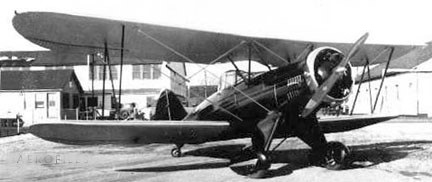
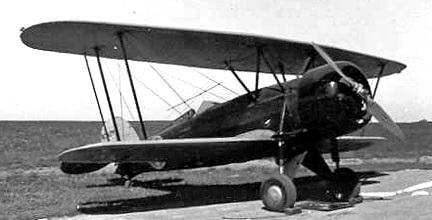
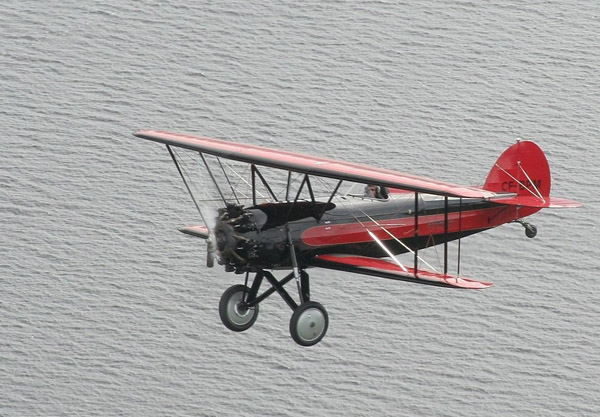
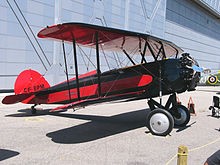
The ATO aka 10-T Taperwing of 1928 (ATC 123) was designed by Charlie Meyers and first flew on 30 April 1929. The price was $8,325 and 54 were built. Sometimes popularly referred to as “Waco 220” for its horsepower.
Waco ATO N5673
The BSO (or BS-165) of 1929 operated under ATC 168 (and 2-262 for EDO twin-float modification) and about 45 were built, at $6,370.
Waco BSO NC8543 Prototype
Twenty-nine CSO / CS-225 was built in 1929 for $7,335 under ATC 240. Thirty military exports as CSO-A and 240-A were built in 1932.
Waco CSO NC673N
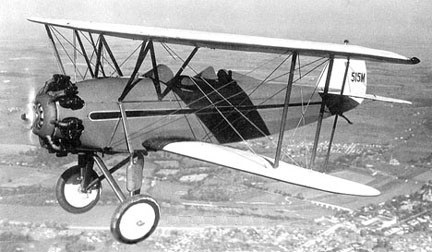
The 1929 CTO (or 225-TW) (ATC 257) was a taperwing CSO. Thirteen were built plus 22 military versions as CTO-A in 1932. ATC 2-378 was for two single place models with 240hp Wright R-760 engines and raked top wing with I-struts; NC21M and NC666N.
Waco CTO N515M
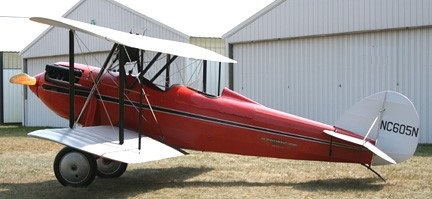
The Waco DSO / 10-H (ATC 42) of 1928 sold for $3,935 with the 150 hp Hisso A ($4,085 with Hisso E) and 62 were built. 2-ATC 245 was for the EDO float conversion.
Waco DSO NC605N
The 1930 HSO (ATC 333) was designed by A Francis Arcier (principal Waco designer from 1930-47). The one built, NX/NC4N, was priced at $7,500 and later modified as taperwing HTO NR4N.
Waco HTO NR4N
The 1929 three-place JTO was powered by a 300hp Wright J-6. The one built, N13918, was refitted with a 365hp Wright R-975 in 1932 but only test-flown.
Waco JTO
The 1933 JYO were two USN version of the JTO for evaluation.
One Waco KSO was built, NX795E, in 1929. Possibly a modified GXE with a 100hp Kinner K-5.
Waco KSO NX795E
One Waco PSO (ATC 339) was built, NC699N, in 1930, priced at $5,175.
Waco PSO from ASO NC119Y
One WACO QSO (ATC 337) was built in 1930, NC837V, priced at $5,575.
Waco QSO NC837V
One Waco RSO was built, in 1929, NC9531.
Waco RSO NC9531
ATO Scale replica: Williams WACO RTO WACO Aircraft Company ATO
10 / GXE / 90 Engine: 1 x Curtiss OX-5, 90 hp / 67 kW Wingspan: 30 ft 7 in (9.32 m) Airfoil: Aeromarine 2A Length: 23 ft 6 in (7.16 m) Height: 9 ft 0 in (2.74 m) Empty weight: 1199 lb (545 kg) Loaded weight: 2025 lb (920 kg) Payload: 825 pounds (including pilot, fuel and oil) (374 kg) Maximum speed: 97 mph (156 km/h) Cruise speed: 84 mph (135 km/h) Stall speed: 37 mph (60 km/h) Range: 380 miles (610 km) Rate of climb: 500 ft/min (2.54 m/s) Crew: one Capacity: two passengers
10-W / ASO / 220-T / J-5 Straightwing / Waco Sport / Whirlwind Waco Waco 10 variant Engine: 1 x Wright J-5, 220 hp / 164 kW Wingspan: 30’7″ Length: 22’6″ Useful load: 900 lb Max speed: 126 mph Cruide speed: 108 mph Stall: 40 mph Range: 525 mi Price 1927: $7,215 Price 1929: $7,335 Seats: 3 95 built
ATO Taperwing variant of ASO Engine: 1 x Wright J5-9, 220 hp / 164 kW Wing span: 30 ft 3 in Length: 22’6″ Useful load: 813 lb Max speed: 130 mph Cruise speed: 110 mph Stall: 52 mph Range: 700 mi Seats: 3 54 built
BSO Variant of ASO 45 built
BSO / BS-165 Engine: 1 x Wright R-540A, 165 hp / 123 kW Wingspan: 30’7″ Length: 23’6″ Useful load: 956 lb Max speed: 120 mph Cruise speed: 100 mph Stall: 44 mph Range: 600 mi Seats: 3
BSO-A Engine: 1 x Wright R-540A, 165 hp / 123 kW Wingspan: 30’7″ Length: 23’6″
CSO / C-225 Engine: 1 x Wright R-760 / J-6-7, 225 hp / 168 kW Wingspan: 30’7″ Length: 22’6″ Useful load: 972 lb Max speed: 128 mph Cruise speed: 108 mph Stall: 45 mph Range: 540 mi Seats: 3 59 built
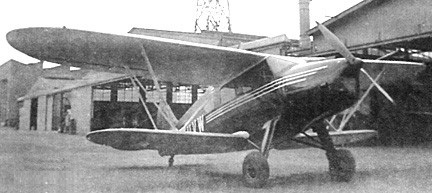
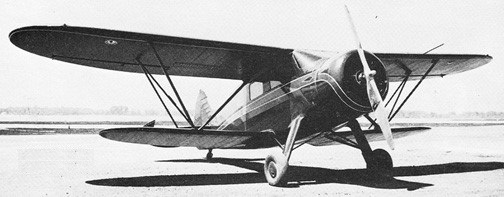
Manufactured from 1936, sixty-eight AQC-6 (ATC 598) were built.
The ZQC-6 model (285 hp Jacobs L-5MB engine) could be converted to an AQC-6 (330 hp Jacobs L-6MB).
Waco ZQC-6
At least two AQC-6 Freighter aircraft and eight ZQC-6 Freighter aircraft were ordered through Fleet Aircraft and built for use in Canada with additional freight doors on both sides of the fuselage and equipped for floats. Additional aircraft may have been modified. CF-BDW appears as EGC-7 in some regs.
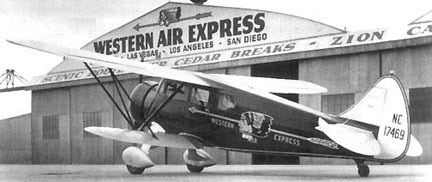
Twenty EQC-6 were built in 1936 (ATC 597) for $9,650. The USCG used three EQC-6 bought from Waco as J2W-1 (V157, V157, and V159). One ZQC-6 was impressed by the USAAF as UC-72Q and five as UC-72H in 1942. Additional aircraft impressed by the US Navy were undesignated.
Waco EQC-6 NC17469
US Army Air Forces designation for impressed Custom Cabin series Wacos. UC-72Q – one impressed ZQC-6 UC-72G – one impressed AQC-6 (NC20906) UC-72H – five impressed ZQC-6
The Swedish Air Force designation for ZQC-6 was Tp-8a and Tp-8 was a generic designation for all Wacos.
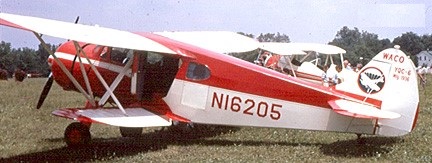
Waco YQC-6 N16205
The Royal Australian Air Force impressed a YQC-6 serialled A-54. It was re-engined with a 200 hp (149 kW) De Havilland Gypsy 6 inline engine in 1946 (VH-UVW).
Waco YQC-6 Gypsy engine VH-UVW
The Argentine Navy operated EQC-6 and UOC. The Royal Canadian Air Force impressed AQC-6. The Canadian Department of National Defence purchased two ZQC-6. The Finnish Air Force impressed ZQC-6.
The DQC-6 of 1936 (ATC 597) seated 4-5 and sold for $8,975. Eleven were built: NC2277, NC15706, NC15714, NC15722, NC16214, NC16218, NC16515, NC16520, NC16525, NC16591, and NC16595.
Waco DQC-6 NC16214
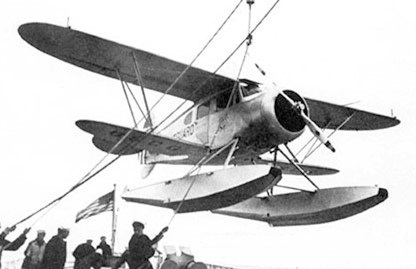
Three USCG version of the EQC-6, on twin floats for operation from a cutter, and EGC-7 on wheels, were built in 1937 as J2W-1; V157, V158, and V159.
Waco J2W-1
Waco J2W-1
Waco UQC-6 NC12643
One 1937 VQC-6 (ATC 631) was built (NC16243), reportedly first registered as UQC-6, but unconfirmed by factory records.
AQC-6 / UC-72G Engine: Jacobs L-6MB, 330 hp (246 kW) Max Speed: 170 mph (274 km/h) Cruising Speed: 155 mph (249 km/h) Service Ceiling: 18,500 ft (5,638 m) Range: 550 mi (885 km) Empty weight: 2,313 lb (1,049 kg) Loaded weight: 3,650 lb (1,656 kg) Span: 35 ft (10.7 m) Length: 26 ft 8 in (8.1 m) Height: 8 ft 8 in (2.6 m) Wing Area: 244 sq ft (22.7 sq m) 7 built
DQC-6 Engine: Wright R-760-E1, 285 hp (213 kW) Wingspan: 35’0″ Length: 26’2″ Useful load: 1425 lb Max speed: 170 mph Cruise speed: 151 mph Stall: 55 mph Range: 580 mi Seats: 4-5 11 built
VQC-6 Engine: Continental W-670-M1, 250 hp (186 kW) Wingspan: 35’0″ Length: 26’8″ Useful load: 1470 lb Max speed: 160 mph Cruise speed: 150 mph Stall: 55 mph Range: 600 mi Seats: 4-5 One built.
YQC-6 Engine: Jacobs L-4, 225 hp (168 kW) Wingspan: 35’0″ Length: 26’2″ Useful load: 2050 lb Max speed: 159 mph Cruise speed: 140 mph Stall: 52 mph Range: 650 mi 13 built. Unit cost: $7,295 Seats: 4
ZQC-6 / UC-72Q / UC-72H / Tp-8a Engine: Jacobs L-5MB, 285 hp (213 kW) Propellers: 2-bladed Upper wingspan: 35 ft 0 in (10.67 m) Lower wingspan: 24 ft 6 in (7.47 m) Wing area: 244 sq ft (22.7 m2) total Length: 26 ft 8 in (8.13 m) Height: 8 ft 8 in (2.64 m) Empty weight: 2,023 lb (918 kg) Gross weight: 3,500 lb (1,588 kg) Maximum speed: 166 mph (267 km/h; 144 kn) Cruise speed: 150 mph (130 kn; 241 km/h) Service ceiling: 17,000 ft (5,182 m) Crew: one Capacity: four passengers 68 built
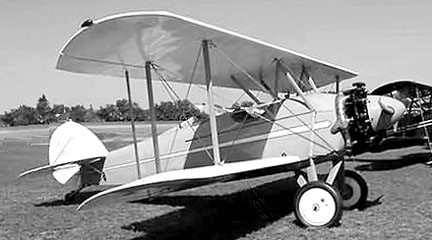
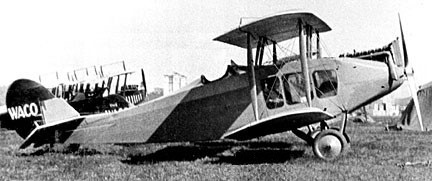
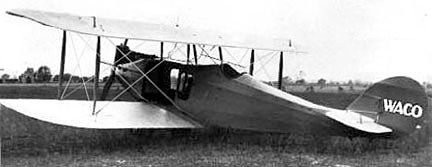
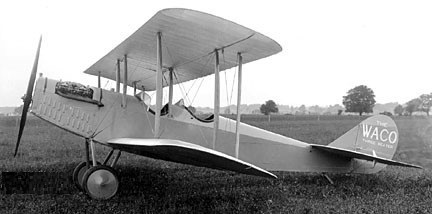
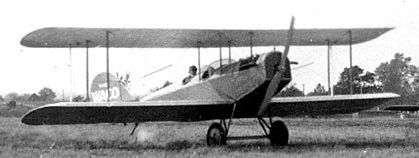
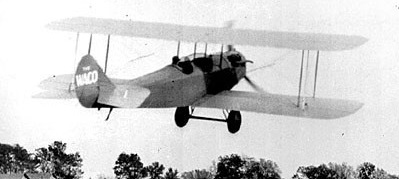
Following Buck Weaver’s death in 1924, Clayt Bruckner and Sam Junkin reorganized the business and soon introduced the company’s popular Model 9 (or Nine) in 1925. Powered by a Curtiss OX-5 or Wright Hispano engine, the WACO Nine delivered better performance than the readily available war surplus Curtiss Jennys at an affordable price.
The design of the 1925 Waco 9 (ATC 11) was state-of-the-art for its time—a fabric-covered wooden wing structure strengthened with welded steel tubing. The front cockpit was equipped with a bench seat that accommodated two passengers with a single cockpit for the pilot in the rear of the aircraft. An engine radiator mounted under the forward edge of the upper wing became a distinguishing WACO trait.
First mass-production model was the three-seat Model 9, steel-tube framing, powered by OX-5, equipped for EDO floats. The first aircraft to be fitted with aluminum floats, by EDO Corp in 1928.
The design of the Nine was state-of-the-art for its time—a fabric-covered wooden wing structure strengthened with welded steel tubing. The front cockpit was equipped with a bench seat that accommodated two passengers with a single cockpit for the pilot in the rear of the aircraft. An engine radiator mounted under the forward edge of the upper wing became a distinguishing WACO trait.
The stylish WACO Nine made a good showing during the 1925 Ford Air Tour. The accompanying publicity quickly translated into increased aircraft sales and 276 Nines were sold between 1925 and 1927 for $2,025-2,500.
An outstanding barnstormer, more than 14 Nines competed in the 1926 National Air Races with several finishing first in their events. WACO Nines also saw duty as crop-dusters—the airplane could be outfitted with floats for water landing—and were also used as an early commuter aircraft.
Mainly poweed with a 90hp Curtiss OX-5, they were also supplied with 100hp Curtiss OXX-6, 100hp Curtiss C-6 or 150hp Hisso A.
In 1924, the first cabin WACO aircraft was manufactured, the six-passenger WACO 8, featuring an open cockpit positioned behind the cabin for the pilot and co-pilot, powered by 200 hp (149 kW) Liberty.
A preliminary first flight was made in late Aug 1924, piloted by Clayton Brukner, and an official first flight was made on 21 October 1924, piloted by Tex LaGrone.
Only one WACO 8 was ever sold for $4,500 to an aerial photo company in Kansas City and it was eventually used to aerially map the Ozarks. It was eventually destroyed in a landing accident.
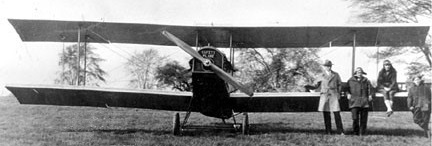
The Waco team continued to assemble airplanes from parts salvaged from surplus World War I Curtiss Jennys, continuously tinkering with their designs and making improvements.
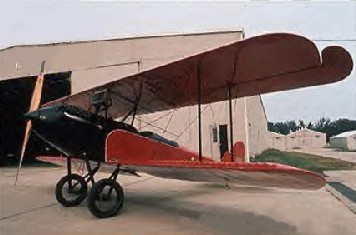
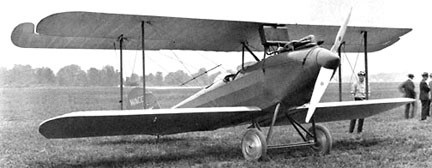
Similar to the Waco 6, the 1924 Waco 7 used many Curtiss JN-4 parts with new interchangeable wing panels and powered by a 90 hp (67 kW) Curtiss OX-5.
The three-passenger WACO 7 was modestly successful with 16 aircraft sold at $2,500.
Engine: 90 hp (67 kW) Curtiss OX-5 Max speed: 90 mph Stall: 30 mph
The Waco team continued to assemble airplanes from parts salvaged from surplus World War I Curtiss Jennys, continuously tinkering with their designs and making improvements.
Used many Curtiss JN-4 parts with new interchangeable wing panels and powered by a 90 hp (67 kW) Curtiss OX-5.
The first Troy-built model, the WACO 6, was soon being marketed and four were built
The Waco team continued to assemble airplanes from parts salvaged from surplus World War I Curtiss Jennys, continuously tinkering with their designs and making improvements.
The 1921 Weaver 5 three place open cockpit biplane used many Curtiss JN-4 parts with new interchangeable wing panels and powered by a 90 hp (67 kW) Curtiss OX-5.
Eventually, they sold two WACO 5 biplanes, conversions of JN-4C Canucks, two with 150hp Hisso A engines. Selling for $1,500-2,000, the final one was built at Advance Co in 1923.




















 All Aero