Andrews A.1 Special

The idea was for an aircraft of low initial cost and low operating cost to enable the many young people of the day to follow up their Private Pilot Licence with a modestly priced 200 hours needed for their Commercial Licence. That was the original concept of the Andrews A.1 and the whole philosophy of its design. The structural design of the A.1 was heavily influenced by the limitations of small production lines and the need to be built in workshops which normally catered for maintenance with the addition of some simple tooling.
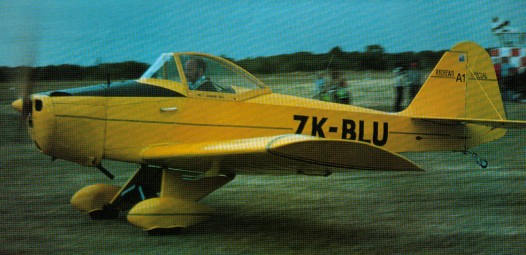
This aircraft, of which there is only one in existence (ZK-BLU), was the pioneer post-war homebuilt in New Zealand. It was built to Certificate of Airworthiness standard during the 1950’s by a CAD aeronautical engineer, Mr Cliff Andrews, although it later flew under a Permit to Fly. It first flew in 1957 but was largely inactive until 1973 when it was restored by Mr Andrews and sold to Alan Rowe of Lower Hutt. The aircraft’s construction employs a welded tube fuselage and tailgroup, and wings constructed of two wooden spars with a Warren-girder metal truss structure between. The whole airframe is fabric-covered.
Engine: Continental A65, 65 hp.
Span: 24 ft 0 in
Wing area: 115.5 sq.ft
Length: l9 ft 0 in
Height: 5 ft 7 in
Empty weight: 700 lb
MAUW: 950lb
Max speed: 102 mph at SL
Cruise: 94 mph.
ROC: 450 fpm.
Range: 270 miles.

Anderson, Greenwood & Co AG-14 / AND-51

Anderson, Greenwood & Company was organized in 1945 to design and manufacture airplanes. Its first model, the AG 14, was ready five years later. An all-metal pusher, the cabin seats two side-by-side with dual controls.

First flying on 1 October 1947, the AG 14 was certificated on 21 September 1950, but the Korean War came along and only 5 AG14’s were ever produced during 1950-1953.

One AG-14 prototype was built in 1947, NX80828, which received the Approved Type Certificate 4A1. It was later re-designated as AND-51.

The five AG-14 production examples built in 1950 were N9300K to N9304K, c/ns 1 to 5), later redesignated AND-51-A, with the same Approved Type Certificate 4A1. C/n 2 later became N4254M and c/n 3 later became N314AG.

One plane modified in 1962 as Mississippi State Univ XAZ-1. Advertised c.1964 by Space Enterprises as Space Coupe AG-14 with 100hp Continental O-220, but no record of production.

Gallery

Engine: Continental C90, 90 hp
Wing span: 34 feet 7 in
Wing area: 120 sq.ft
Length: 22 feet
Height: 7 ft 9 in
Empty weight: 850 lb
Loaded weight: 1400 lb
Top Speed: over 120 mph
Landing Speed: 49 mph
Cruising range: 4 hours
Service Ceiling: 16,500
Rate of Climb: over 700 f.p.m.

Anderson, Greenwood & Co.

A Houston man¬ufacturer of valves for the oil, petrochemical, gas transmission and powerplant industries, originally incorporated 1941 for research into private owner aircraft, but closed down and re-formed after the war. Developed the AG-14 light pusher monoplane but the company completed only four production models before engaging in subcontract work.

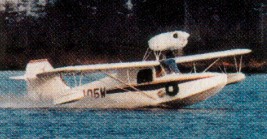
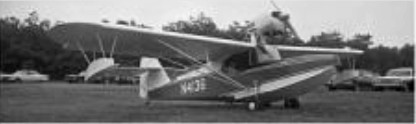
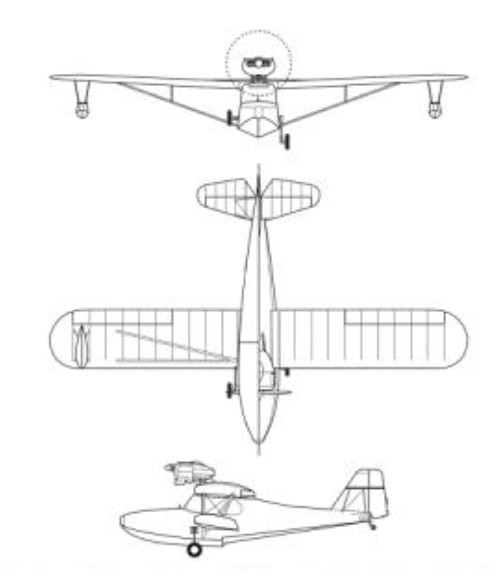
Anderson EA-1 Kingfisher             

Earl Anderson, a Boeing 747 Captain, spent nine years developing the EA-1 Kingfisher at a cost of $5,500, and first flew it on 24 April 1969. At that time, it used a 100-hp Continental 0-200, similar to the Volmer VJ-22 Sportsman, which served as a design inspiration. Later, Anderson switched to a 115-hp Lycoming 0-235-C1, and by January 1975 had logged more than 600 hours on the amphibian. Seating two people side-by-side in an enclosed cabin, the Kingfisher uses standard Piper J-3 Cub wings, with tip floats of mahogany and plywood covered with fiberglass. The fuselage also is wooden, the framework covered with plywood and fiberglass. The landing gear is retractable.

200 sets of plans had been sold by 1978.

Gallery

Engine: 100 hp Continental O-200
Prop: 2 blade fixed pitch, wood
Max speed: 96 mph
Cruise speed: 85 mph
Range: 322 miles
Empty weight: 1032 lb
MTOW: 1540 lb
Wingspan: 36 ft 2 in
Length: 23 ft 6 in
Wing area: 178.5 sq.ft

Engine: Lycoming O-235, 115 hp.
Span 37 ft l in.
Wing Area 185 sq.ft.
Height 8 ft 4 in.
Length 23 ft 7 in.
Gross Weight 1600 lb.
Empty Weight 1092 lb.
Fuel 20-26 USgal.
Vmax 113 mph.
Cruise 90 mph.
Climb 650 fpm.
Stall 42 mph.
Ceiling 13,500 ft
Range 330 sm.
Seats 2.
Landing gear:
Retractable tail wheel.

Engine: Continental O-200A, 100 hp.
Span 37 ft l in.
Wing Area 185 sq.ft.
Height 8 ft 4 in.
Length 23 ft 7 in.
Gross Weight 1600 lb.
Weight empty: 1050 lbs.
Fuel cap: 20 USG.
Speed max: 95 mph.
Cruise: 85 mph.
Range: 280 sm.
Stall: 42 mph.
ROC: 700 fpm.
Take-off dist: 1000 ft (land), 2000 ft (water).
Seats 2.
Landing gear: Retractable tail wheel.

Andreasson BA-6

Designed by Björn Andreasson and first flown in 1955, the BA-5 single-seat aerobatic sports monoplane was developed primarily for amateur construction.

The BA-6 is of all-wood construction and, with the exception of the fabric-covered control surfaces, has plywood covering. Fully aerobatic, The BA-6 has a Cessna-type spring-steel cantilever landing gear. Landing flaps are fitted.

SE-BXX and SE-BXY

The first two built were fitted with Continental A65 65hp engines and the airframe will take the Continental C85.

Engine: Continental A65, 65 hp
Wingspan: 23 ft
Length: 16 ft 5 in
Height: 5 ft
Max speed: 145 mph
Landing speed: 34 mph
Time to 20,000ft: 6 min
Range: 1200 mi

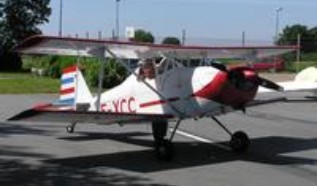
Andreasson BA-4 / Crosby Aviation Ltd BA-4B

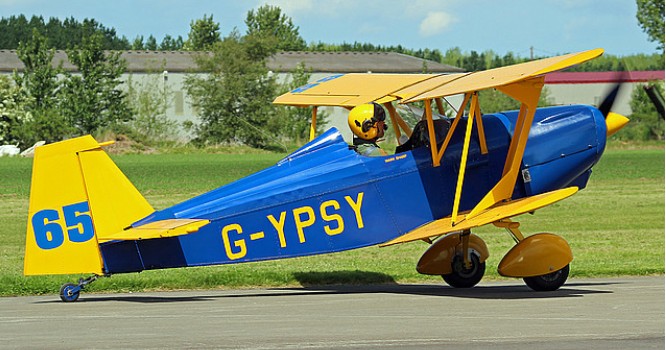
Designed by Björn Andreasson as a homebuilt in 1944 as the single-seat biplane BA-4 was built at Malmo Aviation’s plant at Bulltofta, Sweden.

In 1966 it was designated as the BA-4B c/n 1 registered SE-XBS and was powered by a Continental O-200-A.

The rights to the design were sold to Peter J.C. Phillips who formed Crosby Aviation Ltd to market kits and plans of the BA-4B. The prototype was imported to the UK in 1968 as G-AWPZ.

Andreasson BA-4B

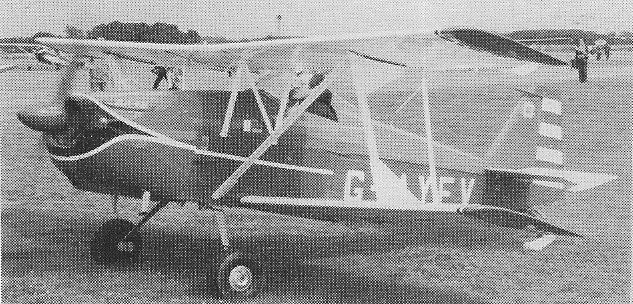
Three aircraft were laid down for initial sales at Knutsford, Cheshire, UK, and all were completed, including G-AYFU, V and W.

Crosby Aviation built G-AYFV

Crosby Aviation offered two versions: the BA-4B with a Rolls-Royce/Continental O-200-A; and the Super BA-4B with a Rolls-Royce/Continental O-240-A.

Gallery

BA-4B
Engine: Rolls-Royce/Continental O-200-A
Wingspan: 18.06 ft
Length: 15.04 ft
Empty Weight: 330 kg / 728 lbs
MTOW Weight: 450 kg / 992 lbs
Stall: 52 kt / 60 mph / 96 kmh
Cruise: 113 kt / 130 mph / 210 kmh
VNE: 130 kt / 149 mph / 240 kmh
Take-off distance (50ft obstacle): 890 ft / 270 m
Landing distance (50ft obstacle): 1530 ft / 465 m

Super BA-4B
Engine: Rolls-Royce/Continental O-240-A
Wingspan: 18.06 ft
Length: 15.06 ft

ANB ANB-M / ANB-I

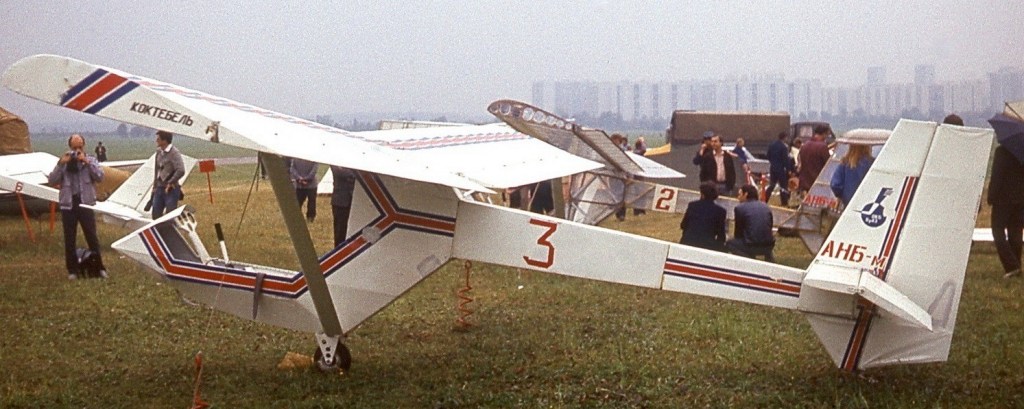
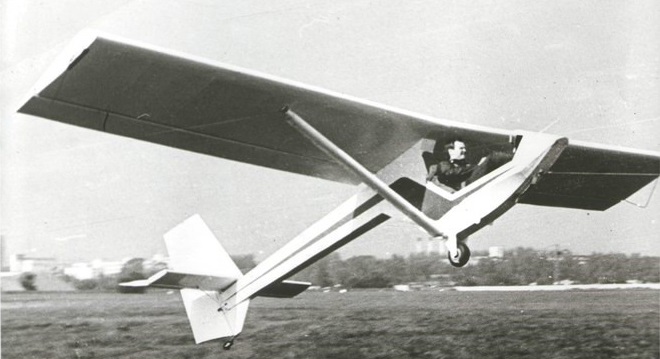
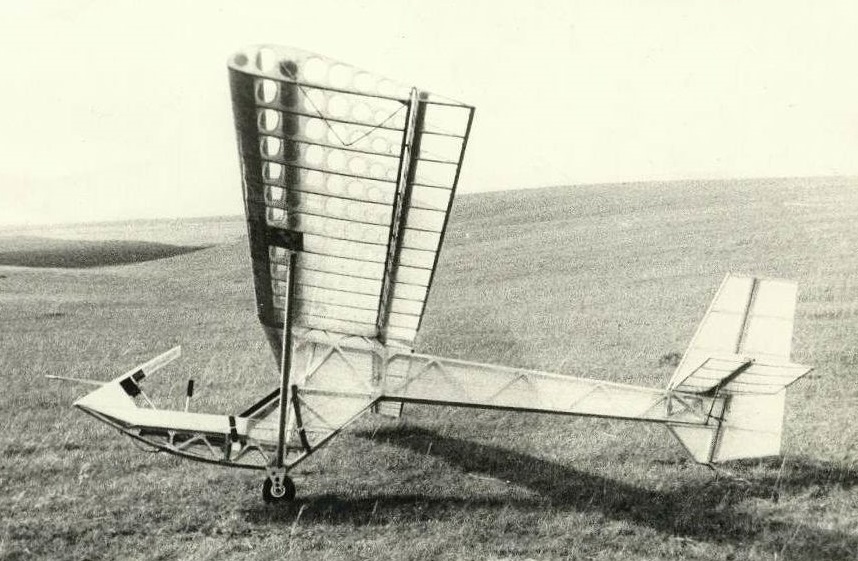
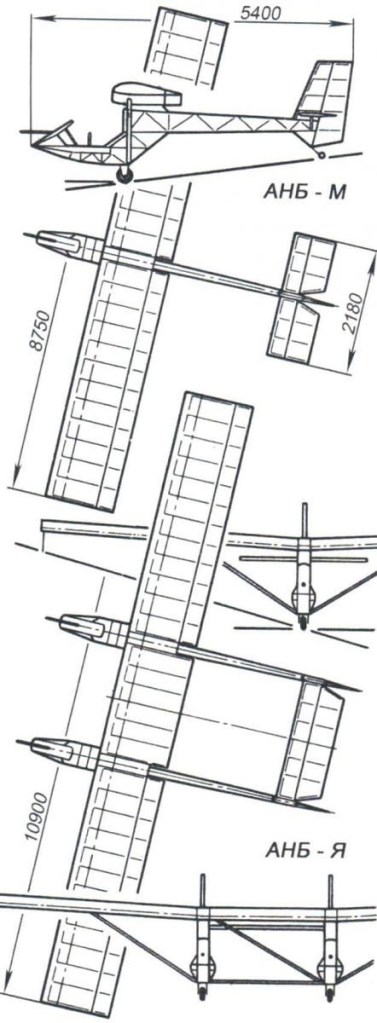
The ANB-M Part103 Sailplane is a full metal primary glider with plans for homebuild.

On May 1, 1983 the glider was ready and tested. The ANB-M “Transparent” in Crimea at the All-Union Review Competition of SLA-84 was awarded the 1st prize.

The ANB-I – a modular multi-purpose double glider – was created on the basis of two ANB-M as a result of a simple refinement – two fuselages are fixed parallel at a distance of 2.2 m from each other (the idea was submitted by the designer of gliders V. Janusov).

It turned out a rather exotic design, jokingly called “Snake Gorynych.” The wing span thus became 11 m, and weight – 135 kg.

Gallery

ANB-M
Wing area: 10.5 sq.m
Empty weight: 70 kg
Take-off weight: 145 kg
Seats: 1

ANB-I
Wing span: 11 m
Weight: 135 kg