Pioneer aviator Charles Francis Walsh flew an aircraft powered by a Macomber axial internal-combustion engine in May 1911, the “Walsh Silver Dart”.
Aircraft
Walraven W.41938
L. W. Walraven began designing and building light aircraft at Bandoeng, Java, in spare time as chief engineer to Netherlands East Indies Army Air Force, from 1922. Completed W.41938, which was ordered as trainer by Netherlands East Indies flying clubs.
Walraven
Netherlands
L. W. Walraven began designing and building light aircraft at Bandoeng, Java, in spare time as chief engineer to Netherlands East Indies Army Air Force, from 1922. Completed W.41938, which was ordered as trainer by Netherlands East Indies flying clubs.
Wallman Sportplane
Circa 1975 Fred W Wallman Jr built the two-place, open cockpit, high-wing monoplane, Sportplane, registered N4FW. The fuselage and tail were steel tube, and wing was all wood.
The Sorrtplans was first flown on 24 September 1975, piloted by Bert Sissler. Only the one was ever built.
Engine: 115hp Lycoming O-235-C1
Wingspan: 30’0″
Length: 21’6″
Useful load: 566 lb
Cruise speed: 100 mph
Stall: 35 mph
Wallman, Fred W Jr
Minneapolis MN.
USA
Circa 1975 built a sportplane
Wallis 1981 Biplane
In 1981 Stanley B Wallis of Ypsilanti MI, USA, built a two-place, open cockpit biplane, original design to resemble the best of the great old biplanes of the 1925-32 period.
Engine: 260hp Ford auto
Wallis, Stanley B
Ypsilanti MI.
USA
Circa 1981 biplane builder
Wallbro Monoplane

All-British aeroplane constructed by brothers Percy Valentine & Horace Samuel Wallis in the shed at the rear of their parents’ house in Cambridge with ‘offices’ of the Wallbro Aeroplane Co. in their bedroom overlooking the rear garden. By May 1910, it was complete and was put on display to the public. On July 4, 1910, the brothers made their first tentative ‘hop’ near Abington, where the machine had been brought to be housed. A complete and detailed description of the craft can be found in the Thursday, May 12, 1910 edition of the Cambridge Daily News.
The brothers were strong believers in the strength of steel tubing. The fuselage used mainly one-inch diameter tube of 20 gauge, arranged on the girder principle, strongly braced with steel wire. The cross tubing were double bolted onto steel lugs similar to those used in motor cycle construction. The wire stays were attached to eyebolts passing through these lugs. Tightening of the wires was accomplished by means of bronze tensioning screws, which have right and left-hand screw threads. These ideas together with a multitude of others succeeded in producing a machine, which was both light and very strong. The fuselage was twenty-five feet long with a wing span of thirty feet. The undercarriage was also of tubular design but used heavier gauge tubing.
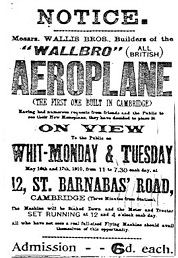
Wallbro Aeroplane Co / Wallis, Percy Valentine & Horace Samuel
John Wallis of Rangles Farm in March, Isle of Ely was born in 1827. In 1850 he married Mary Johnson, a widow with three children. They had two boys, John born in1851 and Samuel Banks, born in 1855. Samuel married Rebecca King from High Bow in London and they set up their home at 12, St. Barnabas Road, in Cambridge. Samuel had a successful Grocers and Tea Importers business in Cambridge. They had six children, Victor, their eldest was born in 1877, Horace was born in 1883, Percy Valentine born in 1885, Garnett born in 1887 and Beatrice born in1886 & Kate.
Horace, and Percy his younger brother started motor cycle racing and by the turn of the century were making their own motor cycles they set up the “Walbro” Cycle and motor works They must have decided to branch into aircraft about 1908 and started building their “Walbro” Monoplane. Being familiar with the fabrication of motor cycle frames using steel tube they must have decided that this material for all the frames of their monoplane. This was a spare-time project even though they named the project The “Wallbro” Aeroplane Co Cambridge. Their Office and works was at their Parent’s home.
In St. Barnabas Road and they gave their aircraft project was to be the first ‘All British Aeroplane’. The two boys started work on what they hoped would be the lightest but strongest monoplane in Cambridge. The aircraft was assembled in a shed at the back of their parent’s house.
The brothers designed their flying machine to embody a number of new ideas. The design followed the ideas used by Bleriot and Antoinette monoplanes yet it differed from both these machines in several important ways. One such variation was the framework.
Wallace Brothers Blackhawk
The 1919 Wallace Blackhawk was a two-place open-cockpit biplane. It was possibly powered by a 90hp Curtiss OX-5.
 All Aero