Designed by Michel Barry, the Souris bulle is built entirely of wood. The company supplied kits in various forms, up to a complete airframe ready to cover.
Engine: JPX 4T60, 60 hp Wing span: 11.25 m Wing area: 15.1 sq.m MAUW: 450 kg Empty weight: 170 kg Fuel capacity: 2 x 25 lt Max speed: 170 kph Cruise speed: 150 kph Minimum speed: 65 kph Climb rate: 5.5 m/s Pwr off sink: 1.35 m/s Fuel consumption: 10 lt/hr Seats: 2 Plan price (1998): 2300 Fttc Kit price (1998): 110 000 Fttc
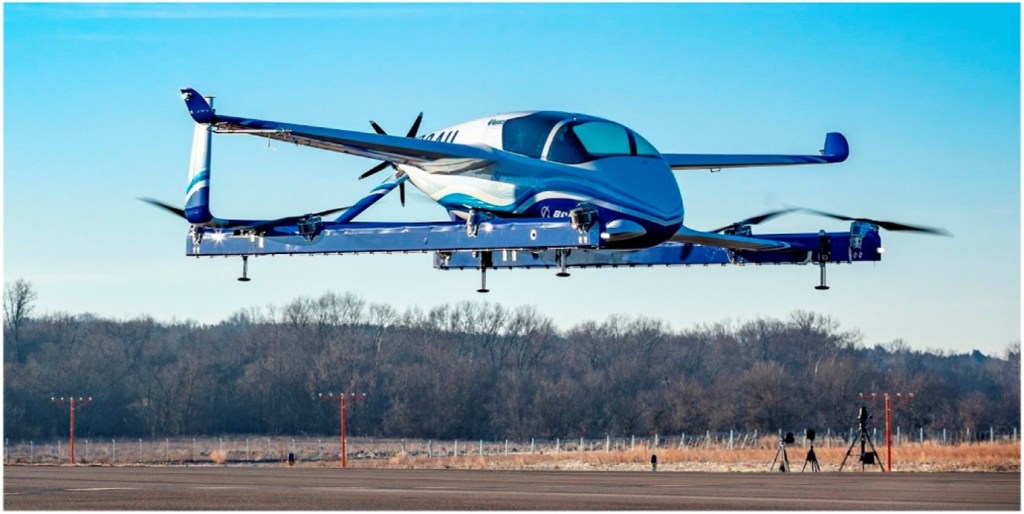
Aurora Flight Sciences, an independent subsidiary of Boeing, hovered a full-size prototype of their Pegasus Passenger Air Vehicle (PAV) on 22 January 2019 at the Manassas Regional Airport in Manassas, Virginia.
Just a few months later on 4 June 2019, the Pegasus PAV crash-landed when the autoland function inadvertently entered ground mode and commanded the motors to shut down.
Built in the Paris factory of the firm Frères Voisin and powered by a 7-cylinder 35 hp R.E.P. engine – the first of two monoplanes designed by the Swiss-born Clément Auffm-Ordt (often misspelled as Auffin-Ordt). This tractor monoplane had a unique solution to lateral stability, whereas the wing could be tilted as a whole, while a small center surface could be tilted separately. Preliminary tests began at the airfield at Buc on April 23, 1908 with little success, though promising enough to build a second machine, a pusher monoplane tested in Switzerland on the frozen lake near St. Moritz in early 1909 and abandoned after crashing from a height of six meters onto the ice. Although the machine seemed to be quite intact after its mishap nothing was heard from M. Aufmm-Ordt again, at least related to aviation.
Charles Audenis (1889-1972) built two machines together with his friend Jean Jacob in 1912-1913, in which he participated in several regional meetings in the Lyon area. The rather Farman-inspired machine was powered by a Gnôme rotary.
Charles Audenis (1889-1972) started his aviation career as a mechanic at Bron (Lyon, France). He qualified for his licence (no. 788) on a Farman in 1912. He built two machines together with his friend Jean Jacob in 1912-1913, in which he participated in several regional meetings in the Lyon area.
Designed by Paul Aubert, the Aubert PA-20 Cigale (English: Cicada), PA-204 Cigale Major and PA-205 Super Cigale were a family of high-wing cabin monoplanes built in France in the years immediately before and immediately after World War II. The original Cigale was shown at the 1938 Paris Salon but its development was interrupted by the War. The Cigale was a high-wing cantilever monoplane of conventional configuration with fixed, tailwheel undercarriage.
PA-20
The original two-seat PA-20 Cigale first flew on 25 February 1938, piloted by Maurice Bruneteau, powered by a Train 6T. Various refinements were made, including a change to a Renault 4Pei engine, and the aircraft was redesignated PA-201 Cigale. This original aircraft was destroyed during the course of World War II, but in 1945, Paul Aubert returned to the design, building another aircraft to the PA-201 standard. This went on to prove highly successful when flown competitively in 1945 and 1946.
PA-201
Aubert further modified his design into a four-seater, flying the PA-204 Cigale Major on 21 April 1947, and soon building a second example to this standard. The aircraft was equipped with a Renault 4 Pei engine (manufactured by SNECMA), and four people could be accommodated in a closed cockpit. The Cigale Major PA-204 was certificated in 1951.
PA-204
The second prototype PA-204 was subsequently re-engined first with a SNECMA-Regnier 4LO-2 in June 1955 (PA-204S), and then with a Lycoming O-290-D2B (PA-204L), tested on July 27, 1955, and a Lycoming O-320 in 1956 (PA-205 Super Cigale). The 204L has a wider cabin and better forward view than the earlier machine fitted with the SNECMA engine. With this engine, Aubert was finally satisfied with the design and built around thirty production examples, eight of which went to Aéroclub Air France.
A version equipped to carry a doctor and one stretcher patient, in addition to the pilot, was built in 1956.
PA-204 Cigale-Major Improved four-seat variant with a Renault 4Pei inverted inline engine. Prototype flew in 1949, with production from 1954.
PA-204S Super Cigale Further developed with a Régnier 4L02 engine.
PA-204L Super Cigale Final production variant with an Avro Lycoming engine with a range of power output between 135 to 180 hp.
Specifications:
PA-20 Cicada Engine: Train 6T, 60 hp Span: 9.50 m Wing area: 12.84 m² Length: 7.15 m Empty weight: 334 kg Max weight: 580 kg Cruising speed: 186 kph Range: 500 km Crew: 2
PA-204L Engine: 1 × Lycoming O-320, 110 kW (150 hp) Propellers: 2-bladed Length: 7.50 m (24 ft 7 in) Wingspan: 10.00 m (32 ft 10 in) Height: 2.40 m (7 ft 10 in) Wing area: 12.90 m2 (138.9 sq ft) Empty weight: 640 kg (1,411 lb) Max takeoff weight: 1,250 kg (2,756 lb) Maximum speed: 255 km/h (158 mph; 138 kn) Cruising speed: 230 km/h (143 mph; 124 kn) Range: 1,880 km (1,168 mi; 1,015 nmi) Service ceiling: 4,500 m (14,764 ft) Crew: 1 Capacity: 3 passengers
PA-204S Super-Cigale Engine: 170 hp SNECMA-Regnier 4LO-2 Wingspan: 32 ft 9 in Length: 25 ft 3 in Empty weight: 1499 lb Loaded weight: 2645 lb Max speed: 155 mph Cruise: 141 mph
Aubert-Aviation was formed 1932 and commenced aircraft design in 1936. In 1938 name was changed to Societe Anonyme des Avions P. Aubert and PA-20 Cigale trainer which, after successful trials, was shown at Paris Salon.
Aubert and undertook considerable work for the nationalised industry. A direct contract for the production of Morane-Saulnier MS.230 trainers was placed with the company by the French Government, but all work ceased with the capitulation of France in June 1940.
After war PA-20 was revived as PA-201 and PA-204 (high-wing cabin monoplanes with cantilever undercarriage; common name Cigale). As Cigale Major PA-204 was certificated in 1951.