
A single-piston-engine monoplane of 1920, one was built.
A single-piston-engine monoplane of 1920, one was built.
The company was founded by Pavel Beneš, Miroslav Hajn, Jaroslav František Koch and Václav Malý in 1919. Taken over by Milos Bondy a Spol about 1923, but acquired 1926 by Skoda, which also made Hispano-Suiza air engines under license. During the 1930s the factory became the biggest aircraft producer in Czechoslovakia and moved to Letňany in Prague, where production continued. During World War II Avia produced aircraft for the German Luftwaffe. After the war the company was nationalized and became involved in the automotive industry. It manufactured aircraft up to 1963, then targeted on truck production and continued to make aircraft engines (producing only propellers from 1988). The company was split in 1992 into propeller and truck sections, both using the Avia brand.
Before the war the company produced civilian and military aircraft, including the Avia BH-1, Avia BH-21, Avia B-534 and Avia B-71 (Soviet licensed Tupolev SB). Early Avia designers were Benes and Hajn: hence initials in aircraft designations. BH-1 was light sporting two-seater; BH-3 a low-wing strut-braced single-seat fighter for the Czechoslovak National Defense Ministry; BH-25 a five seater; BH-26 a two-seat fighter; BH-33 a single-seat biplane fighter developed from the BH-21.
Company made Fokker F.VII/3m under license, and Avia FIV IX was a Fokker-designed bomber. Before the war the company built fast metal-skinned transports of original design: Avia 51, 56, and 57. B 534 biplane was outstanding single-seat biplane fighter (445 built) used by Czechoslovak Air Force and widely considered best of class in Continental Europe. B 71 was Soviet-designed monoplane bomber.
In 1945 factories were reconstituted under Government, but production of Avia 36 light monoplane was resumed and Douglas C-47s were converted for civil use. Avia had started building Messerschmitt Me 109G soon after WWII as the Avia S-99, but soon ran out of the 109’s Daimler-Benz DB 605 engine.
Also during the war the Germans set up a number of assembly plants in Czechoslovakia for production of the Messerschmitt Me 262, designated the Avia S-92. After the war the manufacturing infrastructure remained intact, so production could start up again for the new owners.
The first S-92 was assembled at Letňany Research Institute in 1945 with the airframes coming from Avia and the engines from the repair works in Malešice (the Junkers Jumo 004, now called the M-04). The S-92’s first flight was on 27 September 1946, with Avia’s chief pilot Antonin Kraus in control. That same year on December 10 the CS-92 took to the air for the first time.
Delivery of the first S-92 to the Czechoslovak Air Force was on 6 February 1948. Twelve were made in all, nine S-92 and three CS-92, equipping the 5th Fighter Flight, until they were grounded for use as instructional airframes in 1951.
By the time Yugoslavia showed interest in buying the S-92, Avia was looking at closing down the production line to make way for newer up-to-date aircraft, and when Avia were given a license to make the Mikoyan-Gurevich MiG 15 Fagot (they were already making the Yakovlev Yak 23 Flora, as the S-101) the S-92 production lines were dismantled.
An Avia S-92 (A-1a) and Avia CS-92 (B-1a) can be seen at the Vojenské Muzeum, Kbely AB.
The Avia S-199 was a fighter aircraft built in Czechoslovakia after World War II using parts and plans left over from Luftwaffe aircraft production that had taken place in the country during the war. While a problematic aircraft, unpopular with its pilots, it achieved fame as the first fighter obtained by the Israeli Air Force for use during the War of Independence. Czechoslovak pilots nicknamed it Mezek (“Mule”), whilst in Israel it was known as the Messer (“knife”; it is a common mistake that it was nicknamed Sakeen; the official name was even different – Python).
The S-199 continued to use the Me 109G airframe, but with none of the original engines available, the engine (Junkers Jumo 211) and propeller from the Heinkel He 111 bomber were used instead. The result of this compromise was an aircraft with poor handling qualities. The substitute engine lacked the responsiveness of the Daimler-Benz unit, was heavier, and the torque created by the massive paddle-bladed propeller made control difficult. This latter flaw, combined with the 109’s narrow-track undercarriage also made landings and take-offs more hazardous. A final hidden danger lay in the synchronization gear which did not seem to work properly, leading a few Israeli aircraft to shoot off their own propellers.
Later produced Avia B-33 (licensed Ilyushin Il-10) or Avia 14 (licensed Ilyushin Il-14M), that airliner version (able to carry 42 passengers) became the largest aircraft ever produced in Czechoslovakia.
In 1992, AVIA was transformed into a stock company, and also Avia – Hamilton Standard, a new company with AVIA’s equity share manufacturing aircraft propeller was established. One year later, the propeller manufacture was moved from the Letňany factory to the new premises near Stará Boleslav. This definitively terminated the aircraft production in Letňany.

Stall: 41 kt / 47 mph / 76 kmh
Cruise: 113 kt / 130 mph / 210 kmh
VNE: 135 kt / 155 mph / 250 kmh
Empty Weight: 340 kg / 750 lbs
MTOW Weight: 590 kg / 1300 lbs
Climb Ratio: 800 ft/min / 4,2 m/s
Take-off distance (50ft obstacle): 590 ft / 180 m
Landing distance (50ft obstacle): 590 ft / 180 m

Developed in the 1940s.
First flew in November 1995 the APM-20-1 Lionceau two-seat light aircraft suited to training and many other roles.
First flew in November 1995 the APM-20-1 Lionceau two-seat light aircraft suited to training and many other roles.
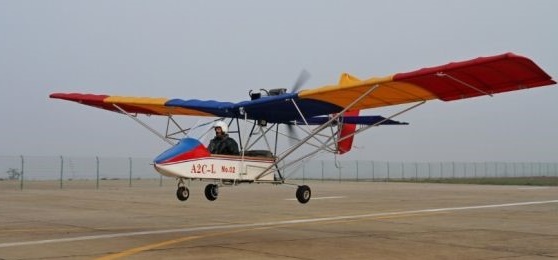
The A2C-L ultra-light aircraft was developed by the AVIC Special Vehicle Research Institute after the A2C seaplane achieved commercial success. The aircraft is transformed and updated from the seaplane and finished its test flight in 2012.
The A2C seaplane is the first ultra-light aircraft that obtained a certificate of model design approval and a production permit issued by the Civil Aviation Administration of China.
An ultra-light aircraft independently developed by China, it got the special flight permit and completed its delivery test flight on 11 March 2016. Nearly 100 A2C planes have been sold to regions including Sichuan, Hubei, Anhui, Inner Mongolia and Xinjiang.
Avicopter, owned jointly by the Tianjin city government and Avic, also encompasses long-established Chinese helicopter plants such as Harbin Aircraft and Changhe Aircraft, in Jingdezehn, and a new base at Tianjin. Tianjin is the builder of the AC313.
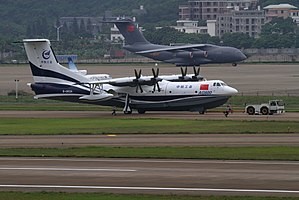
The AVIC AG600, code named Kunlong (鲲龙), also known as TA-600, is one of China’s three “big plane projects” approved by the State Council of China in 2009, along with the Xi’an Y-20 and C919. It is intended for both civil and military roles. In civil use, as an aerial firefighter it will be capable of dropping 12 tonnes of water, while in search and rescue operations it will accommodate up to 50 passengers. It is also intended to meet China’s strategic defence needs in the South China Sea area.
It was designed by the Aviation Industry Corporation of China (AVIC). The aircraft was developed by a group of 70 aircraft component manufacturers and research teams in association with more than 150 institutes across 20 provinces and municipalities in China. Over the years, its silhouette has been slowly revised by way of modified float supports, a more blended, better-contoured cockpit roofline, and a “T-style” tail unit (as opposed to the split vertical tail fins of the SH-5). On the whole, the aircraft has continued use of flying boat basics – high, shoulder-mounted wings, two engines installed at each wing, and a boat-like hull for water landings. The hold will also support seating for up to 50 passengers. The resulting aircraft has proven heavier than previously planned at approximately 107,000lb, up from the original 98,000lb. The added weight has altered the expected operational range, reduced from 3,200 miles to 3,100 miles. The AVIC AG600 is an amphibious aircraft having the hull of a flying boat for waterborne operations along with a wheeled retractable undercarriage for alighting on land. The prototype AG600, built by CAIGA, has a wingspan of 38.8 metres (127 ft) and is powered by four turboprop engines. The type of engine is WJ-6, a modified Chinese-made version of the Soviet Union’s Ivchenko AI-20 series. It is designed to have a maximum takeoff weight of 53.5 t (118,000 lb) and a maximum range of over 5,000 km (3,100 mi).
The aircraft is powered by four Chinese-made WJ-6 turboprop engines driving four six-bladed constant speed propellers. WJ-6 is a license-built copy of the Ivchenko AI-20 engine and generates a power output of 3,805kW (5,103hp).
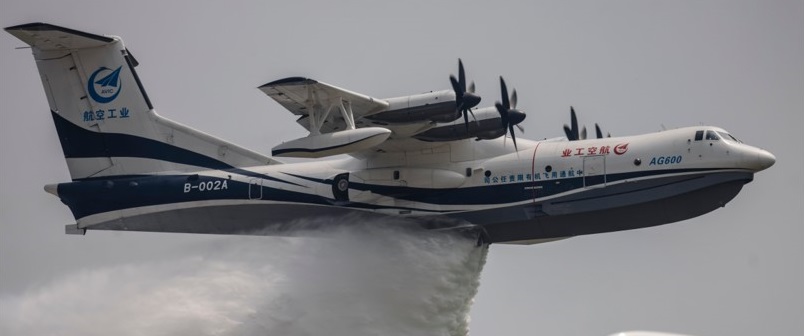
The mid and forward fuselage sections of the aircraft were completed in December 2014 and March 2015 respectively. The horizontal and vertical tail was completed by January 2016. The prototype was rolled out on 23 July 2016 at the Zhuhai AVIC factory. Its maiden flight was made from the runway of Jinwan Civil Aviation Airport in Zhuhai, Guangdong on 24 December 2017, at 09:39 China Standard Time. 17 orders had been received from Chinese customers before the flight.
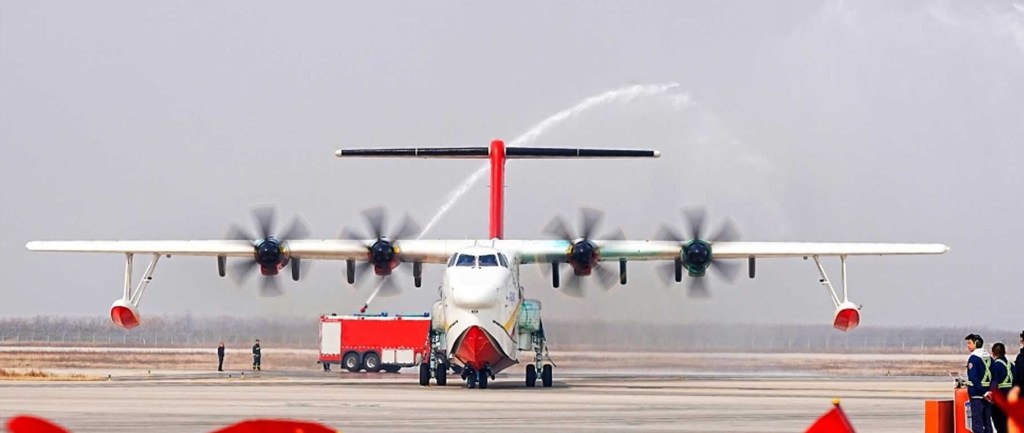
On March 2, 2025, China announced that the AG600, the country’s domestically developed large amphibious seaplane, has successfully completed its flight testing phase and is on the verge of receiving its type certificate from the Civil Aviation Administration of China (CAAC).
According to a statement from the Aviation Industry Corporation of China (AVIC), the state-owned aerospace giant overseeing the aircraft’s development, the AG600 prototype conducted its final flight test on the morning of Friday, March 1, 2025, at a civil aviation testing center in Pucheng, located in Shaanxi Province. This successful flight concludes a two-year testing program, which saw the aircraft complete a total of 2,014 flights spanning 3,560 hours.
The AG600 program was officially approved by the Chinese government in June 2009, with research and development kicking off later that year. The program saw the collaboration of tens of thousands of engineers and researchers from over 160 domestic institutes, enterprises, and universities. The first prototype of the AG600 was constructed in 2014 and completed in July 2016. After its debut flight in December 2017 at Zhuhai in Guangdong Province, the aircraft has undergone extensive testing across various regions of China.
The aircraft can take-off and land from 1,500m-long, 200m-wide and 2.5m-deep water. It has the capacity to collect 12t of water in 20 seconds and can carry up to 370t of water on a single tank of fuel. The AG600 can perform take-off and landing in severe weather conditions with a wave height of 2m. The maximum take-off weight of the aircraft is 53.5t on runways and 49t on water.
AG600 aircraft received two option orders at the 10th Airshow China held in Zhuhai in November 2014, bringing the total option orders to 17.
AG600
Engines: 4 × WJ-6 turboprops, 3,805 kW (5,103 hp) each
Propellers: 6-bladed constant speed
Wingspan: 38.8 m (127 ft 4 in)
Length: 36.9 m (121 ft 1 in)
Height: 12.1 m (39 ft 8 in)
Max takeoff weight: 53,500 kg (117,947 lb)
Maximum speed: 570 km/h (354 mph; 308 kn)
Cruise: 500 kph
Stall: 220 kph
Range: 4,500 km (3,418 mi; 2,970 nmi)
Service ceiling: 10,500 m (34,400 ft)
Capacity: 50 passengers
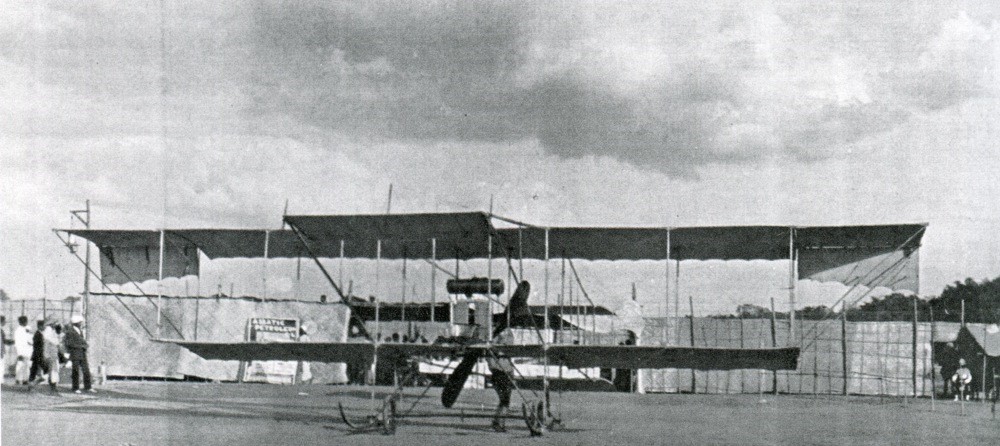
A Farman- and Aviatik-inspired Argus-powered biplane built by the “Aviator” company of Baron Pierre de Caters and the Bollekens brothers. The plane was flown during a tour in India in late 1910 – early 1911 by de Caters and Jules Tyck.
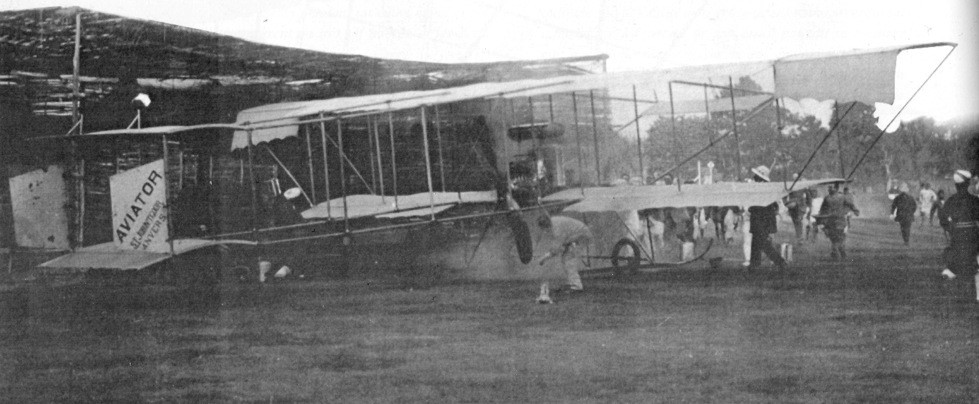
Span: 32’10”
Length: 35’5″
Weight gross: 551 lbs

