Avions de Transport Regional ATR72

ATR72-212

The ATR72, a stretched development of the ATR42 (the fuselage had grown by 4.5 metres to provide space for up to 74 seats), was launched in January 1986 and first flew on 27 October 1988. Significant changes from the ATR-42 (apart from the fuselage stretch) include Pratt and Whitney Canada PW 124-B turbo props with roughly 20 percent more power than the PW 120 of the ATR-42, wingspan extended by 2.48 metres (although the whole of the wing outboard of the nacelles has been simplified and improved), and greater use of composites.
French certification was achieved in September 1989, by which time five aircraft were flying. The first customer delivery, to KarAir in Finland, was made exactly a year after the first flight.
By May 1995,152 ATR-72’s had been firmly ordered or delivered. Construction of the ATR-42 and ATR-72 is on a common assembly line at Toulouse. The ATR72 fuselage and tail is manufactured in Italy, the wings, undercarriage and engine cowlings in France, the engines in Canada, and propellors in the USA.
The ATR72-212A designation being a marketing ploy and rating commonality of Mount Cook Airline for the ATR72-500. The 212A model being certified on 14 January 1997.

ATR72
Engines: 2 x Pratt & Whitney Canada PW 124/2 turboprops , 2,400 shp (1 790 kW).
Wing span: 88 ft 9 in (27,05m).

ATR72 200
Engine: 2 x PWC PW123/PW126

ATR72-210
Engines: 2 x Pratt & Whitney Canada PW127, 2475 shp.
Seats: 66.

ATR72-212

ATR72-212A
Engines: 2 x Pratt & Whitney Canada PW127F, 2750 shp.
Props: 6 blade Hamilton Standard/Ratier-Figeac 568F composite.
Length: 27.166 m.
Wing span: 88 ft 9 in (27,05m).
Height: 7.65 m.
MTOW: 22,500 kg (49,603 lbs).
MLW: 22,350 kg (49,273 lbs).
Max zero fuel wt: 20,300 kg (44,753 lbs).
Max payload: 7450 kg (16,424 lbs).
Seats: 66. Range: 942 nm.
TO field length: 1290m (4232 ft).
Ldg field length: 1067 m (3500 ft).
Max cruise: 278 kts.
Operating ceiling: 25,000 ft.

ATR72-500
Avions de Transport Regional ATR42

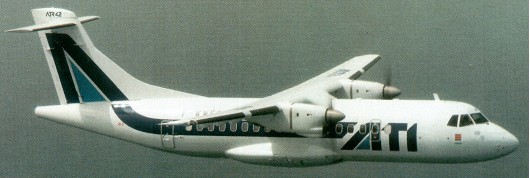
Both Aerospatiale in France, and Aeritalia in Italy, had developed proposals in the late 1970’s for twin turboprop 38/40 seat aircraft. Both companies were looking for partners to further develop the concepts and eventually, in July 1981, a joint venture consortium, ATR, was formed. The new project was designated the ATR 42, the 42 indicating the number of seats at 81 cm pitch. The initials ATR stand for Avion de Transport Regional/ Aereo daTransporto Regionale/ Regional Transport Aircraft. The type made its first flight in August 1984 and was certificated in September 1985. The launch customer was Air Littorial, a French regional opera¬tor, which began operating the type in the following December. The ATR 42 300 (the higher weight version) accommodates a maximum of 50 passengers, but a more typical layout is for 46 passengers. In addition to the generous overhead lockers, baggage compartments are provided both behind the flightdeck and in the rear fuselage. The aircraft is powered by two Pratt and Whitney Canada PW120s, flat rated at 1800shp and driving Hamilton Standard four bladed composite propellors. The ATR 42 structure makes extensive use of composites, particularly Keviar/Nomex sandwich for the wing and tail leading edges, wing and undercarriage fairings, and fuselage tail cone. Carbon/Nomex sandwich is used for the rudder, elevators, flaps, and engine nacelles, and carbon monolithic structure is used for the ailerons and outer wing panels. using experience gained with the Airbus, the flight deck is EFIS equipped. Subsequently the consortium has developed the ATR 72, a stretched version of the ATR 42 which uses the same wings and tail but uprated engines.

Avions de Transport Regional ATR42 Article

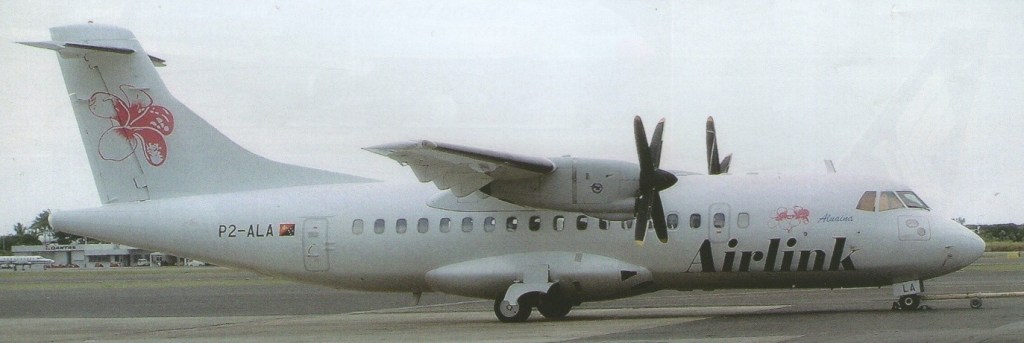
ATR 42-320 P2-ALA

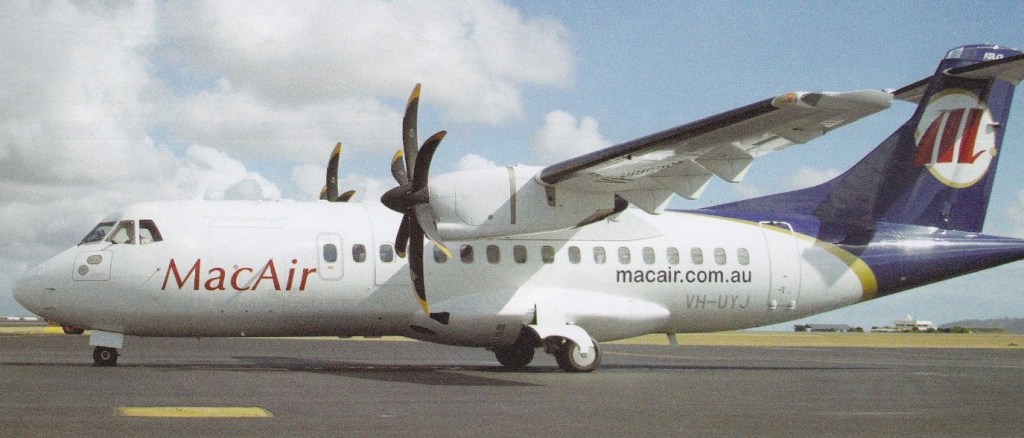
As at May 1995, 286 of these aircraft had been ordered or delivered. ATR42F freighter. The ATR42-500 first flew in September 1994.

1998 ATR42-500 VH-UYJ

The ATR 42-600 pre-series aircraft (F-WWLY c/n 811) completed its maiden flight on 4 March 2010 from Toulouse Blagnac Airport in southern France. The two-hour flight included tests of the Pratt & Whitney PW127M turboprops, the balance of the propellers, the new avionics, hydraulic and electrical systems.

The ATR 42-600 will undertake a 75hour flight test campaign. Many of the systems are the same as used in the ATR 72-600, which began its 150-hour flight test programme in July 2009. To March 2010 ATR had orders for five 42-600s and 54 72-600s.

Gallery

ATR42-300
Engines: 2 x Pratt & Whitney PW120.
Pax cap: 46.

ATR-42R
Engine: 2 x P&W PW 120 turboprop.
Installed pwr: 2680 kW.
Span: 24.6 m.
Length: 22.7 m.
Wing area: 54.5 sq.m.
Height: 7.586m.
Empty wt: 9937 kg.
MTOW: 15,750 kg.
Payload: 4530 kg.
Cruise speed: 470 kph.
Initial ROC: 490 m / min.
Ceiling: 7650 m.
T/O run (to 15m): 660 m.
Ldg run (from 15m): 560 m.
Fuel internal: 5700 lt.
Range/payload: 2535 km with 4000 kg.
Capacity: 44 pax.

ATR42-400MP

ATR42-500
Engines: 2 x Pratt & Whitney PW127E.
Pax cap: 46-50.

Avions de Transport Regional

Avions de Transport Regional was founded 1982 by Aerospatiale of France and Alenia of Italy to develop a twin-turboprop regional transport aircraft. The initial ATR 42 42/48-seat airliner or freighter was first flown in August 1984, with production deliveries from 1989. Followed by the larger ATR 72 for 66-74 passengers (first flown October 1988 and also delivered from 1989). Both also available in Maritime Patrol form.

Jan 2007

Avionnerie Lac St. Jean Cyclone

Super Cyclone

Quebec’s Avionnrie Lac St-Jaen marketed an exact replica of the 1954 Cessna 180 as the Cyclone 180 kit plane. The Cyclone 180 can be completed to replicate a CE-170, CE-180 or CE-185.

Cyclone
Engine: Continental, 230 hp.
HP range: 145-350.
Speed max: 170 mph.
Cruise: 158 mph.
Range: 870 sm.
Stall: 37 mph.
ROC: 1300 fpm.
Take-off dist: 250 ft.
Landing dist: 950 ft.
Service ceiling: 17,700 ft.
Fuel cap: 65 USG.
Weight empty: 1700 lbs.
Gross: 3000 lbs.
Height: 7.5 ft.
Length: 26 ft.
Wing span: 38 ft.
Wing area: 185.7 sq.ft.
Seats: 4.
Landing gear: nose or tail wheel.

Super Cyclone
Engine: Continental, 300 hp.
HP range: 300-350.
Speed max: 175 mph.
Cruise: 165 mph.
Range: 1000 sm.
Stall: 37 mph.
ROC: 1500 fpm.
Take-off dist: 250 ft.
Landing dist: 650 ft.
Service ceiling: 17,700 ft.
Fuel cap: 90 USG.
Weight empty: 1800 lbs.
Gross: 3500 lbs.
Height: 7.5 ft.
Length: 26 ft.
Wing span: 38 ft.
Wing area: 185.7 sq.ft.
Seats: 2.
Landing gear: nose or tail wheel.

Avion Inc

USA . Formed 1942 to undertake research, engineering, and production of military aircraft. Orders during war included subassemblies for Northrop and Lockheed. In January 1943 received Northrop subcontract for three XP-79 jet fighters, one of which (MX-324) was the first American rocket-propelled aircraft to fly, on July 5,1944.

Aviolight SRL

Founded 1988 by Partenavia, Tecnam, and Avio Interiors to manufacture the Partenavia-developed P.86 Mosquito two-seat lightplane (first flown 1986). Also assigned P.66D Delta two/three-seater.
In 2008, Partenavia, an Aeritalia division, announced a decision to transfer manufacturing of single engined aircraft, including the Mosquito, to fellow Aeritalia subsidiary Aviolight, which was floated at the end of February 2008.

Aviolanda

AVIOLANDA MAATSCHAPPIJ VOOR VUEGTUIGBOUW NV
AC-pi / ML-sp
Founded December 1926. Before Second World War built under license Dornier Wai twin-engined flying-boats for Royal Netherlands Naval Air Service and Curtiss Hawk biplane fighters for East Indies Army Air Service. After war made assemblies for Gloster Meteor, Hawker Hunter, and Lockheed Starfighter. Made N.H.I. Kolibrie helicopter. Developed AT-21 pilotless drone and aircraft components (e.g. passenger ramps). Extensive repair and overhaul work also undertaken.
Aviolanda, De Schelde and Fokker were eventually to unite, but not until long after World War Two.