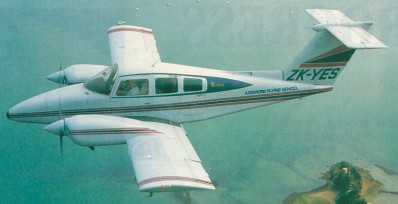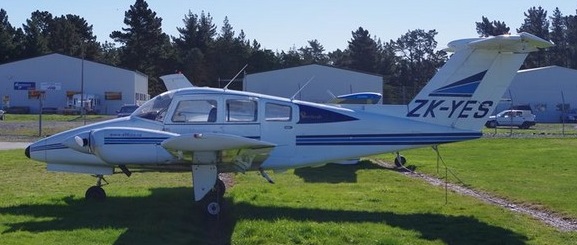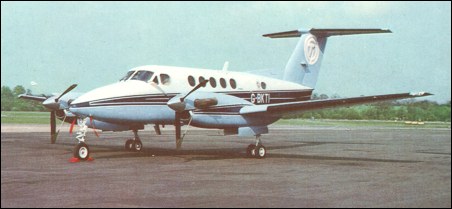
Beechcraft 200 King Air / 1300 Commuter / C-12

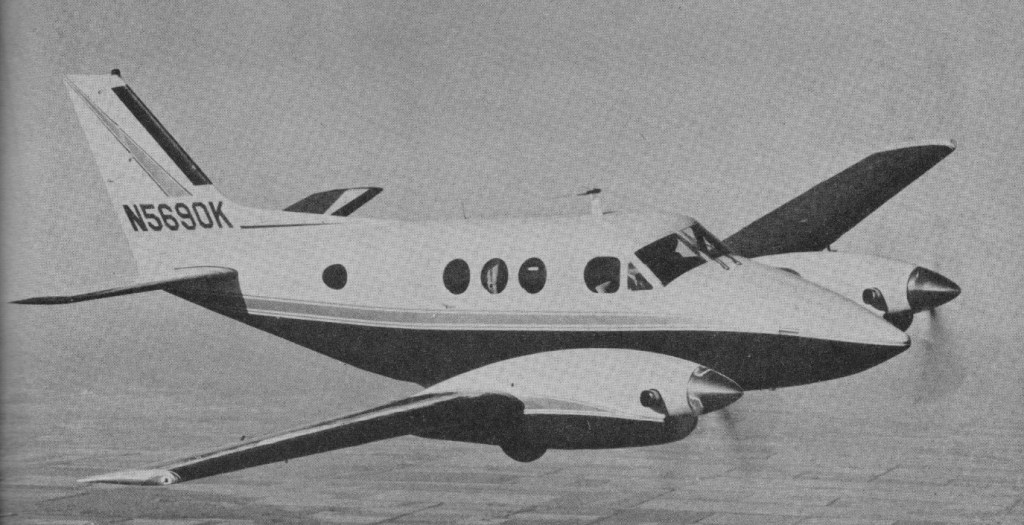
A development of the King Air 90/100, the prototype King Air 200 flew on 27 October 1972. With bigger engines, a bigger wing, more fuel capacity and more useful load, the B200 came along in 1980 with even more efficient Pratt & Whitney PT6A42 engines and another increase in load.

Beechcraft 200 King Air Article

The T-tail Super King Air, with its two 850-shp Pratt & Whitney engines, can be operated from smaller airports; takeoff and landing over a 50-foot obstacle can be accomplished in 2579 and 2845 respectively, without prop reversing.
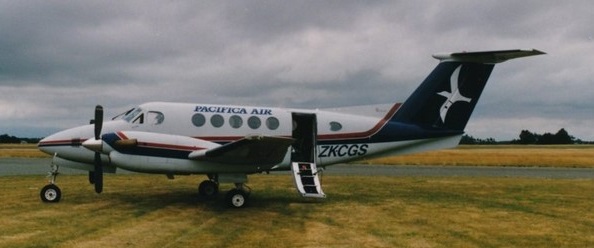
Beechcraft 200 Super Kingair ZK-CGS

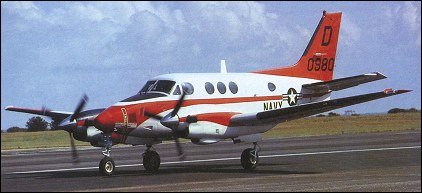
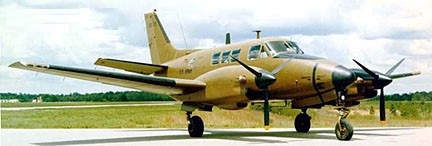
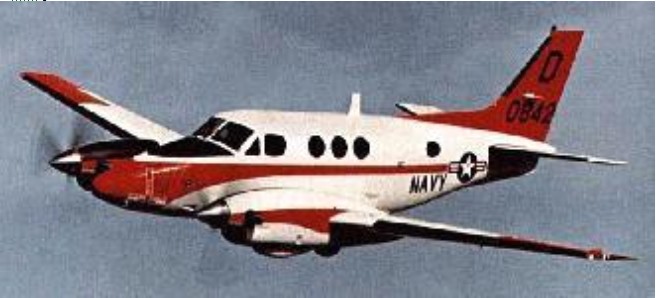
First deliveries of Super King Airs were made in early 1974, and the better capability of this aircraft resulted in the company receiving contracts for the supply and support of 34 examples modified for service with the US Army. These are powered by 559kW PT6A-38 turboprop engines, and were allocated the designation C-12A subsequent military orders for the C-12A have to date included 27 and 30 for the US Army and USAF respectively. Other service variants are the UC-12B (66 ordered) for the US Navy/Marine Corps, powered by 634kW PT6A-41 turboprops; the C-12C (14) for the US Army with PT6A-41 engines; the generally similar C-12D (27) for the US Army, but with an added cargo door; and the special-mission RU-21J (three) bristling externally with antennae and equipped for the requirements of the US Army’s ‘Cefly Lancer’ programme. More recent variants are the RC-12D ‘Guardrail V electronic reconnaissance platform, C-12E upgraded transport for the USAF, C-12F transport for USAF and UC-12F for the Navy, RC-12H reconnaissance variant and UC-12M utility transport.

Beechcraft C-12 reconnaissance ops

The USAF purchased 40 twin-turboprop Super King Air I 200Cs as C-l2Fs to meet part of its Operational Support Aircraft requirement following an initial period of lease.
The cargo door developed for the US Army’s C-12D has been available as an option for civil production since 1979, and in April 1981 Beech introduced a new version, identified as the Super King Air B200. It differs by having PT6A-42 turboprop engines which offer improved cruising performance.
A little known but important part of Beech’s product line is the company’s special mission range of aircraft standard models factory modified and certified for aerial survey, photography, specialized training and other unusual purposes. One aircraft developed is a Super King Air with tip tanks, several of which are being built for the French Institut Geographique National for long range photo flights. The tip tanks add about an hour to the KA’s endurance.
Other military versions of the King Air series I include the C/UC/RC-12, RU-12, and T-44 for the US forces, together with maritime surveillance variants produced for export customers, for which search radar, low-light TV, Flir, and acoustic processing equipment are optional.
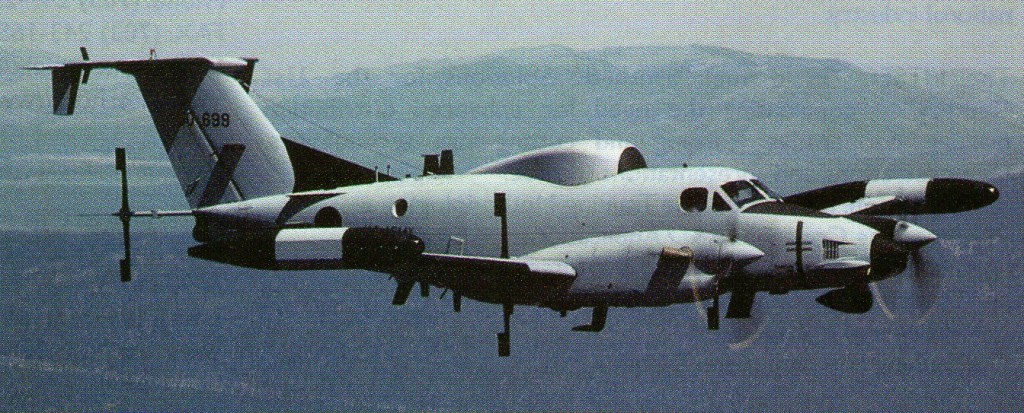
Beechcraft RC-12 Guardrail

In 1995, Raytheon rolled out its 1,500th King Air 200, complete with an EFIS avionics panel.

Variants

Super King Air Model 200T:
designation of two specially-equipped aircraft for the French Institut Geographique National for high-altitude photographic and weather observation duties;

Super King Air Maritime Patrol 200T:
maritime patrol/multi-mission aircraft, with new outboard wing panels to provide for installation of wingtip fuel tanks, strengthened landing gear, hatch for dropping survival equipment, bubble observation window in aft cabin, and search radar with a 360° scan underfuselage radome; orders include 13 for Japan Maritime Safety Agency, and one for Uruguayan navy;

Super King Air B200C:
version of civil B200 with a cargo door as standard;

Super King Air B200CT:
version of civil B200 with a cargo door and removable wingtip fuel tank provisions as standard;

Super King Air B200T:
version of the civil B200 with removable wingtip fuel tank provisions as standard;

Super King Air 300:
improved version with PT6A-60A turboprops each rated at 783kW and corresponding increase in take-off weight. The 300LW is a lightened version optimised for European operations;

1300 Commuter:
King Air B200 version for commuter airlines. Accommodates up to 13 passengers with an optional belly luggage pack.

Gallery

BE-200 Super King Air
First built: 1974.
Engines: 2 x P&W PT6A-42, 850 shp.
Props: Hartzell 3-blade, 98.5-in.
Seats: 8/15.
Length: 43.8 ft.
Height: 15 ft.
Wingspan: 54.5 ft.
Wing area: 303 sq.ft.
Wing aspect ratio: 9.8.
Maximum ramp weight: 12,590 lbs.
Maximum takeoff weight: 12,500 lbs.
Standard empty weight: 7538 lbs.
Maximum useful load: 5052 lbs.
Maximum landing weight: 12,500 lbs.
Wing loading: 41.3 lbs/sq.ft.
Power loading: 7.4 lbs/hp.
Maximum usable fuel: 3645 lbs.
Best rate of climb: 2450 fpm.
Service ceiling: 35,000 ft.
Max pressurisation differential: 6.5 psi.
8000 ft cabin alt @: 29,742 ft.
Maximum single-engine rate of climb: 740 fpm @ 122 kts.
Single-engine climb gradient: 364 ft/nm.
Single-engine ceiling: 21,735 ft.
Maximum speed: 294 kts.
Normal cruise @ 27,000 ft: 279 kts.
Fuel flow @ normal cruise: 563 pph.
Endurance at normal cruise: 5.9 hrs:
Stalling speed clean: 99 kts.
Stalling speed gear/flaps down: 75 kts.
Turbulent-air penetration speed: 170 kts.

A200
Engines two 850-shp Pratt & Whitney reverse flow, free turbines.
Seats 6-13.
Gross Wt. 12,500 lbs.
Emp¬ty Wt. 7437 lbs.
Fuel capacity 544 USG.
Top speed 333 mph.
Cruise 322 mph.
Stall 86 mph.
Initial climb rate 2450 fpm.
Ceiling 31,000+ ft.
Range 2022 sm.
Takeoff distance (50’) 2579 ft.
Landing distance (50’) 2074 ft.
Seats: 6-13

Super King Air B200
Engines: 2 x Pratt & Whitney Aircraft Canada PT6A-42 turboprops, 850 shp / 634kW
Max Take-off weight: 5670 kg / 12500 lb
Empty weight: 8,283 lb
Fuel capacity: 544 US gal
Std useful load: 5,052 lbs.
Wingspan: 16.61 m / 54 ft 6 in
Length: 13.34 m / 43 ft 9 in
Height: 4.57 m / 14 ft 12 in
Wing area: 28.15 sq.m / 303.00 sq ft
Max. speed: 545 km/h / 339 mph / 294 kt
Cruise speed: 523 km/h / 325 mph
Ceiling: 10670 m / 35000 ft
Range: 3756 km / 2334 miles
Initial climb rate: 2,460 fpm
Takeoff distance: 2,579 ft
Landing distance: 2,845 ft.
Seats: 8

C-12 Huron
Engines: 2 x Pratt & Whitney PT6A-21, 550 SHP
Maximum Range: 215miles (346km)
Rate-of-Climb: 2,010ft/min (613m/min)
Service Ceiling: 35,105ft (10,700m; 6.6miles)
Accommodation: 1 + 5

C-12D
Engine: 2 x P&WAC PT6A.
Installed pwr: 1270 kW.
Span: 16.6 m.
Length: 13.4 m.
Wing area: 27.9 sq.m
Empty wt: 3655 kg.
MTOW: 5670 kg.
Payload: 2040 kg.
Cruise speed: 510 kph.
Initial ROC: 730 m / min.
Ceiling: 9450 m.
T/O run (to 15m): 1005 m.
Ldg run (from 15m): 790 m.
Fuel internal: 1160 lt.
Range: 3300 km.
Capacity: 14 pax.

U-21J
US Army version of the Super King Air 200 for battlefield reconnaissance and EW missions

RC-12D
Engines: two 1,050 shp (783 kW) Pratt & Whitney PT6A turboprops
Gross weight: 14,200 lb (6 441 kg).

RC-12J

RC-12K
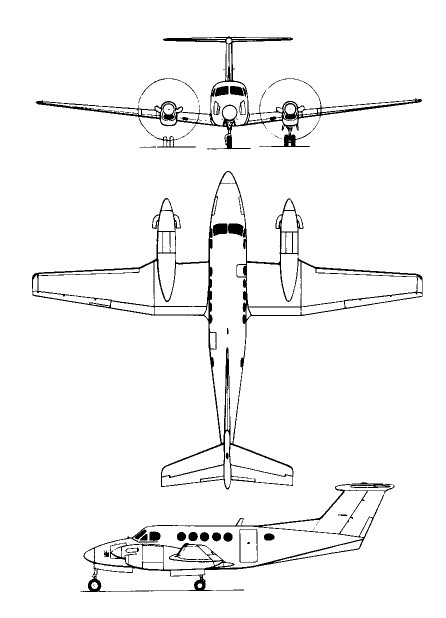
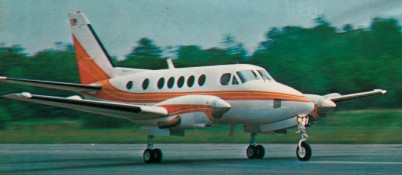
Beechcraft 100 King Air / U-21F

B100 King Air

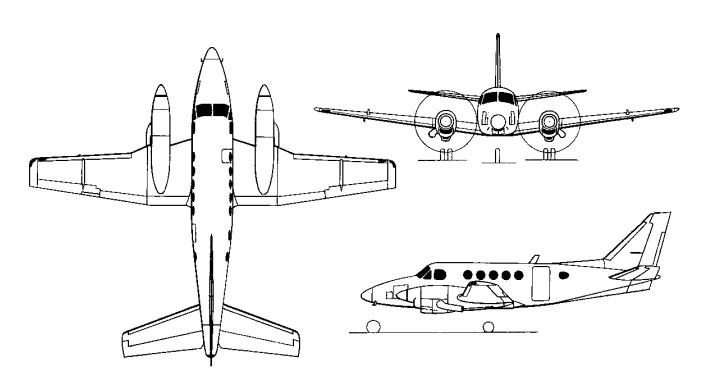
The 100 series was introduced in 1969 when initial deliveries were made in August 1969, and employed the 680-shp Pratt & Whitney turboprop. All have full-feathering, reversible propellers. It differed from the earlier King Airs in reduced wing span, a lengthened fuselage to provide accommodation for a maximum of 15 persons, increased elevator and rudder areas, twin-wheel main landing gear, and more powerful engines. The new wing was generally similar to that developed for the Model 99 Airliner. Their pressurized, three-compartment interior can be maintained at sea level atmosphere pressure to flight levels as high as 10,500 feet.

In October 1971 Beech began deliveries of the improved King Air A100, this variant incorporating detail improvements, and the first five were supplied to the US Army under the designation U-21F, 70-15908/15912. Examples have been procured by the Spanish air force, and a Universal Aircraft Com/Nav Evaluation (UNACE) configured version, for the rapid inspection and calibration of air navigation systems, has been supplied to countries that include Algeria, Belgium, Canada, Indonesia, Malaysia, Mexico, and the USA. Beech also produces specially modified camera-equipped versions of the King Air for aerial survey, and examples are in service in this role in Canada, Chile, France, Jamaica, Saudi Arabia, Thailand, and the USA.

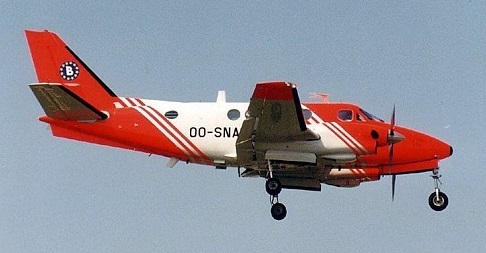
Beechcraft A.100 King Air OO-SNA (c/n B-217)

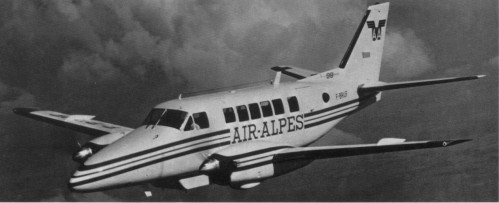
The higher capacity versions are the A100 and B100, with the latter being the first King Air to be outfitted with Garrett turboprops. In parallel with A100 production since late 1975, Beech has produced a complementary King Air B100 offering higher performance. It differs by the installation of 533kW Garrett TPE331-6-252B turboprop engines, and of equipment directly associated with the engine installation. Beech has mated two Garrett AiResearch TPE 331 6 252B 840 shp derated to 715 shp turboprop engines to the A100 airframe. Beech made the move to assure that they would have two sources of engines considering the interruption in deliveries that was caused when United Aircraft of Canada, Ltd. (now known as Pratt & Whitney of Canada) struck for 19 months in 1974 and 1975. The derated TPE 331 turboprop engines affect the pilot’s procedures and the aircraft’s performance more than the handling qualities. The B100’s powerplant thrust line was raised somewhat, to counter the longitudinally destabilizing influence of five percent more horsepower. Because the derated Garrett powerplants are ca-pable of producing 840 shp, their performance in the B100 on hot days and at altitude surpasses that of the MA 28s used on the A100. Thus, the B100 is 16 knots faster than the A100 at 10,000 feet and 27 knots faster at FL 200 (262 knots compared with 235 knots at maximum cruise power). Range for both 100s at maximum cruise power with maximum payload on board and 45 minutes’ reserve is slightly more than 1,200 nm.
Production of the King Air 100 ended in 1983.

Gallery

A100
Engines: 2 x Pratt & Whitney PT6A-28 free turbine, 680 shp / 507kW.
Wingspan: 14.0 m / 45 ft 11 in
Length: 12.17 m / 39 ft 11 in
Height: 4.7 m / 15 ft 5 in
Gross Wt. 11,568 lbs.
Empty wt: 6754 lb.
Equipped useful load: 4564 lb.
Payload max fuel: 1415 lb.
Wing loading: 40.8 lb/sq.ft.
Pwr loading: 8.46 lb/hp.
Fuel capacity 470 USG/3149 lb.
Ceiling 24,850 ft.
Range max fuel/cruise: 933nm/3.7hr.
Range max fuel /range: 1319nm/6.3hr.
Max cruise: 248 kt.
Max range cruise: 211 kt.
Vmc: 85 kt. Stall: 75-89 kt.
1.3 Vso: 98 kt.
Takeoff distance (50’) 2681 ft.
Landing distance (50’) 2109 ft.
ROC: 1963 fpm.
SE ROC: 452 fpm @ 119 kt.
SE ceiling: 9,300 ft.
Certified Service Ceiling: 24,850 ft.
Seats: 8 to 15.
Pressurisation: 4.6 psi.
8000ft cabin alt: 21,000ft.

BE-B100 King Air
First built: 1976.
Engines: 2 x Garrett TPE 331-6-252B, 715 shp.
Props: Hartzell 4-blade, 90-in.
Seats: 8/15.
Length: 39.9 ft.
Height: 15.4 ft.
Wingspan: 45.9 ft.
Wing area: 280 sq.ft.
Wing aspect ratio: 7.5.
Maximum ramp weight: 11,875 lbs.
Maximum takeoff weight: 11,800 lbs.
Standard empty weight: 7082 lbs.
Maximum useful load: 4793 lbs.
Zero-fuel weight: 9600 lbs.
Maximum landing weight: 11,210 lbs.
Wing loading: 42.2 lbs/sq.ft.
Power loading: 8.3 lbs/hp.
Maximum usable fuel: 3149 lbs.
Best rate of climb: 2139.
Service ceiling: 28,138 ft.
Max pressurisation differential: 4.6 psi.
8000 ft cabin alt @: 21,200 ft.
Maximum single-engine rate of climb: 501 fpm @ 129 kts.
Single-engine climb gradient: 233 ft/nm.
Single-engine ceiling: 12,120 ft.
Maximum speed: 265 kts.
Normal cruise @ 21,000ft: 262 kts.
Fuel flow @ normal cruise: 540 pph.
Endurance at normal cruise: 5.3 hrs:
Stalling speed clean: 93 kts.
Stalling speed gear/flaps down: 83 kts.
Turbulent-air penetration speed: 170 kts.

Beechcraft 99 Commuter

Beechcraft 99

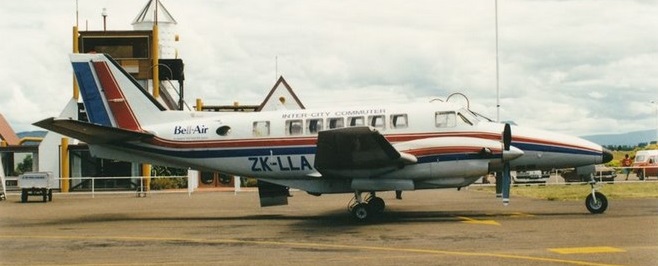
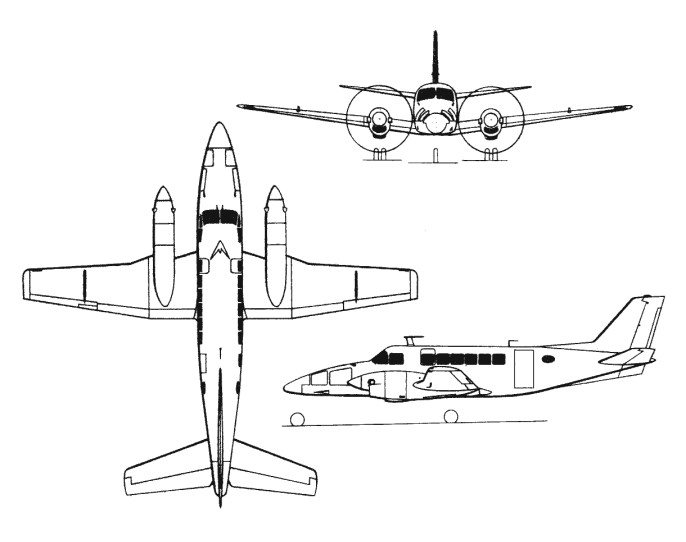
In production until 1978 the Beechcraft 99 Airliner was the first turbine-powered retractable landing gear aircraft to meet FAA approval for commuter air carrier service (regulations requiring a flight attendant for aircraft with 20 or more passengers). The test and development aircraft, which first flew in December 1965, was again a stretched fuselage Queen Air, initially with piston engines but was quickly upgraded to Pratt&Whitney PT6-A-27 turboprops. It was flown in July 1966, with type approval obtained in May 1968. With only capacity for two pilots and 15 passengers, it was less economical than the Twin Otter and required longer runways to operate from.

Beechcraft 99 Commuter Article

First delivered in 1968, the Model 99 was powered by twin 550-shp Pratt & Whitney turboprops driving reversible propellers. These enable the Beechcraft 99 to cruise at more than 250 mph and pull a gross load of 10,200 pounds or more. Introduced in 1969, the 99A Airliner housed 680-shp Pratt & Whitney free-shaft turbines flat rated at 550 shp. Except for the engines, the 99A is identical to the original 99.

Beechcraft 99A ZK-LLA

The 99B, announced in 1972, featured engineering improvements for increased reliability, maintainability and passenger comfort. The ship has an air-conditioning unit as an option with its high pressure continuous-flow oxygen system. Also, an optional cargo door and cargo pod, installed beneath the fuselage, in¬creases its cargo capability. Seating can be varied to suit specific needs. After building only 164 Model 99 aircraft, Beech withdrew from this market in 1975. However, with the Air Deregulation Act of 1978 the upgraded Model 99 was brought back into production as the model C99 Airliner powered by the P&W PT-6A-36, with a further 75 of these C99s being built.

99
Engines: 2 x Pratt & Whitney (UACL) PT6A 20 turboprop, 550 shp.
Props: 6 ft 7in (2.02 m) dia 3-blade.
Wing span: 45 ft 10.5in.
Length: 44 ft 6.75in (13.58m).
Wing area: 279.7 sq ft (25.88 sq.m).
Gross Wt. 10,400 lbs (4,717 kg).
Empty Wt. 5675 lbs.
Fuel capacity 374 USG.
Max cruising speed: 254 mph (409 kph) at 10,000 ft (3,050 m).
Range: 1,100 miles (1,770 km) with 1,800 lb (816 kg) payload.
Crew: 2.
Pax cap: 15.
Stall 75 mph.
Initial climb rate 1910 fpm.
Ceiling 25,000 ft.
Takeoff distance (50’) 3200 ft.
Landing distance (50’) 2470 ft.

99A
Engines: 2 x Pratt & Whitney PT6A 27 turboprop, 680 shp.

B99
Engine: 2 x P&WAC PT6A-27, 680 hp.
Seats: 17.
Wing loading: 38.97 lb/sq.ft.
Pwr loading: 8.02 lb/hp.
Gross wt: 10,995 lb.
Empty wt: 5891 lb.
Equipped useful load: 4784 lb.
Payload max fuel: 2318 lb.
Range max fuel/cruise: 749nm/3hr.
Range max fuel /range: 1097nm/5.3hr.
Ceiling: 26,313 ft.
Max cruise: 245 kt.
Max range cruise: 209 kt.
Vmc: 85 kt.
Stall: 75-91 kt.
1.3 Vso: 98 kt.
ROC: 2070 fpm.
SE ROC: 561 fpm @ 117 kt.
SE ceiling: 13,000 ft.
Min field length: 2800 ft.
Fuel cap: 2466 lb.
Takeoff distance (50’) 2480 ft.
Landing distance (50’) 1810 ft.

BE-C99 Airliner
First built: 1981.
Engines: 2 x P&W PT6A-36, 715 shp.
Props: Hartzell 3-blade, 93-in.
Seats: 17.
Length: 44.6 ft.
Height: 14.4 ft.
Wingspan: 45.9 ft.
Wing area: 279.8 sq.ft.
Wing aspect ratio: 7.5.
Maximum ramp weight: 11,380 lbs.
Maximum takeoff weight: 11,300 lbs.
Standard empty weight: 6124 lbs.
Maximum useful load: 5256 lbs.
Maximum landing weight: 11,300 lbs.
Wing loading: 40.4 lbs/sq.ft.
Power loading: 7.9 lbs/hp.
Maximum usable fuel: 2466 lbs.
Best rate of climb: 2221 fpm
Service ceiling: 28,080 ft.
Maximum single-engine rate of climb: 539 fpm @ 119 kts.
Single-engine climb gradient: 270 ft/nm.
Single-engine ceiling: 14,360 ft.
Maximum speed: 226 kts.
Normal cruise @ 8,500 ft: 249 kts.
Fuel flow @ normal cruise: 740 pph.
Endurance at normal cruise: 2.8 hrs:
Stalling speed clean: 94 kts.
Stalling speed gear/flaps down: 83 kts.
Turbulent-air penetration speed: 169 kts.

Beechcraft 95 Travel Air

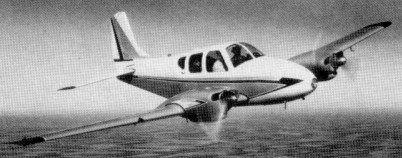
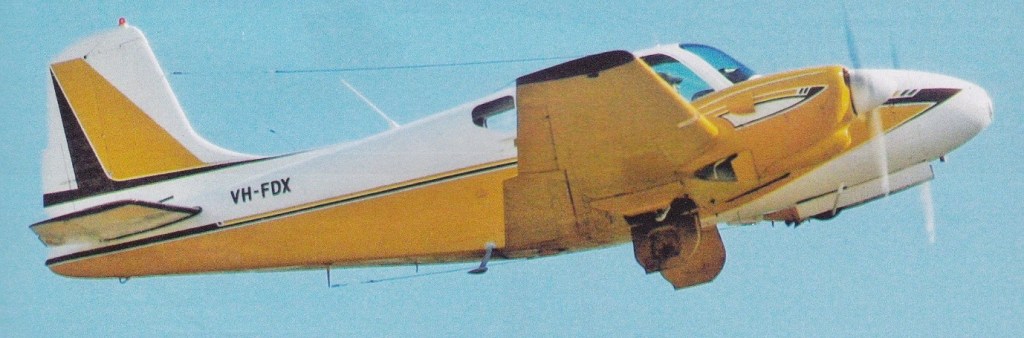
When the Model 95 Travel Air was in its prototype stage in 1956, it was known as the Badger. It entered production in 1958, with a factory list price of $49,500.

The first Beech Travel Air on the British register (1960) was G-APUB.

B95 Travel Air VH-FDX, ex-VH-CLK, April 2007

In the 10 following years, the Travel Air was subject to a few major changes. Engine power output remained at 180 on all models, with carburetors being replaced by fuel injectors in 1964. In that same year, the cabin was stretched an additional 20 inches. The factory price rose, in 1968, to $153,500 list, including avionics. Only 14 1968 E95 model were built. In all these years and changes, the basic performance figures of the Travel Air differed only slightly. Top speed varied only by a mile per hour or so, cruise rose from 195 to 200, and range and altitude held constant. A limitation of the Travel Air to some pilots was the low single-engine ceiling of 4400 feet.

1958 Beechcraft Travel Air
Engines: Lycoming O-360-A1A, 180 hp
TBO: 2000 hrs
Fuel type: 80/87
Propeller type/diameter: Hartzell/72 in
Landing gear type: Tri/Retr.
Max ramp weight: 4000 lb
Gross weight: 4000 lb
Landing weight: 4000 lb
Empty weight, std: 2500 lb
Useful load: 1172 lb
Payload, full std. fuel: 548 lb
Usable fuel, std: 112 US gal
Wingspan: 37 ft. 10 in.
Overall length: 25 ft. 4 in.
Height: 9 ft. 6 in.
Wing area:193.8 sq. ft
Wing loading: 20.6 lbs./sq. ft
Power loading: 11.1 lbs./hp
Wheel base: 7 ft.
Wheel track: 9 ft. 7 in.
Wheel size: 6.5 x 8 in (mains), 5 x 5 in (nose)
Seating capacity: 4
Cabin doors: 1
Cabin width: 42 in
Cabin height: 50 in
Baggage capacity: 270 lb front, 270 lb rear
Cruise speed 75% power @ 7,500 ft.: 200 kt
Cruise speed 65% power @ 10,500 ft.: 195 kt
Cruise speed 55% power @ 14,000 ft.: 181 kt
Fuel consumption 75% power: 21.0 USgph
Fuel consumption 65% power: 17.5 USgph
Fuel consumption 55% power: 15.0 USgph
Max range (w/reserve): 1360 nm
Vs: 84 mph
Vso: 70 mph
Best rate of climb @ gross: 1360 fpm
Best rate of climb, 8000 ft. @ gross: 800 fpm
Service ceiling (ft.): 18,100
Takeoff ground roll: 1700 ft (no wind, standard day, sea level)
Takeoff over 50-ft. obstacle: 2000 ft
Landing ground roll: 1100 ft
Landing over 50-ft. obstacle: 2200 ft

Beechcraft 1960 B95 Travel Air
Engine: Lyc. O-360-A1A, 180 hp
TBO: 2000 hr
Propeller: Const. spd.
Landing Gear type: Tri./Retr.
Gross weight: 4100 lb
Empty weight, std: 2860 lb
Useful load, std: 1240 lb
Fuel: 84 US gal
Wingspan: 37 ft. 10 in.
Overall length: 25 ft. 4 in.
Height: 9 ft. 8 in.
Wing area: 199 sq. ft
Seating capacity: 6
Cabin width: 42.5 in
Cabin height: 50 in
Baggage capacity: 270 lb (front.) /400 lb (rear)
Cruise speed, 8,000 ft 75% power: 170 kt
Cruise speed, 8,000 ft 65% power: 167 kt
Max range (w/ reserve) 75% power: 887 nm
Max range (w/ reserve) 65% power: 1008 nm
Fuel consumption 70% power: 21.0 US gph
Fuel consumption 65% power: 17.2 US gph
Stall speed (gear, flaps down): 60 kt
Best rate of climb: 1300 fpm
Service ceiling: 18,100 ft
Takeoff ground roll: 1740 ft
Landing ground roll: 1015 ft

D95A
Engines: 2 x IO 360 B1B.

E95
Engines: 2 x Lycoming O 360-AlA, 180-hp.
Seats 4-5.
Gross Wt. 4200 lbs.
Empty Wt. 2650 lbs.
Fuel capacity 112 USG.
Top speed 240 mph.
Cruise 200 mph.
Stall 75 mph.
Initial climb rate 1250 fpm.
Range 1035 sm.
Ceiling 18,100 ft.
Takeoff distance (50’) 1280 ft.
Landing distance (50’) 1590 ft.

E95 Travel Air
Engines: 2 x 180¬hp Lycoming IO 360 B1B.

Beechcraft 90 King Air / U-21 / VC-6 / T-44 Pegasus / Swearingen Taurus

Beech had been working on the model 90 King Air since 1963 (then identified as the Beech Queen Air Model 65-80) utilising the 373kW P&W turboprop PT6 engines. This aircraft was basically a Queen Air fitted with turboprop engines and first flew in January 1964. It proved to be faster than the Twin Otter but still only provided seating for nine passengers. The Model 65-80 designation was confusing as there were Model 65 and Model 80 Queen Airs in production, so the aircraft became known temporarily as the Model 65-90T (T standing for turboprop). In due course, an even better job was made of clarifying the situation by renaming the turboprop-powered Queen Airs as King Airs. In effect, therefore, the Model 65-90T was the prototype for the Beech Model 90 King Air series, but more specifically became the prototype of the unpressurised military Kings Airs.

Beechcraft 90 King Air / U-21 Article

Announced with a basic price of $300,000, first deliveries were planned for the Fall of 1964. Following the first flight of the Model 65-90T, a civil equivalent was produced in parallel with a pressurised cabin, and the first production prototype of this aircraft, designated Model 90 King Air, flew for the first time on 20 January 1964.

The Pratt & Whitney PT6A-6, 550 shp King Air was fully pressurised.

The first overseas tour for Beech’s King Air started 4 September 1965 with a non-stop Gander, Newfoundland, to Paris flight, first for a plane in this category. Bob Oestreicher, Beech pilot, and Pierre Allain, of Neuchtel, Switzerland, landed at Toussus-Le-Noble Airport near Paris 9 hr 50 min after takeoff. Groundspeed for the 2600 mile trip was 264 mph at 17,000 ft. The only squawk was the clock lost 30 sec over the Atlantic.

US Army testing of the Model 65-90T, under the military designation NU-8F, had shown the aircraft to be suitable for the military requirement, so an initial order for 48 aircraft, under the designation U-21A (TC 3A20), was placed. Beech distinguished its military King Airs from civil versions by identifying them as Model 65-A90-1, and began modification of the civil aircraft to provide a utility interior. This accommodates a crew of two and 10 troops, or six to eight command personnel, or three stretchers, and seating can be removed easily for the carriage of up to 1361kg of cargo.

Beech U-21A

Initial deliveries of production U-21As, which were given the name Ute, began on 16 May 1967, and subsequent contracts resulted in more than 160 being built. These included U-21As and RU-21A/RU-21D variants all with 410kW Pratt & Whitney PT6A-20 turboprops, and RU-21B/ RU-21C/RU-21E variants with 462kW PT6A-29s. The RU-21s were developed especially for operation in an electronic reconnaissance role in South-East Asia, sprouting a strange collection of aerials and sensors, and being equipped internally with related avionics’ systems, plus nav/com systems suitable for all-weather operations. RU-21Bs and RU-21Cs had Beech designations Model 65-A90-2 and Model 65-A90-3 respectively, and the designation U-21G applied to 17 aircraft for the USAF that were similar to the U-21A. Deliveries of the civil Model 90 King Air began in late 1964, this having cabin pressurisation, and accommodating a maximum of 10 persons, including the pilot. It was superseded in early 1966 by the King Air A90, which introduced the more powerful PT6A-20 engines.

The 90, A90 (first flying in 1966) and B90 are all powered by 500 shp.

The A90 was followed by a King Air B90 with detail improvements in 1970, the B90 was fitted with a 550-shp Pratt & Whitney engines.

In September 1970 by the King Air C90 which introduced a more advanced pressurisation and heating system for the cabin, still with 550-shp Pratt & Whitney engines. The C90 was in production in 1982, with a total close to 1,000 having been delivered by the end of the year. One of these, designated VC-6B, also serves with the USAF’s 1,254th SAM Squadron. The single VC-6A operated by the 89th Military Airlift Wing at Andrews AFB, Maryland, was placed in service in early 1966, and retired in 1985.

Since its introduction, the C90 has been the subject of steady improvement, the 1982 powerplant was the PT6A-21. Ten examples of the C90 serve with the Spanish air force and civil aviation school for instrument training and liaison.

The E90 became part of the lineup in 1972 and employed the 680-shp Pratt & Whitney PT6A-28 turboprop, flat-rated to 410kW. All have full-feathering, reversible propellers. Their pressurized, three-compartment interior can be maintained at sea level atniosphere pressure to flight levels as high as 10,500 feet. The E90 is virtually a more powerful version of the C90. This version remains in production in 1990.

An addition to the King Air line in June 1979 is the F90, a fuel-efficient version, thanks in part to the new Pratt & Whitney engines with improved turbine blades which extract more power from the engine, four blade propellers and full deicing equipment. At 300 mph true air speed it burns less than 70 gallons per hour. Slower-turning props also reduce interior noise levels. This combined the pressurised fuselage of the Model 90, with the wings and tail unit of the Models 100 King Air and 200 Super King Air respectively. The dual wheel gear are fitted with brake deice systems. The pressurization differential of 5.0 pounds/sq.in. provides a sea-level cabin at 11,000 feet. The F90 was powered by 750 shaft horsepower Pratt & Whitney PT6A 135 engines and sold for $954,500.

In 1976 the Naval Air Systems Command selected Beech win¬ner of an industry, competition for a three year pur¬chase of new multi engine training aircraft for Naval aviators. The Navy selected an aircraft that combined features of the C90 and E90, designated T 44A. The aircraft is powered by two 550 shp PT6A-34B turbo-prop engines. A total of 15 aircraft purchased by the Navy are to replace piston engine powered TS 2A and TS 2B trainers.

Students selecting the Specialized Undergraduate Pilot Training [SUPT] turboprop track attend T-44 training conducted by the U.S. Navy at Corpus Christi, Texas, and then go on to flying duties in turboprop aircraft. Training includes the Navy common maritime turboprop course followed by an Air Force top-off course. The top-off course consists of single aircraft and formation tactical low level airdrop procedures. Training takes approximately 26 weeks and includes 152 hours ground training, 30 hours in the flight simulator and 111 flying hours in the T-44. The T-44 is equipped with deicing and anti-icing systems augmented by instrumentation and navigation equipment which allows flight under instrument and icing conditions. The interior includes a seating arrangement for an instructor pilot (right seat), a student pilot (left seat), and a second student. Two additional passenger seats are included. A distinguishing feature of the aircraft is the avionics fault insertion capabilities afforded the instructor pilot from the right-seat armrest and the second student/observer audio control panel that allows the second student to monitor all radio communications.

T-44A Pegasus

The T-44A aircraft was procured as a commercial-derivative aircraft certified under an FAA Type Certificate. Throughout its life, the aircraft has been operated and commercially supported by the Navy using FAA processes, procedures and certifications. It continues to be maintained commercially at all levels of maintenance, and relies on COTS/NDI components and equipment to support airworthiness. Aircraft modification efforts are “turnkey” projects (procurement and installation) implemented as part of competitively awarded maintenance contracts. Where extensive integration efforts are required, the non-recurring engineering phase, including test and certification, is typically performed by Raytheon Aircraft Company under a sole-source engineering contract with the Navy.

The 3,000th example of the King Air family was delivered to a customer on 17 April 1981.
While production of the F90 ended at 231 aircraft, the C90 continued in production, 1,415 of the low-tailplane variants having been delivered by early 1989.

The Swearingen Taurus was a modified Beech King Air 90 with two 700hp P&W PT6A-135 circa 1986.

Gallery

B90
Engines two 500-shp Pratt & Whitney turboprops.
Seats 6-10.
Gross Wt. 9650 lbs.
Empty Wt. 5685 lbs.
Fuel capacity 384 USG.
Cruise 260 mph.
Stall 87 mph.
Initial climb rate 1900 fpm.
Ceiling 27,000 ft.
Range 1480 sm.
Takeoff distance (50’) 1420 ft.
Landing distance (50’) 2300 ft.

C90 King Air
First built: 1964.
Engines: 2 x P&W PT6A-21, 550 shp.
Props: Hartzell 3-blade, 93.4-in.
Seats: 6/10.
Length: 35.5 ft.
Height: 14.3 ft.
Wingspan: 50.3 ft.
Wing area: 294 sq.ft.
Wing aspect ratio: 8.6.
Maximum ramp weight: 9705 lbs.
Maximum takeoff weight: 9650 lbs.
Standard empty weight: 5765 lbs.
Maximum useful load: 3940 lbs.
Maximum landing weight: 9168 lbs.
Wing loading: 32.8 lbs/sq.ft.
Power loading: 8.8 lbs/hp.
Maximum usable fuel: 2573 lbs.
Best rate of climb: 1955 fpm.
Service ceiling: 28100 ft.
Max pressurisation differential: 4.6 psi.
8000 ft cabin alt @: 21200 ft.
Maximum single-engine rate of climb: 539 fpm @ 108 kts.
Single-engine climb gradient: 299 ft/nm.
Single-engine ceiling: 15050 ft.
Maximum speed: 224 kts.
Normal cruise @ 18,000ft: 218 kts.
Max range cruise: 197 kt.
Fuel flow @ normal cruise: 432 pph.
Endurance at normal cruise: 5.4 hr
Range max fuel/cruise: 881nm/4.0hr.
Range max fuel /range: 1251nm/6.4hr.
Stalling speed clean: 89 kts.
Stalling speed gear/flaps down: 76 kts.
1.3 Vso: 99 kt.
Turbulent-air penetration speed: 169 kts.

C90A
Cruise: 247 kt.
Seats: 10.
Range 7 POB & res: 1100 nm

E90
Engine: 2 x P&WAC PT6A-28, 550 hp.
TBO: 3500hr.
Seats: 10.
Wing loading: 34.4 lb/sq.ft.
Pwr loading: 9.2 lb/hp.
Gross wt: 10,160 lb.
Empty wt: 5961 lb.
Equipped useful load: 3949 lb.
Payload max fuel: 773 lb.
Range max fuel/cruise: 1004nm/4hr.
Range max fuel /range: 1609nm/7.5hr.
Ceiling: 27,620 ft.
Max cruise: 248 kt.
Max range cruise: 216 kt.
Vmc: 86 kt.
Stall: 77-86 kt.
1.3 Vso: 100 kt.
ROC: 1870 fpm.
SE ROC: 470 fpm @ 111 kt.
SE ceiling: 14,390 ft.
Min field length: 2110 ft.
Takeoff distance (50’) 2024 ft.
Landing distance (50’) 2110 ft.
Fuel cap: 3176 lb / 474 USG.
Cabin pressure: 4.6 psi.

F90 King Air
First built: 1979.
Engines: 2 x P&W PT6A-135, 750 shp / 559kW.
Props: Hartzell 4-blade, 92-in.
Seats: 6/10.
Wingspan: 13.99 m / 45 ft 11 in
Length: 12.13 m / 39 ft 10 in
Height: 4.8 m / 15 ft 9 in
Wing area: 25.98 sq.m / 279.65 sq ft
Wing aspect ratio: 7.5.
Maximum ramp weight: 11,030 lbs.
Maximum takeoff weight: 10,950 lbs.
Standard empty weight: 6549 lbs.
Maximum useful load: 4481 lbs.
Zero fuel wt: 9,600 lbs.
Maximum landing weight: 10,950 lbs.
Wing loading: 39.1 lbs/sq.ft.
Power loading: 7.3 lbs/hp.
Maximum usable fuel: 3149 lbs.
Best rate of climb: 2380 fpm.
Service ceiling: 29,802 ft.
Max pressurisation differential: 5 psi.
8000 ft cabin alt @: 23,120 ft.
Maximum single-engine rate of climb: 600 fpm @ 117 kts.
Single-engine climb gradient: 309 ft/nm.
Single-engine ceiling: 14,419 ft.
Maximum speed: 267 kts.
Normal cruise @ 22,000ft: 257 kts.
Fuel flow @ normal cruise: 538 pph.
Endurance at normal cruise: 5.3 hrs:
Stalling speed clean: 94 kts.
Stalling speed gear/flaps down: 77 kts.
Turbulent-air penetration speed: 169 kts.

U-21A Ute
1967 Staff transport
Engines: two 550hp P&W PT6A-20
Wingspan: 45′ 11 in
Length: 35’6″
Useful load: 4220 lb
Max speed: 265 mph
Range: 1675 mi
Seats: 10
No built: 140, 66-18000/18047, 67-18048/18076, -18078/18084, -18086, -18088, -18090/18092, -18094/18103, -18116/18118
4 for electronic warfare as RU-21A, 67-18112/18115
4 modified for electronic reconnaissance as EU-21A, 66-18000, -10803, -18007, 67-18058
2 for ground instruction as GU-21A, 66-18006, -18012
4 for special development tasks as JU-21A, 66-18008, 67-18063, -18065, -18069

RU-21B
1967 Special military applications
No built: 3 67-18077, -18087, -18093

RU-21C
1967 Staff transport
No built: 2 67-18085, -18089

RU-21D
1967 Modified cockpit
No built: 18 67-18104/18111, -18119/18128, plus 18 U-21A conversions

JRU-21D
No built: 1 unknown modification 67-18125

RU-21E
1971 Staff transport.
No built: 15 70-15875/15890; with 3 modified RU-21D

U-21G
1971 Electronic countermeasures
No built: 17 70-15891/15907

RU-21H
1971 Staff transport
No built: 32

RU-21J
1972 Battlefield surveillance
No built: 20 71-21058/21060
3 modified for a short time from C-12L, then reverted

T-44A Pegasus / H-90
Engines: 2 x P&W-Canada PT6A-34B, 550hp
61 built

Beechcraft 77 Skipper

The Model 77 Skipper’s development program was a result of the fourth Beech study of a two place airplane in 10 years. The first three studies included input from noted engi¬neers outside Beech, including Karl Bergey, Fred Weick and John Thorp. Howard “Pug” Piper was a consultant to Beech when the Skipper was in its early developmental stages, and Jim Bede provided some additional input as well. Originally developed as the PD 285, starting in late 1973, this single-engine trainer was first delivered in early 1979. The design for the first test bed airplane was frozen in 1974, and the first experimental airplane flew in February 1975. The two seat prototype was powered by a Continental O-200 of 100 hp and had a gross weight of 1600 lbs. A slow and deliberate development program followed. The airplane flew with three different engines and with two different tails, one a conventional tail with a stabilator, the other a T tail with an elevator. The Skipper did have slightly better spin recovery with the T tail. Beech engineers experimented with different control sys¬tems as well. They tried and rejected flaperons (combina¬tion flaps and ailerons). Scale models were spin tested, and a wind tunnel was used for the same purpose. The GAW 1 airfoil was used from the start. The Skipper was always designed as a two place air-plane, and there was no plan to stretch it to a four place. The production design of the airplane was not frozen until early 1978.
A low-wing T-tail model, it was powered by a four-cylinder Lycoming engine rated at 115 hp at 2,700 RPM. The Skipper’s canopy-type cabin gives the instructor and student pilot optimum, all-around visibility, while both left and right doors provide for convenient entry. An external tunnel on the bottom of the fuselage houses primary controls and makes for additional cabin room, as well as allowing for easy maintenance. A new concept in airfoil design was utilized by the Skipper. Its airfoil section is an outgrowth of NASA’s high-speed, super-critical airfoil technology and provides a lower drag, higher lift capability. The T-tail configuration places the horizontal stabilizer above the slipstream in undisturbed air to give smoother flight and more positive control during landing maneuvers.
The Skipper is the third Beechcraft T-tail model, following the Super King Air and Duchess. A substantial portion of its construction is bonded metal, including the lower cabin section of the fuselage, the entire wing, the leading edge of the vertical stabilizer, the trim tabs, and the rudder. The landing gear is a low-maintenance, spring system designed for sturdiness and utility. Control response is superbly balanced, and the ailerons are quite frisky in all speed ranges right down to the stall. Stalling the Skipper is almost fun. The wings give lots of prestall buffetto let you know that it is about to quit flying. For cross-country flights, the 29 gallons of usable fuel combine with a 65% power setting to yield a 4.6-hour endurance. Only 312 of these two-place trainers were built before production was halted abruptly in 1981.

Engine: 1 x Lycoming O-235-L2C, 115 hp.
TBO: 2000 hrs.
Prop: McCauley 2 blade, fixed pitch 72in.
Seats: 2.
Length: 24 ft.
Height: 7.9 ft.
Wingspan: 30 ft.
Wing area: 129.8 sq.ft.
Wing aspect ratio: 6.9.
Max ramp wt: 1680 lbs.
Max take off wt: 1675 lbs.
Standard empty wt: 1100 lbs.
Max useful load: 580 lbs.
Max landing wt: 1675 lbs.
Wing loading: 12.9 lbs/sq.ft.
Power loading: 14.6 lbs/hp.
Max useable fuel: 29 USG/174 lbs.
Climb rate: 720 fpm @ 65 kts.
Climb gradient: 665 ft/nm.
Rate of climb @ 8000 ft: 340 fpm.
Service ceiling; 12,900 ft.
Max speed: 106 kts.
Cruise @ 65% power @ 8,000ft: 96 kts.
Fuel flow @ 65% power @ 8,000ft: 35 pph.
Endurance @ 65% power @ 8,000ft: 4.6 hr.
Stalling speed clean: 49 kts.
Stall speed flaps down: 47 kts.
Turbulent air penetration speed: 109 kts.
Fixed undercarriage.
Takeoff distance (50′) 1,280 ft
Landing distance (50′) 1,313 ft

Beechcraft 76 Duchess

The Beech Duchess 76 was FAA certified in January 1978. The T tail four seater is powered by 180 hp Lycomings. It cruises at 153 knots and has a single engine climb at sea level of 235 feet per minute. Suggested price was $81,950. The twin features doors on both sides of the cabin, and optional avionics are similar to those on the Beechcraft Sierra. The Model 76 makes use of honeycomb-bonded wings for a smoother airfoil design with less drag and a lower manufacturing cost. Outstanding design characteristics of the new Duchess include an aerodynamically advantageous T-tail, which places the horizontal surfaces above the propeller slipstream for better stability and handling, and opposite-rotating propellers to eliminate the ‘critical engine” aspect of multi-engine flying.

Beech’s new Model 76 Duchess was temporarily grounded because the rudder trim tab push-rod became disconnected during a flight. Sixty three of the light twins were affected. Beech designed new, stronger push-rods for both rudder and elevator trim tabs.

In 1980, a 28-volt electrical system was added to provide increased cranking power in cold weather, more power for avionics and more parts commonality with other Beech products.
A total of 437 produced between 1978 and 1982.

Gallery

BE-76
Engine: 2 x Lycoming O 360 AlG6D, 180 hp, one counterclockwise rotating Lycoming LO 360 A1G6D, 180 hp.
TBO: 2000 hrs.
Prop: Hartzell 2 blade, constant speed full feathering 76 in.
Seats: 4.
Length: 29 ft.
Height: 9.5 ft.
Wingspan: 38 ft.
Wing area: 181 sq.ft.
Wing aspect ratio: 8.
Max ramp wt: 3916 lbs.
Max take off wt: 3900 lbs.
Empty wt: 2,565 lbs.
Useful load: 1,351 lbs.
Payload with full fuel: 751 lbs.
Max ramp wt: 3,916 lbs.
Zero fuel wt: 3500 lbs.
Max landing wt: 3900 lbs.
Wing loading: 21.5 lbs/sq.ft.
Power loading: 10.8 lbs/hp.
Max useable fuel: 100 USG/600 lbs.
Vyse: 85 kts.
Climb rate: 1248 fpm @ 97 kts.
Climb gradient: 772 ft/nm.
Rate of climb @ 8000 ft: 760 fpm.
Service ceiling: 19,650 ft.
SE rate of climb: 235 fpm @ 85 kts.
SE climb gradient: 162 ft/nm.
SE ceiling: 6170 ft.
Max speed: 177 kts.
Max Speed at 6,000ft; 166 kts.
Cruise @ 65% power @ 8,000ft: 156 kts.
Cruise Speed, 75%, 8,000ft; 164 kts.
Fuel flow @ 65% power @ 8,000ft: 112 pph.
Fuel Flow, 75%, SL; 10.8 gph.
Endurance @ 65% power @ 8,000ft: 5.1 hr.
Max cruise, 75 % pwr at 6,000 ft: 166 kts.
Econ cruise, 55% power at 12000 ft: 151 kts.
Duration at max cruise: 4.9 hrs.
Duration at econ cruise: 6.7 hrs.
Stalling speed clean: 70 kts.
Stall speed gear/flaps down: 60 kts.
Turbulent air penetration speed: 132 kts.
Retractable nose wheel undercarriage.