Wright-Bellanca WB-1

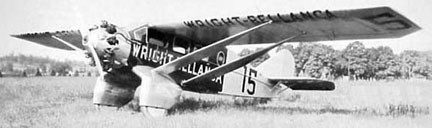
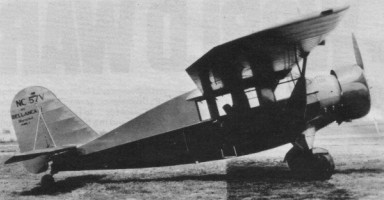
In 1925, Bellanca went to work for the Wright Aeronautical Corporation of Paterson, NJ. His assignment there was to develop an aircraft around the new Wright Whirlwind engine. He already had a design in mind, which was an improved version of the CF, called the CG. This design evolved into the Wright-Bellanca WB-1.

First flying in September 1925 piloted by Lt Fred Becker, the WB-1 enjoyed a short, but successful flying career. The aircraft had already won one race and efficiency contest at the 1925 Nationals, piloted by Becker, before an untimely accident destroyed the craft during preparation for an attempt to break the world’s non-refueled endurance record. It was destroyed in a crash-landing during speed and payload trials in 1926 at Curtiss Field, seriously injuring Becker.

At the time of the crash, Bellanca was already working on an improved version of the WB-1 designated the WB-2.

Engine: Wright J-4, 200 hp
Wingspan: 45’0″
Length: 24’9″
Useful load: 1440 lb
Max speed: 132 mph
Cruise speed: 100 mph
Stall: 45 mph
Seats: 5

Bellanca CF

In 1921, a group of investors lured Bellanca westward to Omaha, NE, in hopes of establishing that town as a center for aircraft manufacture. Before the aircraft could be built, the company went bankrupt, but construction of the aircraft continued under the financial backing of a local motorcycle dealer named Victor Roos. The resultant aircraft, the Bellanca CF, was called by Janes’s All the World’s Aircraft “the first up-to-date transport aeroplane that was designed, built, and flown with success in the United States.” Among the local people helping to build the aircraft was the daughter of Bellanca’s landlord, Dorothy Brown. Giuseppe and she were married on November 18, 1922.
Despite its advanced design, the Bellanca CF could not compete with the economics of the time. In the days just after World War I, a surplus Curtiss Jenny could be purchased for as little as $250.00. A Bellanca CF, with a price tag of $5000.00, was just too expensive and the aircraft never went into production.

Bellanca 1912 Monoplane

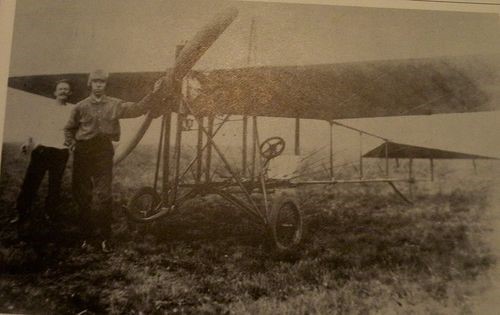
At the urging of his brother Carlo, who was already established in Brooklyn, New York, Giuseppe Bellanca immigrated to America in 1911. Before the end of the year, he began construction of his third airplane design, a parasol monoplane. The engine was a 3-cylinder Anzani of 30 hp, mounted before the wing. Built in the backyard of his brother Carlo’s grocery shop in New York, after construction was completed, he took the small craft to Mineola Field on Long Island, NY, and proceeded to teach himself to fly.

He began by taxiing. He then, taxied faster, which gave way to short hops. The hops got longer, until, on May 19, 1912, there was not enough room to land straight ahead, and Bellanca had to complete a turn in order land safely. Having successfully taught himself to fly, Bellanca then set about teaching others to fly, and from 1912 to 1916, he operated the Bellanca Flying School with two more copies he built. One of his students was a young Fiorello La Guardia, the future mayor of New York City. In return for flying lessons, La Guardia taught Bellanca how to drive a car.

Engine: Anzani 30 hp

Bellanca Aircraft Corp / Wright-Bellanca / Columbia Aircraft Co / Bellanca Development Co / AviaBellanca

Giuseppe Mario Bellanca was born in 1886 in Sciacca, Sicily. As a young man, he attended the Technical Institute in Milan, graduating with a teaching degree in mathematics in 1908. During his quest for a second mathematics and engineering degree, he became enamoured of aviation, and set out to design and build his own airplane. Bellanca’s first aircraft design was a “pusher” aircraft, somewhat similar to the Wright Flyer. Lacking funds for such an endeavor, he joined with two partners, Enea Bossi, and Paolo Invernizzi. The union of the three produced the first flight of a totally Italian-designed and Italian-built aircraft in December of 1909. Bellanca’s second design, was a tractor-type aircraft. Although the aircraft was successfully constructed, it was never flown due to insufficient funds for an engine.
At the urging of his brother Carlo, who was already established in Brooklyn, New York, Giuseppe Bellanca immigrated to America in 1911. Before the end of the year, he began construction of his third airplane design, a parasol monoplane. After construction was completed, he took the small craft to Mineola Field on Long Island, NY, and proceeded to teach himself to fly. He began by taxiing. He then, taxied faster, which gave way to short hops. The hops got longer, until, on May 19, 1912, there was not enough room to land straight ahead, and Bellanca had to complete a turn in order land safely. Having successfully taught himself to fly, Bellanca then set about teaching others to fly, and from 1912 to 1916, he operated the Bellanca Flying School. One of his students was a young Fiorello La Guardia, the future mayor of New York City. In return for flying lessons, La Guardia taught Bellanca how to drive a car.
In 1917 the Maryland Pressed Steel Company of Hagerstown, MD hired Bellanca as a consulting engineer. While there, he designed two trainer biplanes, the CD, and an improved version, the CE. With the conclusion of WWI, Maryland Pressed Steel’s contracts were cancelled and the company entered into receivership. Thus, the CE never went into production.
In 1921, a group of investors lured Bellanca westward to Omaha, NE, in hopes of establishing that town as a center for aircraft manufacture. Before the aircraft could be built, the company went bankrupt, but construction of the aircraft continued under the financial backing of a local motorcycle dealer named Victor Roos. The resultant aircraft, the Bellanca CF, was called by Janes’s All the World’s Aircraft “the first up-to-date transport aeroplane that was designed, built, and flown with success in the United States.” Among the local people helping to build the aircraft was the daughter of Bellanca’s landlord, Dorothy Brown. Giuseppe and she were married on November 18, 1922.
Despite its advanced design, the Bellanca CF could not compete with the economics of the time. In the days just after World War I, a surplus Curtiss Jenny could be purchased for as little as $250.00. A Bellanca CF, with a price tag of $5000.00, was just too expensive and the aircraft never went into production. After the disappointment of the CF, Bellanca designed wings for the Post Office Department’s DH-4’s. His new wings were a tremendous improvement over the original design, but only a few aircraft were so modified.
In 1925, Bellanca went to work for the Wright Aeronautical Corporation of Paterson, NJ. His assignment there was to develop an aircraft around the new Wright Whirlwind engine. He already had a design in mind, which was an improved version of the CF, called the CG. This design evolved into the Wright-Bellanca WB-1.
The WB-1 enjoyed a short, but successful flying career. The aircraft had already won one race and efficiency contest before an untimely accident destroyed the craft during preparation for an attempt to break the world’s non-refueled endurance record. Fortunately, at the time of the crash, Bellanca was already working on an improved version, of the WB-1 designated the WB-2.
During 1926, the WB-2 won two efficiency trophies at the National Air Races in Philadelphia. Wright considered putting the aircraft into production, but decided against it to avoid alienating other aircraft companies that were potential customers for their engines. Disappointed by Wright’s decision, Bellanca left the company and joined with a businessman named Charles Levine to form the Columbia Aircraft Company. Wright sold the WB-2 and all drawings and production rights to the new company. The WB-2 went on to a long and fruitful flying career starting with establishing a new world’s non-refueled endurance record of 51 hours, 11 minutes, and 59 seconds in April of 1927.
In the latter half of 1926, Charles Lindbergh wanted to buy the WB-2, now named the ‘Columbia’, for his proposed flight from New York to Paris. He was rebuffed by Levine who also had designs on the flight and the $25,000 prize money. Lindbergh then went to Ryan for his “Spirit of St. Louis”. Meanwhile Levine, in choosing the crew, managed to promise two seats to three people. So while the Columbia was grounded by a court order brought by the third party, Lindbergh took off on his successful flight to Paris.
Eventually, the ‘Columbia’ was cleared of litigation and took off on its successful transatlantic flight on June 4, 1927. In the cockpit were Clarence Chamberlin, one of the pilots of the endurance record and Charles Levine, who became the first transatlantic passenger. The plan was to fly all the way to Berlin, and Chamberlin had vowed to fly until they ran out of fuel. Forty-three hours later, they landed in Eisleben, Germany, the first of two successful Atlantic crossings for Bellanca’s most famous aircraft.
Disappointed because the ‘Columbia’ was not the first aircraft to accomplish the New York to Paris flight, Bellanca severed all relations with Levine, and started his own company, the Bellanca Aircraft Corporation of America, and rented facilities on Staten Island, NY. The new Bellanca model was designated the CH, and was basically a commercial version of the WB-2. The new company also had two other models that were built for special orders, the Bellanca Model J and the Model K.
It was not long before Bellanca caught the attention of the Du Pont family of Delaware. They wanted to start aircraft manufacturing in Delaware, and in late 1927, an agreement was made with Bellanca to locate his factory outside of Wilmington. The site was large enough for a first-class airfield, with a seaplane ramp on the nearby Delaware River.
This was a busy time in Bellanca’s life. Along with all that was happening in his professional life, he and Dorothy celebrated the birth of their son August T. Bellanca in March of 1927.
With the exception of a few years immediately before and during the early stages of WWII, Bellanca was President and Chairman of the Board from the corporation’s inception on the last day of 1927 until he sold the company to L. Albert and Sons in 1954. All assets were acquired by Northern Aircraft in 1955 and Bellanca name finally dropped 1959 after merger with non-aviation companies.
After his departure from the company, Giuseppe and his son, August, formed the Bellanca Development Company with the purpose of building a new aircraft. It would have increased performance due to the use of lighter materials for its structure. Work on this aircraft was progressing when Giuseppe Bellanca succumbed to leukemia and died on December 26, 1960. After his father’s death, August continued the project, and under his guidance, the aircraft, a record breaker, first flew in 1973.
Northern Aircraft became Downer, then Inter-Air, and in 1967, Bellanca Sales, a subsidiary of Miller Flying Services. As the company grew, its name became Bellanca Air¬craft Corporation. Champion Aircraft Corporation was merged into it in 1970, adding two place aerobatic, sport and utility aircraft to the line.
1974 closed with the firm still in the busi¬ness only of building Vikings in Alexandria and Champi¬ons in Osceola, Wisconsin, and with sales slowing a bit. In late 1974, Bellanca was forced to suspend production in order to work off an in¬ventory of airplanes.
In 1978 Bellanca became a wholly-owned subsidary of Anderson, Greenwood, of Houston, Texas, subsequently developing the T-250 Aries and Eagle.
Work stopped in 1980 and the firm liquidated in 1981.
Assets were sold to Viking in 1982.
Viking resumed Viking production in 1984. Work stopped in 1988.
The original Bellanca company was restarted by Guiseppe Mario Bellanca and son August in 1968, initially in West Virginia and later Maryland.
Work stopped in 1986.
The firm was resurrected as AviaBellanca.
In 1993, August Bellanca donated his father’s 1920 CF to the Smithsonian along with many personal and corporate papers and correspondence. NASA craftsmen restored the aircraft and it is on display at the Smithsonian Air & Space Museum’s new Steven F. Udvar-Hazy Center near Washington’s Dulles International Airport. The far-sighted, innovative designer and builder of American aircraft, Giuseppe M. Bellanca was enshrined in the National Aviation Hall of Fame in 1993, the Delaware Aviation Hall of Fame in 1999.

1998:
Avia Bellanca Aircraft Corp
11800 Sunrise Valley drive, Suite 322
Reston
Virginia 20191
USA
Bell X-14

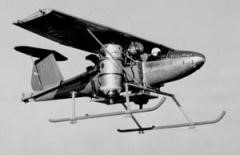
The Bell X-14 was produced as a vertical take-off prototype and achieved its first hovering flight on 17 February l957. The X-14 was originally created to explore the feasibility of operating a VTOL aircraft from a normal pilot station using standard flight instruments and references. Of equal importance, the X-14 was to demonstrate various VTOL systems and engine technologies—the aircraft was the first to demonstrate the concept of using vectored jet thrust as the only power system.
The airframe was as simple and light as possible, and was characterized by an open cockpit and fixed tailwheel landing gear. In its original form the aeroplane was powered by a pair of Bristol Siddeley Viper turbojets located side-by-side in the extreme nose of the aeroplane exhausting via nozzles on the sides of the aeroplane on the centre of gravity. For vertical take-off the nozzles were vectored directly downward, and for transition into forward flight were vectored gradually aft. The first successful transition was accomplished in May 1958, and the aeroplane was later re-engined with General Electric J85 turbojets. The X-14 made its last flight on 29 May 1981.
The X-14 successfully demonstrated that the concept of vectored jet thrust was viable, as subsequently used on the BAe/McDonnell Douglas Harrier. Flight tests using the X-14’s variable stability control system resulted in major contributions to the understanding of V/STOL handling characteristics. The X-14 also proved useful as a testbed for various unique V/STOL concepts, such as NASA’s direct side-force maneuvering system.
Over 25 pilots from around the world “previewed” V/STOL handling qualities in the X-14 prior to making test flights in other V/STOL designs. The single X-14 continued flying for nearly a quarter century before being retired to the Army Aviation Museum at Fort Rucker, Alabama. It is currently in storage at a private collection in Indiana.

Fastest Flight: 172 mph
Highest Flight: 18,000 feet (approx)

Bell X-5

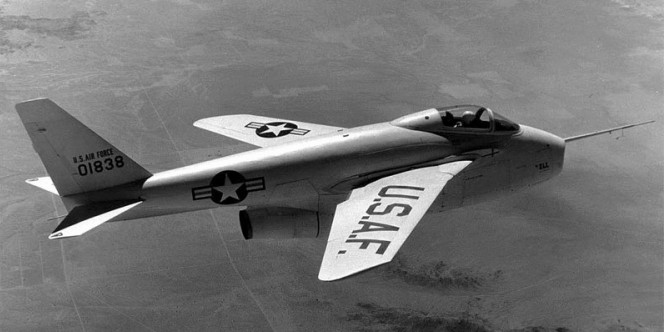
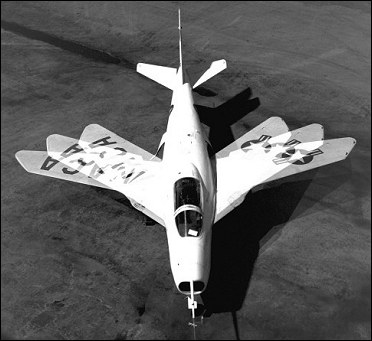
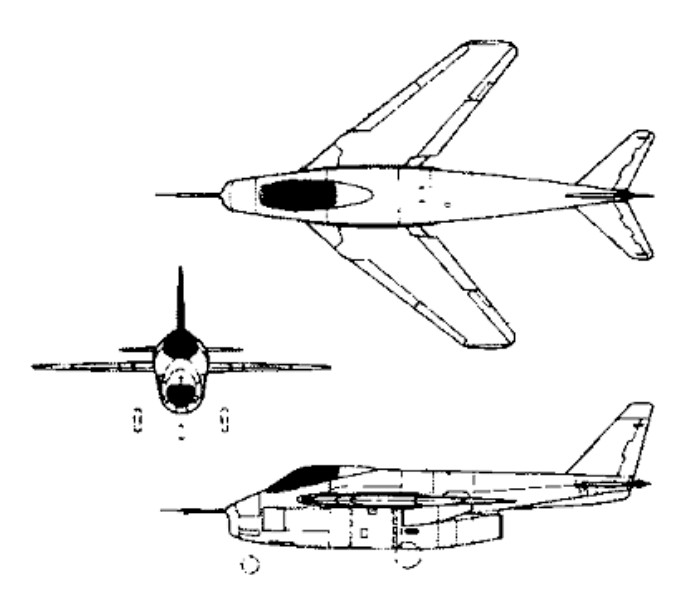
The Bell X-5 was produced to investigate the aerodynamic consequences of altering the wing geometry in flight, and first flew on 20 June 1951. Work on the two X-5s began in 1948, the basis of the design being the Messerschmitt P.1101 prototype that had almost been completed by the Germans at the end of World War II. Two X-5s were manufactured by Bell, differing from their German ancestor primarily in being able to adjust their wing sweep angle in flight. The variable sweep wing could be adjusted to 20, 40 or 60 degrees the hydraulic operating mechanism automatically compensating for the inevitable shift in the position of the design’s centre of gravity.

Powered by a 4900-lb (2222-kg) thrust Allison J35-A-1; turbojet located in the lower fuselage and exhausting under the tail boom. Special fairings were also fitted to ensure that the leading and trailing edges of the wing roots presented smooth aerofoil surfaces at all times.

Bell X-5 Article

The first prototype (50-1838) was completed on February 15th, 1951 and first flown on June 20th, 1951. A second prototype (50-1839) followed into the air on December 10th, 1951. Both airframes accounted for some 200 total flights with the first prototype netting 133 flights alone. All three wing sweep positions were trialed on the first prototype’s ninth flight with success.

The Bell X-5 was produced to investigate the aerodynamic consequences of altering the wing geometry in flight, and first flew on 20 June 1951. Work on the two X-5s began in 1948, the basis of the design being the Messerschmitt P.1101 prototype that had almost been completed by the Germans at the end of World War II. Two X-5s were manufactured by Bell, differing from their German ancestor primarily in being able to adjust their wing sweep angle in flight. The variable sweep wing could be adjusted to 20, 40 or 60 degrees the hydraulic operating mechanism automatically compensating for the inevitable shift in the position of the design’s centre of gravity.

Powered by a 4900-lb (2222-kg) thrust Allison J35-A-1; turbojet located in the lower fuselage and exhausting under the tail boom. Special fairings were also fitted to ensure that the leading and trailing edges of the wing roots presented smooth aerofoil surfaces at all times.

The first prototype (50-1838) was completed on February 15th, 1951 and first flown on June 20th, 1951. A second prototype (50-1839) followed into the air on December 10th, 1951. Both airframes accounted for some 200 total flights with the first prototype netting 133 flights alone. All three wing sweep positions were trialed on the first prototype’s ninth flight with success.

In practice, it was found that the X-5 inherited some particularly vicious stall-spin instability characteristics. The cause was believed to be the positioning of the tail section within the design and compounded by the position of the vertical tail fin itself. As the wing sweep changed, essentially the entire aerodynamic qualities of the aircraft changed with it. The resulting action could lead the aircraft into an irrecoverable spin – this eventually occurring on October 14th, 1953 – the second prototype was lost to such a spin while running its wing sweep at 60-degrees, killing Air Force test pilot Captain Ray Popson.

The program was shelved and ultimately cancelled by the USAF. Testing did continue on with the first prototype into 1955 after which the aircraft served out the rest of her term as a chase plane until early 1958.

During Neil Armstrong’s first (and only) flight in the Bell X-5 in October 1955, the landing gear door fell off. Armstrong recalled;
“My checkout pilot was Jack McKay, and he explained that they often had trouble getting the nose gear tucked up. So, after take off, when retracting the gear, you were advised to nose over and go for about half a G. That would help get the nose gear in place, due to less download on the gear. So I attempted to do it, but it didn’t seem to be locking up. In thee meantime, I was nosing over, getting into a nose down position and, of course, the aircraft was speeding up, and I suspect that I actually ‘oversped’ the gear-limit speed, knocking the fairing door off. I never got the indication that the gear was completely retracted, so I put it back down and wasn’t able to conduct my flight plan. I never got a chance to fly the airplane again. They decided it was at the end of its research lifetime”.

The remaining Bell X-5 was handed over to the National Museum of the United States Air Force in Dayton, Ohio, in March of 1958 where it resides even today as part of the Research & Development Gallery at Wright-Patterson Air Force Base.

Engine: 1 x Allison J35-A-17 tubojet, 2223kg
Take-off weight: 4536 kg / 10000 lb
Wingspan: 5.66-9.39 m / 18 ft 7 in-30 ft 10 in
Length: 10.16 m / 33 ft 4 in
Height: 3.66 m / 12 ft 0 in
Max. speed: 1046 km/h / 650 mph

Bell X-2

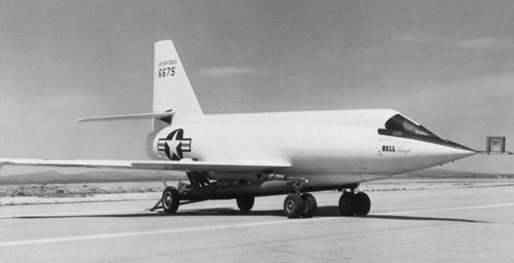
Two X-2s were built by Bell Aircraft at their Niagara Falls, New York, facility. The airframes were composed primarily of stainless steel and “K-Monel,” an advanced lightweight heat-resistant stainless steel alloy swept wings.

The powerplant comprised a 15,500 lb (6804 kg) thrust throttable Curtiss-Wright XLR-25-CW-1 liquid propellant rocket.

The jettisonable cockpit can be separated from the fuselage in an emergency by an explosive charge, a ribbon-type parachute lowering the complete cockpit to a lower altitude at which the pilot can bale put.

The first X-2 was dropped into Lake Ontario on 12 May 1953 following an explosion and fire that also caused extensive damage to the EB-50A launch aircraft.

A leather gasket made by the Ulmer Company, when saturates with liquid oxygen, was so unstable that a shock of and magnitude caused the gasket to blow. A number of accidents occurred involving the X-1-3, X-1A, X-1D, and X-2, before the malfunctioning gasket was identified and a fix made.

Bell X-2 and Boeing B-50

The second aeroplane made the type’s first powered flight on 18 Novernber 1955, and recorded an altitude of 126,000 ft (38,465 m) as well as a speed of Mach 3.2 (2,094 mph; 3,370 km/h), the latter being recorded during the type’s fatal last flight on 27 Septernber 1956. This remained the highest speed at which man had flown until 1961. The aircraft experienced “inertia coupling” resulting in complete loss of control—pilot Milburn Apt was killed in the accident. No examples of the X-2 survive.

Dick Day warned his air force associates not to push ahead so fast with the X-2, piloted by Ivan Kinchloe, Frank ‘Pete’ Everest, and Milburn G. Apt. Data from their work was confirming evidence from NACA wind tunnel tests that the X-2 would experience ‘rapidly deteriorating directional and lateral (roll) stability near Mach 4’. On 25 April 1956, the X-2 broke the sound barrier for the first time. Less than a month later, it flew past Mach 2. By mid-summer it was pushing Mach 3. When Mel Apt took the X-2 up on 27 September 1956, for his very first flight in the aircraft, his flight plan called for ‘the optimum maximum energy flight path,’ one that would rocket him past Mach 3 – and into roll coupling. The fatal crash happened just as Dick Day thought it might. At 65,000ft and a speed of Mach 3.2, Apt lost control of the X-2 due to roll coupling and became unconscious. By the time he came to it was too late. He died instantly when the plane hit the desert floor.

The two X-2s achieved 20 flights in total between 1952 and 1956.

Engine: 1 x Curtiss-Wright XLR25-CW-1 rocket engine, 6804kg
Wingspan: 9.75 m / 31 ft 12 in
Length: 13.41 m / 43 ft 12 in
Height: 4.11 m / 13 ft 6 in
Max. speed: M3.2 (2,094 mph; 3,370 km/h).
Ceiling: 38405 m / 126,000 ft / 38,465 m
Crew: 1

Bell 65 VTOL

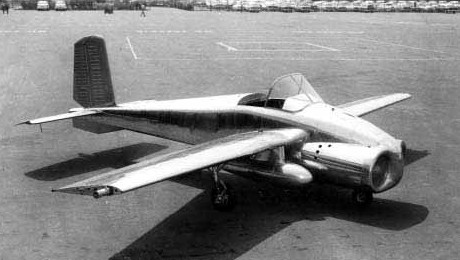
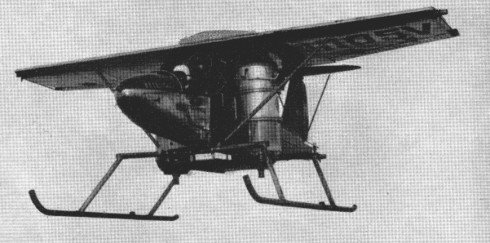
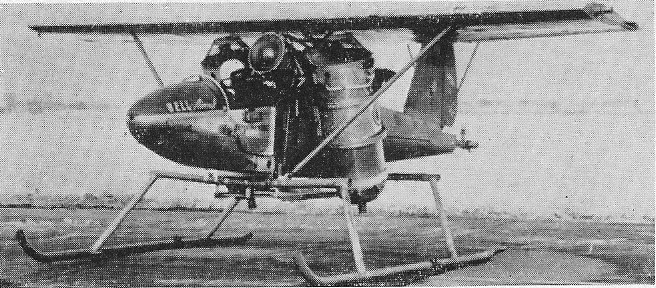
The Bell 65 VTOL was built to test the practicability of rotatable turbojets providing thrust for both lift and forward propulsion. Two turbojets, which raised it off the ground for take-off, could be turned 90 degrees in the air to provide forward thrust, leaving the fixed wing to provide lift.

Bell 65 VTOL Article

Constructed largely from existing parts, power was provided by two 1000 lb thrust Fairchild J44 turbojets and one Continental-Turbomeca Palouste compressor.

Control at low-speed being obtained from compressed-air jets at the tail and wingtips fed by the Palouste.

Engines: two x 1000 lb thrust Fairchild J44 turbojet
Wingspan: 26 ft
Wing area: 130 sq.ft approx.
Length: 21 ft
Loaded weight: 2200 lb approx.