Belyayev BP-3

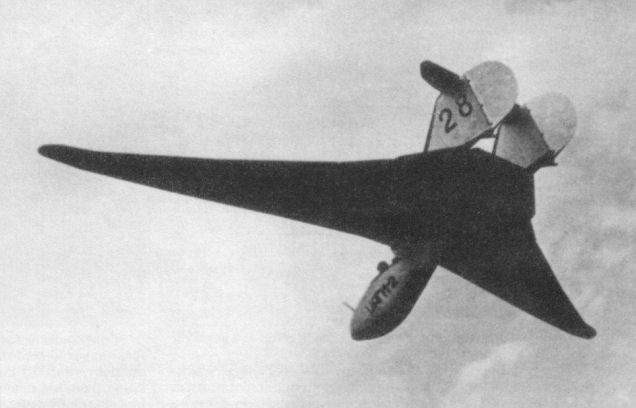
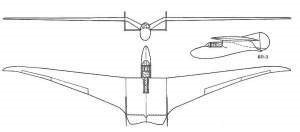
The Belyayev BP-3 (Russian: Беляев БП-3) glider of 1936 was developed by Victor Belyayev with forward-swept wing as a continuation of the BP-2 but in tandem configuration.

Success with the BP-2 led Belyayev to conceive of an improved model with larger dimensions and some changes. This two-seater capacity model appeared in 1935 as the BP-3 and had the wingspan increased to 20 meters.

The wing shape in the plane was generally similar to that of the previous BP-2, but in this case the wingspan had been significantly increased. Unlike the BP-2, the BP3 used a medium deployment wing with a gull-like curvature. This allowed to reduce the surface of the rudders and a more compact location of these. The hanging flaps located under the center plane disappeared.

The tail unit also received changes. Maintaining the double empennage structure, the horizontal plane on these was eliminated.

The BP-3 glider was designed as a two-seater and its crews were located in a closed cockpit.

The BP-3 was built in the TsAGI workshops and was flown for the first time on July 18, 1935. From the first flight, this aircraft presented excellent characteristics, with an aerodynamic quality that reached 33:1 glide, so it was decided to use it to establish a new record for gliding range.

The prototype was possibly followed by several copies built in the workshops of the Yeisk Naval Pilot School.

BP-3
Wingspan: 20 m
Length: 5.6 m
Height: 2.2 m
Wing area: 3.54 m²
Empty weight: 400 kg
Glide ratio: 33: 1
Seats: 2

Belyayev BP-2 / TsAGI-2

The Belyayev BP-2 (TsAGI-2) (Russian: БеляевБП-2 (ЦАГИ-2)), was an inverted arrow wing glider developed by Víctor Belyayev to test the effectiveness of this wing composition. Only one copy was produced.

In August 1933 Belyayev participated as a member of the TsAGI technical commission in the IX National Sailing Competitions held in Koktebel, Crimea. The main task of the commission was to check the technical condition of the gliders presented and to grant the authorization to fly. The commission considered that the best exponents were four glider models in a tailless configuration: the BICh-11, BICh-12 and BICh-13 from BI Cheranovski and the LAK-1 glider from a Leningrad flying club.

The presence at the Koktebel competitions prompted Belyayev to implement a conception idea for an airplane. The presence at the TsAGI of AA Sienkov, one of the pioneers of glider construction in the USSR, also played an important role in his decision.

In the TsAGI workshops during the winter of 1933 – 1934, these two specialists began on two new gliders: the BP-1 (TsAGI-1) from Sienkov and the BP-2 (TsAGI-2) from Belyayev. The name BP comes from the term B esxbosti P laner or paneer without glue.

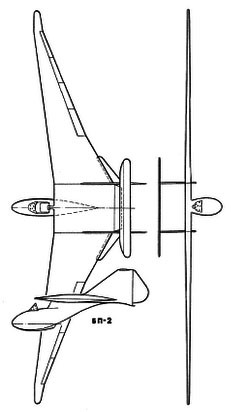
The BP-2 glider was conceived as a flying wing without horizontal tail planes, but with the presence of double keels with rudders.

The wing design was characterized by its large wingspan. The centroplane, designed with an M-6 profile, had a rectangular shape in the plane and the wing consoles with the G-387 profile were fixed to it. The wing, with an area of 18.5 m², presented a configuration with inverted sagging and noticeable stretching towards the ends; standing high above the fuselage. In conjunction with the wing configuration, the entire structure of the glider was conceived seeking the lowest weight and the best possible aerodynamics. The structure incorporated a single spar built in the shape of a box and located at 30% of the wing chord. Four-section ailerons were located on the wing’s trailing edge, designed to ensure the balance of the aircraft and its control. These ailerons covered 9% of the wing surface.

Hanging flaps were located on the trailing edge of the centerplane, designed with the aim of achieving glider balance in flight and improving longitudinal control. In addition to these flaps, two lateral flaps with a smaller area were located at the trailing edge and designed to modify the curvature of the wing profile at the base of the consoles.

The entire wing structure was built in wood and practically in its entirety was covered with plywood (only a small section in the central region of the wing was covered with fabric.

The landing gear consisted of a ski at the bottom of the nacelle and skids under the empennage.

The cockpit was located in the forward part of the centroplane, in front of the wing leading edge, ensuring the necessary centering. This gave the pilot excellent visibility, but in conjunction with the wing configuration impaired the longitudinal stability of the model. To correct this problem on both sides of the central wing area, two large area vertical surfaces topped by a small stabilizer with a large elevator were placed. Large rudders were located in the rear of both keels.

During the design process, an important investigative work was carried out in order to achieve the best wing shape. The configuration of the BP-2 was initially quite criticized in the TsAGI. Several specialists expressed doubts about the flight capabilities of the concept. It was decided to test the model in the wind tunnel. In the TsAGI there was also a 200-meter-long hydrochannel that had an electrically operated trolley for towing the models, which ran the entire length of it. It was decided to use this truck to tow the glider models, thereby quickly and effectively demonstrating that Belyayev’s design it was able to take off and stay in the air without difficulty.

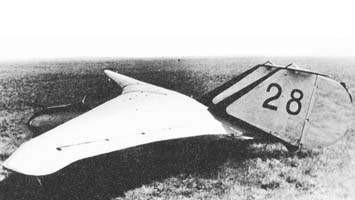
Once finished, first flying in August 1934, the BP-2 was sent to Koktebel to participate in the X National Sailing Competitions, being flown by the pilot DA Koshits. The model demonstrated excellent flight stability and superb control. Pilot Koshits performed Nesterov’s “dead” loop on this glider.

BP-2 glider during the 1934 competitions.

Pilots who had a chance to test it declared that the BP-2 had good flight characteristics and the ailerons were quite effective. It spun quite well. Landing speed was only 40 – 45 km / h. The only defect noted was the poor effectiveness of the rudders, which had to be complemented by the ailerons in flight to achieve the desired effect.

Despite its excellent design the BP-2 was only able to show a glide ratio close to 18 – 1. The main culprits for this limitation were the elevator located on the empennages and the flaps hanging under the centroplane.
After the tests the BP-2 returned to Moscow flying behind a Polikarpov R-5 towplane.

The experience gained with the BP-2 glider served as the basis for the development of the improved BP-3 and the DB-LK bomber.

BP-2
Wingspan: 14.8 m
Wing area: 18.4 m²
Aspect ratio: 11.9
Length: 5.08 m
Height: 2.40 m
Empty weight: 199 kg
Wing loading: 16.5 kg / m²
Minimum descent speed: 1.35 m / s
Stabilizers surface: 0.64 m²
Depth hole area: 1.42 m²
Keel surface: 2.76 m²
Rudder surface area: 1.08 m²
Spoiler area: 1.7 m²

Belyayev UK / Kazan Aviation Institute (KAI) UK

In the 1930s on the way to increasing speed, a new phenomenon known as “Flutter” appeared. Many aeronautical researchers dedicated themselves to investigating this phenomenon and the ways to combat it. In the USSR, the research carried out in this field at the TsAGI by a group of specialists headed by Victor Belyayev had a special impact.

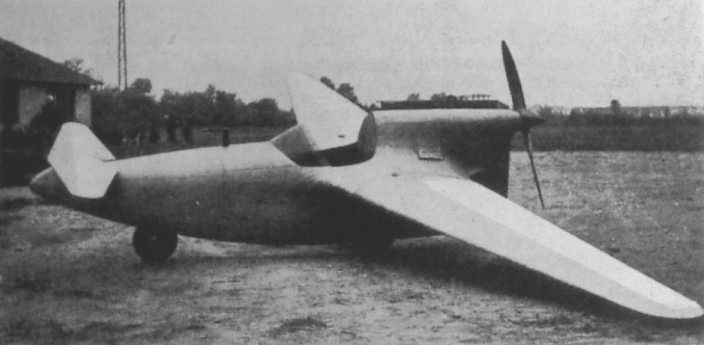
In the course of the research process, it was linked to the increase in wing resistance through the change of its shape, achieving a self-balancing state capable of counteracting the appearance of the “Flutter” throughout the range of increased speeds. To demonstrate this principle, engineers Victor Nikolayevich Belyayev and Victor Ivanovich Yujárin developed a new wing design at the TsAGI . The plan view depicted an open M with a slim profile and large wingspan.

To verify the effectiveness of this new “elastic” wing, the manufacturers, in addition to the tests in the wind tunnel, decided to build two experimental gliders that were successfully tested, allowing to collect valuable information on the way to design a high-speed aircraft with this wing plant.

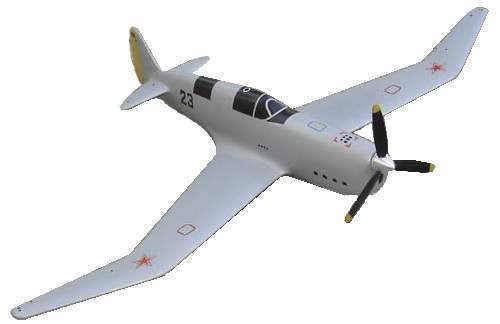
In 1938, Víctor Belyayev’s group designed an experimental aircraft that received the UK name according to the acronym of “U prugoye K rylo” or Elastic Wing with the new wing structure, which at the time was popularly known as “butterfly” type wing.

The UK design was compact enough to be able to use the lightweight 430 hp Renault Ro.1 12-cylinder engine. In 1936 a group of Soviet specialists had traveled to France to familiarize themselves with this technology and to buy several licenses for the production of Renault engines for the development of light aviation in the USSR. Among these engines was the Ro.1, which was to be produced at Factory No.26 in Ribinsk.

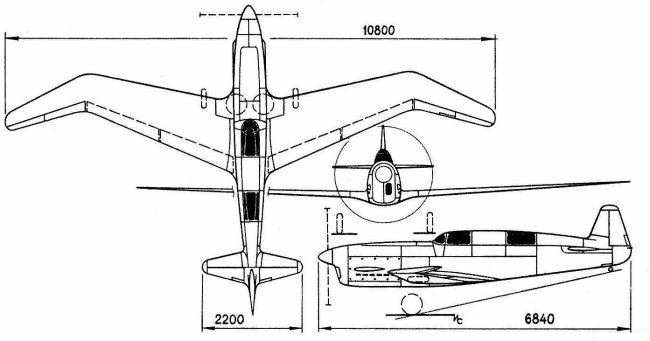
An 11 m² wingspan “butterfly” wing was attached to the fuselage, with a profile of variable thickness throughout the wingspan, 7.7% at the root and 5% at the ends, which was attached to the fuselage in low implantation. Long flaps were located on the trailing edge to improve takeoff and landing characteristics. The thin double-section ailerons were located along the entire span of the positive-taper section of the wing.

The UK was conceived to carry out all the high-school piloting maneuvers on it and was equipped with special recording equipment to measure the deformations of the wing and the impact on the stability of the aircraft in the different flight regimes. The structure was calculated to withstand overloads of 13 units.

The construction of both the wings and the fuselage was made of wood.

The landing gear was of the conventional retractable type, with a small tail wheel and the main landers that were collected into elliptical cavities located in the fusion zone of the fuselage and the wing root.

The cockpit was closed, with capacity for two crew members in tandem: the pilot and a specialist, destined to guarantee the correct registration of the instruments.

The fuel system included tanks located in the wing, in the negative sagging zone.

A single-seater version known as UK-1 was also conceived designed as a sports aircraft with the aim of setting a new speed record in land aircraft.

The excellent results obtained during the tests with the Belyayev gliders, as well as the excellent results that the project calculations yielded, led the TsAGI management to “think big”, so it was decided to close the development of the record-breaking aircraft and concentrate on designing a much more ambitious project: the DB-LK bomber, with an inverted swept wing similar to that used by gliders. This bomber was designed in 1938 and in its state tests, which lasted until 1941, it showed better performance than the Ilyushin DB-3M with the same power plant and bomb load.

Despite the reorientation of the project, the idea of building the single-engine model with an “elastic” wing was not rejected. At the request of the TsAGI the OKB for light constructions of the Kazan Aviation Institute (KAI) , under the direction of ZI Itskplich (who until 1939 worked on the OKB-301 dedicated to the study of Caudron models in the USSR under the direction of AA Dubrovin ) and later by GN Borobiov, two specimens were studied: the UK-1A with the “butterfly” wing and the UK-1B with a low wing of normal configuration. Both were two-seater and differed only in the wing, in order to be able to carry out comparative experiments.

Due to the fact that the Renault Ro-1 engine was never produced, it was decided to install the MV-6 engine (a copy of the 6-cylinder Renault Bengali 6 produced under license in the USSR) in both examples, which was characterized by having only half the projected power. This reality definitively removed the idea of being able to establish a new speed record, but despite this it was thought that, in parallel with the experimental tasks, the aircraft could be ideal for participating in different air competitions.

The first of two aircraft built at KAI was completed in 1940. In the spring of the following year it was handed over to the TsAGI for the development of the tests. With the beginning of the war these were not realized.

The second was never finished. Actual flight data was not preserved.

Engine: A 430 hp Renault Ro.1 12-cylinder engine
Wingspan: 10.8 m
Wing area: 11.0 sq.m
Length: 6.84 m
Tailplane wingspan: 2.2 m
Empty weight: 750 m
Takeoff weight: 1028 m
Speed at altitude: 510 km / h
Landing speed: 100 km / h
Ceiling: 11000 m
Range: 900 km
Accommodation: 2

UK-1A

Belyayev OI-2

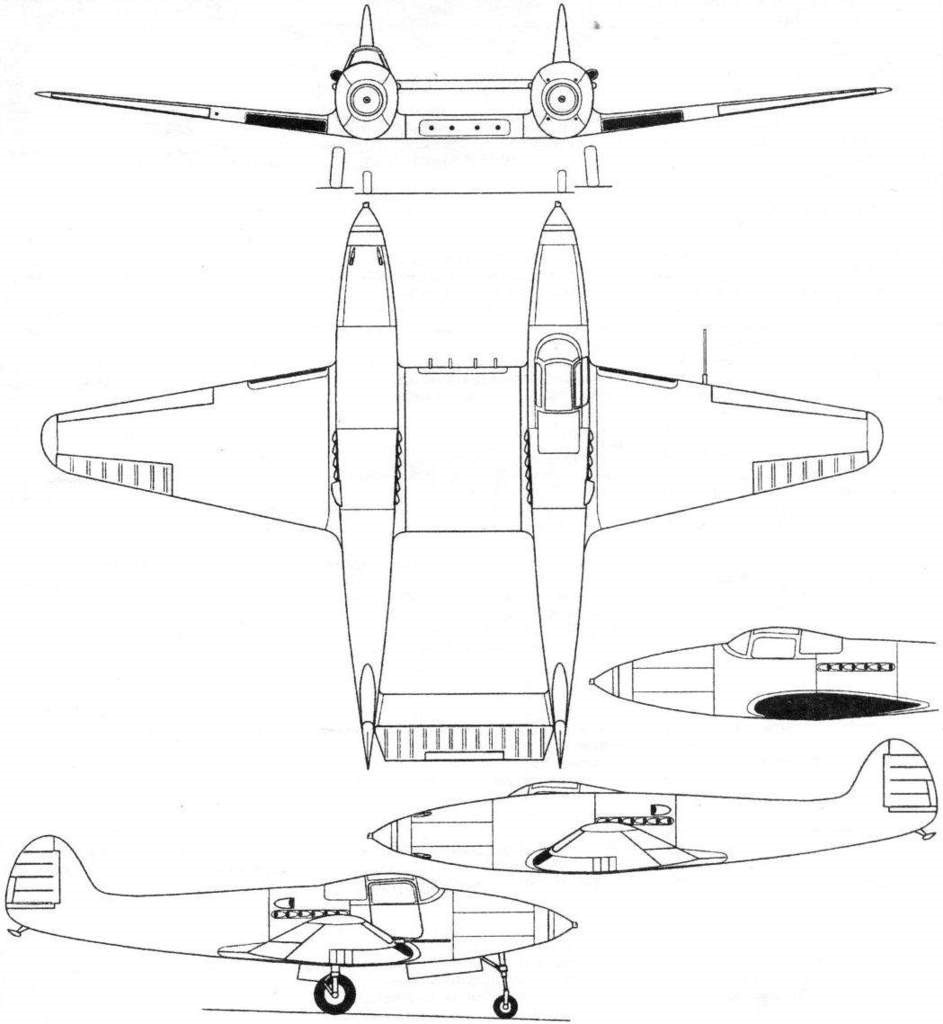
Designed by Viktor N. Belyayev, the Belyayev OI-2 had twin fuselages linked by a central wing section, allowing greater range and greater load than the model with a single fuselage. The design began in early 1941, before the USSR began receiving the American Airacobra. The plane would carry a single pilot in the right fuselage. In each fuselage was a Klimov M- 120UV 18-cylinder water-cooled engine.

The bomber could be armed with two 23 mm guns shooting through the propeller hubs, four 12.7 mm machine guns in the nose of the fuselage and 4 ShKAS 7.62 mm machine guns in the center section wing with 500 rounds each. It could also carry 4 FAB -100 100 kg bombs, or 8 of 50 kg or 16 of 25 kg, or 52 bombs of 10 kg under the center wing section, plus underwing supports on the outer wing sections for FAB 500 -500 kg or two FAB -250 of 250 kg.

It appears that the project was receiving by the VVS on April 22, 1941 receiving approval. Excellent visibility forward and to the right was found, but poor visibility as to the left. Another shortcoming was the arrangement of the machine guns. The conclusions of the commission proposed Belyayev deepen the design of the aircraft and submit a project ‘s finish, transfer the pilot to the left fuselage in order to improve visibility and increase range to 2000 km for use as a bomber escort. Soon after, the USSR came against Germany in World War II fighters and the project was canceled.

Belyayev, Victor Nikolayevich

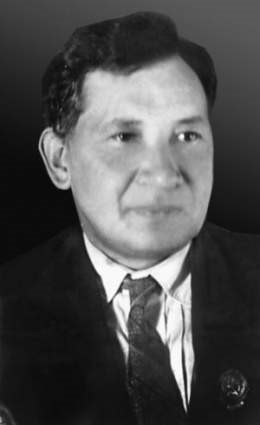
Victor Belyayev was born on March 28, 1886. Between 1920 and 1923 he studied at the Moscow Polytechnic Institute and the MGU. In 1920 he took his first steps in aeronautical construction by building a biplane glider following the NB Delone scheme, but with wheel landing gear.

He began his professional career in aviation in Leningrad in 1925, when he joined to work as an engineer at OMOS led by DP Grigorovich, specializing in issues related to the calculation of aircraft resistance.

In 1926, at the age of 30, he moved to TsAGI, led by AN Tupolev. In this institution he worked on the resistance calculations of the Túpolev ANT-6, ANT-7, ANT-9, ANT-14 and the gigantic ANT-20 planes.

Between 1926 and 1924 Belyayev developed the theory and methodology for the calculation of rectangular wings, which was widely used as a theoretical basis for the calculation of resistance in Soviet aeronautical development for models with straight wings or low sagging. When the Belyayev aeronautical construction resistance department was created in the TsAGI in 1931, he went on to direct a research group, a task that he knew how to combine with his aeronautical projection and construction activity.

Over the years, before aeronautical engineers, he presented the task of overcoming the dangerous effect called “Flutter” as a way to achieve the necessary increases in flight speeds. Belyayev studied the phenomenon and provided fundamental contributions to combat it. For the first time he proposed to use anti-flutter weights as a measure to increase the stability of flight surfaces.

At TsAGI, engineers VN Belyayev and VI Yujarin developed a new wing design capable of moving the center to face this phenomenon without losing the necessary structural strength. The plan view of this configuration resembled an expanded letter M with a slim profile and large wingspan.

The need to confirm the effectiveness of this wing solution led Belyayev back into the field of aircraft construction. In 1934 he designed the BP-2 glider (Besxbosti Planer – Paneador sin tail), also known as TsAGI-2, demonstrating a high level of originality by applying the scheme without tail and its wings with inverted wing tufting. The model was tested towed by a forklift in the TsAGI hydro- channel. The BP-2 participated with great success in the IX National Competitions, held in Koktebel in 1934, showing excellent results. At the end of the competitions he was airlifted to Moscow, towed by aPolikarpov R-5.

With its second design, the glider recordista BP-3 of 1935, Victor Belyayev reaffirm its success. This glider first flew on June 18, 1935 and was characterized by its excellent flight characteristics. It has been claimed that several specimens were built in the workshops of the Yeisk Naval Pilot School. Both gliders demonstrated the accuracy of Belyayev’s calculations and the effectiveness of his original scheme.

In 1935 and in response to a competition launched by the All-Russian Scientific and Technical-Engineering Society of Aviation (AviaVNITO) and the newspaper “Tras el volar” developed a project for a twin-engine transport plane known as AviaVNITO-3, which was characterized also for the originality in the technical solutions. This project won second place in the competition and was proposed for serial construction, but was ultimately not built.

In the late 1930s, Belyayev went on to lead an aeronautical design structure known as OKB-16, located at the No.156 Experimental Building Factory in Moscow. In this factory were established several OKB aircraft building, including those of SA Kochierigin, VV Shevchenko and the famous TsKB-29 of the NKVD.

Among the members of this group were PN Obrubov, LL Selyakov, EI Korzhenievski, DA Zatvan, BS Biekin and NY Leontiev. Most of the works of this group were characterized by the novelty of their designs, apart from traditional schemes.

In 1938, on their own initiative, Belyayev and his collective began the development of a bomber version based on the AviaVNITO-3. Known as DB-LK, this version was tested in 1940 showing better performance than the DB-3M bomber, which was already being built. serially. In this same period, the experimental UK aircraft with an elastic butterfly wing with a Renault engine of 430 hp, which was built at the KAI in 1941, and the EOI experimental fighter with an original double fuselage scheme were projected in this same period. This fighter began to be built in1940, but it was destroyed before the evacuation in October 1941, along with the plans and calculations.

With the start of the war bureau buildings Belyayev was dissolved and he was evacuated to Omsk, where he initially worked in the factory No.166 and later as head of the group of calculations in KB of VM Myasichev, the factory No .288. In 1944 Belyayev worked on calculations for the high-level reactive fighter Bartini R-114.

At the end of the war Victor Belyayev returned to TsAGI where he devoted himself to the study of resistance in aeronautical construction. For his contributions in the field of structural resistance and the theory of the “Flutter” in 1940 he was awarded the category of doctor of technical sciences and in 1949 he received the category of professor.

He died on 25 of July of 1953 at 68 years old.
Belworthy Figaro

The Figaro ZK-PUR is another creation from Alan Belworthy. This microlight has a two-seat tandem cockpit and is flown solo from the rear seat. Power is from a Ford two-litre Sierra with 9:1 pistons and a slightly ground camshaft. The aircraft is constructed from wood except for the steel tube and fabric covered elevator and rudder. The wings are basically Jodel and the fuselage is built along the Pietenpol style.

Engine: Ford Sierra 2-litre.

Beltrame Colibri

The Colibri was built in 1937 by Quinto Beltrame. It is plywood monocoque, with an 18 hp opposed-piston single cylinder air cooled two-stroke Beltrame engine, and three drive belts to the prop. The 450 cc engine produces 18 hp at 4200 RPM, with oil and fuel mixed.

The elevator is the only controllable surface: +12.5 degrees, – 2.5 degrees, 30 degrees lateral tilt each side.

Engine: Beltrame 450 cc, 18 hp
Wingspan: 6.06 m
Length: 3.55 m
Height: 1 m
Wing area: .5 sq m
Empty weight: 70 kg
Loaded weight: 160 kg
Stall speed: 60 km/h
Cruise speed: 140 km/h
Max speed: 160 km/h
Take off run: 125 m
Landing roll: 50 m
Range: 500 km

Bellaire Monoplane Co SE-II

Bellaire SE-II                      Courtesy Rick Berstling, West Aviation Co.

This aircraft is available only as pre-built assemblies. All fit and welded 4130 steel components are available with construction drawings. 2009 Price: 17500 USD

Stall: 31 kt / 36 mph / 58 kmh
Cruise: 91 kt / 105 mph / 169 kmh
VNE: 104 kt / 120 mph / 193 kmh
Empty Weight: 245 kg / 540 lbs
MTOW Weight: 522 kg / 1150 lbs
Climb Ratio: 800 ft/min / 4 m/s
Glide Ratio: 9-1
Take-off distance (50ft obstacle): 400 ft / 122 m
Landing distance (50ft obstacle): 400 ft / 122 m