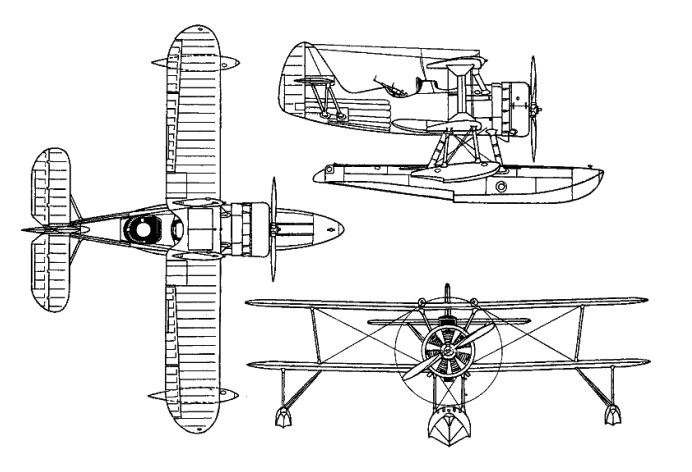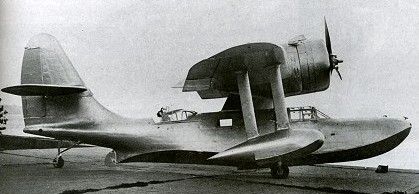
Beriev KOR-2 / Be-4

More or less in parallel with the construction and development of the KOR-1 floatplane, The Beriev bureau worked on the design of a small flying-boat intended to fulfil the same requirement as the hastily developed KOR-1, but to provide much enhanced performance.
In configuration the Beriev KOR-2 was a parasol-wing monoplane, the wing pylon-mounted above the stepped flying-boat hull, and braced by two streamlined struts on each side.
An inverted gull wing, with a wing-mounted engine and three-bladed controllable-pitch propeller. The tail unit was similar in configuration to that of the KOR-1, except that the high-mounted tailplane was a strut-free cantilever structure.
First flown in 1940, this Beriev design was built in a factory at Taganrog, on the shore of the Sea of Azov, only a small number of these aircraft had been completed and delivered to the Soviet navy before the Taganrog area was over-run by the invading Germans in the autumn of 1941. Production of the KOR-2, or Beriev Be-4 as it had then been redesignated, was resumed at a Central Asian factory during 1942, but no records of the number constructed have so far been discovered.

Engine: 1 x Shvetsov M-62 radial, 671kW
Take-off weight: 2760 kg / 6085 lb
Empty weight: 2055 kg / 4531 lb
Wingspan: 12.0 m / 39 ft 4 in
Length: 10.5 m / 34 ft 5 in
Height: 4.05 m / 13 ft 3 in
Wing area: 25.5 sq.m / 274.48 sq.ft
Max. speed: 360 km/h / 224 mph
Ceiling: 8100 m / 26600 ft
Range: 950 km / 590 miles
Armament: 1 x 7.62mm machine-gun, 300kg of bombs
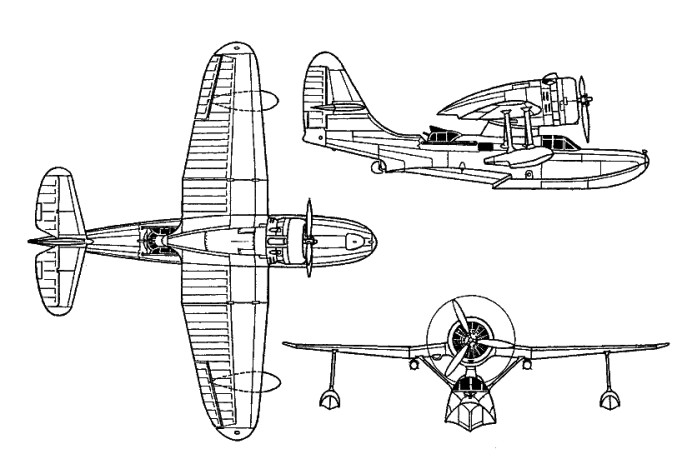
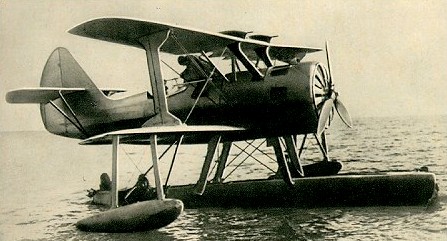
Beriev KOR-1 / Be-2

The Be-2, originally designated KOR-1, was a shipboard reconnaissance seaplane. It was first flown on 4 September 1936 by P O Noman and entered service in 1938.

Engine: 1 x M-25A, 715hp
Take-off weight: 2425 kg / 5346 lb
Empty weight: 1640 kg / 3616 lb
Wingspan: 11.0 m / 36 ft 1 in
Length: 7.1 m / 23 ft 4 in
Height: 4.4 m / 14 ft 5 in
Wing area: 31.8 sq.m / 342.29 sq ft
Max. speed: 277 km/h / 172 mph
Ceiling: 6600 m / 1650 ft
Range: 860 km / 534 miles

Beriev

Starting seaplane design in 1928, Georgi. M. Beriev became the leading designer of Russian waterbased aircraft. Beriev had gained considerable expertise as an assistant to French designer, Paul-Aime Richard, during the latter’s stay in the Soviet Union from 1928 to 1930.
Chief designer of the TsKB seaplane group and the bureau of G M. Beriev, at Taganrog on the Azov Sea.
In 1930, he was responsible for the twin-engined MBR-2 flying-boat, Be-2 reconnaissance seaplane and Be-4 flying-boat. Beriev design bureau became center of Soviet seaplane development in 1945, a major flying-boat project being the twin-jet Be-10. Be-12 twin-turboprop antisubmarine and reconnaissance amphibian manufactured between 1963 and 1973 and used widely by Soviet/Russian Navy until about 1997, when withdrawn; several Be-12s have been modified for civil uses, including transport and firefighting. A-40/Be-40 Albatross Mermaid turbofan-powered intermediate-range antisubmarine, search-and-rescue and patrol amphibian, first flown December 1986 and ordered for the Russian Navy in 1992 but not funded.
An improved search-and-rescue variant became the Be-42 (sometimes referred to in the West as A-45).
A laser-gun test-bed aircraft based on the llyushin II-76 was produced by Beriev and has been flown since 1980s as A-60, while in 1978 the first flight took place of the Beriev A-50 Mainstay airborne early warning and control aircraft, also based on the II-76 and in Russian operational service since 1984. Beriev Be-32 16-passenger twin-turboprop transport (first flown 1976), similar to earlier Be-30 (first flown 1968), was still to enter production in 1998. Be-102 multipurpose amphibian designed in 1993 but remained project in 1998. Be-112 Pelican larger multipurpose amphibian under consideration for development, while Be-200 twin turbofan multipurpose amphibian (initially for firefighting) first flew in 1998. Be-103 six-seat light amphibian, also suited to cargo carrying, survey and other roles, first flew July 1997; has twin piston engines carried on mounts either side of the rear fuselage. Very heavy lift cargo and passenger amphibians have been projected as Be-1200 and Be-2500, possibly to fly next century. Company then named Joint Stock Company “Taganrog Aviation Scientific- Technical Complex named after G.M. Beriev,” and became part of the AVPK Sukhoi organization.

Berg & Storm Type II / Type III

This 1910 machine was designed by Olaf Berg (aerodynamic expert) and Louis Storm (statics expert) for the shipbuilders firm Burmeister & Wain in Denmark. Olaf Berg was one of the early flying pioneers in Paris in 1908, where he saw Farman, Blériot and Levasseur fly at Issy-les-Moulineaux. It was powered by a three-cylinder Nielsen engine. The type III was bought by the Danish army and served until 1914. It currently resides in the Denmark Flymuseum.

Wingspan 8.8 m / 31’2″
Length 8.3 m / 26’3″
Height 2.1 m
Weight empty: 770 lbs
Speed: 60 mph

Bergonzi Ardea  

In Italy, Pier Carlo Bergonzi had built the Bergonzi “Ardea” at the factory of Breda. The aircraft was built as a fighter in 1918 and Breda bought the rights from Bergonzi.

The plane flew, exhibited in 1919, and had good characteristics, but was damaged (the wheel fell into a pothole) and was not restored.

Bergonzi, Pier Carlo

In addition to Ardea, the Italian had several pre-war projects. The first was a certain airplane Bergonzi-Vigano “Vi-Ber” about which nothing is particularly known. In the same 1912, an all-metal sports double monocoque took off according to the “duck” Tonini-Bergonzi-Negri “Italia I” scheme with the Gnome-Rhone 50CV engine. The plane was too heavy for such a motor, and besides, it was destroyed during the tests by Tonini who did not have the right to pilot it – Bergonzi should fly on it.

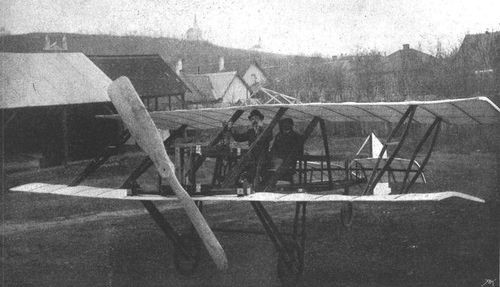
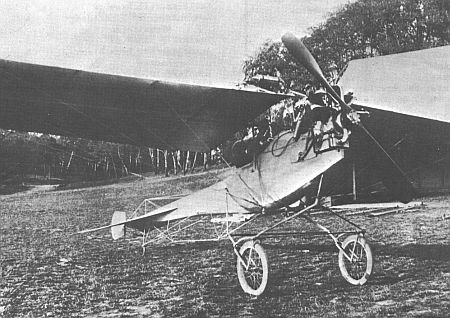
Berger 1910 Doppeldecker

An Austro-hungarian design by Franz Berger, the machine was an early example of negative stagger – the lower wing mounted considerably forward of the top wing. Of wooden construction with the exception of the wing struts which were of aluminium, the photograph was taken before February 19, 1910 in the Hungarian region of the double-monarchy, at Balatonboglár near Lake Balaton (in German: the “Plattensee”) at a time when no engine was fitted. It was however planned to use an Anzani 3-cylinder radial of 35-40 hp.

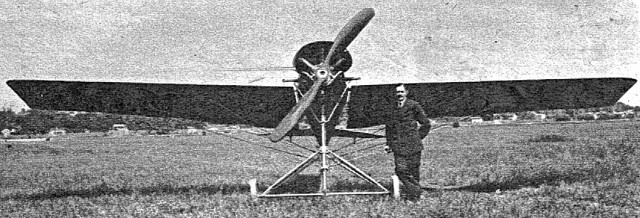
Berger Monoflygplan

The Monoflygplan of 1911 was an unsuccessful design by Swedish actor Bror Berger, powered by a 42 hp R.E.P 5-cylinder fan type air-cooled engine.

Building began during 1910 in a closed-down cinema behind the Blanchs Café, and in September 1911 Berger tried the machine at Gärdet, Stockholm. The first take-off attempt ended when the landing gear collapsed and the propeller broke. A new propeller was bought from Landskrona while sturdier gear was fitted, and the resulting new trials were, according to the press, very promising. Yet after 1911 nothing more was mentioned of the monoplane until it was donated to the Stockholm Technical Museum in 1927, in the same state of repair as it remains in today.

Bergamaschi Cantieri, Aeronautici

Originally operator of a flying school and began in 1927 to build single-seat and two-seat training aircraft, the Bergamaschi C-1 and C-2 respectively, which incorporated improvements to facilitate flying training. These included a well-sprung landing gear and aerodynamic features to improve stability. Absorbed into Caproni group 1931 as Caproni Aeronautica Bergamasca.