First flown in November 1990 the prototype of the LT-IIM Swati two-seat metal/wood monoplane was designed by the Technical Centre of Directorate General of Civil Aviation in India, which received certification in 1992 and is marketed.
Aircraft
Bharat Heavy Electricals Ltd
First flew in November 1990 the prototype of the LT-IIM Swati two-seat metal/wood monoplane, designed by the Technical Centre of Directorate General of Civil Aviation in India, which received certification in 1992 and is marketed.
BFW CL.III
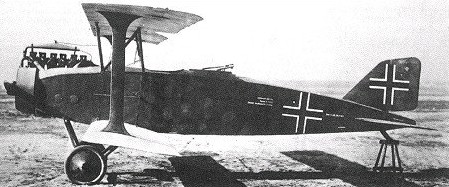
Redesign of the CL.la by BFW in accordance with the “new design principles” as requested by Idflieg resulted in the CL.III, a single prototype of which was completed at the close of hostilities but was not apparently subjected to Idflieg testing. Adhering closely to the concept of the CL.la, the CL.III was powered by a 200hp Benz Bz IV engine and featured longer-span, more angular wings. A further development, the CL.IV, remained on the BFW drawing boards.
Engine: 200hp Benz Bz IV
Wingspan: 11.54 m / 38 ft 10 in
Length: 7.81 m / 26 ft 7 in
BFW 18 / CL.II
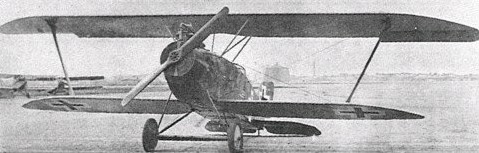
The second prototype of the CL.I two-seat reconnaissance fighter was completed with a 175hp MAN (Maschinenfabrik Augsburg-Nurnberg) Mana III six-cylinder in-line engine as the CL.II, or Type 18, in May 1918. In all other respects the CL.II was similar to the CL.I.
Engine: 175hp MAN (Maschinenfabrik Augsburg-Nurnberg) Mana III six-cylinder in-line
BFW 17 / CL.I
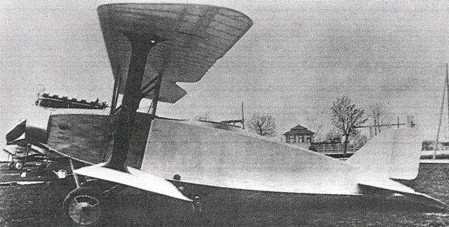
In late 1917, the Bayerische Flugzeugwerke (BFW) of Munich was awarded a contract to build two prototypes of the CL.I two-seat reconnaissance fighter of original design. At the time, BFW was negotiating a contract to build 100 Halberstadt CL.II reconnaissance fighters and the company’s CL.I was specifically designed to require 20% less manufacturing manhours than the Halberstadt aircraft. The first prototype, known by BFW as the Type 17, was completed in April 1918 with a 160hp Mercedes D III engine. A single-bay unequal span biplane with an intended armament of one fixed LMG 08/15 machine gun and an LMG 14 on a ring mounting, the CL.I was sent to the Adlershof test centre for Typprüfung in July 1918, but the Idflieg reported that it was “in no way equal” to the Hannover CL.V, requesting that improvements be made and the aircraft resubmitted for further evaluation. Accordingly, a lighter fuselage was fitted and, as the CL.la, the aircraft underwent static load testing between 30 August and 14 September 1918. Results were unsatisfactory and BFW agreed to redesign the CL.Ia in accordance with “new design principles”.
Engine: 160hp Mercedes D III
Take-off weight: 1060 kg / 2337 lb
Empty weight: 720 kg / 1587 lb
Wingspan: 10.62 m / 35 ft 10 in
Length: 7.81 m / 26 ft 7 in
BFW / Bayerische Flugzeugwerke
Bayerische Flugzeugwerke (BFW) of Munich, was organised around the former Otto Werke in 1916.
B&F Technik FK-14 Polaris / FK-Lightplanes FK-14
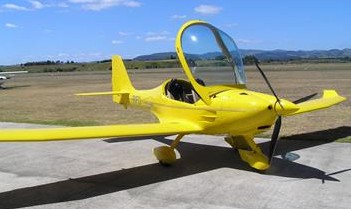
Development of this high-performance cruiser started in 1997, and Otto Funk developed the main wing structure with its special Fowler flap system in co-operation with the University of Stuttgart using its laminar wind tunnel. The rest of the airframe was designed by Peter Funk, whereby standard parts of the FK9 Mk3 were used as far as possible. The construction of the Polaris began in 1998 and the prototype of the FK14 was flown first in May 1999.
The FK14 is constructed in a mix of aluminium and fibreglass composite materials. The cockpit area is built of a crash-resilient tubular steel frame. The wings have a composite leading edge, with spars of carbonfibre covered in sheet aluminium.
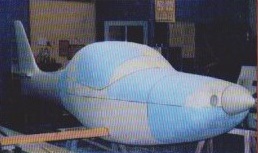
Production of the airframes takes place in Krosno, Poland; assembly of the airframes and the final production of the aircraft in the factory in Speyer in Germany.
Engine options: Rotax 912 / 912-S
Empty weight: 284kg
Max. demonstrated take off weight: 544 kg
Demonstrated ultimate loads: + 6,4g / -4,0g (520kg)
Wingspan: 9,04 m
Length: 5,69 m
Height: 2,00 m (trigearversion)
Vstall: 35 kt / 40 mph / 64 Km/h
Vne: 157 kt / 180 mph / 290 km/h
Cruise (75%): 235 km/h / 243 km/h
Take off run over 15m obstacle: 205m / 180m
Best climb: 1100 / 1500 ft/min at 145km/h
Engine: Rotax 912, 80 hp
Wing span: 8.8 m
Wing area: 9.0 sq.m
Empty weight: 200 kg
MAUW: 450 kg
Max speed: 290 kph
Minimum speed: 65 kph
Seats: 2
B&F Technik FK-12 Comet / FK-Lightplanes FK-12
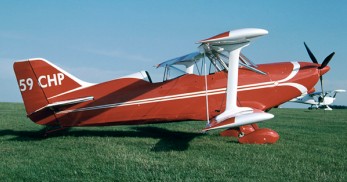
Peter Funk started in 1994 with the development of an Ultralight biplane, which went in production at the end of 1997 as the FK-12 Comet.
The FK12 Comet is an ultra-light two-seat aerobatic biplane design using modern materials.
It has good flight performance with optimised laminar flow wings with 4 full length ailerons (flaperons) making it highly agile with good viability. The wings fold down in a few minutes giving it a width of only 2.42m for storage.

The FK12 has a max. speed of 220 km/h and engines used are Rotax 912 or 912S of 80-100hp. Price 2009: 46000 EURO

Engine: Rotax 912, 80 hp
Wing span: 6.7 m
Wing area: 13.4 sq.m
Empty Weight: 265 kg / 584 lbs
MTOW Weight: 450 kg / 992 lbs
Fuel capacity: 42 lt
Cruise: 103 kt / 118 mph / 190 kmh
VNE: 119 kt / 137 mph / 220 kmh
Stall: 35 kt / 40 mph / 65 kmh
Climb Rate: 1200 ft/min / 6,9 m/s
Take-off distance (50ft obstacle): 460 ft / 140 m
Landing distance (50ft obstacle): 520 ft / 160 m
Fuel consumption: 12.8 lt/hr
Certification: Vz
Seats: 2
Price (1998): 91 600 DM
B&F Technik FK 11

Created by apprentices at the Airbus school at Speyer, the engine is situated behind the pilot and drivs one prop on either side of the fuselage via toothed belts.
Engine: Suzuki Swift, 50 hp
Empty weight: 200 kg
Wing span: 8.8 m
Wing area: 8 sq.m
Fuel capacity: 80 lt
Certification: vVz
MAUW: 450 kg
Seats: 2
Max speed: 280 kph
Cruise speed: 200 kph
Minimum speed: 60 kph
Climb rate: 6.5 m/s
Fuel consumption: 8.5 lt/hr
Price (1998): 75 000 DM
Kit price (1998): 33 000 DM
B&F Technik FK-10
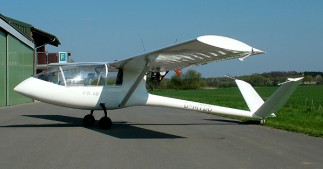
The FK-Leichtflugzeuge FK-10 is a product of B&F Technik Vertriebs GmbH. The FK10 was designed by Otto Funk as a two-seat version of the FK6 and was built in 1994 in the trainee workshop of the MBB Company in Speyer. A Göbler-Hirth 2704 engine powers this fibreglass ultralight. Just one B&F FK10 was built.

