In the 1980s was developing Sup’aero as single-seat canard monoplane powered by two Microturbo jet engines.
Aircraft
Centrair / Societe Nouvelle Centrair
Produce gliders in Alliance, Marianne, 101 Club and Pegase series. In 1980s developed Parafan powered parawing microlight, and was developing Sup’aero as single-seat canard monoplane powered by two Microturbo jet engines and Sup’Air as six-seat composites lightplane with tail-mounted propeller for piston engine.
2008:
Societe Nouvelle Centrair
B.P. 44 Aerodrome
Le Blanc 36300
France
Celier Aviation XeWing
The Celier XeWing (contraction of Xenon Wing) is a Polish ultralight aircraft that was designed by Frenchman Raphael Celier and produced by his company Celier Aviation of Jaktorów-Kolonia, Poland.
The XeWing was developed by mating the fuselage from the Celier Xenon 2 gyroplane with a newly designed folding strut-braced parasol wing in place of the rotor system. The aircraft was intended to comply with the Fédération Aéronautique Internationale microlight rules. It features a two-seats-in-side-by-side configuration enclosed cockpit, fixed tricycle landing gear and a single engine in pusher configuration.
The aircraft wing is made from aluminum sheet, has a span of 6.6 m (21.7 ft) and an area of 10 m2 (110 sq ft). The wing can be folded for ground transportation and storage. The standard engine specified was the 100 hp (75 kW) Rotax 912ULS four-stroke powerplant.
Despite the commonality of the fuselage and engine package with the Xenon 2, the XeWing cannot swap its fixed wing for a rotor system.
It was introduced at AERO Friedrichshafen in 2009. The aircraft was intended to be supplied as a kit for amateur construction or as a complete ready-to-fly-aircraft (projected price of €60,000, assembled, in 2011).
By 2012 the company was no longer advertising the XeWing and it is unlikely that it progressed beyond the prototype stage.
XeWing
Engine: 1 × Rotax 912ULS, 75 kW (101 hp)
Wingspan: 6.6 m (21 ft 8 in)
Wing area: 10 m2 (110 sq ft)
Empty weight: 300 kg (661 lb)
Gross weight: 472.5 kg (1,042 lb)
Fuel capacity: 85 litres (19 imp gal; 22 US gal)
Cruise speed: 150 km/h (93 mph, 81 kn)
Stall speed: 70 km/h (43 mph, 38 kn)
Crew: one
Capacity: one passenger
Celair Eagle 300
A six-seat STOL cabin lightplane (first flown 1990)
Celair Celstar GA-1
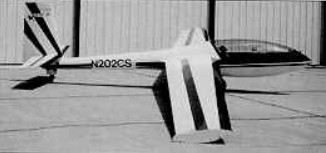
Designed by South African power aerobatics champion Peter Celliers and first flown in 1989, is a new composite aerobatic glider, the Celair Celstar GA 1, designed to JAR 22 specifications (10 g) for competition flying. The machine is stressed to +10g and 10g, with a best glide angle of 23:1.
It has full span mass balanced ailerons. Airbrakes are used for approach control. The main wheel is retractable.
Wing span: 11.2m / 36.75ft
Wing area: 11.54sq.m / 124.22sq.ft
Empty Weight: 265kg / 584lb
Payload: 120kg / 265lb
Gross Weight: 385kg / 849lb
Wing Load: 33.36kg/sq.m / 6.83lb/sq.ft
Water Ballast: 0
Aspect ratio: 10.9
Airfoil: Wortmann FX-71-L-150/25
Structure: glass fiber/ epoxy / aramid
L/DMax: 25
MinSink: 0.89 m/s / 2.9 fps / 1.75 kt
No. of Seats: 1
Celair (Pty) Ltd
South Africa
Developed Eagle 300 six-seat STOL cabin lightplane (first flown 1990); program later offered for sale. Also developed Celstar CG-1 composites aerobatic glider.
Ceita
In 1911 a monoplane was designed and built by Ceita in France.
CEI Free Spirit Mk. II

Originally developed by Cabrinha as the Free Spirit Mk I and first flown 1986.
A composite design with forward swept wing and 2+1 seating. First flown in 1995. The kit price in 1998 was US$24,950.
Engine: Continental IO-360, 210 hp.
Speed max: 265 mph.
Cruise: 220 mph.
Range: 1400 sm.
Stall: 52 mph.
ROC: 2000 fpm.
Take-off dist: 600 ft.
Landing dist: 750 ft.
Service ceiling: 24,000 ft.
Fuel cap: 52 USG.
Weight empty: 1150 lbs.
Gross: 2150 lbs.
Height: 7.5 ft.
Length: 20.6 ft.
Wing span: 30.3 ft.
Wing area: 85 sq.ft.
Seats: 3.
Landing gear: retractable nose wheel.
CEI
1995-7: 345 Woodside Way, Auburn, CA 95603, USA.
Markets kits to construct the Free Spirit Mk II two-seat low-wing monoplane, originally developed by Cabrinha as the Free Spirit Mk I and first flown 1986.
CEA-UFMG CEA-311 Anequim

The CEA-UFMG CEA-311 Anequim was built by students of the Center for the study of Aeronautical Engineering at the Federal University of Minas Gerais in Belo Horizonte, Brazil, directed by Professor Paulo Iscold.

CEA-311 Anequim is a Brazilian experimental single-engine plane, designed and built by a team of students and researchers from the Center for Aeronautical Studies at the Federal University of Minas Gerais. The project started in March 2011 and the first flight took place in November 2014 with Gunar Armin in command.

The Portuguese word for the Mako Shark is Anequim, a name adopted for a single-engine speedster designed by a team of professors and students at the Center for Aeronautical Studies at the Federal University of Minas Gerais (CEA-UFMG) in Belo Horizonte, Brazil. With lines similar to those of a Mako’s body, Anequim CEA-311 is a light-composite airplane powered by a four-cylinder Lycoming IO-360 (albeit modified for Anequim). Anequim has been clocked at 282 knots (324 mph) and achieved five speed records. In August 2015, the single engine entered the world history of aviation by breaking 5 international speed records of the International Aeronautical Federation for airplanes from 300 to 500 kilos.


