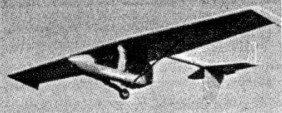
Developed in 1982 by David Cook in England, the Shadow has two seats with fully enclosed cockpit in tandem and fibreglass fuselage. First flew in 1983. Detachable wings and horizontal tail surfaces with conventional 3-axis control, and a tricycle undercarriage, and is certified to BCAR Section S. Tandem one/two seat single engined high¬wing monoplane with conventional three axis control. Wing has swept back leading and trailing edges, and tapering chord; flaps fitted. Two fin tail. Pitch control by elevator on tail; yaw control by fully flying ventral rudder; roll control by half span ailerons; control inputs through stick for pitch/roll and pedals for yaw. Wing braced from below by struts; wing profile Cook devised section; 100% double surface. Undercarriage has three wheels in tricycle formation; rubber suspension on nosewheel and glass fibre sus¬pension on main wheels. Ground steering by differential braking. Brakes on main wheels. Honeycomb laminate fuselage, totally en¬closed. Engine mounted below wing driving pusher propeller. Flaps and ailerons made from honeycomb laminate. Composite con-struction wing. The Shadow is an advanced design which has been developed with the backing of Ciba Geigy Aerospace and makes extensive use of honeycomb laminates. The first prototype was started in January 1982 and was a pusher aircraft powered by a 430 Cuyuna engine. First flown in August of that year by its designer and D Clarke, it showed over 80mph (130kph) on only 80% power and without any form of pod. Encouraged by this performance, Dave Cook then designed a second prototype, this time using a Robin EC44 engine and aiming to produce a machine which would be a direct bridge between microlights and conventional aircraft. Control surfaces are differential ailerons, a fully flying ventral rudder, normal elevator and four position flaps, the latter added to keep landing speeds down. For ground steering the hydraulic disc brakes can be operated independently. The wing design uses a plywood I section spar stiffened at the flanges by the addition of a fabricated aluminium¬ alloy box section. Foam ribs support plywood leading and glass fibre trailing edges, the whole wing being covered by Dacron, glued in place and scaled with dope. The wing has been static tested at + 5.5 g. The Streak Shadow is a shorter span and thinner wing version of the Shadow which first flew in 1986.
Following on from the Shadow C, the Shadow D has better visibility and more room.
Shadow D
Shadow Engine: Robin EC44, 50 hp at 7000 rpm. Propeller diameter and pitch 50 x 34 inch, 1.27 x 0.86 m. Reduction ratio 2.1/1. Power per unit area 0.32hp/sq.ft, 3.4 hp/sq.m. Fuel capacity 6.0 US gal, 5.0 Imp gal, 22.7 litre, Optional fuel Additional bag tank, capacity 21.6 US gal, 18.0 Imp gal, 81.8 litre. Empty weight 323 lb, 147kg. Max take off weight 623 lb, 283kg. Payload 300 lb, 136kg. Max wing loading 3.9 lb/sq.ft, 19.3 kg/sq.m. Max power loading 12.5 lb/hp, 5.7 kg/hp. Load factors +5.5, 3.0 design. Max level speed: >100mph, >160kph. Max cruising speed 85mph, 137kph. Economic cruising speed 70 mph, 113 kph. Length overall 21.0 ft, 6.40 m. Height overall 5.5ft, 1.68m. Wing span 31.5ft, 9.60m. Chord at root 5.8ft, 1.77 m. Chord at tip 4ft, 1.22m. Dihedral 0 degs Tailplane span 8.0 ft, 2.44 m. Fin height 2.0 ft, 0.61 m. Total wing area 158 sq.ft, 14.7 sq.m. Total aileron area 16.4 sq.ft, 1.52 sq.m. Fin area (each) 1.5 sq.ft, 0.14 sq.m. Rudder area 5.5 sq.ft, 0.51 sq.m. Tailplane area 14.5 sq.ft, 1.35 sq.m. Total elevator area 9.2 sq.ft, 0.85 sq.m. Wing aspect ratio 6.4/1. Wheel track 5.5ft, 1.68 m. Wheelbase 6.0ft, 1.83 m. Nosewheel diameter overall 10 inch, 25 cm. Main wheels diameter overall 12 inch, 30 cm.
Engine: Rotax 503, 50 hp. HP range: 30-50. Speed max: 102 mph. Cruise: 75 mph. Range: 165 sm. Stall: 25 mph. ROC: 1100 fpm. Take-off dist: 75 ft. Landing dist: 150 ft. Service ceiling: 25,000 ft. Fuel cap: 6.5 USG. Weight empty: 349 lbs. Gross: 824 lbs. Height: 5.75 ft. Length: 21 ft. Wing span: 32.9 ft. Wing area: 162 sq.ft. Seats: 1/2. Landing gear: nose wheel.
Engine: 40 hp Rotax 447 two cylinder two stroke (437cc). Wing Span: 10.03m. Length: 6.40m. Empty Weight: 150 kg. MAUW: 332 kg. Max. Cruise Speed: 75 kt (121 kph). Range: 240 km.
Laron Shadow Engine: Rotax 503, 50 hp. HP range: 30-50. Speed max: 102 mph. Cruise: 75 mph. Range: 165 sm. Stall: 25 mph. ROC: 1100 fpm. Take-off dist: 75 ft. Landing dist: 150 ft. Service ceiling: 25,000 ft. Fuel cap: 6.5 USG. Weight empty: 349 lbs. Gross: 824 lbs. Height: 5.75 ft. Length: 21 ft. Wing span: 32.9 ft. Wing area: 162 sq.ft. Seats: 1/2. Landing gear: nose wheel.
Streak Shadow Engine: Rotax 582, 65 hp. Speed max: 121 mph. Cruise: 101 mph. Range: 435 sm. Stall: 31 mph. ROC: 1700 fpm. Take-off dist: 100 ft. Landing dist: 200 ft. Service ceiling: 29,000 ft. Fuel cap: 14 USG. Weight empty: 388 lbs. Gross: 900 lbs. Height: 5.75 ft. Length: 21 ft. Wing span: 28 ft. Wing area: 140 sq.ft. Seats: 2. Landing gear: nose wheel.
Shadow B-D –
Shadow D Engine: Rotax 582, 64 hp Wing span: 10 m Wing area: 15.25 sq.m Empty weight: 203 kg Fuel capacity: 23 lt MAUW: 390 kg Max speed: 178 kph Cruise speed: 145 kph Minimum speed: 61 kph Climb rate: 4.8 m/s Fuel consumption: 15 lt/hr Certification: BCAR S Seats: 2 Price (1998): £22,995 Kit price (1998): £16.495
Laron Streak Shadow Engine: Rotax 582, 65 hp. Speed max: 121 mph. Cruise: 101 mph. Range: 435 sm. Stall: 31 mph. ROC: 1700 fpm. Take-off dist: 100 ft. Landing dist: 200 ft. Service ceiling: 29,000 ft. Fuel cap: 14 USG. Weight empty: 388 lbs. Gross: 900 lbs. Height: 5.75 ft. Length: 21 ft. Wing span: 28 ft. Wing area: 140 sq.ft. Seats: 2. Landing gear: nose wheel.
The Cri Cri was superseded by prototypes of the D57 Phryganet (first flight 7 November 1950) of similar general layout and D.21T-4 Super Phryganet (first flown July 30,1951). All three designed Paul J. Deville of Salmson.
A development of the pre-War Salmson D.2, the post-War D.21T-4 Super Phryganet is externally similar to the pre-War model and is of wooden construction.
D.21T-4 Super Phryganet Engine: 135 hp Salmson 7AQ Wingspan: 38 ft 8 in Length: 25 ft 11 in Height: 7 ft 7 in Wing area: 241 sq.ft Empty weight: 1716 lb Loaded weight: 2750 lb Max speed: 134 mph Cruise: 120 mph Service ceiling: 14,300 ft Range: 500 mi
The Cri Cri was superseded by prototypes of the D57 Phryganet (first flight 7 November 1950) of similar general layout and D21T-4 Super Phryganet (first flown July 30,1951). All three designed by Paul J. Deville of Salmson.
The D.57 Phryganet is basically a two-seat side-by-side adaptation of the D.7 Cri-Cri Major. The width of the fuselage was increased and a number od design refinements were included.
Engine: 85 hp Salmson 5 AQ Wingspan: 35 ft 11 in Height: 8 ft 6 in Length: 23 ft 3 in Wing area: 200 sq.ft Empty weight: 1034 lb Loaded weight: 1625 lb Max speed: 99 mph Cruise: 87 mph Range: 310 mi
Compagnie Française d’Aviation (usually known as CFA) was established in 1936 as a division of the Salmson engine company to handle the mass-production of the Salmson D-6 Cri Cri light aircraft.
The CFA D.7 Cricri Major was a postwar-built light high-wing monoplane development of the Salmson D-6 Cri Cri with enclosed two-seat tandem glazed cabin and a fixed tail-wheel undercarriage, powered by a Salmson 5Aq-01 radial engine.
First flying on 15 March 1949, an initial series of ten Cricri (Cricket) Majors was completed and these were bought by aero clubs and private pilots. The design was rather outdated and no further examples were completed.
D.7 Cri-Cri
Four D.7s remained in service in 1956 and one, F-BFNG remained airworthy in 1967. This aircraft has been restored to airworthiness and was operational in 2005.
Engine: 1 × Salmson 5Aq-01, 90 hp (67 kW) Wingspan: 35 ft 11 in (10.95 m) Wing area: 200 ft2 (18.58 m2) Length: 23 ft 3 in (7.09 m) Height: 8 ft 6 in (2.59 m) Empty weight: 1,023 lb (464 kg) Gross weight: 1,585 lb (719 kg) Maximum speed: 93 mph (150 km/h) Cruise speed: 80 mph (129 km/h) Range: 312 miles (500 km) Service ceiling: 13,120 ft (4,000 m) Crew: 1 Capacity: 1 passenger
Compagnie Française d’Aviation (usually known as CFA) was established in 1936 as a division of the Salmson engine company to handle the mass-production of the Salmson D-6 Cri Cri light aircraft.
France Compagnie Française d’Aviation (usually known as CFA) was a French aircraft manufacturer of the 1930s and 40s. It was established in 1936 as a division of the Salmson engine company to handle the mass-production of the Salmson Cri Cri light aircraft.
Manufacturing was interrupted by World War II, but was revived on a small scale thereafter. By 1951, their CFA D.7 Cricri Major design and its derivatives were thoroughly outdated, and the company was dissolved at this time.