At Exeter Airport, during 1948-1950, a series of four-seat lightplanes were constructed: Series 1 CH.3 Ace, Series 2 CH.3 Super Ace, and Series 4 CH.3 Skyjeep. The first of these high-wing cabin monoplanes was flown in August 1946, but high operating costs and unacceptable control system affected sales of the Ace and Super Ace.
The prototype CH.3 Series 1, was fitted with a 125 hp Lycoming engine, a single fin and rudder, and a wooden wing.
Production versions, the CH.3 Series II, was all-metal and fitted with a 145 hp DH Gipsy Major 10 engine. It also has the twin fin and rudder assembly later fitted to the prototype.
The CH.3 Series III had a tailwheel landing gear.
The Series IV version of the Series III had a hinged rear fuselage deck.
By August 1959 the tail wheel undercarriage CH.3 Srs. 4 Skyjeep VH-RCD four-seater had a deepened rear fuselage.
Engine: 1 x Gypsy Major Mk.10, 145 hp Wingspan: 36 ft Length: 21 ft 6 in Empty weight: 1344 lb Loaded weight: 2350 lb Max speed: 126 mph Cruise: 110 mph Stall: 38 mph Range: 400 mi Seats: 4
Chrislea was based originally at Heston, Middlesex, in 1936, building joint designs of R. C Christophorides and B. V. Leak. In 1938 one L.C.1 Airguard was built, a two-seat, low-wing cabin monoplane for Civil Air Guard. Company transferred to Kentish Town shortly before Second World War, undertaking subcontract work for aircraft industry. Moved again in 1947 to Exeter Airport, where during 1948-1950 a series of four-seat lightplanes were constructed: Series 1 CH.3 Ace, Series 2 CH.3 Super Ace, and Series 4 CH.3 Skyjeep. The first of these high-wing cabin monoplanes was flown in August 1946, but high operating costs and unacceptable control system affected sales of the Ace and Super Ace; more conventional system used on 1949 Skyjeep. Total production (all three types) about 26 aircraft. In 1952 assets acquired by C. E. Harper Aircraft Ltd and all surviving models were scrapped.
Constructed at the Republic of Korea Chinhae Naval Shipyard in 1957, the then un-named flying boat was of mixed metal and wood construction. Power was two 213 hp Continental 0-470-11 engines.
In response to the considerable aging and reduction of the inventory of the country’s air fleet, the FAA encouraged a plan for the progressive replacement of the fleet through manufacturers of national origin.
It was decided for Chincul SACAIFI to manufacture aircraft under license from Piper Aircraft Corporation. The company was a wholly owned subsidiary of “La Macarena S.A.”, Piper’s Argentine distributor. Thanks to Piper’s licensed production plan to produce aircraft. abroad, it envisaged assembly in emerging third world countries, with the main benefit of commercial penetration and the reduction of labor costs that this implied.
With industrial promotions, which gave reductions and tax deferrals to certain areas of the country, they took the owners of Chincul to settle in the town of Pocito in the province of San Juan.
There were built two hangars: Endings, and production: 70 m front by 110 m long. Together with other sectors and annexed workshops, the total covered area reached 14,000 sq.m covered.
The inauguration of the plant occurred on December 12, 1972. The plant maintained a simultaneous process with 10 assembly lines, with about 450 employees (between technicians and aeronautical mechanics), working 24 hours a day, 365 days a year “24×7”. In total they produced some 960 aircraft. In 1978 there were 500 employees.
By the middle of the 1980s, the Sanjuanina plant started a slow downward slope due to the inflationary process that was experienced at that time, in addition to the bankruptcy of its Piper Aircraft mother house.
The Cuyano settlement of the Beraza tried to keep the head for a while longer, but 10 years of setbacks prevented it.
Signed agreement with Bell Helicopter Textron 1990 for helicopter co-production.
Finally, between 1991 and 1994, a final series of the PA-18 Super Club model was produced, definitively ceasing the activity on January 31, 1995, the date on which its huge gates were closed at the Pocito plant.
Today the facilities offer the image of a sad abandonment.
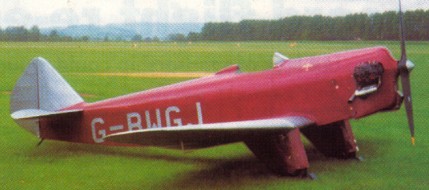
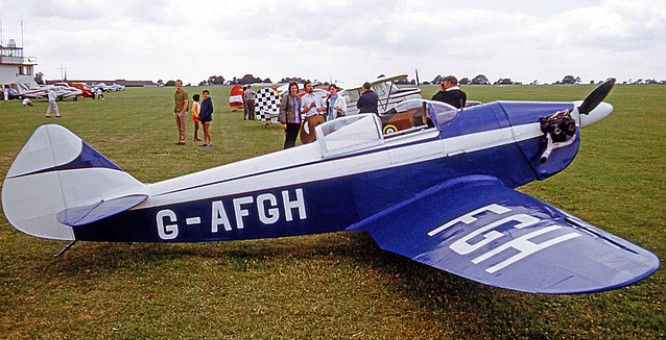
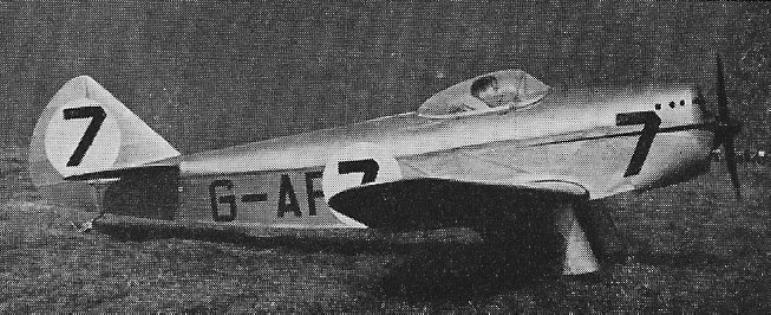
A single-seat light aircraft designed by Hon Andrew W. H. Dalrymple and A. R. Ward. A low wing open-cockpit wooden monoplane with fixed “trousered” landing gear and Carden-Ford engine, first flown April 1937.
Founded at Chilton, near Hungerford, Berkshire, in 1937 to build D.W.1 single-seat light aircraft designed by Hon Andrew W. H. Dalrymple and A. R. Ward, both former de Havilland students.
A low wing open-cockpit wooden monoplane with fixed “trousered” landing gear and Carden-Ford engine, first flown April 1937. Three D.W.1 s built, followed by one faster D.W.1 A, first flown July 1939. Design of D.W.2 only half finished when Second World War began and it was never completed.
During the war company did subcontract work for MAP and aircraft industry generally. Dalrymple died in a flying accident in December 1945, and company reregistered on June 5,1946 as Chilton Aircraft Company Ltd.
The death of Dalrymple in a flying accident on Christmas Day 1945 brought an end to the aeronautical activities.
Prototype Olympia single-seat sailplane built 1947; rights in this sold to Elliotts of Newbury Ltd. in 1952. Company began work in electrical industry.
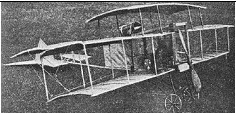
A design of Fred T. Childs of Akron, Ohio. The top wing measured 36 by 7 ft, and the lower 26 by 7 ft, the surface being 578 ft. It had two side surfaces measuring 6 by 7 ft ft, set at a dihedral angle, the idea being that these will maintain equilibrium during flight on the theory that a tip to one side or the other will cause an increased resistance on the side tipping over, with a resultant righting of the machine. The total weight of the machine, without the engine, was given as 250 lbs.
For exhibiting the machine at a county fair, a 2-cylinder, 7 hp Waterman engine was installed, but the motor intended to drive the machine was a 35 hp air-cooled, promised not to weigh more than 150 lbs including the magneto and accessories. The two 7-foot propellers were driven by cable, but it was intended to try chains and sprockets.
Ian Chichester-Miles, formerly Chief Research engineer of British Aerospace Aircraft Division at Hatfield, Hertfordshire, established Chichester-Miles Consultants (CMC) to develop a high performance light business jet.
Design of the four-seat Leopard started in January 1981 and was sufficiently advanced for a mockup to be completed in early 1982. Detail design and construction of a prototype by Designability Ltd of Dilton Marsh, Wiltshire, began in July 1982, under contract to CMC.
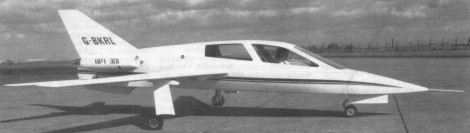
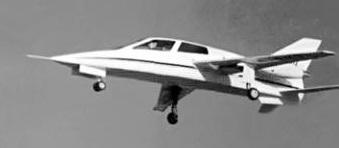
CMC Leopard cn 001
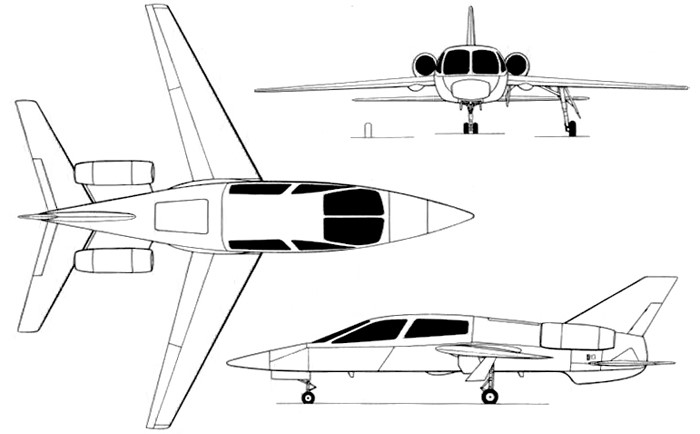
A four-seat light business jet aircraft, the wings are two-spar structure, primarily of GFRP, with some carbonfibre reinforcement. Full span electrically actuated trailing-edge flaps of carbonfibre, with deflections of +/- 45° for high drag landing and air-braking/lift dumping. No ailerons or spoilers. Thickness/chord ratio 14% at root, 11% at tip. Sweepback at quarter-chord 25°.
The Leopard airframe has an all-moving fin and tailplane and wings that combine laminar flow with supercritical technology.
Cantiler mid-wing monoplane. ARA designed wing section and 3D profiles combining laminar flow and super critical wing technology.
The fuselage is built in three sections: Unpressurised nose section accomodating avionics and nosewheel gear when retract, pressurised cabin section (production aircraft only) and unpressurised rear section providing a baggage bay, with fuel tanks below and equipment bays to rear.
Basic monocoque structure, primarily of GFRP with some carbonfibre reinforcement; fore and aft cabin bulkheads, engine and tailplane axle frames moulded in.
Pressure cabin section divided approximately along aircraft horizontal datum, with upper section formed by electrically actuated upward opening canopy hinged at windscreen leading-edge. Multiple latches around canopy lower-edge. Bonded-in acrylic side windows carry pressurisation tension. Nose opens for access to avionics.
Powered by two NPT 301 engines developing 300-350 lb thrust, this glass-fibre composite mini business jet is designed to keep pace with Learjets and Jumbos. Complete with a glass cockpit, the Leopard will carry four passengers and baggage over 1500 nm at around 500 mph at 41,000-45,000 feet.
CMC Leopard cn 001
First shown statically at Farnborough in 1986, the first flight of the prototype (G-BKRL) took place on 12 December I988 at RAE Bedford, piloted by Cranfield test pilot Angus McVitie for a 27min flight.
CMC has limited the aircraft to 130kt and a maximum altitude of 3,500ft. The Leopard prototype was tested from speeds as low as 75kt with maximum 41° flap. Minimum zero-flap speed was less than 90kt. Undercarriage cycling was proved during this flight.
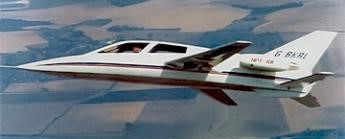
The prototype flying in the 1990 Farnborough display.
The converted missile NPT301 turbojet engines were intended solely for the 001, and NPT was slated to develop new engines for the final version of the aircraft. But when NPT went bankrupt, the entire Leopard project was delayed for one year until CMC teamed up with Williams International Corp., Walled Lake, Michigan.
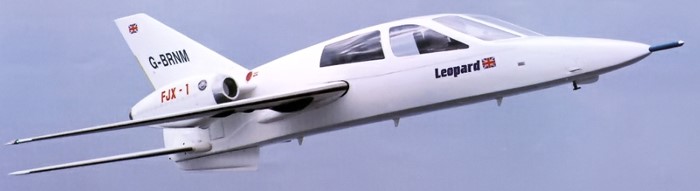
FJX-1 powered Leopard
Williams developed the FJX-1 engine for CMC’s first production-configured aircraft, the 002, built at the Designability R&D Center in Dilton Marsh, England. Rated at 680 lb-thrust, the FJX-1 had more than twice the power of the NPT301. That was okay for the 002, but it was not quite enough for the final aircraft.
Engines: 2 x Noel Penny NPT 301 turbofan, 300-350 lb. Seats: 4. Cruise: 800+ kph. Range: 2775+ km.