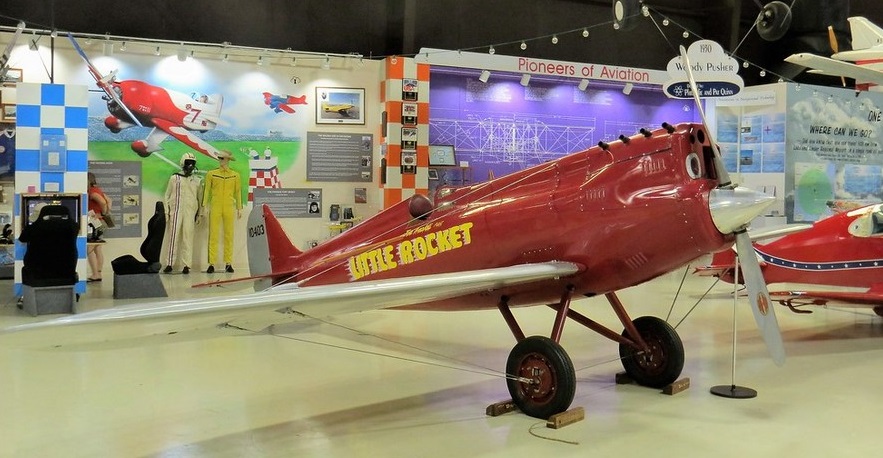
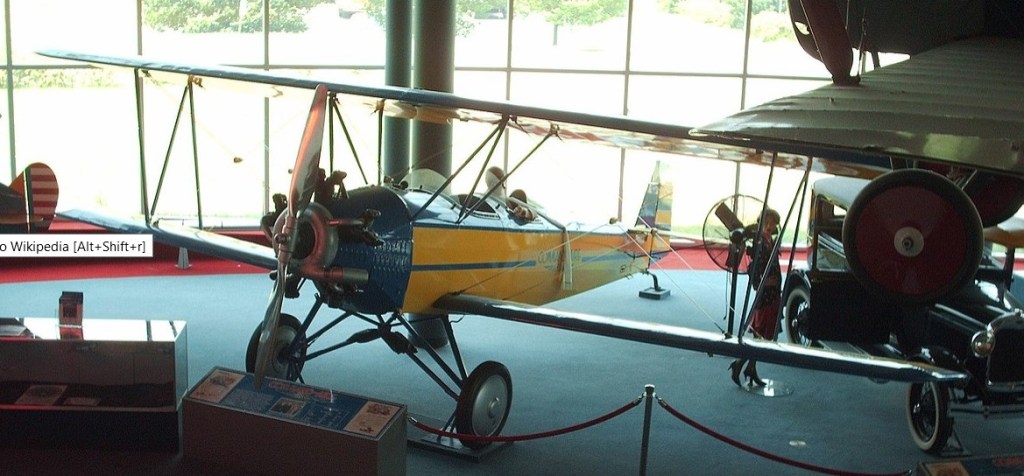
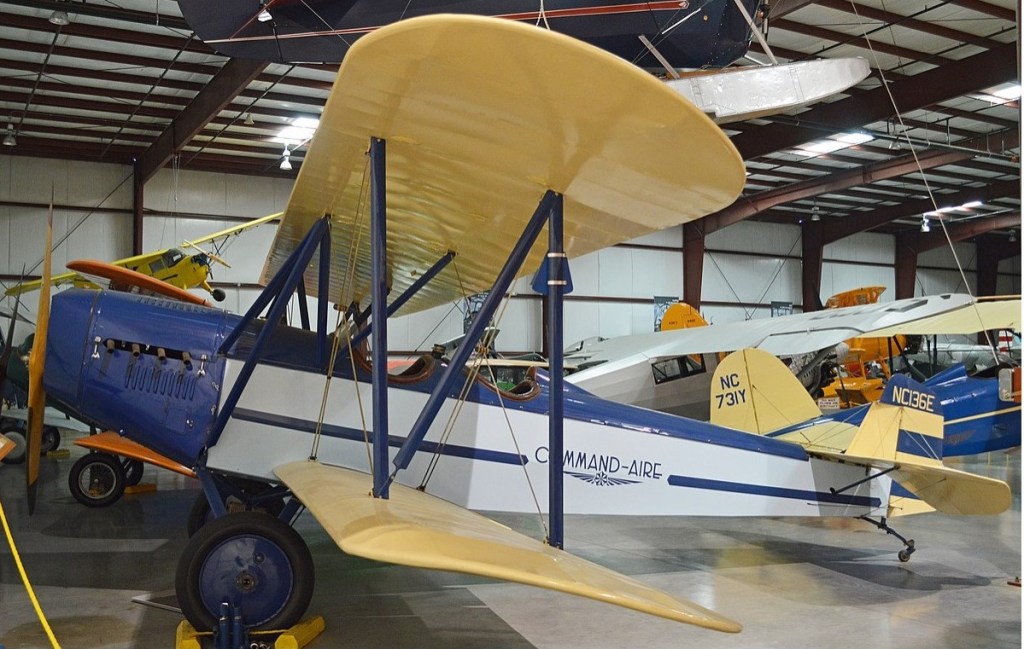
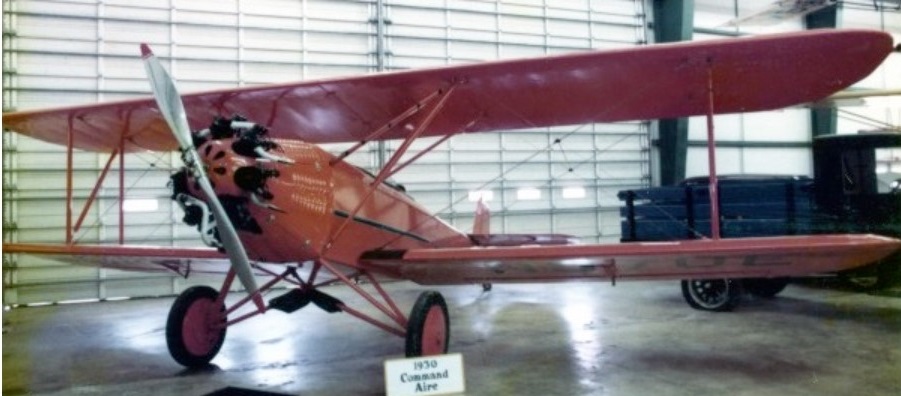
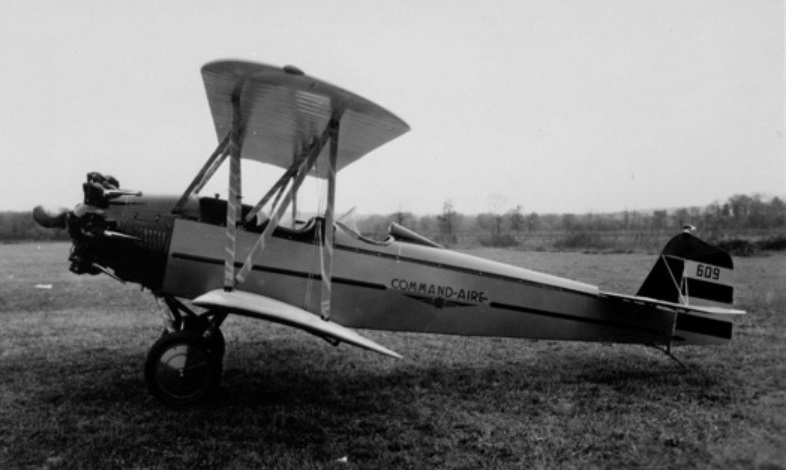
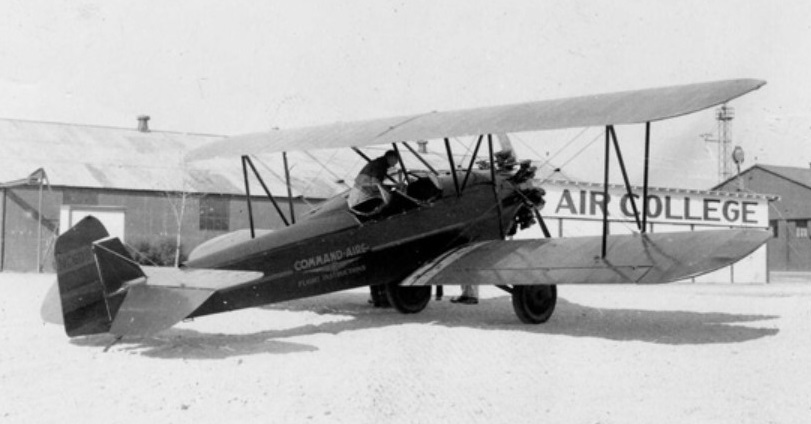
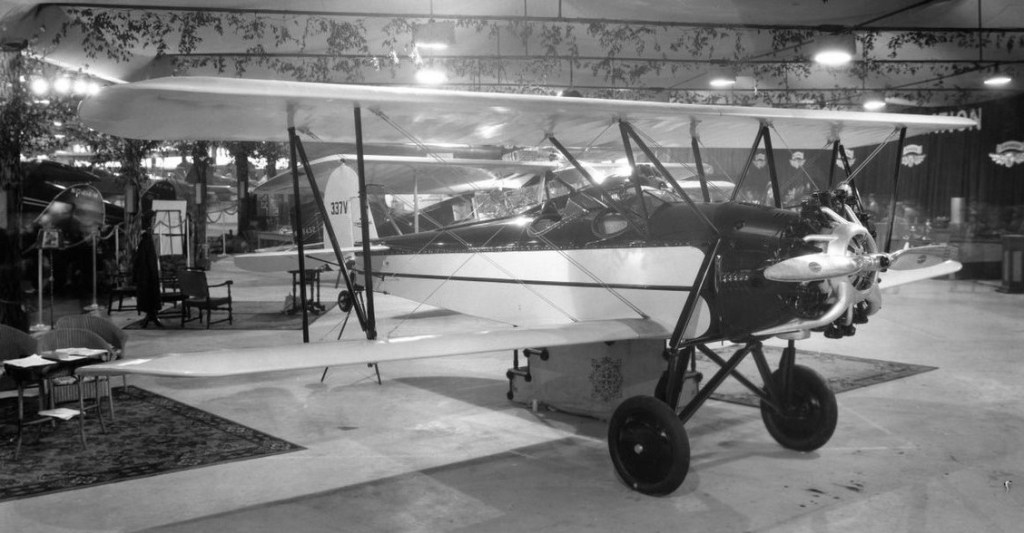
Command-Aire MR-1 Little Rocket Racer N345JA (Reproduction) on static display at the Sun’n Fun Florida Air Museum at the Lakeland Linder Regional Airport in the City of Lakeland Polk County Florida U.S.A.
Command-Aire built one little Rocket Racer. The Rocket was built to compete in the 1930 All American Derby. Equipped with a super-charged 90 hp Cirrus and Lee Gelbach at the controls, running a race course that spanned most of Mid-America, the little Rocket repeatedly recorded ground speeds of 215 mph, its average point-to-point time being in the neighbourhood of 160 mph. The aircraft won the 5,500 mile race and $15,000 prize (a fortune in the depression) with an average speed on 127mph.
The Rocket no longer exists, but Joe Armaldi in Florida built a replica of the racer.
The Command-Aire did not at first appear to offer much of an advancement over the vast multitude of three seat biplanes built around the ubiquitous Curtiss OX-5 engine to similar designs, with similar dimensions and construction methods, many of which were already in production. The basic design was by Morton Cronk, and although it had excellent high altitude capabilities, it was slow. This setback nearly foundered the company before its first aircraft entered production.
Albert Vollmecke, a Heinkel engineer was in the US attempting to find a customer to build Heinkel HD 40 mailplanes under licence for the US market. Seeing that there was little prospect of any sales in the US, he decided to hire on with an American company, Command-Aire.
His first task was to rework the design to provide documentation for the new approval process. While there was only one major visible external difference, he undertook an extensive redesign based on his experience in the much more scientifically-grounded German aviation industry, and to bring the design into line with CAA (now FAA) certification requirements, which involved a lot of submissions, and alterations, and resubmissions before they signed off on it. Many parts had to be redesigned when it was easier to redo the design, than to use the existing design to calculate the necessary strength margins. The most obvious change was a switch from four small conventional ailerons at the tips to two slotted nearly full-span ailerons on the lower wing. This improved low speed control dramatically, allowing lateral control even after the aircraft had stalled – a novelty among American aircraft at the time, and a recurring advertising theme.
The second change was the incorporation of a Phylax fire suppression system capable of putting almost any fire out in flight. The third novelty was the use of a rotisserie type fuselage jig, that ensured accuracy and consistency between the airframes they built, reducing the chance of building an airplane that couldn’t be rigged to fly right. Although Command-Aire’s advertising claims that Vollmecke invented this, he claimed he merely brought the idea from Europe.
The fuselage was built from welded chromium-molybdenum alloy steel tubes, faired with wooden battens. The top of the fuselage was covered in large metal panels that could be readily opened to provide access, and a compartment for luggage was provided between the cockpits large enough for a suitcase.
The slightly staggered wings were built around solid spruce spars, with spruce and plywood warren truss type ribs. The wings were braced with cables.
The ailerons and the entire empennage were also built from chromium-molybdenum alloy steel tubing, and all controls were actuated through pushrods and bellcranks, with no cables or pulleys used. The ailerons on the prototype were conventional, however on production variants, they extended across nearly the full span on the lower wings only, and had a slot that allowed air to flow over the aileron at low airspeeds and high angles of attack, which helped ensure lateral control even after the wings had stalled. These were not Frise-type ailerons though, but conventional ailerons with a slot at the hinge line.
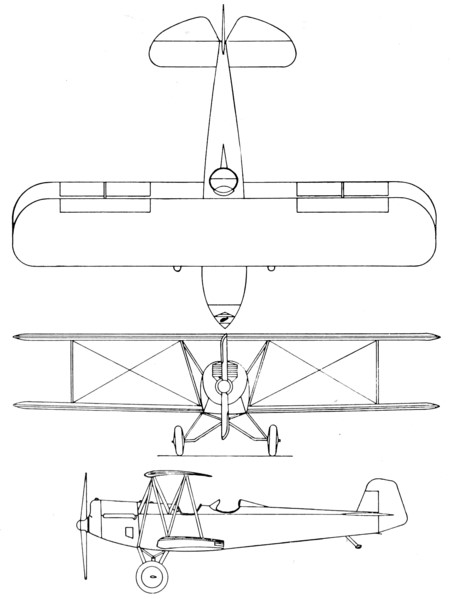
The undercarriage was a split axle type, braced to a steel tube four point pyramid that extended from the belly of the aircraft, with suspension provided with bungee cords which were protected by leather boots. Both cabane and interplane struts took the form of an N and were steel tubing as well. The 3C3 can be distinguished from later types by having an additional strut providing lateral bracing from the forward strut anchor point on the wing, to the lower longeron at the firewall, triangulating the structure. The 4C3 and later types dispensed with this extra strut, and coincided with an extensive redesign that otherwise had few external differences.
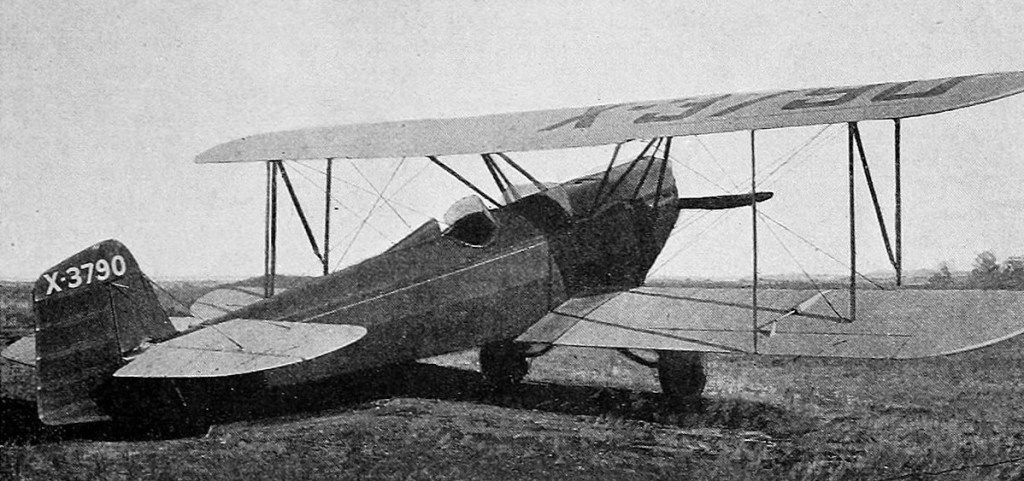
The 3C3 first flew in January 1928 and received certification in July 1928.
Command Aire 3C3 prototype from Aero Digest, February 1928
While normally a three-seat design, those aircraft with a T in the designation were built as two-seat trainers specifically for flight instruction, and a crop-dusting version was also sold, with the space in the front cockpit being filled with a large hopper, and the fuel tank relocated to the wing centre section. At least 17 of these were built, with others converted from other variants.
The 3C3 was one of the most pleasant and stable aircraft of the 1920’s. In the companies “hands off” flight demonstration, the fearless pilot would climb out of the cockpit and straddle the turtle deck like a horse while the aircraft cruised the skies, this proved a quite effective sales technique. He turned the aircraft by leaning in the desired direction.
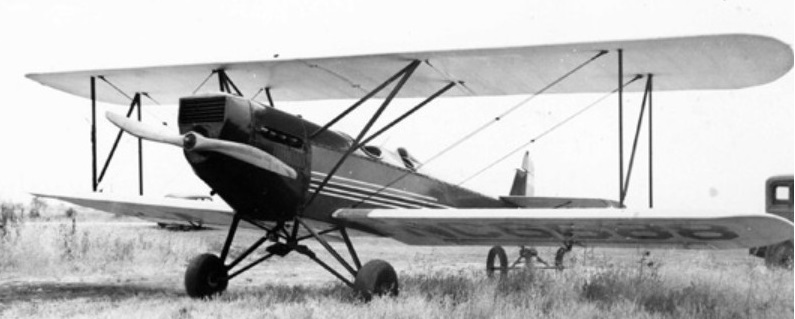
Command-Aire 3C3 NC6688 msn 513 showing salient characteristics, including triangulated cabane that was simplified on later models
The 3C3 is similar in construction to most aircraft of the period and used a war surplus OX-5 engine. One of the notable features was the metal cowls, cockpit and turtle deck which made half the aircraft metal covered–not fabric covered. The aircraft was controlled by push-pull tubes and bell cranks, there were no wires, cables or pulleys.
In another publicity stunt, a flight of over 100 mi (160 km) from San Diego to Los Angeles was made without once using the control stick as all control inputs were through the rudder pedals.
In 1929, the government decided to allow aerobatics (known as stunting at the time), during the Annual Arkansas Air Tour being held in 1929 and so a team of three Warner-powered Command-Aire 3C3-As were formed as “The Blue Devils”, but painted incongruously in black and orange stripes.
The 3C3 sold for $5500 in 1929.
The BS-14 and BS-16 (BS standing for Biplane sport) were the final developments, and again featured extensive redesign work, but once again with few visible external alterations. The rudder was redesigned, and a new and promising engine was added to the lineup – the Lycoming R-680. On the BS-16, the undercarriage was changed to the outrigger type and a tailwheel was provided in lieu of the skid used previously, while the rear seat was raised to improve visibility.
A variety of engines were installed during the life of the design, with the area ahead of the firewall being redesigned to accommodate lighter engines, with longer noses to maintain the correct balance.
The problematic engine supply situation was well understood long before the last Curtiss OX-5 was installed in an airplane, and substantial efforts for alternatives were made. Simplicity and reliability were key, and the solutions invariably involved air-cooled radial engines, however the designs were not sufficiently developed, and there were many failures, and for various reasons. As a German, it was natural for Vollmecke to look to Germany, where some of the best designs were available, however two major problems surfaced. The first was that the supply of these engines was endangered by economic instability in Germany. The second was that the Command-Aire people were never able to get their engines to run right on the fuel available. Vollmecke suspected that the octane rating was too low, which caused knocking – potentially damaging the engine. Only 7 aircraft were built with the German radials. The Czechoslovakian Walter NZ-120 was even less successful, and only one was used. The most successful of the replacement engines with Command-Aire, was the Curtiss Challenger, despite its poor reputation elsewhere. Over 50 aircraft were fitted with this engine. Had the company continued in existence, then the Wright J6 and Lycoming R-680 that were only installed in a small number of airframes, would probably have eventually outsold the OX-5 as they did with other aircraft types.
A Challenger powered-Command-Aire 5C3 was entered into the Guggenheim Safe Aircraft Competition in 1929. The 3C3 was the last aircraft not specially designed for the contest to be eliminated, and would actually enter revenue service. It later succeeded on a repeat of the test that it was eliminated on.
The Command-Aire 5C3 was featured in the Berryloid advertising series for aircraft dope, each featuring a different fabric covered aircraft, and each aircraft painted as a different bird. This advert was from the November 1929 Aerodigest
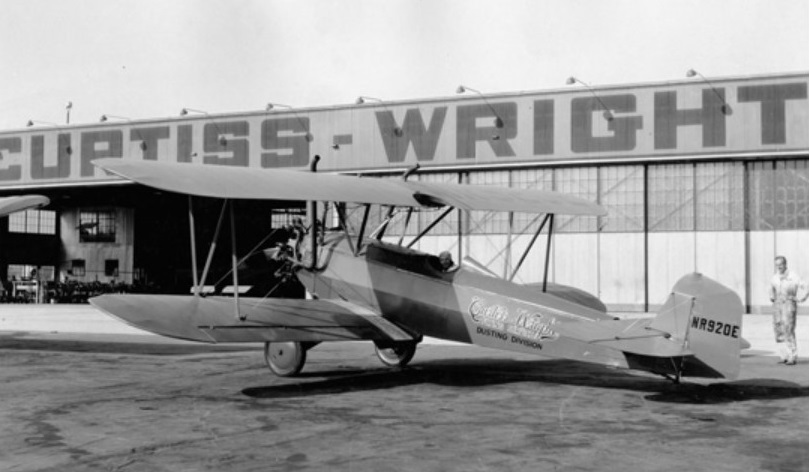
5C3 NC925E
In 1929, Command-Aire contracted the Curtiss Flying Service to handle sales, through their large number of facilities, and Curtiss purchased a large number of aircraft for flight training for their own schools. Recognizing that the excessive number of aircraft companies in the aviation industry would force consolidation into a smaller number of larger companies, it had long been the intention to merge Command-Aire into a larger company even before the onset of the Great Depression forced matters. Negotiations had been underway for just such a merger – into Curtiss, at one time the largest aircraft manufacturer in the United States, however while negotiations were still underway, Curtiss’s financial problems forced it to merge with Wright Aeronautical. Unfortunately, Wright had themselves recently absorbed Travel Air, whose offerings included the Travel Air 2000 which was similar to the Command-Aire biplanes. Negotiations collapsed, and along with them, went the contracts for supplying the flying schools – and access to the sales network.
Command-Aire landed a by now much needed contract from the Chilean government to produce 36 3C3-BTs to be built at a specially-built facility in Chile, however no Command-Aires seem to have been either used in that country, either civil or military.
Only one example appears to have been exported, a 3C3 that went to Canada in 1931, where it went through a succession of private owners as CF-APQ, having previously been NC5590 in the US.
Produced 1928-1931a total of 184-254 (total for 3C3, 4C3, 5C3, BS-14 and BS-16) were built/
1928 ATC 53, 2-201 Engine: 90 hp (67 kW) Curtiss OX-5 Propeller: 2-bladed Wooden fixed pitch Upper wingspan: 31 ft 6 in (9.60 m) Upper chord: 60 in (1.5 m) Wing sweep: 0° Lower wingspan: 31 ft 6 in (9.60 m) Lower chord: 60 in (1.5 m) Wing area: 303 sq ft (28.1 m2) Airfoil: Aeromarine 2A Length: 24 ft 6 in (7.47 m) Height: 8 ft 4 in (2.54 m) Empty weight: 1,410 lb (640 kg) Gross weight: 2,200 lb (998 kg) Useful load: 790 lb (360 kg) Fuel capacity: 40 US gal (150 l; 33 imp gal) Oil capacity: 4 US gal (15 l; 3.3 imp gal) Maximum speed: 100 mph (160 km/h, 87 kn) Cruise speed: 85 mph (137 km/h, 74 kn) Minimum control speed: 36 mph (58 km/h, 31 kn) Range: 440 mi (710 km, 380 nmi) 116 built. Crew: One Capacity: Two Undercarriage track: 87 in (2.2 m)
3C3-A 1929 ATC 118 Engine: 110 hp (82 kW) Warner Scarab 20 built. 1 fitted with Edo floats.
3C3-AT
3C3-AT N970E W-108
1929 ATC 151 2 seat trainer developed from 3C3-A about 6 built.
3C3-B 1929 ATC 120, 2-440 Engine: 105 hp (78 kW) Siemens-Halske Sh 12 5 built 1st possibly modified from 3C3 with a new c/n.
3C3-BT 1929 ATC 209 Engine: 113 hp (84 kW) Siemens-Halske Sh 14 2 seat trainer developed from 3C3-B. 2 built plus 1 converted from 3C3-B.
Command-Aire started in 1926 as the Arkansas Aircraft Co. Inc. of Little Rock, Arkansas.
In 1929 Command-Aire was one of the top manufacturers and was recognized for having one of only two designs to pass the Guggenheim Safety Trial, in which all existing aircraft designs were flown and judged for safety.
In 1930 the company entered their “Little Rocket,” in the All American Derby.
Command-Aire despite all of its successes was unable to survive the post-depression era and closed their doors forever in 1931.
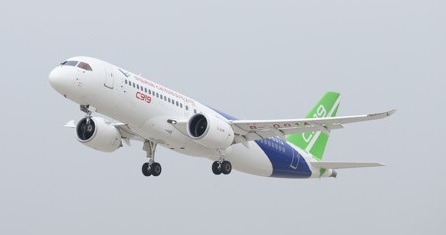
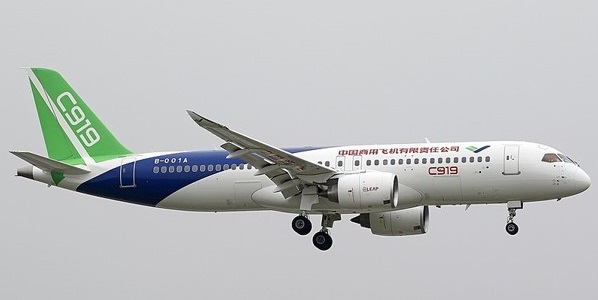
Designed to compete with the Airbus 320 and Boeing 737, the C-919 aircraft was made by the Commercial Aircraft Corporation of China, Comac; founded in 2008 with the purpose of producing the first commercially functioning aircraft for passengers – something the state-run company had previously failed to succeed in doing in the 1970s. The C stands for “COMAC” and “China”, 9 means “forever” while 19 refers to its capacity of 190 passengers. The C also has the implication that forms an “ABC” parallel situation with Airbus and Boeing. In Mandarin Chinese, 9 (Chinese: 九; pinyin: jiǔ) is a homophone of 久, meaning “forever” as a Chengyu in Chinese: 天长地久; pinyin: tiān cháng dì jiǔ.
Several components from the plane were imported, including the landing gear of German origin, Austrian interior and Franco-American engines. The aircraft, primarily constructed with aluminium alloys, is to be powered by either CFM International LEAP or ACAE CJ-1000A turbofan engines, and can carry 156 to 168 passengers in a normal operating configuration up to 5,555 km (3000 nmi).
The center wing box, outer wing box, wing panels, flaps, and ailerons are planned to be built in Xi’an, China; the center fuselage sections are planned to be built in Hongdu, China. Aluminium-lithium alloys account for 8.8% of the structure and composite materials for 12%. The air frame will be made largely of aluminum alloy. Aircraft design and assembly is performed in Shanghai.
The wing is supercritical, increasing aerodynamic efficiency by 20% and reducing drag by 8% compared to a non-supercritical one. The center wing box was originally intended to use carbon fibre composites. It was changed later to an aluminum design to reduce design complications.
Both Pratt & Whitney and CFM International offered to provide the engines for the aircraft, the former offering the PW1000G and the latter the LEAP-1C; the latter was ultimately selected.
The engine’s nacelle, thrust reverser and exhaust system will be provided by Nexcelle, with such features as an advanced inlet configuration, the extensive use of composites and acoustic treatment and an electrically operated thrust reverser. Michelin will supply Air X radial tyres. Its integrated modular avionics architecture is based on Ethernet.
Comac applied for a type certificate for the aircraft from the Civil Aviation Authority of China on 28 October 2010. In June 2011, COMAC and Irish low-cost airline Ryanair signed an agreement to co-operate on the development of the C919. The production of the prototype began on 9 December 2011.
Canada’s Bombardier Aerospace has been collaborating since March 2012 on supply chain services, electrical systems, human interface and cockpit; and on flight training, flight-test support, and sales and marketing, from June 2013.
In 2012 the C919 order book stood at 380 units worth US$26 billion, and averaging $68.4 million. In June 2015, the China National Radio predicted a $50 million price, cheaper than the B737 or A320 list prices.
It rolled out on 2 November 2015 and first flew on 5 May 2017. The C-919’s maiden voyage lasted 79 minutes, taking off and returning to the Shanghai Pudong International airport. The flight was a particularly symbolic moment for China, as a sign of their entrance and rise into the aviation world, and was broadcast live on state-controlled television.
Comac powered on its second prototype on 28 July 2017. The first has not flown since the maiden flight but no major issues have surfaced while small improvements were being made. On September 28, it made its second flight at 10,000 ft (3,000 m), which lasted 2 hours 46 minutes, although it was supposed to last one more hour. On November 3, it made its third flight in 3h 45min, reaching 3,000 m (9,800 ft). It was then transferred on 10 November from Shanghai to Xian to continue its flight test campaign, a 2h 24min, 1,300 km (700 nmi) flight reaching 7,800 m (25,600 ft) and Mach 0.74 (825 km/h; 445 kn). The second prototype made its first flight on 17 December 2017.
An unfinished C919 at the Comac Shanghai Research and Development Center in Shanghai in May 2017.
The delay between first and subsequent flights underline the program immaturity by maiden flight: flying early at low speed and altitude is possible but faster and higher is limited by aeroelastic flutter needing ground vibration testing and aircraft instrumentation which were not ready in May. Due to flight testing problems, the 2020 introduction previous schedule was delayed to 2021, for China Eastern Airlines. In February 2018, the first prototype was flying more than once a week.
Part of the problem is that Comac’s home base is Shanghai Pudong International Airport, one of the busiest airports in the country. The company decided to transfer its first test aircraft in November to Yanliang in Xi’an, a city in western China. That should make for a better base to conduct tests.
At the November 2010 Zhuhai Airshow, Comac announced orders for 55 C919 aircraft from six airlines, with an additional 45 options. The purchasing airlines or lessors included China Eastern Airlines, Air China, Hainan Airlines, China Southern Airlines, CDB Leasing Company, and GE Capital Aviation Services. On 19 October 2011, Chinese ICBC Leasing ordered 45 C919s and agreed to be the launch customer. On 11 November 2014, Comac announced at the 2014 Zhuhai Airshow that China Merchants Bank’s aircraft leasing division made a firm commitment for 30 C919s, and that total orders were now up to 450 aircraft.
At the June 2015 Paris Air Show, Ping An Leasing signed a letter of intent for 50 C919s, becoming one of Comac’s largest customers, and Puren Group signed a letter of intent for seven C919s and seven ARJ21s, intended for the start-up Puren Airlines. In November 2016 COMAC has received an order for 20 C919s including 5 firm from Shanghai Pudong Development Bank Financial Leasing and for 36 C919s from CITIC Group Financial Leasing including 18 firm. While no down payments were needed before its maiden flight, 500,000 yuan ($76,000) were deposited subsequently for each firm order. The last ICBC Leasing order for 55 on 5 December 2017 brought the order book to 785. In February 2018, its total order book was for 815, before the order for 200 from HNA Group in June 2018, along with 100 ARJ-21s.
In February 2018, Comac had 815 orders mostly from Chinese leasing companies or airlines with the exception of GE, before the order for 200 from HNA group.
In June 2018, Aviation Week reported the flight-test aircraft grounding for modifications, extending the schedule by three months but maintaining a 2020 certification target. The two prototypes were having their flaps and tailplanes modified, due to delamination of the carbon-fiber reinforced plastic elevators. Fuel tanks were also modified. The third test aircraft was also being modified and maximum-rate pressurization was tested.
C919 Engines: 2 x CFM LEAP-1C, 31,000 lbf (137.9 kN) Wingspan: 35.8 m / 117.5 ft Length: 38.9 m / 127.6 ft Height: 95 m / 39.2 ft Empty weight: 42,100 kg / 92,815 lb MTOW: 72,500 kg / 159,835 lb Maximum payload: 20,400 kg / 45,000 lb Maximum fuel: 19,560 kg / 43,122 lb Cruise: Mach 0.785 (450 kn; 834 km/h) Range: 4,075 km / 2,200 nm Approach speed: 135 kn (250 km/h) Takeoff dist: 2,000 m (6,600 ft) Landing dist: 1,600 m (5,200 ft) Seats: 188-168
C919 Wingspan: 33.6 m / 110 ft Wingspan with winglets: 35.4 metres / 116 ft Fuselage width: 3.96 m / 13.0 ft Fuselage height: 4.166 m / 13.67 ft Fuselage cross-section: 12.915 sq.m / 139.02 sq ft Payload capacity: 20.4 tonnes Cruise: Mach 0.785 / 450 kn / 834 km/h Operating ceiling: 12,200 m / 39,800 ft Range std: 4,075 km / 2,200 nmi Range ER: 5,555 km / 2,999 nmi
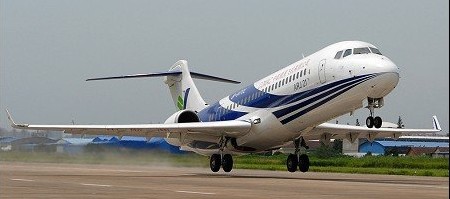
The Comac (formerly ACAC) ARJ21 Xiangfeng (Soaring Phoenix in Chines) is a 2008 twin-engined regional airliner. It is the first passenger jet to be developed and indigenously produced by the People’s Republic of China.
ARJ21-700 Engines: 2 x 6954kg General Electric CF34-10A Take-off weight: 43500 kg / 95902 lb Empty weight: 24955 kg / 55017 lb Wingspan: 27.29 m / 90 ft 6 in Length: 33.46 m / 110 ft 9 in Height: 8.44 m / 28 ft 8 in Wing area: 79.86 sq.m / 859.61 sq ft Max. speed: 876 km/h / 544 mph Cruise speed: 724 km/h / 450 mph Ceiling: 11900 m / 39050 ft Range: 3700 km / 2299 miles Crew: 2 Passengers: 90
Commercial Aircraft Corporation of China, Comac, was founded in 2008 with the purpose of producing the first commercially functioning aircraft for passengers – something the state-run company had previously failed to succeed in doing in the 1970s.
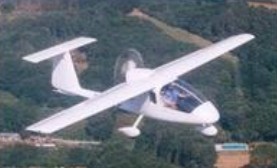
Eyeing entry into the U.S. market in 2012 was the Colyaer Freedom S100, a long-wing, composite Spanish entry that was ASTM-certified (#44) but lost its distributor. In 2012 a Lakeland, Fla., dealer was working on reintroducing it to America.
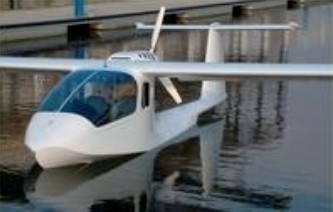
The Colyaer Gannet S100 is a seaplane that shares the wing, tail and upper fuselage of the Colyaer Martin 3. It has a water rudder and an optional reversible prop. On both airplanes, the engine is in the rear, which means less noise and greater visibility. Both the Colyaer Martin 3 and the Colyaer Gannet S-100 are made of Kevlar, which has a better strength-to-weight ratio than fiberglass, making the airplane both strong and light.
Stall: 35 kt / 40 mph / 65 kmh Cruise: 97 kt / 112 mph / 180 kmh VNE: 140 kt / 162 mph / 260 kmh Empty Weight: 270 kg / 595 lbs MTOW Weight: 450 kg / 992 lbs Climb Ratio: 1000 ft/min / 5 m/s Glide Ratio: 20 Take-off distance (50ft obstacle): 140 ft / 43 m Landing distance (50ft obstacle): 140 ft / 43 m
Ultralight Motorglider also with shorter wingspan model 110 with better cruise; 200km/h. The Colyaer Gannet S100 is a seaplane that shares the wing, tail and upper fuselage of the Colyaer Martin 3. On both airplanes, the engine is in the rear, which means less noise and greater visibility. Both the Colyaer Martin 3 and the Colyaer Gannet S-100 are made of Kevlar, which has a better strength-to-weight ratio than fiberglass, making the airplane both strong and light.
Stall: 35 kt / 40 mph / 65 kmh Cruise: 97 kt / 112 mph / 180 kmh VNE: 140 kt / 162 mph / 260 kmh Empty Weight: 270 kg / 595 lbs MTOW Weight: 450 kg / 992 lbs Climb Ratio: 1000 ft/min / 5 m/s Glide Ratio: 23 Take-off distance (50ft obstacle): 390 ft / 120 m Landing distance (50ft obstacle): 390 ft / 120 m
Grumman began designing the G-42 in mid-1939 as a successor to the J2F Duck but as a consequence of wartime priorities this was transferred to Columbia as the Columbia JL.
A total of three were produced.
XJL-1 Type: 6 place military utility amphibian Engine: 1 x Wright R-1820-56 Cyclone, 1200 hp Prop: 3 blade CS metal Max speed: 174 mph Cruise speed: 119 mph Range: 2070 miles MTOW; 13,000 lb Wing span: 50 ft 0 in Length: 45 ft 11 in