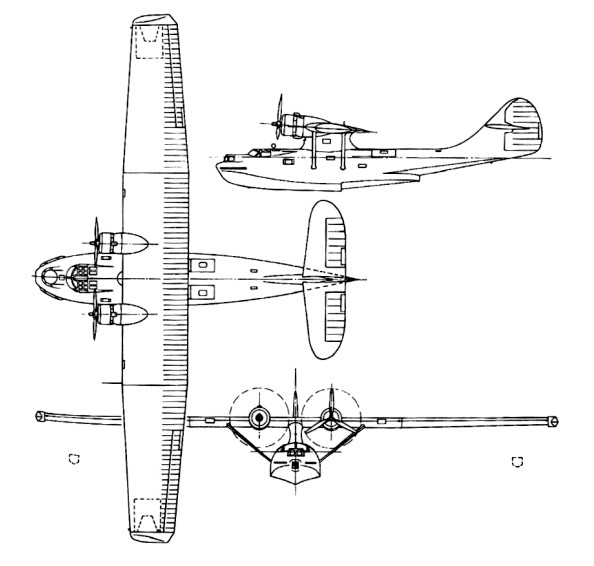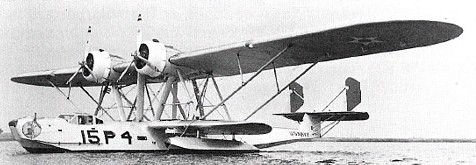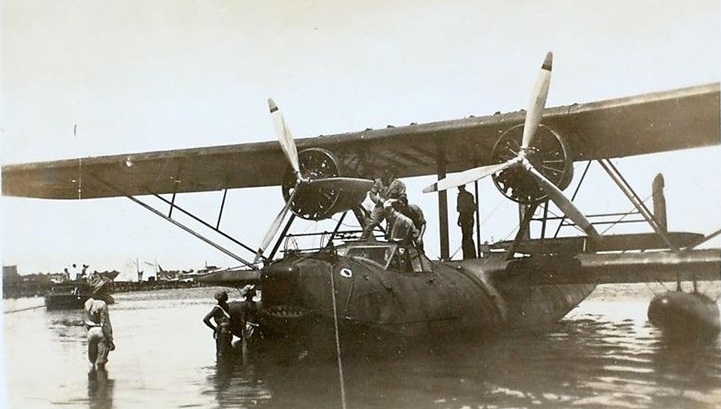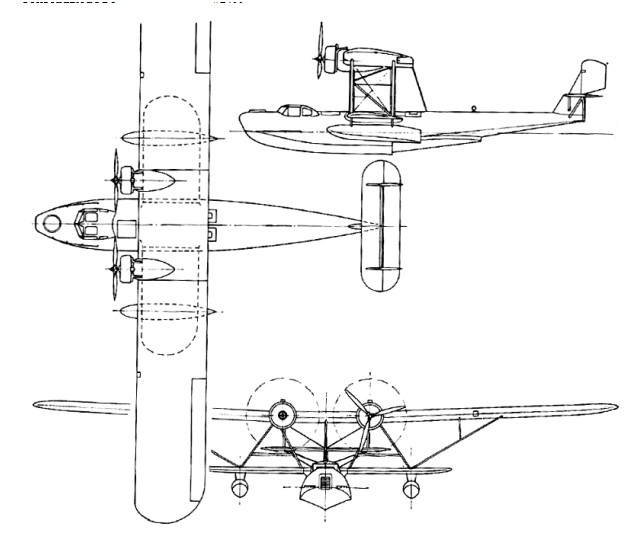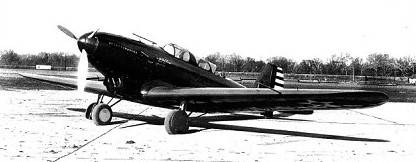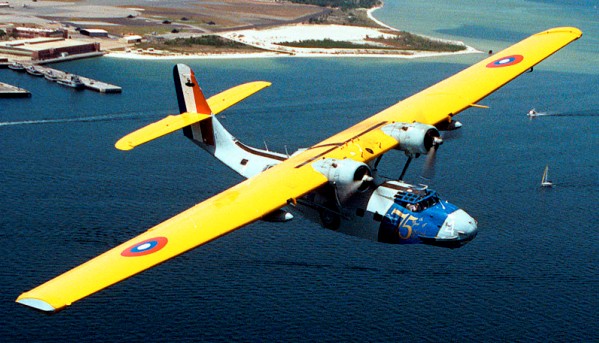
The Consolidated Model 28, designed by Isaac Laddon, originated from a US Navy requirement of late 1933.
The prototype XP3Y-1, developed from the PY-1/P2Y and flown for the first time on 28 March 1935, introduced the parasol wing constructed on the basis of a cantilever wing requiring no supporting structures, although two small-section struts were mounted between wing and hull on each side. Another new feature was the introduction of stabilising floats which retracted in flight to form the wingtips. Power was from two 825 hp R-1830-54 engines.
Initial trials of the prototype left little doubt that the Navy was about to acquire a significant aircraft. Sixty PBY-1 ordered in 1933 and powered by 850 hp engines were ordered and began to enter squadron service in 1937. By mid-1938 14 squadrons were operational.
The first 22 aircraft built were PBYs and were built in the USA. Also built by Boeing Aircraft of Canada at their Vancouver plant, as the PB2B-1. Fifty-five Boeing Canada-built PBY-5 were eligible for conversion to 28-5ACF status which allows further conversion to air transport category.
Production as a pure flying-boat ended with the PBY-4, for the last of these was converted to an amphibian with retractable tricycle-type landing gear, under the designation XPBY-5A. Subsequent aircraft had this as standard.
Production of the PBY series would be undertaken by Consolidated in the United States, Canadian Vickers and Boeing of Canada in Canada, the Naval Aircraft Factory in Britain and state factories in the Soviet Union under the Lend-Lease Act. Between 27 and forty Model 28 Catalinas were built in the Soviet Union as the MP-7.
On 7 May 1945, RAF Coastal Command flew its last raid against a German submarine when a Catalina of 210 Sqn, piloted by Lt. K. Murray, located a U-boat that had stopped dead between Shetland Islands and Norway, and recorded engine noises showing that the U-boat must be in distress. The Catalina dropped a series of depth charges. The boat was U-230 under 1st Lt. Emmerich, and it radioed later that it was badly damaged. On Wednesday 9 May 1945, the U-230 went down with all her crew off Bergen, Norway.
Initial export aircraft went to Russia, where the type was built subsequently in large numbers under the designation GST. The RAF acquired a single example for evaluation in 1939 and almost immediately ordered a batch of 50, the first of many to serve with Coastal Command. The name Catalina (adopted first by the RAF) was used later by the USN for the various versions which entered service. The type was also to serve with the RAAF, RCAF, RNZAF and the air arm of the Dutch East Indies.
The RNZAF operated 56 Catalinas, both PBY 5 and PB2B 1 models. They were used for maritime reconnaissance and air sea rescue between 1943 and 1956. The PBYs were withdrawn from service post war and sold for scrap in 1952; the PB2Bs soldiered on until replaced by Short Sunderlands in 1953 54.
The RCAF chose the PBY-5A as its replacement for the Supermarine Stranraer. During World War II, Boeing Aircraft of Canada, Canadian Vickers and Canadair Ltd. made almost 800 PBY’s. The RCAF called its version the ‘Canso A’ – A for amphibious. The PBY-5A first flew for the Royal Canadian Air Force on 20 March 1944.
Canadian Vickers built 130 for the RCAF, 9806-9844, and 11001-11100, and 230 to the USAF as OA-10A, 44-33868 to 44-34097.
139 were exports to the RAF, 36 as Catalina IIA, 12 PBY-5A as Catalina III, 11 PBY-5A as Catalina IV, and 70 PBY-5B as Catalina IVA.
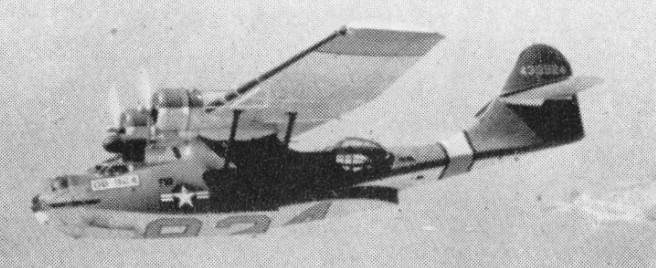
A number were operated by the USAAF as OA-10As. Seventy-five went to the USAAF as OA-10B in 1945.
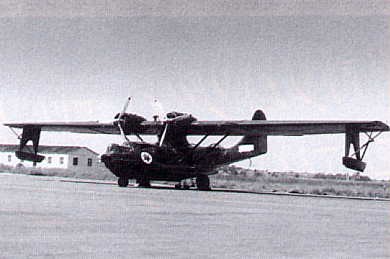
The Amtorg KM-2 was an improved PBY Catalina, built under Consolidated license.
The GST (Russian State Aircraft Factory) was responsible for the production for a licence-built version. Russian-built engines were substituted and armament consisted of three 12.7mm or 7.62mm machine guns.
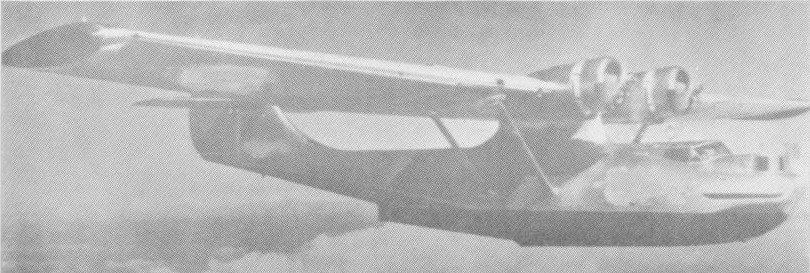
Altogether 2398 were built by Convair, 676 in Canada, and others in Russia.
Steward-Davis built about 13 Super Catalina civil conversion of PBY-5A/-6A wth two 1900hp Wright R-2600, larger squared tail, prop spinners, and faired-over nose turret. Many served in USFS fire duty, notably N6453C and N9505C.
In 1964 the province of Quebec, Canada, was using seven modified PBY to reduce forest fires. Field Aviation of Toronto modified the PBY to carry 800 USG of water that could be dumped in 0.8 sec and refilled in 14 sec during a touch and go on lakes or rivers.
Variation:
Bird Corporation Innovator
Consolidated PBY-5A Catalina
Engines: 2 x Pratt & Whitney R-1830-92 14-cylinder Twin Wasp radial, 1,200hp, 880kW.
Length: 63 ft 10 in (19.45m)
Wingspan: 104.00 ft (31.70m)
Wing area: 130.0 sq.m / 1400 sq ft
Wing load: 25.42 lbs/sq.ft / 124.00 kg/sq.m
Height: 20.18 ft (6.15m)
Empty Weight: 20,911 lbs (9,485kg)
Maximum Take-Off Weight: 35,422 lbs (16,067kg)
Fuel capacity: 1457 gal.
Maximum Speed: 179 mph (288kmh; 156kts)
Cruise speed: 250 km/h / 155 mph
Maximum Range: 2,545 miles (4,095km)
Rate-of-Climb: 526ft/min (160m/min)
Service Ceiling: 14,698 ft (4,480m)
Armament:
2 x 12.7mm machine guns in bow turret
2 x 12.7mm machine guns in fuselage blisters (one each side).
1 x 7.62mm machine gun in ventral tunnel section.
Bombload of up to 4,000lbs
Accommodation: 9
Hardpoints: 2
Canso PBY-5A
Engines: 2 Pratt & Whitney R1830 Twin Wasp, 1200 hp.
Wingspan: 104 ft.
Length: 63 ft 10.5 in.
Fuel cap: 6500 lt.
Empty wt: 20,913 lbs.
MAUW: (military): 36,400 lbs (16,51l kg).
Max speed: 179 mph.
Range: 2350 sm (3728 km).
PB2B-1
Engines: 2 Pratt & Whitney R1830 Twin Wasp, 1200 hp.
Length: 65.1 ft (19.83 m).
Wing span: 104 ft. (31.7 m).
Weight empty: 14,240 lb. (6,465 kg).
Crew: 8-9.
Armament: 4 x mg.
Max. bomb load: 2,000 lb. (900 kg).
Cruise speed: 180 mph (290 kph).
Ceiling: 24,000 ft (7,300 m).
Range: 4,000 miles (6,400 km).
Canadian Vickers PBY-5A
Engines: 2 x Pratt & Whitney R-1830-92 Twin Wasp, 1200 hp
Wing Span: 104ft (31.7m)
Length: 63ft 10.5in (19.47m)
Height: 20ft 2in (6.15m)
Speed: 199 mph (322 km/h)
Range: 2,545 miles(4,095 km)
Armament: six .303 Brownings and 4,000lb (1,816kg) of depth charges
Russian State Aircraft Factory PBY
Engines: 2x Shvetsov Ash-61R, 1000 ho
Span: 104 ft 0 in
Max speed: 190 mph at 10,500 ft