Kyle Smith Aircraft Co,
Kyle Smith Aircraft Co,
Wheeling WV.
USA
1919: West Virginia Aircraft Co.
This company was established at Wheeling, West Virginia, and produced a three-seat triplane during 1919-1920.
Kyle Smith Aircraft Co,
Kyle Smith Aircraft Co,
Wheeling WV.
USA
1919: West Virginia Aircraft Co.
This company was established at Wheeling, West Virginia, and produced a three-seat triplane during 1919-1920.
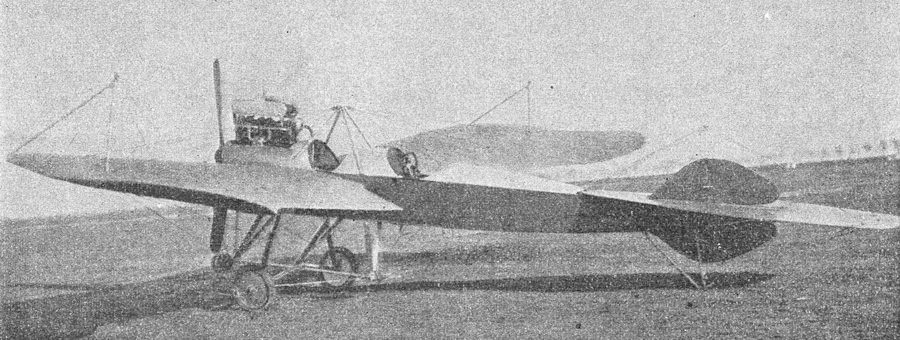
Paul Westphal built his second design “Taube” after the guidelines of the army. It passed the tests easily, but was not bought. He then gave up his own attempts.
Paul Westphal was one of the constructors at the “Alte Startplatz” of the Berlin-Johannisthal airfield.
He was a co-designer of the early Geest planes and set up his own “business” when he rented shed #8 at Johannisthal in 1911. In 1912 he completed his first monoplane.
His “Taube” second design was not bought so he gave up his own attempts and went to the Kondor Flugzeugwerke GmbH at Essen, Rhineland before summer 1914 where he became chief engineer then.
Built by Gordon W. Westphal, the Rose Parakeet replica N16N sn GW-100 was first registered on 23 February 1976. Classified as an amateur built experimental, it was powered by a Lycoming O-290 engine.
2337 12th Ave NW
Rochester, MN
USA
Built a replica Rose Parakeet in 1976.
The Westmacott Skylark was a single-seat biplane glider built by R.J. & K. Westmacott at Minety. UK, in 1959.
Eventually it was stored at Minety.
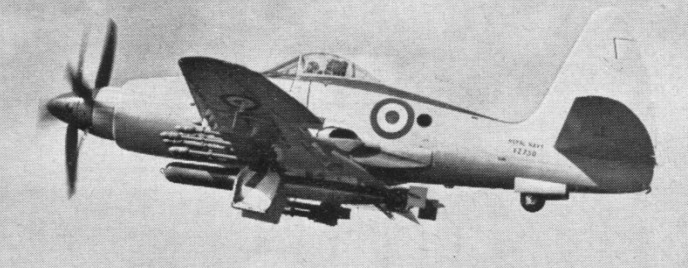
Under the project designation P.10, Westland began to study early in 1944 a long-range shipboard day fighter for Naval use, with the added capability of carrying a torpedo, rockets or bombs for anti-shipping strikes. Around this proposal, Specification N. 11/44 was written, and, in November 1944, a contract was confirmed for six prototypes (including two in land-based RAF configuration to Spec F.13/44). Redesignated W.34, and subsequently named the Wyvern TF Mk 1, the Westland aircraft was a low-wing monoplane of relatively conventional layout, but larger and heavier than any previous British single-seat Naval fighter. It had upward-folding outer wing panels with hinged tips, and a 3500hp Rolls-Royce Eagle 24-cylinder liquid-cooled H-type engine driving eight-blade contraprops. Provision was made in the design for the later introduction of a turboprop engine, such as the Rolls-Royce Clyde. Basic armament comprised four 20-mm Hispano Mk V cannon in the wings, with the possibility of carrying a 46cm Mk VIII torpedo under the fuselage three 464kg bombs or eight 27kg rocket projectiles.

Only 15 aircraft were built with the Rolls Royce Eagle (2700 hp) fitted.

In August 1946, an order for 20 pre-series Wyverns with Eagle engines was confirmed, but a planned batch of 10 for the RAF was dropped, together with the F.13/44 prototypes. Subsequently, the pre-production batch was halved.
The first of six prototypes flew on 16 December 1946. However, a turboprop version with the Armstrong Siddeley Python had meanwhile been given the go-ahead and the Wyvern TF Mk 1s were assigned to various development tasks, never becoming operational. All six prototypes were flown, as were six pre-series TF Mk 1s, but the final four of the latter, although built, remained unflown as all development effort switched to the TF Mk 2.
Following the RAF’s decision to pro¬ceed no further with this project the Royal Navy opted to concentrate all future development around the Arm¬strong Siddeley Python turboprop en¬gine.
The Naval Air Staff ordered three prototypes of the (W.35) Wyvern TF Mk 2, to Specification N.12/45. Two were to be powered by the Armstrong Siddeley Python and the third by a 4500hp Rolls-Royce Clyde. In the event, the former engine was to be preferred for production aircraft. In overall configuration and armament the Wyvern TF Mk 2 closely resembled the Mk 1, although there were differences in detail, and the first flight of the Clyde-engined prototype was made on 18 January 1949, followed by the first with a Python on 22 March 1949.
Flight testing soon showed the need for modifications, noticeably to the tail unit with the progressive introduction of a larger tailplane, more fin area, dihedral on the tailplane and, eventually, finlets. Prolonged testing and development also proved necessary to achieve a satisfactory engine/propeller/throttle response system for the special demands of carrier landings, involving the two Python prototypes and most of 20 pre-series TF Mk 2s ordered in 1948 (together with a single W.38 Wyvern T Mk 3 two-seat training version).
The first pre-series TF Mk 2, with a Python 2, flew on 16 February 1950, and, in June that year, became the first British turboprop aircraft to engage in carrier deck landings, aboard HMS Illustrious. Carrying a belly torpedo and 16 RPs it was a single seat strike/intruder fighter.
The final seven pre-series aircraft were completed as Wyvern S Mk 4s, this being the designation of the definitive variant with all the handling and engine modifications, and the primary mission changed to strike. The S Mk 4 was powered by a Python 3 rated at 3670hp plus 535kg residual thrust.
The principal production model was the Wyvern S.Mk 4, 94 being built in the early to mid-1950s, and these were augmented by a number of Wyvern TFMk 2 aircraft modified to Wyvern S.Mk 4 standard. Deliveries to the first FAA squadron (No 813) began during 1953. In addition, a solitary Wyvern T.Mk. 3 trainer was also completed although no production orders were forthcoming.

In September 1954, 813 embarked with their Wyverns on HMS Albion for carrier-based service in the Mediterranean. The Wyvern soon showed a worrying habit for flameout on catapult launch; the high G forces resulting in fuel starvation. A number of aircraft were lost off Albion’s bows and Lt. B. D. Macfarlane made history when he successfully ejected from under water after his aircraft had ditched on launch and been cut in two by the carrier. 813 did not return to Albion until March 1955 when the problems had been resolved.
830 Squadron was re-equipped with new aircraft before embarking in HMS Eagle on April 19, 1956. These aircraft were still designated Wyvern S.Mk4 and differed slightly in external appearance. The modifications which were visible from external inspection were:
(i) A modified cockpit canopy. This was the same shape as the previous canopy but it was a completely clear hood and did not have the metal bracing strut just aft of the pilot’s head.
(ii) The airbrake was re-designed and this can be seen from an underside view of the aircraft.
(iii) The folding wingtip facility was modded out.
Three other squadrons subsequently flew the Wyvern S Mk 4, front-line service continuing until March 1958. Operational use of the Wyvern during the Suez campaign in 1956 marked the only occasion on which British turboprop-powered aircraft saw combat use.
830 Squadron aircraft were flown ashore to Stretton and to Lee-on-Solent on January 3, 1957, and the squadron was officially disbanded from HMS Eagle in Devonport dockyard on January 5 1957.
Wyvern TF Mk 1
Max take-off weight: 9924 kg / 21879 lb
Empty weight: 7005 kg / 15443 lb
Wingspan: 13.42 m / 44 ft 0 in
Length: 11.96 m / 39 ft 3 in
Height: 4.72 m / 16 ft 6 in
Wing area: 32.98 sq.m / 354.99 sq ft
Max. speed: 734 km/h / 456 mph
Ceiling: 9785 m / 32100 ft
Range: 1908 km / 1186 miles
Wyvern S.Mk 4
Engine: one 4,110-eshp (3065-ekW) Armstrong Siddeley Python ASP3 turboprop
Maximum speed 616 km/h (383 mph) at sea level
Service ceiling 8535 m (28,000 ft)
Range 1455 km (904 miles) with auxiliary fuel
Weight empty 7080 kg (15,608 lb)
MTOW 11113 kg (24,500 lb)
Wing span 13,41 m (44 ft 0 in)
Length 12.88 m (42 ft 3 in)
Height 4.80 (15 ft9 in)
Wing area 32.98 sq.m (355 sq ft)
Armament: four 20-mm cannon
Bombload: 1361 kg (3,000 lb)


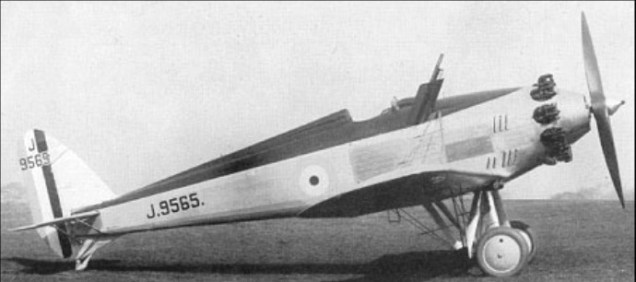
Usually known as the COW-Gun Fighter, this prototype monoplane was one of two ordered by the Air Ministry (with the unorthodox Vickers Type 161) in fulfilment of Specification F.29/27. This called for an aircraft armed with the 37mm Coventry Ordnance Works (COW) cannon that had been evolved during World War I and was thought to have potential as an anti-bomber weapon. The COW gun was to be mounted at an upward angle of at least 45 degrees from the horizontal, with the idea that the fighter would approach enemy bombers from below and astern. The Westland prototype was, in effect, an enlargement of the F.20/27 prototype, and had the COW gun mounted to fire upwards at 55 degrees, with the breech casing in the starboard side of the open cockpit. Aiming was by means of a periscopic sight, and a special “ammunition dispenser” carried 39 rounds. The fighter was of similar all-metal construction to the F.20/27 and, like the latter, was first flown with a small fin and rudder which later had to be considerably enlarged to obtain satisfactory spinning characteristics. Powered by a 485hp Bristol Mercury IIIA nine-cylinder air-cooled radial, the F.29/27 first flew in December 1930, but the RAF quickly lost interest in the COW gun. With a Mercury IVA, the COW-Gun Fighter remained at the A & AEE until July 1934.
Max take-off weight: 1762 kg / 3885 lb
Empty weight: 1186 kg / 2615 lb
Wingspan: 12.45 m / 41 ft 10 in
Length: 9.09 m / 30 ft 10 in
Height: 3.22 m / 11 ft 7 in
Wing area: 20.62 sq.m / 221.95 sq ft
Max. speed: 296 km/h / 184 mph
Ceiling: 8900 m / 29200 ft


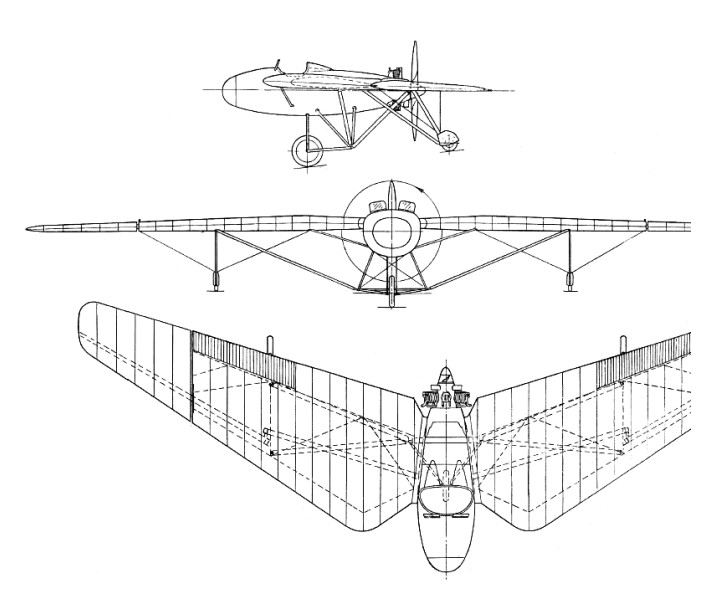
In the early 1920’s Captain (now Professor) G. T. R. Hill began a study of aeroplane design, with the object of discovering a means of securing safety in flight. This was to be achieved by improving stability and control at low speeds, and even below stalling speed, so that the fatal spin, all too common in those days, would never occur.
Captain Hill’s investigations eventually led him to evolve a tailless form of aircraft in which the wings were arranged roughly in the form of a blunt arrow-head and, it was built in his home with Mrs. Hill’s assistance, he built a prototype as a glider, naming it after that pre-historic reptile the Pterodactyl, in view of its wing-tip control.
Successful tests on the South Downs demonstrated to the Air Ministry the practicability of the design, and they, in view of its possible military advantages, co-operated with Captain Hill to fit the machine with a small 34hp Bristol Cherub engine.
The first power flight of the Pterodactyl took place at the Royal Aircraft Establishment, Farnborough in December 1925, and, after final demonstrations before Sir Samuel Hoare, then Secretary of State for Air, the Westland Works took over the development of the type, Captain Hill joining the staff for this purpose.
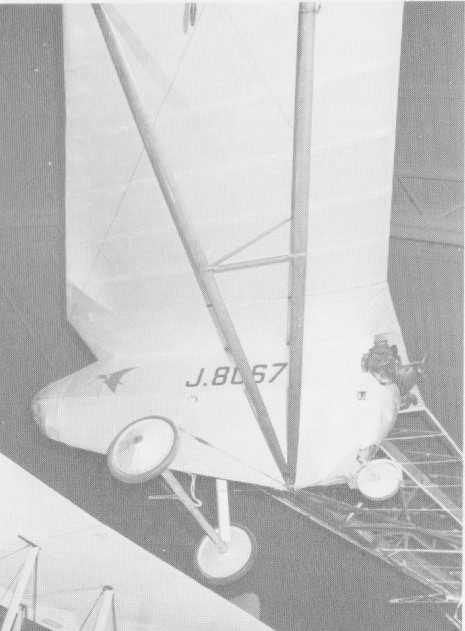
The Pterodactyl I was flown until superseded by the IA in 1928 and was subsequently stored by Prof Hill. He presented the machine to the Science Museum in 1951.
The first Westland-Hill production was a side-by-side two-seater J9251, with wings differing in plan-form considerably from those of the original machine. It was designated the Mk. IA when fitted with a 34hp Bristol Cherub engine and first flown in 1928.
After the Cherub engine was replaced by a 70hp Armstrong Siddeley Genet, and small rudders were fitted, it was given the mark number IB.
With a re-designed undercarriage it was re-designated IC.
The design was important, since it successfully demonstrated that a wing loading far greater than that of the prototype did not affect the solutions of stability and control evolved by Captain Hill. Originally flown by Flt.-Lt. L. G. Paget, A.F.C., and with Flt.-Lt. F. J. Brunton carrying out some of the later work, this Pterodactyl was used for a great number of investigations and, as a result, it was possible to proceed with complete confidence to other designs, of which the Pterodactyl Mk. IV was the next to be built. The Pterodactyl IV K1947 of 1931 was a three seat, larger version powered by a 120-hp Gipsy III.
Hill and Westland had plans for a whole series of the Pterodactyls, includ¬ing a flying boat and an airliner, but only four were built, the last being the Pterodactyl Mark V which had a 600 hp Rolls-Royce Goshawk steam cooled engine and was intended as a fighter. The theory was that the tailless configuration would give the rear gunner an almost unlimited field of fire with his pair of synchronized Vickers guns.
Test pilot Harald Penrose was soon demonstrating the Pterodactyl’s stability, and even performing aerobatics as well as flying it inverted. But a landing accident damaged the sole Mark V and further work on Hill’s designs was abandoned in the mid 1930s.
Hill I
Wingspan: 13.72 m / 45 ft 0 in
Wing area: 20.62 sq.m / 233 sq.ft
Empty weight: 207.7 kg / 458 b
Mk. IA
Engine: 1 x 32hp Bristol Cherub
Wingspan: 13.86 m / 45 ft 6 in
Wing area: 18.58 sq.m / 199.99 sq ft
Length: 5.18 m / 17 ft 0 in
Height: 2.03 m / 7 ft 8 in
Max take-off weight: 408 kg / 899 lb
Speed: 70 mph
Mk. IB
Engine: 1 x 70hp Armstrong Siddeley Genet
Mk. IC
Engine: 1 x 70hp Armstrong Siddeley Genet
Mk.IV
Engine: 120-hp Gipsy III
Seats: 3
Mk. V
Engine: 600 hp Rolls-Royce Goshawk
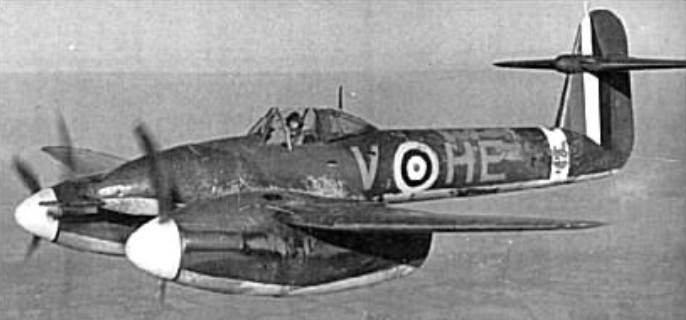
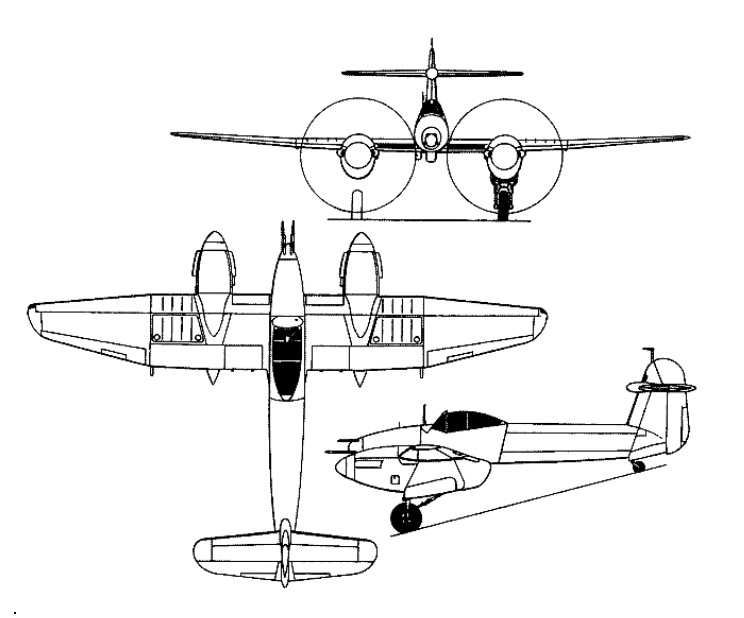
The only Westland fighter to achieve operational status with the RAF, the Whirlwind was designed in response to Specification F.37/35 for a “cannon fighter” armed with four 20mm guns. As the P.9, the Westland design emerged as a low-wing monoplane with two Rolls-Royce Peregrine I 12-cylinder liquid-cooled Vee engines, each rated at 885hp at 4575m. The four Hispano Mk I guns were grouped in the nose, the pilot enjoyed a good all-round view from a fully-enclosed cockpit in line with the wing trailing edge, and radiators were buried in the wing leading edges inboard of the nacelles. Construction was of metal throughout, with flush-riveted stressed skins, a novelty being the use of magnesium rather than aluminium sheet to cover the monocoque fuselage aft of the cockpit.
Two prototypes were ordered by the Air Ministry in February 1937, and the first of these flew on 11 October 1938. Despite delays in development and production of the Peregrine engine, two contracts were placed in 1939, each for 200 fighters as Whirlwind Is, and the first series aircraft (P6966) flew in June 1940.
In the event, production ended with 114 aircraft built, these serving with only two RAF squadrons (Nos 263 and 137). Armament problems and changing operational needs curtailed the usefulness of the Whirlwind, which was enhanced in late 1942 by the addition of a pair of wing racks to carry two 113kg or 227kg bombs. Operational use of the Westland fighter came to an end in November 1943.
Replica: Butterworth Westland Whirlwind
Whirlwind I
Engines: 2 x Rolls Royce Peregrine I, 873 hp
Wingspan: 13.72 m / 45 ft 0 in
Wing area: 23.22 sq.m / 249.94 sq ft
Length: 9.83 m / 32 ft 3 in
Height: 3.20 m / 11 ft 6 in
Empty weight: 3699 kg / 7840 lb
Max take-off weight: 4658 kg / 10,270 lb
Max. speed: 313 kts / 579 km/h / 360 mph
Landing speed: 80 mph
ROC: 3000 fpm / 915 m/min
Ceiling: 9150 m / 30000 ft
Range: 1287 km / 800 miles
Crew: 1
Armament: 4x 20mm Hispano Mk.1 MG, 60 rds each
Whirlwind IA
Engines: 2 x Rolls Royce Peregrine I, 873 hp
Wingspan: 13.72 m / 45 ft 0 in
Wing area: 23.22 sq.m / 249.94 sq ft
Length: 9.83 m / 32 ft 3 in
Height: 3.20 m / 11 ft 6 in
Max take-off weight: 5165 kg / 11387 lb
Empty weight: 3770 kg / 8311 lb
Max. speed: 313 kts / 579 km/h / 360 mph
Landing speed: 80 mph
Ceiling: 9150 m / 30000 ft
Range: 1287 km / 800 miles
Crew: 1
Armament: 4x 20mm MG
Bombload: 454kg
 All Aero