The Akaflieg Darmstadt D 36 Circe was designed by Dipl Ing Klaus Holighaus.
Aircraft
Darmstadt University Aviation Soc D-22
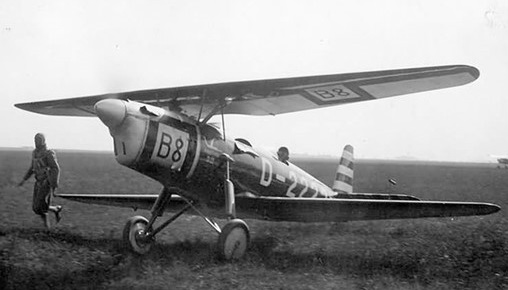
The Darmstadt D-22 was an all-wood sport biplane designed and built in Germany in 1931 by the Akademische Fliegergruppe of Darmstadt University of Technology, a group of aerodynamical engineering students. A development of the Darmstadt D-18 designed by F. Fecher, the D-22 was a slightly enlarged, more streamlined and more powerful German sports-plane built to compete in the 1932 Coupe Deutsch de la Meurthe.
The D-22 had an unorthodox configuration, being a cantilever biplane, with an upper wing placed low, just above the fuselage and ahead of its lower wing. The design emphasized aerodynamics and lightness and the aircraft was small with a streamlined silhouette.
The D-22 boasted an oval cross-section fuselage skinned with plywood and fabric on parts of the single-spar wings. This could, as was required by the rules of the competition, be dismounted and folded rearwards. The crew of two sat in tandem in open cockpits each with its own with windshield. The landing gear was fixed with a tail skid. The engine was mounted in the fuselage nose and drove a two-bladed fixed-pitch propeller.
Propulsion was from a 75.7 kW (101.5 hp) Argus As 8 4-cylinder inverted air-cooled, in-line piston engine driving a 2-bladed fixed-pitch propeller which powered the D-22 to a top speed of 230 km/h (140 mph, 120 kts).
Two were constructed. One was allocated G-ABPX and was known to have a Gipsy III engine.
One was allocated D-2222.
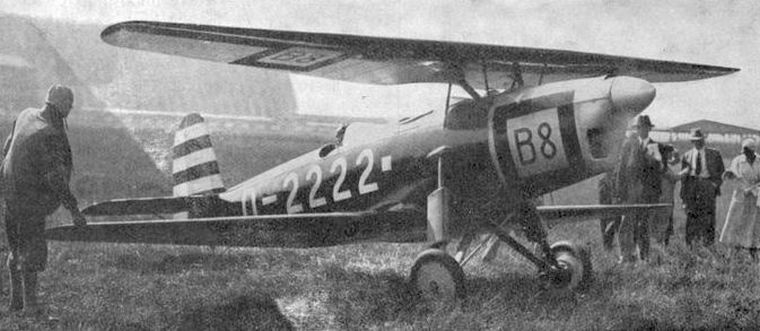
The trial was to be run in two 1,000 km stages separated by a 90-minute refuelling stop and was limited to aircraft with an engine capacity not exceeding eight litres. The starting point of the race was still at Étampes. Suzanne Deutsch de la Meurthe offered one million Francs in prize money while Ministère de l’Air (Air Ministry) offered another three million.
Only one, a D-22A flew in the cup. Not having flaps or slats, she was severely handicapped in the landing trials, eventually finishing 35th out of 43 contestants. However, after this she improved her score after a rally around Europe, where she took the 4th place with a cruise speed of 205 km/h (127 mph; 111 kts). In the maximum speed trial, the D-22A was beaten only by the five Heinkel He 64s, reaching 230.7 km/h (143.4 mph; 124.6 kts). As a result, she eventually finished 17th overall.
Sold in 1933, she competed for several more years in various events.
Wingspan: 24 ft
Length: 21 ft 6 in
DAR DAR-10F
The DAR 10F was the only Bulgarian designed military aircraft to have seen service. It was a trim but conservative light bomber with an 840/960 hp Fiat A74RC38 radial, and with spatted wheels and a crew of two under a glasshouse canopy.
The gun armament was heavy: two 20 mm (0.79 in) MG FF cannon in the wings and two 7.92 mm (0.312 in) MG 17 in the top decking, all firing ahead, and an MG 15 in the rear cockpit. In spite of this the 10F could still carry up to 500 kg (1102 lb) of bombs. Darjaviia Aeroplanna Rabotilnitza flew the prototype in 1941 and a small but unknown number entered Bulgarian service.
Span: 12.65 m (41 ft 6 in)
Length: 9.83 m (32 ft 3 in)
Gross weight: 3420 kg (7540 lb)
Maximum speed: 454 km/h (282 mph)
DAR DAR-4
Three engined transport for state airline
DAR Rilski Orel
1935 Bulgarian single seat training parasol sailplane.
Wingspan: 15.82m
3 assembled –
Albatross
Chuchuliga (Lark)
Rilski Orel (Rilski Eagle)
Rilski Orel gained 1936 Olmpic gold.
DAR Zdravka Toprakchiev
1926 Bulgarian parasol sailplane
Hermann Winter, one assembled, named after Mjr Toprakchiev, a Bulgarian national hero.
DAR Zdravka Vekilski
1926 Bulgarian parasol single seat sailplane
Herman Vinter assembled one. Named after a Bulgarian national hero, Lt Vekilski.
DAR / Darjavna Aeroplanna Rabotilnitza
State Aircraft Works, Bojouristhe, Sofia. Aero department of Ministry of Railways, Posts, and Telegraphs. Subject to Versailles limitations, but by 1932 had produced DAR-4, three engined transport for state airline. Of several subsequent designs, only the DAR-10F of 1941 reached production.
D’Apuzzo D-295
The D’Apuzzo D-295 of 1974 was an unequal-span variant of the PJ-260 built for E Mahler & L Webber.
Engine: 295hp Lycoming GO-480-G1D6
Wingspan: (upper) 27’0″ (lower) 23’9″
D’Apuzzo Junior Aero Sport
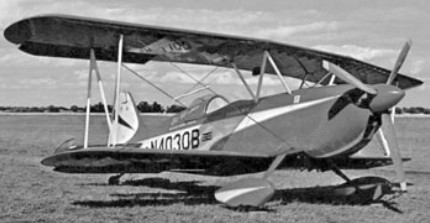
This single-seat sporting biplane is a smaller version of the Senior Aero Sport, and is built from the standard combination of a fabric-covered wooden wing and a fabric-covered steel-tube fuselage.
This single-seat sporting biplane is a smaller version of the Senior Aero Sport and is built from the standard combination of a fabric-covered wooden wing and a fabric-covered steel-tube fuselage. The powerplant drives a constant-speed metal propeller to produce a maximum speed of 160 mph. Plans are no longer available.
Engine 180-hp Lycoming.
Wingspan 21’8″
Length 18’3″
Gross wt. 1,275 lb.
Empty wt. 840 lb.
Fuel capacity 20 USG.
Top speed 160 mph.
Cruise speed 140 mph.
Stall 55 mph.
Climb rate 2500 fpm.
Ceiling 20,000 ft.
Takeoff run 400 ft.
Landing roll 550 ft
Range 300 sm.

