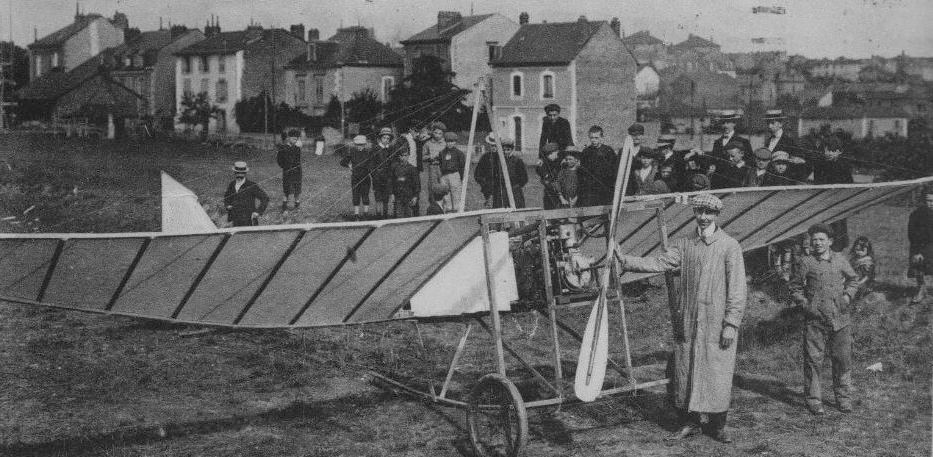
The Debort No.3 was a very simple tractor monoplane built in Limoges, France, in 1909/10 by Serge and Jack Debort.
The Debort No.3 was a very simple tractor monoplane built in Limoges, France, in 1909/10 by Serge and Jack Debort.

Having developed the all-metal single-seat Partenavia P.53 Aeroscooter earlier, Mario de Bernardi sought to improve the design as the two-seat de Bernardi M.d.B. 02 Aeroscooter. The aircraft was to be built by CAP in Bergamo, Italy.
The Aeroscooter is a low-wing, two-seat monoplane. The partial welded steel tube fuselage uses aluminum skins. The wing uses a wood spar. The tricycle landing gear uses trailing link suspension. The single-piece plexiglas canopy slides forward to open. All fuel is housed in the 20 l (5.28 US gal; 4.40 imp gal) header tank and 50 l (13.21 US gal; 11.00 imp gal) main tank behind the passenger’s seat.
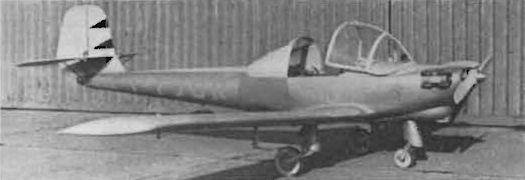
The prototype was built by De Bernardi with the assistance of two mechanics. In April 1959, De Bernardi died of a heart attack after flying a demonstration of the prototype at Rome Urbe Airport.
An example is on display at Museo Aeronautico Caproni di Taledo, Milano.
The daughter of De Bernardi was offering plans for a modernized version of the Aeroscooter using a Rotax 912UL engine to be flown under Italian microlight category.
M.d.B. 02 Aeroscooter
Engine: 1 × Agusta GA.70/0, 62 kW (83 hp)
Propeller: 2-bladed fixed-pitch
Wingspan: 9.5 m (31 ft 2 in)
Wing area: 8.300 m2 (89.34 sq ft)
Length: 5.5 m (18 ft 1 in)
Height: 1.70 m (5 ft 7 in)
Empty weight: 260 kg (573 lb)
Gross weight: 460 kg (1,014 lb)
Fuel capacity: 60 l (15.85 US gal; 13.20 imp gal)
Maximum speed: 210 km/h (130 mph, 110 kn)
Cruise speed: 190 km/h (120 mph, 100 kn)
Stall speed: 50 km/h (31 mph, 27 kn)
Range: 600 km (370 mi, 320 nmi)
Rate of climb: 6 m/s (1,200 ft/min) at sea level
Take-off run: 50 m (164 ft)
Landing run: 50 m (164 ft)
Crew: 2
Around 1742 the Marquis de Bacqueville is reported to have thrown himself from the roof of his house and managed to fly “with artificial wings” across the Seine, at which point he fell heavily into a boat and broke his thigh. He was more than 60 years old, “slightly crazy but with a lot of spirit.” There seems no record of how the wings worked.
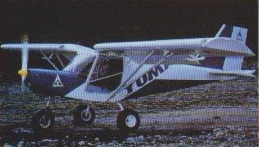
Manufactured in Italy, the Yuma is of all metal construction..
Engine: Rotax 912, 80 hp
Wing span: 8.2 m
Wing area: 12.5 sq.m
MAUW: 450 kg
Empty weight: 282 kg
Fuel capacity: 87 lt
Max speed: 175 kph
Cruise speed: 150 kph
Minimum speed: 40 kph
Climb rate: 4.5 m/s
Seats: 2
Fuel consumption: 16 lt/hr
Certification: Italy
Price (1998): 73,000,000 L
Kit price (1998): 40,000,000 L
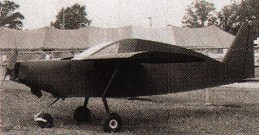
Circa 2008
Engine: Lycoming O-290, 108 hp
Cruise: 160 mph
Stall: 50 mph
Range: 500 sm
Rate of climb: 800 fpm
Takeoff dist: 500 ft
Landing dist: 550 ft
HP range: 85-160 hp
Fuel capacity: 26 USG
Empty weight: 600 lb
Gross weight: 1200 lb
Length: 18 ft
Wing span: 21 ft
Wing area: 60 sq.ft
Seats: 2
Cockpit width: 38 in
Landing gear: nose
2008: Dcs, Inc.
12618 Millstream Drive
Bowie, Md 20715-1618 USA.
Airplane builder
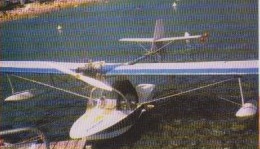
Appearing at the 1997 show at Blois the Termerair featres a fuselage in tube and fabric with laminated floats.
Engine: Rotax 582, 64 hp
Wing span: 10.50 m
Wing area: 16 sq.m
MAUW: 495 kg
Empty weight: 235 kg
Fuel capacity: 55 lt
Max speed: 140 kph
Cruise speed: 110 kph
Minimum speed: 60 kph
Climb rate: 3.5 m/s
Seats: 2
Fuel consumption: 12 lt/hr
Price (1998): 192,000 Fttc
Had a single wheel landing-gear.
Side-by-side two-seat (last rotary-engined design for U.S. Army)
In 1920 Milton C. Baumann designed the revolutionary RB Racer, with solid all-wood wing, totally enclosed cockpit and retractable landing gear linked to rod-operated leading and trailing-edge camber-changing flaps.

