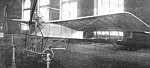
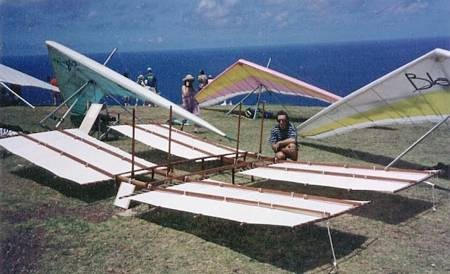
de Groot Hargrave Tandem Monoplane

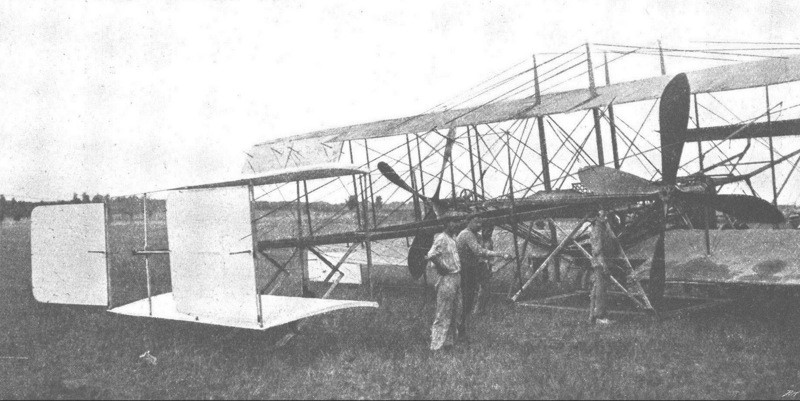
A replica of the Hargrave Tandem Monoplane Glider of 1894 built by Rob De Groot, photographed at the Hang Gliding World Championships of 1994 – the 100th anniversary of the glider designed and built by the Australian pioneer Lawrence Hargrave. As the originals only flight was unsuccessful, Hargrave shied away in his career from monoplanes, adopting instead the idea of biplanes (box-kite designs). The tandem wing monoplane however, became a concept Langley later saw fit to continue with his Aerodrome in 1903.

de Groof Machine Volant

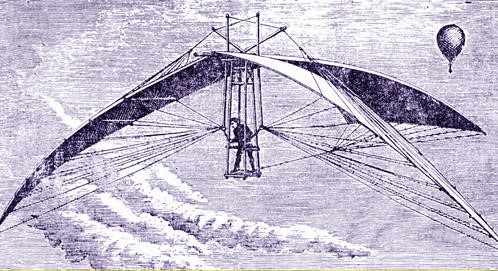
In 1864, a Belgian shoemaker named Vincent de Groof designed an apparatus which was a sort of cross between beating wings and a parachute. His plan was to cut loose with it from a balloon, and to glide down in a predetermined direction by manoeuvring the supporting surfaces. He endeavoured to make a practical experiment, both in Paris and in Brussels, but it was only in 1874 that he succeeded in doing so in London.

The apparatus consisted of two wings, each 24 feet long, moved by the arms and the weight of the operator, and a 20 foot long tail which could be adjusted using one’s feet.

De Groof first went up on June 29, 1874, from Cremorne Gardens, London, attached to the balloon of Mr. Simmons. He came down safely, and claimed to have cut loose at a height of 1,000 feet. Subsequently however, it was stated by others that in fact he had not, on this occasion, cut loose at all, but had descended still attached to the balloon. In any event, he went up again on July 5 following, with the same balloon, and on this occasion he really did cut loose. The result was disastrous. In his descent, as soon as pressure gathered under the moving wings, they were seen to collapse together overhead into a vertical position, bringing De Groof down like a stone and killing him on the spot.
de Glymes DG X

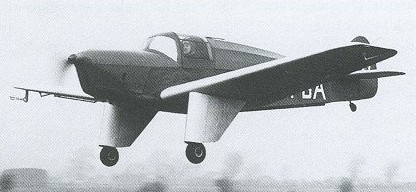
The de Glymmes DG X OO-AKV (c/n 01) was designed by engineer Raoul de Glymes of Hollebecque, Belgium, and fabricated in collaboration with Alfred Herrmann.

This two-seater aircraft was equipped with a Renard 100hp engine and was registered as OO-AKV in 1931.

In 1931, R. Van de Velde owner and pilot of the aircraft flew Brussels – Nuremberg – Vienna (1400 Km) in 9 flight hours with an average speed of 155 Km/H.

On August 22nd, 1931 the same pilot won the first place of a Belgian air raid organized by the “Aeroclub Royal de Belgique”.

The registration and the plane disappeared in 1935.

de Dion-Bouton 1909 Multiplane

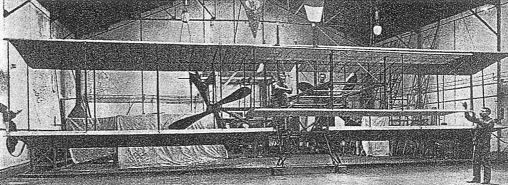
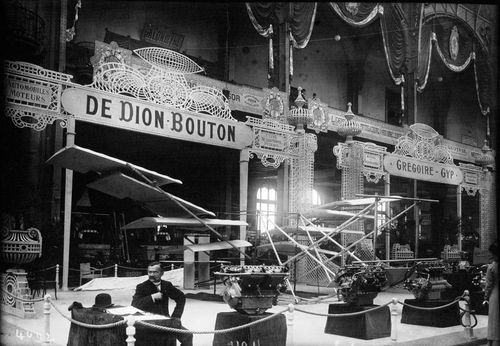
The first of two unsuccessful aeroplanes designed and built by Établissement de Dion-Bouton, the car and motor company. Remotely resembled a Wright Flyer, with twin rudders at the rear, a single small tailplane, and a triplane elevator in front, but instead of wings, each side had four wing-segments set at 30 degrees dihedral. Four propellers were to be employed, driven by a 100 hp engine. Displayed incomplete at the Première Exposition internationale de la locomotion aérienne at the Grand Palais in Paris during September 25 – October 17, 1909, construction and/or testing was likely halted afterwards as nothing more was heard of this flying machine of Jules-Albert de Dion and Georges Bouton.

de Crawhez Triplane

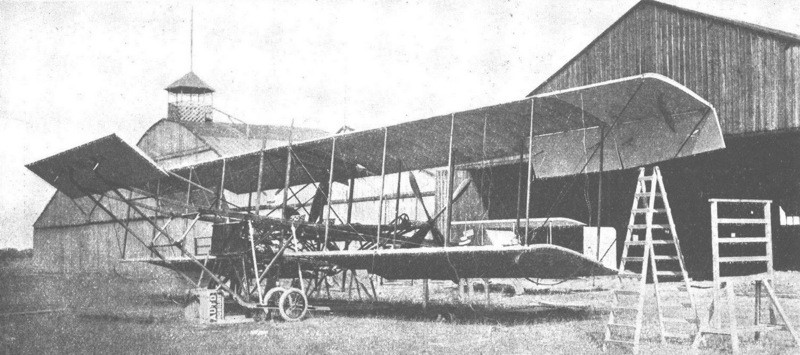
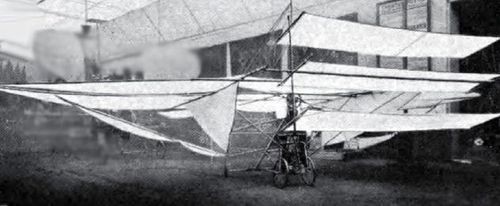
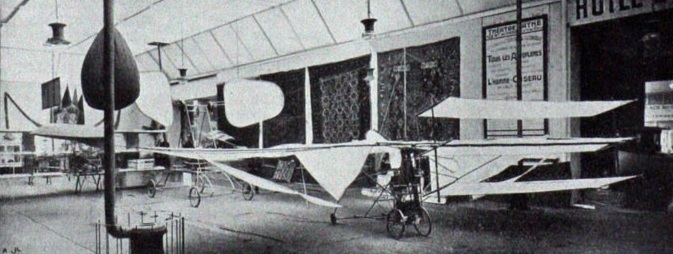
The aeroplane of Baron Jean de Crawhez on display at the Eighth Annual Belgian Motor Show, held in Brussels from the 16th through to the 26th of January 1909. In the background of M. Crawhez’s aeroplane is the ornithopter of M. de la Hault, both Belgian machines.

Brussels Motor Show 1909