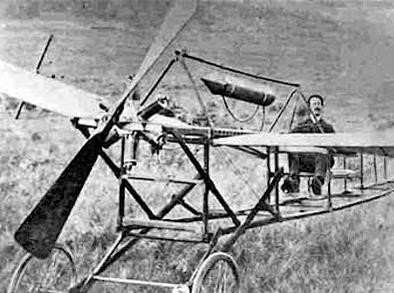
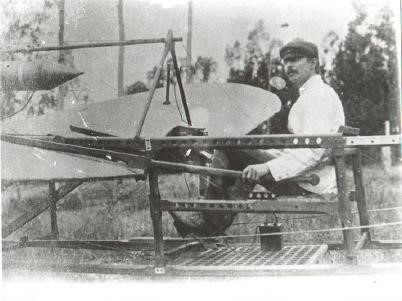
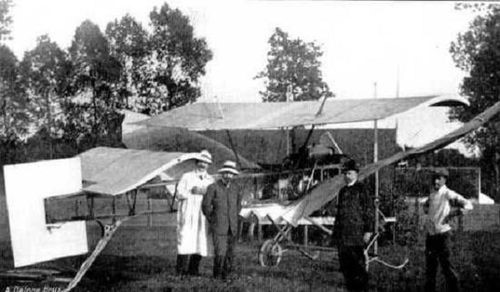
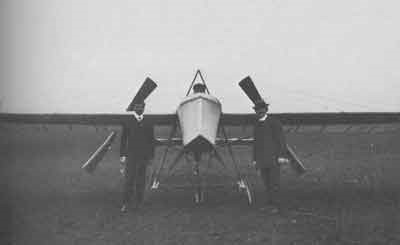
On the 7th January 1910, the first airplane constructed and designed in Brazil took off for its maiden flight in Osasco, São Paulo. The aircraft was conceived by the Frenchman Demetre Sensaud de Lavaud and was very similar to the Bleriot designs. The first flight was only 6-sec long. Afterwards, several other flights followed and the airplane, known as São Paulo, attracted huge crowds during its flights exhibitions. The aircraft was 100% Brazilian-made (even the propellers and the engine were manufactured by Mr. Lavaud). It was the first of several other designs developed in Brazil and the event took place long before the country could see aircraft serial manufacturing.
France Maurice Delanne produced his first design, a light aircraft, the D.ll L’bis Bleu, at Chateauroux in 1929. Proposed a tandem wing arrangement (the “Nevadovich biplane”) in 1936. Virtues claimed for this arrangement included an exceptional e.g. travel and very low stalling speed. The Delanne 20 research aircraft was built on this principle by the Societe Anonyme Frangaise de Recherches Aeronautiques in 1938. A full-scale fighter design, the Arsenal- Delanne A-D 10, was built by Arsenal de I’Aeronautique at Villacoublay in 1939. Completed during the German occupation, it was taken to Germany for further testing.
The flying platforms grew out of research conduction by the US National Advisory Committee on Aeronautics in the early 1950s on the feasibility of one-man flying platforms for combat use. The tests involved pilots “flying” tethered platforms, at first lifted by compressed air, and then by rotors.
The concepts investigated in the tests were based on thinking by NACA engineer Charles H. Zimmerman, who proposed that if the rotors of a helicopter were placed on the bottom of the aircraft, a pilot would be able to steer it just by shifting his or her weight, a concept Zimmerman called “kinesthetic control”. It was hoped that kinesthetic control would allow a pilot to fly such platforms with little training. The tests demonstrated the technical validity of the concept. The NACA results were released to the public, resulting in flying platform prototypes from three companies: de Lackner, Bensen, and Hiller.
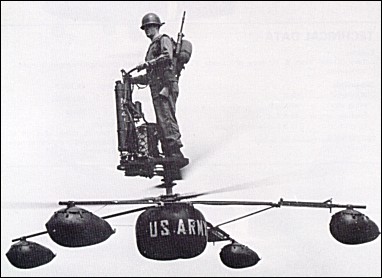
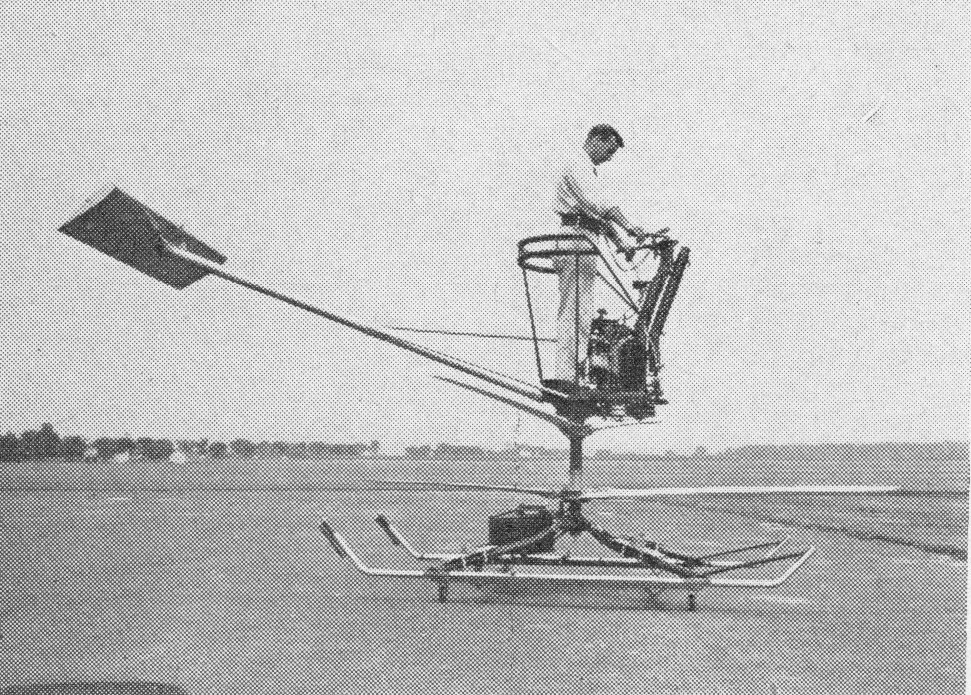
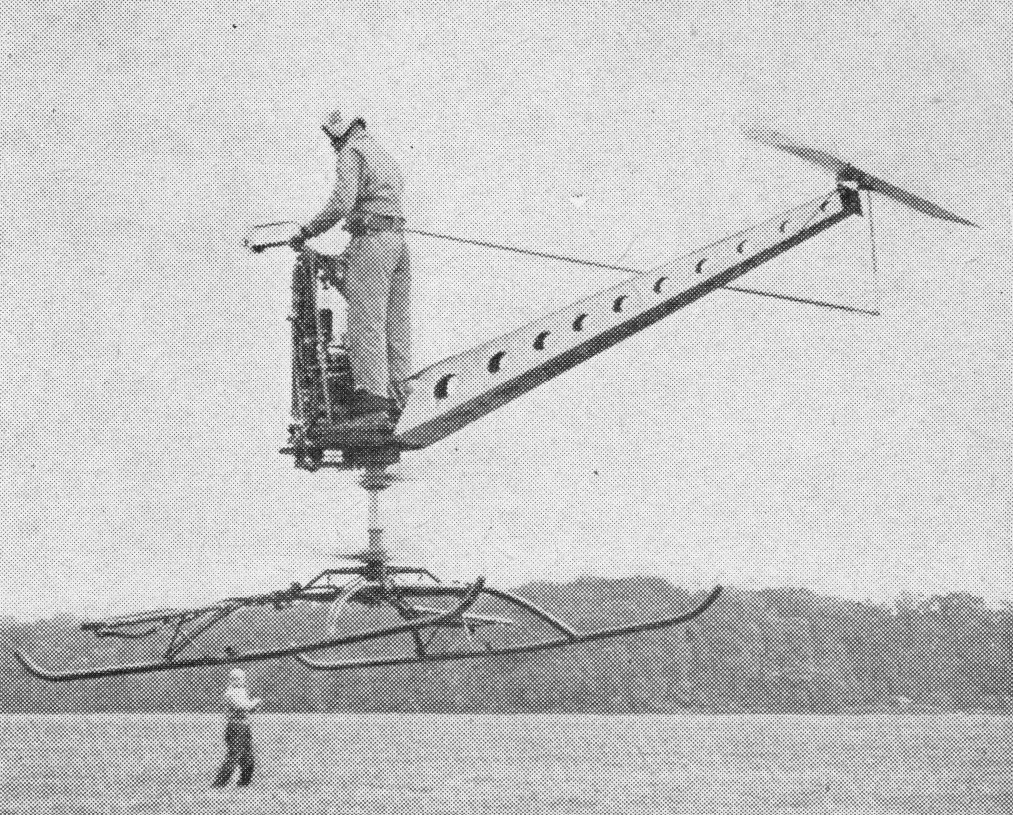
de Lackner company privately developed a rotorcraft named the “DH-4 Helivector”, later renamed the HZ-1 Aerocycle. The de Lackner machine consisted of a frame that supported the engine of a 30 kW (40 HP) Mercury outboard motor, with landing gear consisting of an arrangement of airbags on the ends of spars. The airbags were later replaced by metal skids. The engine drove a pair of 4.6 meter (15 foot) contra-rotating rotors directly beneath it, while the pilot stood vertically on a platform above the engine, protected from falling into the rotors by a safety harness, and hanging on motorcycle handlebars with it a twist-grip throttle. He used kinesthetic control to fly the machine.
Aerocycle, 1958
The Helivector / Aerocycle first flew in January 1955, and the Army ordered twelve examples ‘off-the-shelf’ shortly after. The aircraft was initially designated YHO-2 (a designation which was later also applied to five Hughes H-55 helicopter prototypes), though this was subsequently changed to HZ-1. De Lackner claimed the machines could fly at up to 105 kph (65 mph), carry up to 55 kilograms (120 pounds) payload besides the pilot, and fly for an hour. However, while the thing looked like it would have been a lot of fun to fly, it was also dangerous. Not only did the pilot stand above the whirling rotors, but the rotors were wide and close to the ground, making them a hazard on landings and takeoffs since they could easily kick up rocks and other debris.
The Aerocycle carried its single pilot and 32kW engine on a circular platform located just above two belt-driven, contra-rotating fifteen-foot propellers. The engine throttle and a few basic instruments were attached to bicycle-type handlebars fixed to a three-foot tall pedestal atop the main platform. The pilot stood to the rear of the pedestal and was secured to it by safety belts, and guided his craft by simply leaning in the desired direction of travel. The machine’s landing gear initially consisted of a single large air bag placed directly beneath the propellers and augmented by four smaller air bags fixed to outrigger bars, though this system was ultimately abandoned in favor of helicopter-type metal skids. The HZ-1 was surprisingly stable despite its appearance, and its top speed of more than 110kph made it considerably faster than most of the other unconventional one-man flying machines evaluated by the Army.
The Army’s research was to explore the feasibility of inexpensive, safe, and easily operated personal aircraft. The Aerocycle was especially successful in the ease of operation category, for during the service tests soldiers required only about twenty minutes of instruction before flying the aircraft.
Under test at the Forrestal Research Centre
Some sources claim that the Helivector / Aerocycle was easy to fly, others state that the test pilot insisted that novices could not pilot it safely. After two flight accidents in which the contra-rotating rotors flexed and collided, the project was abandoned as impractical. At least one survives as a museum display.
De Lackner HZ-1 Engine: 1 x Kieckhaefer Mercury Mark 55, 32kW Main rotor diameter: 4.57m Height: 2.13m Take-off weight: 206kg Empty weight: 78kg Max speed: 120km/h Cruising speed: 90km/h Service ceiling: 1520m Range: 24km Crew: 1
In 1908, at the workshops of Julius Miess in Brussels, De la Hault built a lemniscate paddle-wing ornithopter, his No.1, which was tested with encouraging yet unsuccessful results. This was followed by his second attempt in 1910. In the photograph, De la Hault stands second from the right, while helicopter pioneer Henri Villard is seen on the far left.
A high-wing monoplane with two pusher propellers powered by a RAW engine. Probably the 1911 typ C, although possibly the typ B. Deicke was quite prolific; he built 10 types from 1908 until 1933, when he introduced a “Volksflugzeug”, the Deicke ADM 11.