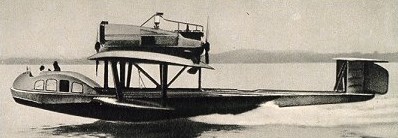
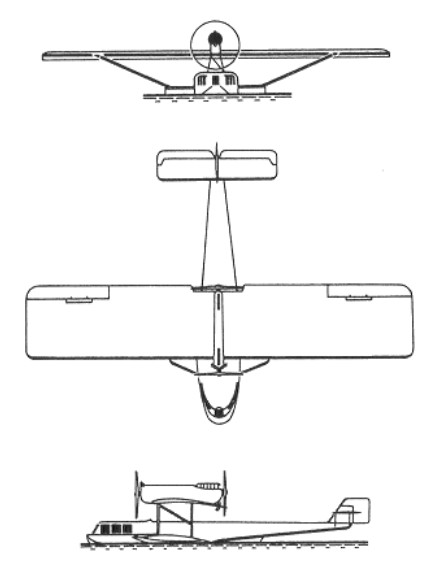
The two improved GsIIs under construction at Seemoos fell foul of the Allied Commission and were destroyed in 1919. Dornier commissioned the firm’s Italian subsidiary to continue development and construction of the forbidden type. The GsII, the famous Wal, which flew in 1922, was built under license in Japan, Netherlands, and Spain and would evolve through the 1920s and into the 1930s. Between the first production Wal of 1923 and the military type of 1932, the airplane’s wingspan increased greatly, its engine power more than doubled, and its loaded weight rose from 8820 to 22000 pounds. It was used for civilian mail service and long range reconnaissance, and the commercial and military models differed little.
Engine: 2 x MB IVa, 190kW Take-off weight: 4315 kg / 9513 lb Empty weight: 1200 kg / 2646 lb Wingspan: 21.0 m / 68 ft 11 in Length: 15.3 m / 50 ft 2 in Height: 4.7 m / 15 ft 5 in Wing area: 80.0 sq.m / 861.11 sq ft Max. Speed: 170 km/h / 106 mph Cruise speed: 140 km/h / 87 mph Ceiling: 4250 m / 13950 ft Range w/max.fuel: 600 km / 373 miles Crew: 2 Passengers: 6
After the armistice, Dornier built a six passenger flying boat, the GsI, with the inher¬ently stable broad beam hull and sponsons that characterized his later boats. First flown in July 1919 the GsI went to Switzerland for test flights, it returned to Fredrichshafen on the 10/12/1919. From there it went on a sales tour to the Netherlands on the 3rd March 1920. The craft was a success, but after a demonstration in the Netherlands, the Allies demanded its destruction because the Control Commission had forbidden that category of aircraft. The GsI was scuttled at Kiel-Holtenaeu on the 25 th April 1920 to prevent it falling into the hands of the Allied Inspection Commission.
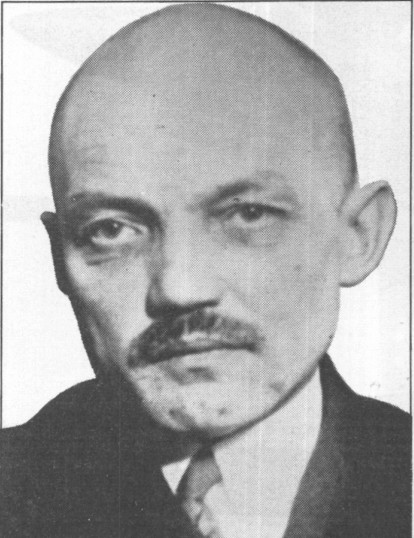
Dr Claude Dornier was employed by Count Zeppelin in 1910, and in 1914 was in charge of the design and construction of large all-metal marine aircraft at Zeppelin-Werke Lindau. Here he produced the Rs.I in 1915, then the largest aircraft in the world, with a span of 43.5m. By 1918 three more giant flying-boats had been built, Rs.II, III, and IV, as well as prototypes of single-seat and two-seat fighters.
All employed Dornier’s techniques of advanced metal construction. After the war the works were transferred to Manzel, near Friedrichshafen, where some two-seaters for the Swiss Air Force were completed. At Manzel, between 1920 and 1925, appeared the Libelle, Delphin, Komet and Merkur, small civil aircraft, and the Falke, an unsuccessful fighter. In 1922 the company became Dornier Metallbauten GmbH and in 1926, as the Manzel works were too small, it transferred to Altenrhein in Switzerland (Aktien Gesellschaft für Dornier Fluzeuge). Here, for the next three years, Aktien Gesellschaft fur Dornier Flugzeug was occupied in building three Do X flying-boats, the largest aircraft of their time, powered by 12 engines. Two were sold to Italy. Bomber designs followed, the Do N, P, and Y being built 1929-1931. These led to the Do F which, like the Do 11, began in 1933 to reequip the German Air Force. However, in 1932 production was resumed in Germany. The Swiss factory subsequently became the Eidgenossisches Flugzeugwerk. 1932 production in Germany, this time as Dornier-Werke GmbH, began with the military Wal (later the Do 18) and Do 11 bomber, supplanted later by the Do 23. In 1934 appeared its first modern warplane, the Do 17, evolved from a fast, six-passenger mailplane designed for Deutsche Luft Hansa. The Do 17 and its successor, the Do 217, which served as a nightfighter, were the only Dornier designs to see largescale production during 1935-1943. Towards the end of the war the company produced the Do 335 push-pull twin-engined heavy fighter with a top speed of 763km/h, probably the fastest piston-engined Second World War fighter.
After the war Dornier became established in Spain. The first postwar aircraft developed completely in Germany was the twin-engined STOL Do 28. An experimental STOL jet transport followed, the Do 31, and the Do 29 research aircraft. From 1966 the company developed the Skyservant and was involved in international programs. Collaboration with Avions Marcel Dassault-Breguet Aviation on Alpha Jet development and production included research into supercritical wing. Merkle joined Dornier in 1969. Became Dornier GmbH in 1972. A majority shareholding was acquired by Daimler-Benz AG in 1985. In 1989 Deutsche Aerospace AG was formed as a corporate unit of Daimler-Benz Group and intended to unite the work of Dornier, MBB, MTU and more, and was renamed Daimler- Benz Aerospace AG. in 1995, with the Regional Aircraft division administered by Dornier Luftfahrt GmbH. In June 1996 Fairchild Aerospace purchased 80% of Dornier Luftfahrt from Daimler-Benz Aerospace, forming Fairchild Dornier Germany Dornier Luftfahrt GmbH. Within Daimler Chrysler Aerospace AG, Dornier Flugzeugwerft GmbH represents part of the Military Aircraft business unit.
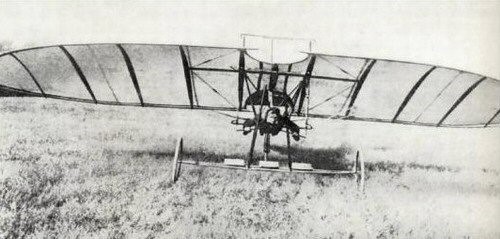
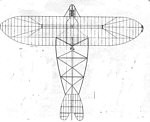
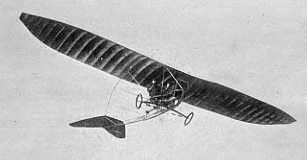
A parasol design started by Diplom Ingenieur Hermann Dorner in the spring of 1907 as a glider with a possibility of attaching an engine at a later time. He was financially assisted by Gottfried Begas, the son of the German sculptor Reinhold Begas. The machine was flown by towing it behind a horse and flights made were about 80 meters in distance at a maximum height of 10 meters. Dorner himself flew the machine and as can be seen in the photo, lay horizontally in the same way the Wright brothers would lie on the lower wing of their biplane gliders or early motorized biplanes.
The Dorner monoplane was a well known sight around Johannistahl. Georg Schendel set a German record for altitude of 2010 meters on 6 June, 1911, and a World Altitude record with passenger, of 1690 meters on 9 June, 1911, in his Dorner. Type II had a 20 hp Dorner-Motor and cost 13,500 Marks. Type III came with a 40 hp Dorner-Motor at 15,500 Marks, or 50 hp at 16,500 Marks. The T.III version had a fatal accident for both passenger and pilot on 9 June, 1911 at Johannistahl.
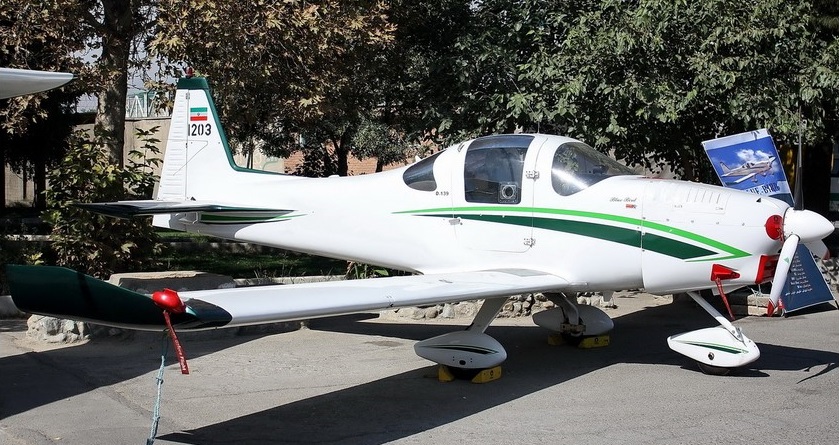
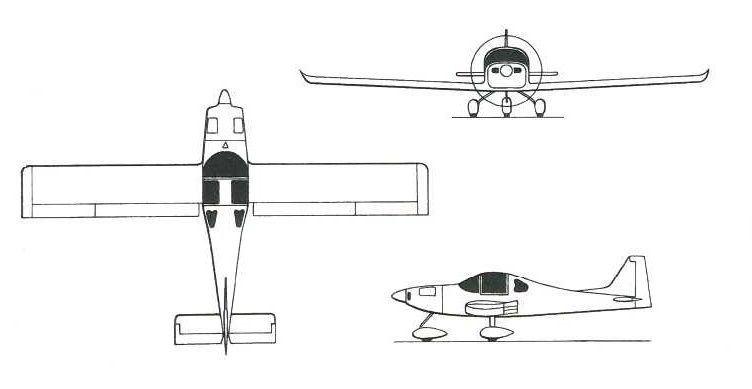
The Dorna Free Bird is an Iranian light-sport aircraft, designed and produced by Hava Faza Dorna Co. of Hasanabad. Designed to comply with the US light-sport aircraft rules, it features a cantilever low-wing, an enclosed cabin with two-seats-in-side-by-side configuration accessed by doors, fixed tricycle landing gear, with wheel pants and a single engine in tractor configuration.
The aircraft structure is made entirely from composite material, with the fuselage a monocoque design. Its 9.45 m (31.0 ft) wing has an area of 11.06 m2 (119.0 sq ft), is built with dual spars and features winglets. It has a low-mounted horizontal stabilizer with a single spar. Both the seats and the rudder pedals are adjustable for pilot height. The cabin is 107 cm (42 in) in width. The standard engine used is the Austrian 100 hp (75 kW) Rotax 912ULS, four-stroke powerplant, driving a Czech-built Woodcomp three-bladed, ground adjustable propeller.
As of February 2017, the design does not appear on the Federal Aviation Administration’s list of approved special light-sport aircraft.
The aircraft was supplied complete and ready-to-fly in 2015 at €85,000 and was still in production in 2017.
Free Bird Engine: 1 × Rotax 912ULS, 75 kW (101 hp) Propeller: 3-bladed Woodcomp ground adjustable Wingspan: 9.45 m (31 ft 0 in) Wing area: 11.06 m2 (119.0 sq ft) Empty weight: 380 kg (838 lb) Gross weight: 600 kg (1,323 lb) Fuel capacity: 70 litres (15 imp gal; 18 US gal) Wing loading: 54.2 kg/m2 (11.1 lb/sq ft) Maximum speed: 220 km/h (137 mph; 119 kn) Stall speed: 64 km/h (40 mph; 35 kn) Rate of climb: 5 m/s (980 ft/min) Crew: one Capacity: one passenger
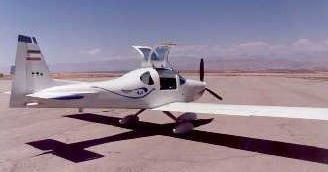
The design of the Parandeh Abi, Blue Bird in English, recreational and training aircraft was begun in 1994 and the first flight was on 27 July 1998. The designer was Mohammad Hassan Karami.
It is a conventionally laid out low wing single-engine monoplane, built entirely from composite materials and seating two side-by-side. Its two spar wings and single spar horizontal tail are rectangular in plan. The wing carries 2.5° of dihedral and the tips are slightly upturned. Plain flaps fill the trailing edges inboard of the ailerons. The elevators are horn balanced, as is the rudder. Together, the fin and rudder are straight tapered, with a small dorsal fillet.
The Parandeh Abi is powered by a Rotax 914 F3 horizontally opposed four-cylinder engine driving a thee-bladed propeller. Its fixed, self-sprung steel cantilever tricycle undercarriage is attached to the fuselage. All wheels have speed fairings. In early production aircraft, access to the cabin was via the top hinged, upward opening canopy, but later examples have forward hinged doors reaching down almost to the wing. The doors contain a framed window, though the total cabin transparency is noticeably reduced. All models have a pair of small, fixed windows in the tapering fuselage behind the seats, where there is a baggage compartment. The aircraft can be equipped with either a stick or yoke for primary control. Other differences between early and later production models include improved engine cooling with the addition of chin and cheek air intakes, enlarged rudder horn balances, tailplane root fillets and fluted skinning on the ailerons and rudder.
The design was type certified to JAR-VLA standards.
Production of the Parandeh Abi began in 2001 with orders for 5 from Iranian flying clubs. By March 2006 Dorna had orders for 14 and options on another 30 and by November 2008 28 had been built at a unit cost of €120,000. As well as supplying clubs and training centres, Parandeh Albis also went to the Iranian Police and to the Civil Aviation Organisation.
By the end of 2012 the company’s website was gone and the domain was for sale. The company may no longer be in business.
Parandeh Abi Engine: 1 × Rotax 914 F3 Propeller: 3-bladed MT-Propeller MTV-6-A/172-8, 1.72 m (5 ft 8 in) diameter Wingspan: 9.45 m (31 ft 0 in). Wing area: 11.06 m2 (119.0 sq ft) gross Airfoil: NACA 63-215 Length: 6.17 m (20 ft 3 in) Height: 2.70 m (8 ft 10 in) Empty weight: 490 kg (1,080 lb) Max takeoff weight: 750 kg (1,653 lb) Fuel capacity: 120 L (26.4 Imp gal, 31.7 US gal) Maximum speed: 282 km/h (175 mph; 152 kn) at 4,267 m (14,000 ft) Cruise speed: 161 km/h (100 mph; 87 kn) economical, at 3,658 m (12,000 ft) Stall speed: 83 km/h (52 mph; 45 kn) sea level, flaps down Never exceed speed: 321 km/h (199 mph; 173 kn) Range: 1,094 km (680 mi; 591 nmi) with maximum fuel Service ceiling: 4,265 m (13,993 ft) Rate of climb: 3.8 m/s (750 ft/min) at sea level Crew: one Capacity: one passenger
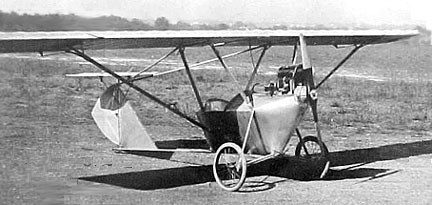
The 1924 Dormoy Bathtub won the Rickenbacker Trophy for its class at the 1924 Nationals. After the 1924 races Dormoy sold it to a farmer, who taxied it around his cow pasture, but was afraid to fly it. It eventually ended up parked in the field, and his cows chewed the wings away.
The 1925 Bathtub was built from scratch with a full-length, covered fuselage.
Only the two originals were built. Many subsequently replicated by home-builders even into the 1990s.