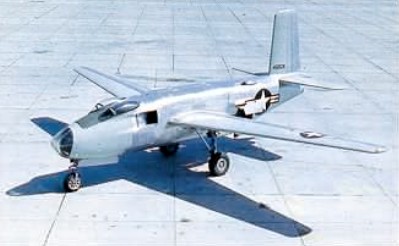
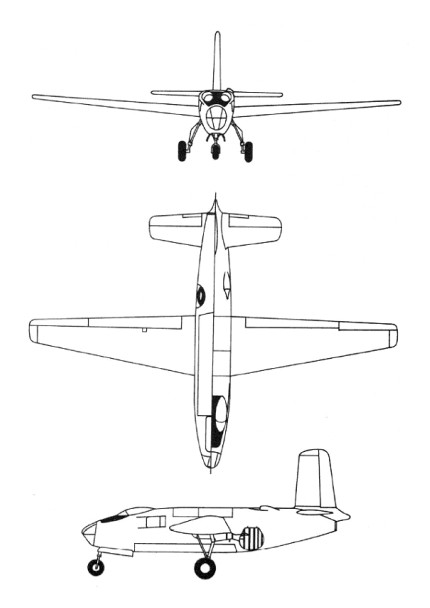
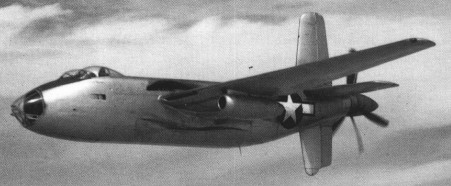
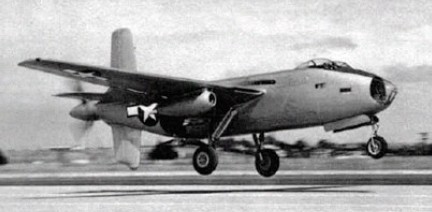
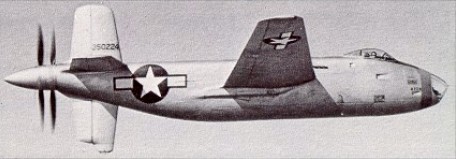
To speed the development of a pure jet bomber, the US Army Air Force contracted Douglas to produce two Douglas XB-43 bomber prototypes using the basic design of the XB-42. The proposed conversion replaced the XB-42’s Allison piston engines with two turbojets. Changes included air inlets, incorporating two extended tail pipes to discharge the jet efflux at the tail, and replacing the cruciform tail unit with a conventional structure which had a fin and rudder of increased height and area by comparison with the XB-42.
The XB-42 static test airframe was modified to produce the first XB-43. With delays resulting from the war’s end and the provision of the turbojet powerplant, eventually, the XB-43 was flown for the first time on 17 May 1946.
By that time, however, and despite the prototype’s good overall performance, The USAAF was already looking to more-capable turbojet-powered bombers and this, the US Army Air Force’s first jet-bomber, was used only for flight-test purposes. The second prototype was completed and delivered in May 1947, being used as an engine testbed before it was retired in late 1953.
XB-43 Engines: 2 x General Electric J35-GI-3 turbojet, 16.7kN Max take-off weight: 17932 kg / 39533 lb Empty weight: 9877 kg / 21775 lb Wingspan: 21.69 m / 71 ft 2 in Length: 15.6 m / 51 ft 2 in Height: 7.39 m / 24 ft 3 in Wing area: 52.3 sq.m / 562.95 sq ft Max. speed: 829 km/h / 515 mph Cruise speed: 676 km/h / 420 mph Ceiling: 11735 m / 38500 ft Range: 1770 km / 1100 miles Armament: 2 x 12.7mm rear-firing guns, 2722kg of bombs
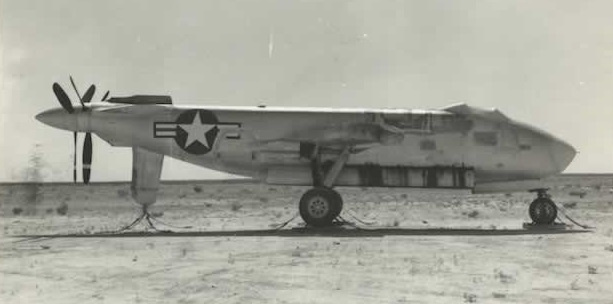
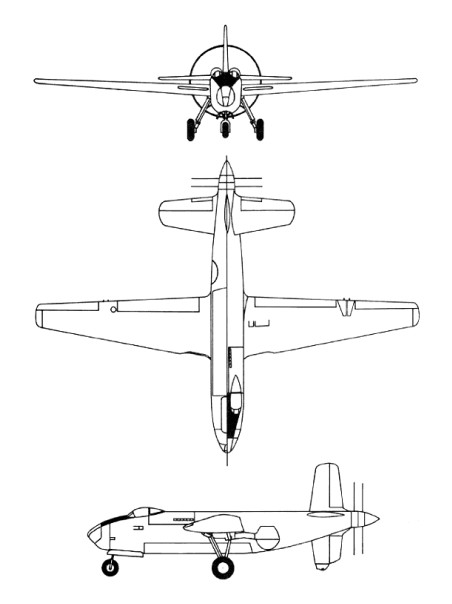
Douglas designed and built two bomber prototypes and one static test airframe under a contract received from the US Army Air Force on 25 June 1943. This was based on two 1800-hp (1342-kw) Allison V-1710-25 inline engines located in tandem in the fuselage to drive a pair of contra-rotating propellers behind the cruciform tail unit. Named Mixmaster by the company, this aircraft had a mid-set cantilever monoplane wing, cruciform tail surfaces and tricycle landing gear, whose main units retracted aft to be housed in the sides of the fuselage. The fuselage provided accommodation for a crew of three. A bomb-aimer/navigator in the nose, and the pilot and co-pilot in a side-by-side cockpit well forward on the fuselage, each beneath an individual canopy. The fuselage also incorporated an internal bomb bay, as well as housing the twin-engine powerplant in a compartment immediately to the rear of the pilot’s cockpit. The two Allison V-1710 engines were used to drive, via shafting and a reduction gearbox in the tailcone, two three-bladed contra-rotating pusher propellers to the rear of the tail unit. Opening the bomb doors in flight interrupted the airflow to the propeller and caused excessive vibrations. The bomber version had six machine guns. The four on the wing trailing edge were aimed by the copilot, whose seat could turn to face aft. An attack version armed with 16 machine guns or a 75mm cannon and two machine guns, or two 37mm cannon was proposed.
Designated XB-42, the Mixmaster was first flown on 6 May 1944.
A second prototype was flown for the first time on 1 August 1944, soon afterwards being modified by the addition of a single canopy over the pilot/copilot cockpit. This prototype was destroyed in a crash during December of that year, but by that time the USAAF had decided not to proceed with production of this design, awaiting instead the development of higher-performance turbojet-powered bombers. As an interim step to allow evaluation of turbine power, the first prototype was given a mixed powerplant comprising two 1025kW Allison V-1710-133 piston engines to drive the propellers, plus two 726kg thrust Westinghouse 19XB-2A turbojets mounted in underwing nacelles.
Redesignated XB-42A, this aircraft was used for performance testing over several months before being retired at the end of June 1949. The XB-42A is now in storage for the National Air and Space Museum. Somewhere along the way its wings were removed for transport and haven’t been seen since.
Douglas XB-42 Mixmaster in storage at Pyote AFB
XB-42 Engines: 2 x Allison V-1710-125, 1800-hp (1342-kw) Max take-off weight: 16193 kg / 35700 lb Empty weight: 9475 kg / 20889 lb Wingspan: 21.49 m / 70 ft 6 in Length: 16.36 m / 53 ft 8 in Height: 5.74 m / 18 ft 10 in Wing area: 51.56 sq.m / 554.99 sq ft Max. speed: 660 km/h / 410 mph Cruise speed: 502 km/h / 312 mph Ceiling: 8960 m / 29400 ft Range: 2897 km / 1800 miles Armament: 4 x 12.7mm machine-guns, 3629kg of bombs
XB-42A Engines: 2 x Allison V-1710-25, 1800-hp (1342-kw) & 2 x turbojets.
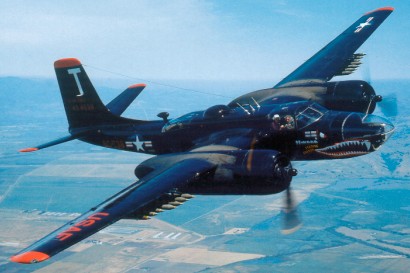
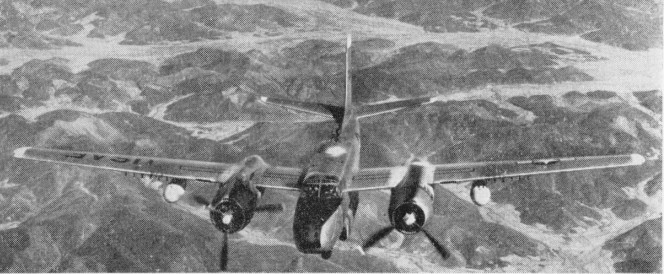
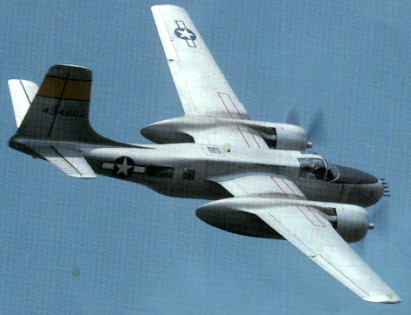
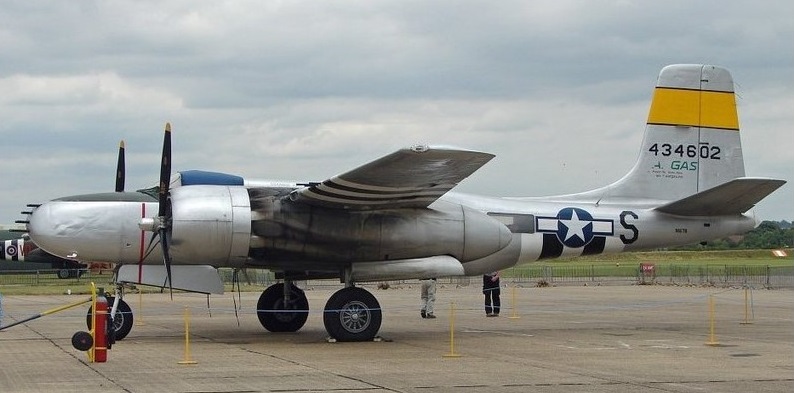
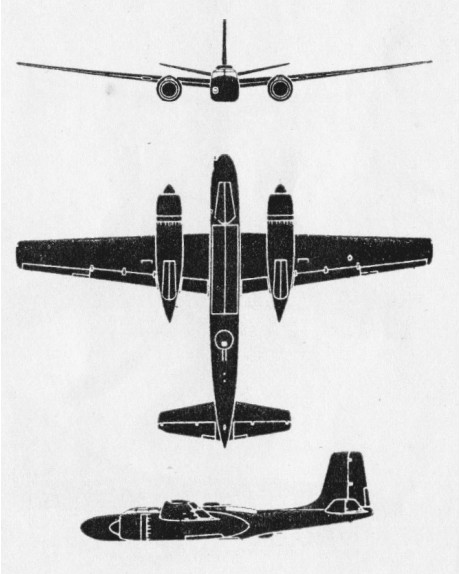
Designed to fulfil a USAAF requirement for an attack bomber to replace the B 26 Marauder, the B 25 Mitchell and the A 20 Havoc, the Douglas A 26 Invader first prototype flew on 10 July 1942. Three prototypes had been ordered in differing configurations: the Douglas XA-26 attack bomber with a bomb-aimer’s position; the XA-26A heavily-armed night-fighter; and the XA-26B attack aircraft with a 75mm cannon. After flight testing and careful examination of reports from Europe and the Pacific, the A-26B Invader was ordered into production, and deliveries to operational units began in December 1943. By the end of World War Two, production of the Invader had ceased. A total of 2,446 were built.
The A-26B Invader had six 12.7mm machine-guns in the nose, remotely controlled dorsal and ventral turrets each with two 12.7mm guns, and up to 10 more 12.7mm guns in underwing and underfuselage packs. Heavily armoured, and able to carry up to 1814kg of bombs, the A-26Bs two, 1491kW Pratt & Whitney R-2800 engines conferred a maximum speed of 375 mph / 571km/h, making the A-26 the fastest US bomber of World War II.
B-26B
Missions with the 9th Air Force in Europe began in November 1944, and at the same time the type became operational in the Pacific. The A-26C with a bomb-aimer’s position and only two guns in the nose entered service in 1945, but saw only limited use before World War II ended. A-26C production totalled 1,091. With little employment ahead of them, so far as anyone could see, one A-26B and one A-26C were converted to XJD-1 configuration, this pair being followed by 150 A-26Cs converted as target tugs for the US Navy with the designation JD-1; some were converted later to launch and control missile test vehicles and drones, under the designation JD-1D. These designations became UB-26J and DB-26J in 1962.
In 1948 the Martin Marauder was finally retired from service and the Invader took over the B 26 designation, it having previously been designated an ‘Attack’ aircraft as the A 26. Two principal sub types were in operation at this time, B 26B and C. The B 26B had a solid nose containing its main armament of six 0.5in Browning machine-guns and the remotely controlled dorsal and ventral turrets, each mounting two similar guns. The B 26C had a transparent nose.
Throughout the 1950s, the B 26 operated with the US Air Forces Europe (USAFE) as a light bomber, target tug and tactical reconnaissance aircraft. The build up of American forces in Europe, which had commenced in 1949 under the leadership of Lt General Curtis E LeMay, proceeded apace in the early 1950s. The B 26B arrived at Laon in France with the 126th Light Bombardment Wing in July 1952; and in December of that year the 7554th Tow Target Flight located to Furstenfeldbruck airbase in Germany. This unit flew the TB 26B variant.
A-26
The RB‑26s did not get off to an auspicious start. Primarily this was due to a lack of equipment, spares and appropriate facilities. On arrival in Germany only 15 days’ supply had been brought over from the US. In addition to this, their all‑important night photo missions were held up for some weeks because no one had made the necessary arrangements for a suitable range for the use of flash bomb cartridges. Eventually arrangements were made with Strategic Air Command to use the ranges at Lakenheath.
Flying for an RB‑26 crew for the first few days of their deployment in Europe consisted of familiarisation flights over their new homeland. Even this became restricted when, in May and early June, a refinery strike in the US severely restricted the use of fuel. For the period of the emergency each pilot was only allowed to for 20 hours.
The RB‑26s were fitted with the comparatively new ‘Hell Roarer’ magnesium illuminator system with split vertical camera installation using the A18 magazine. The ‘Hell Roarer’ was demonstrated to interested parties on November 5 over the Bay of Naples. It turned out to be a veritable firework bonanza. In the cold light of dawn, on November 6 the demonstrating RB‑26 was seen to have a badly scorched tail.
The RB‑26s suffered particularly from severe icing and were grounded for long periods when the temperatures were very low. In late 1953 the problems with the RB‑26 were such that the USAFE prepared to re‑equip the 1st and the 30th TRS with the ‘state‑of‑the‑art’ Martin RB‑57A Canberra. As early as December, crews were being checked out on their respective wings’ Lockheed T‑33s prior to going to Shaw AFB in the USA, home of the 363rd Tactical Reconnaissance Group, a unit also destined to receive the RB‑57A.
Significantly, while the 1st and 30th TRS were preparing to re‑equip with the RB‑57A and relinquish their RB‑26s, in March 1954 another squadron was activated at Spangdahlem with the 10th TRW which began to equip with the older aircraft. The 42nd TRS was activated on March 18.
The 42nd was divided into two flights ‑W and B. W Flight was for weather reconnaissance, and S had the electronic mission. The first RB26 was assigned to W Flight on June 18 and it was not until December that the first aircraft was assigned to B Flight. By this time the weather flight had received its full complement of aircraft.
The aircraft of B Flight increased in sophistication throughout their service with the squadron until replaced in 1956 with the Douglas RB‑66C. The RB‑26s of W Flight were replaced by T‑33As in 1955.
Used also for reconnaissance and target towing, and by Air National Guard. U.S. Navy uses same type as JD-1 for target towing.
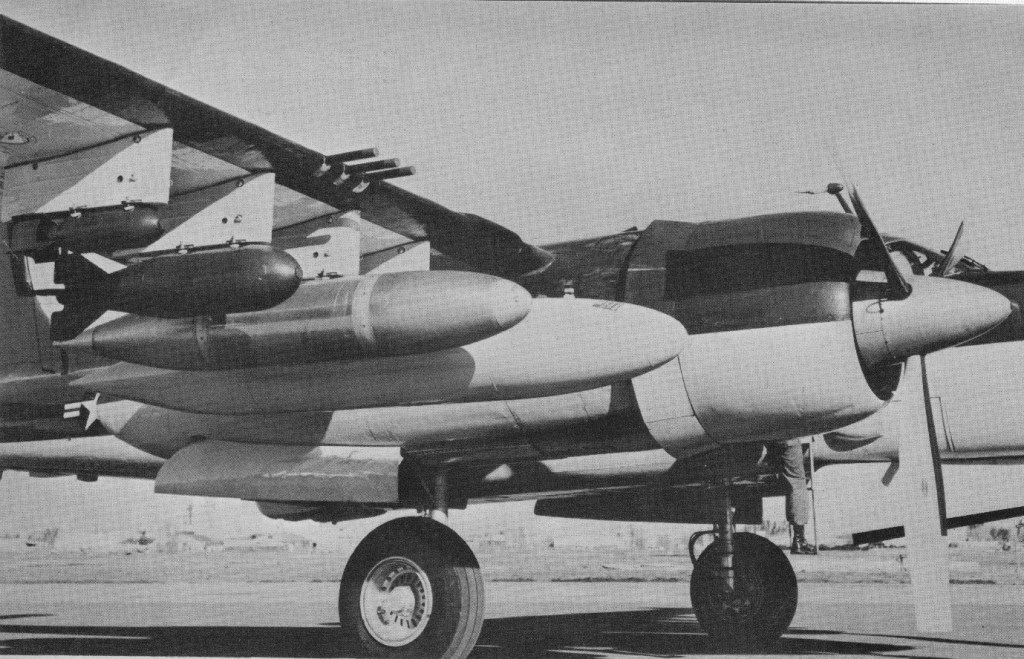
A special COIN version with very heavy armament and extra power was developed by On Mark Engineering in 1963, a prototype being designated YB-26K and named Counter Invader. Subsequently about 70 B-26s were converted to B-26K standard, 40 later being redesignated A-26A. Some were deployed in Vietnam, and others were supplied to friendly nations under the Military Assistance Program. B-26s were used also for training (TB-26B and TB-26C), transport (CB-26B freighter and VB-26B staff transport), RPV control (DB-26C), night reconnaissance. (FA-26C, from 1948 redesignated RB-26C) and missile guidance research (EB-26C). After the war, many A-26s were converted to executive, survey, photographic and even fire-fighting aircraft.
The YB-26K was the test ship for a series of highly modified B-25Ks ordered by the USAF from On Mark Engineering. The production version was to utilise clip-on gun pods instead of wing mounted guns and eliminate JATO racks seen on the YB-26K. The On Mark received old B-26’s from Davis-Monthan AFB storage or Tactical Air Command. $13,000,000 was allotted to rebuild and extensively modify the bombers.
YB-26K
Changes between the B-26B and YB-26K included the wingspan increased 2 feet to 72 ft; normal gross weight up 5000 lb to 41,000 lb; engine horsepower up 500hp each to 2500hp; maximum speed up 31kt to 345 kt; stall speed lowered 9kt to 76kt; rate of climb up 255fpm to 2990fpm; service ceiling raised 7000ft to 30,000ft; and combat radius increased 290nm to 500nm.
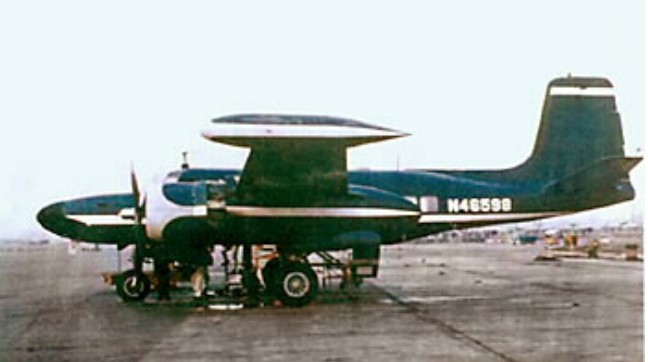
Air America’s night drop bird, 598, aka The Blue Goose or the Blivit. Parked on the Ramp at Udorn in June of 1967. It had an F111 a Terrain Following Radar (TFR) in the nose. This feature allowed low level, jungle top resupply drops at night along the Ho Chi Minh trail between the Mu Gia Pass to Tchepone. 598 had a drop ramp in the aft section and two supply pallets could be carried/dropped. It had a crew of four. Two pilots, a navigator, and a kicker or Air Freight Specialist as they were officially titled.
In total 1,355 were built.
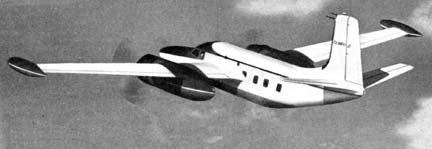
L B Smith Aircraft Corp of Miami FL., produced an executive transport version of surplus Douglas B-26 as the Smith Tempo II in 1959.
A 26B Invader Engines: 2 Pratt & Whitney R-2800. Top speed: 355 mph.
Douglas A 26 C Invader Engine : 2 x Pratt&Whitney R 2800-70 Double Wasp, 1973 hp Length : 51.247 ft / 15.62 m Height: 18.241 ft / 5.56 m Wingspan : 70.013 ft / 21.34 m Wing area : 540.030 sq.ft / 50.170 sq.m Max take off weight : 35006.6 lb / 15876.0 kg Weight empty : 22854.8 lb / 10365.0 kg Max. speed : 324 kts / 600 km/h Cruising speed : 247 kts / 457 km/h Service ceiling : 22096 ft / 6735 m Wing load : 64.78 lb/sq.ft / 316.0 kg/sq.m Range : 1217 nm / 2253 km Crew : 3 Armament : 6x cal.50 MG (12,7mm), Bombload 1814kg
B-26B Engines: 2 x Pratt & Whitney R-2800-27 or -79 Double Wasp, 1491kW Wingspan: 21.34 m / 70 ft 0 in Length: 15.24 m / 49 ft 11 in Height: 5.64 m / 18 ft 6 in Wing area: 50.17 sq.m / 540.02 sq ft Max take-off weight: 15876 kg / 35000 lb Empty weight: 10365 kg / 22851 lb Fuel capacity: 770-1590 gal Max speed: 571 km/h / 355 mph at 15,000 ft Cruise speed: 457 km/h / 284 mph Service ceiling: 6735 m / 22100 ft Range max load: 2253 km / 1400 miles Armament: 10 x 12.7mm machine-guns, 4000 lb / 1814kg of bombs Crew: 3
B-26B Engines: 2 x Pratt & Whitney R2800-79. 2,000 h.p. Wingspan: 70 ft Length: 50 ft. 8 in. Loaded weight: 35,000 lb. Max. speed: 359 m.p.h. Ceiling: over 28,000 ft. Max. range: 1,900 Miles. Armament: 10 x 0.50 in. machine-guns, 6,000 lb. bombs, 14 x 5 in. rockets. Crew: 3
RB-26 Invader
Smith Aircraft Corp Tempo II Engines: 2 x P&W R-2800-C, 2100hp Wingspan: 73’6″ Length: 60’4″ Max speed: 365 mph Cruise: 350 mph Stall: 102 mph Seats: 12
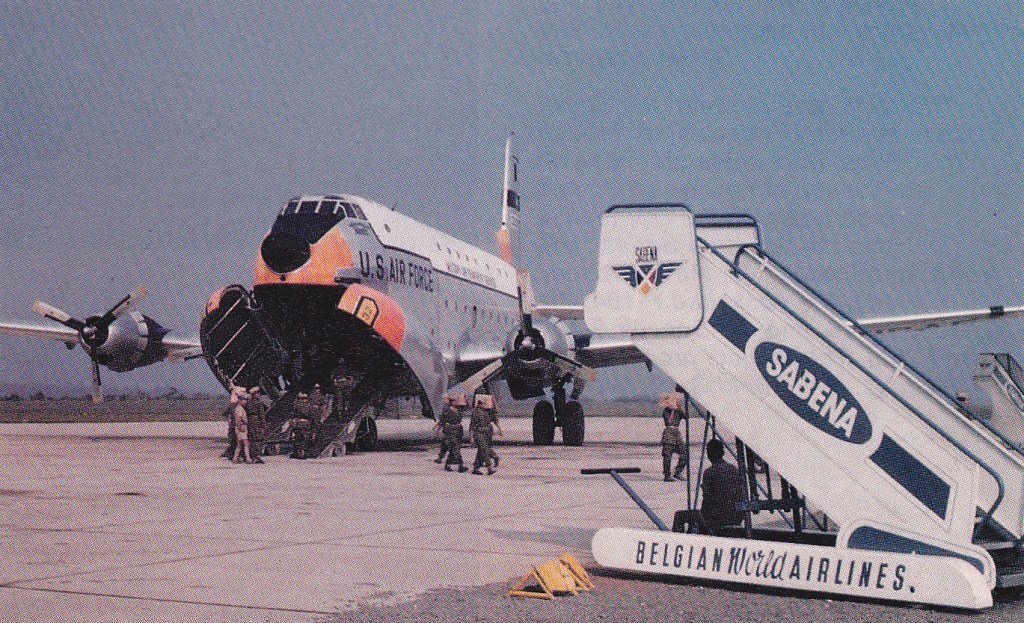
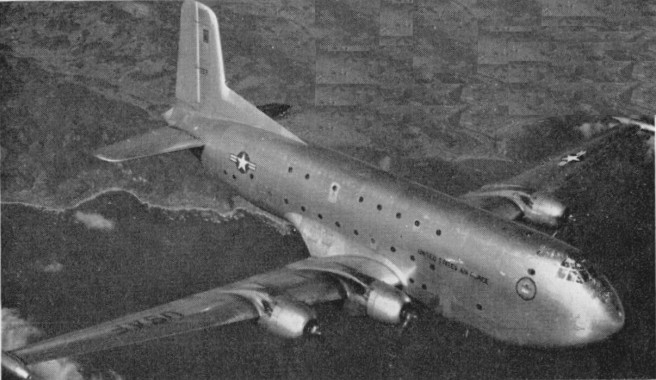
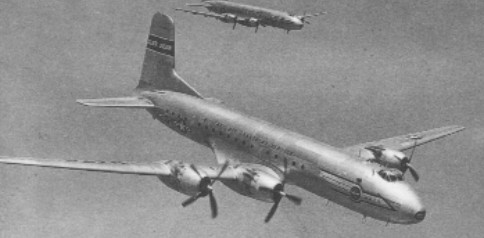
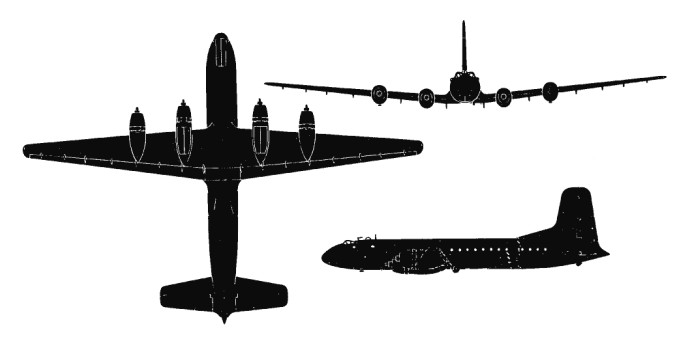
Although the production run of the C-74 Globemaster had been held to 14 airframes, the success of this oversized transport led the US Air Force and Douglas to agree upon construction of an improved long-range transport. The fifth C-74 airframe was used to create the service-test YC-124 Globemaster II which retained the earlier aeroplane’s wings, tail surfaces, and 2610kW R-4360-49 engines. The YC-124 flew on 27 November 1949. The new fuselage was double-decked and the aircraft had enormous clamshell loading doors at the nose with an associated built-in loading ramp, an electric hoist amidships, and two overhead cranes (each with a capacity of 7257kg which could traverse the entire length of the 23.47m-long cargo hold. When used in a transport role (with two decks installed), the Globemaster II could carry a maximum of 200 fully-equipped troops, or 123 stretcher cases plus 45 ambulatory patients and 15 medical attendants.
A pre-production aircraft and 28 C-124A models were retrofitted with the ‘thimble’ nose fairing containing ASP-42 radar. Douglas then manufactured no fewer than 243 C-124C models, with the radome as standard, increased fuel, wingtip fairings housing combustion heaters to de-ice the wing and tailplane leading edges and to heat the cabin, and other improvements. The first service Globemaster began duty in May 1950, the month before the outset of the Korean War. Although production was finished by May 1955, the Globemaster II remained a standard in USAF service for years thereafter.
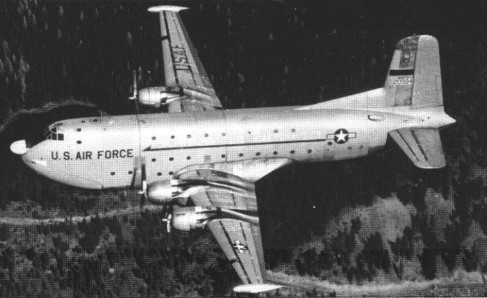
C-124C Globemaster II of 39th Air Transport Squadron flying supplies to Leopoldville in 1963
The Globemaster IIs remained in service until replaced by the Lockheed C-5A Galaxy during 1970. The YKC-124B Globemaster II was Douglas’ bid for a major order for air refuelling tankers. In 1951, engineers began working on a C-124 airframe to be powered by 5,500-shp Pratt & Whitney YT34-P-1 turboprop engines. Gas turbine power produced a kind of ‘Super Globemaster II’ with greater speed, altitude and range capability than the ‘recip’ aeroplane but for reasons not now clear, the USAF decided instead to order the Boeing KC-97 Stratofreighter as its standard tanker even though the latter aircraft did not perform so well. By the time the turboprop Globemaster II flew on 2 February 1954, it had been redesignated YC-124B and was used for proof-of-concept evaluations. Though no orders resulted from its 32-month test programme, the YC-124B contributed substantially to knowledge needed when the C-133 Cargomaster came along.
C-124C Globemaster II Engines: 4 x Pratt & Whitney R-4360-63A Wasp Major, 3800 hp / 2795kW Wing span 173 ft 3 in / 53.1 m Length 130 ft 5in / 39.8 m Height 48ft 3.5in / 14.7 m Wing area: 2,506sq.ft. / 233.0 sq.m Empty weight: 101,165 lb. Max weight: 194,5001b. Max speed: 298 mph at 20,800 ft Cruise speed: 520 km/h / 323 mph ROC: 800 fpm Service ceiling: 21,800 ft. Range w/max.fuel: 6500 km / 4039 miles Range w/max.payload: 1970 km / 1224 miles Crew: 5 Passenger capacity: 200
In 1942 Douglas began to design a larger, would-be successor to the Douglas C-54. The new model, identified in project form as the Model 415, had the same four-engine, low-wing layout as its predecessor, but it was about half again as large dimensionally and twice as heavy. With 3,250hp (2,420kW) Pratt & Whitney R-4360-27 Wasp Major engines, it would cruise at 296mph (476km/h), considerably faster than the C-54. The pilot and co-pilot were separately enclosed in side-by-side bubble canopies, an arrangement later found far from satisfactory from a crew communication standpoint. It was a cantilever low-wing monoplane of all-metal construction, with a conventional tail unit, and retractable tricycle landing gear with twin wheels on each unit. The C-74’s fuselage provided accommodation for the crew and 125 troops, or 115 stretchers with medical attendants, or up to 21840kg of cargo. Orders were received for 50 examples of a military version known as the C-74 Globemaster. In 1945, Pan American Airways also recognized the new model’s potential and ordered 26 with seats for 108 passengers. As ‘DC-6’ was already assigned, the civilian version was called the DC-7. Unlike the C-54, the DC-7 was to have a pressurized cabin. By the time of the first flight on September 5, 1945, the military order had been reduced to 14 units. One, with 103 passengers and crew, flown from the USA to the UK on 18 November 1949, was the first aircraft to fly across the North Atlantic with more than 100 persons on board. With development costs shared by fewer military airplanes, the cost of the DC-7s rose accordingly. Pan American reassessed its needs, as well as the increased cost of the DC-7s, and elected to cancel its order altogether. Although the DC-7 failed as a civil airliner, Douglas did redesign the fuselage of the C-74 to create the C-124 Globemaster II.
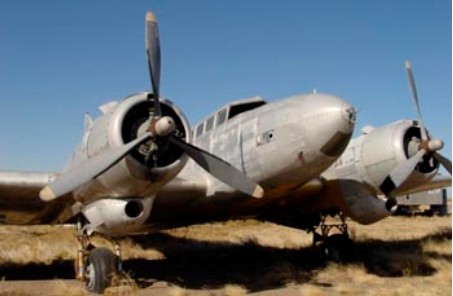
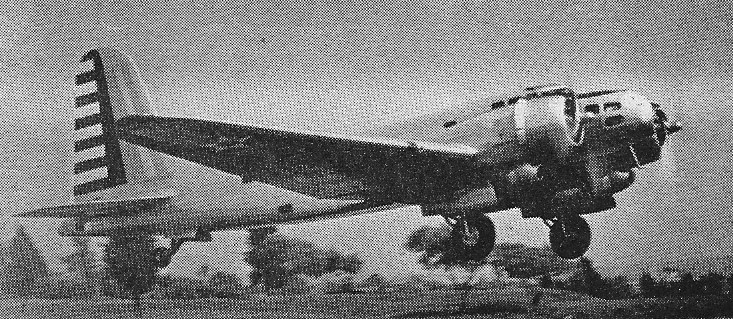
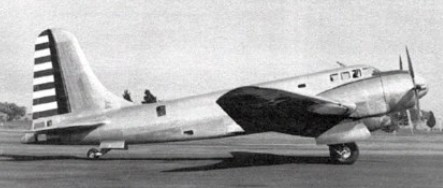
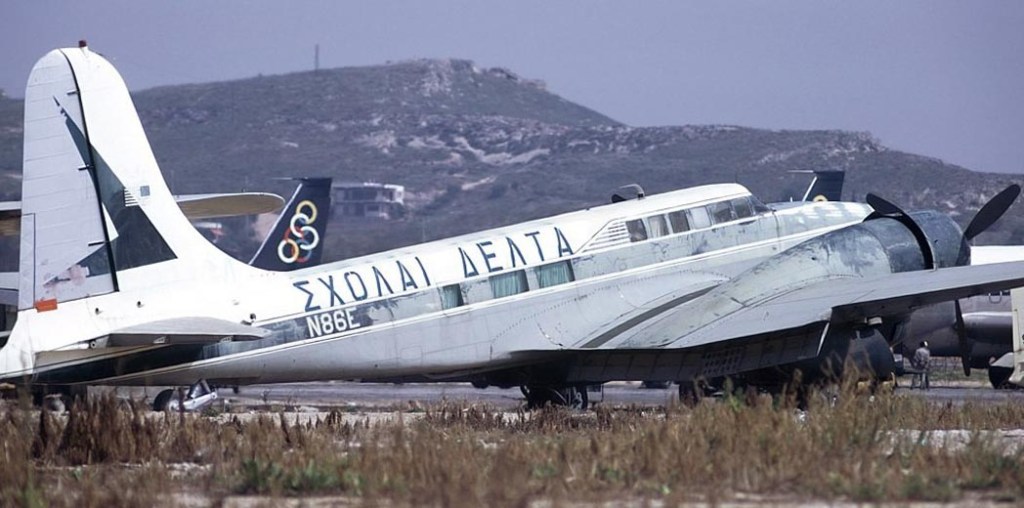
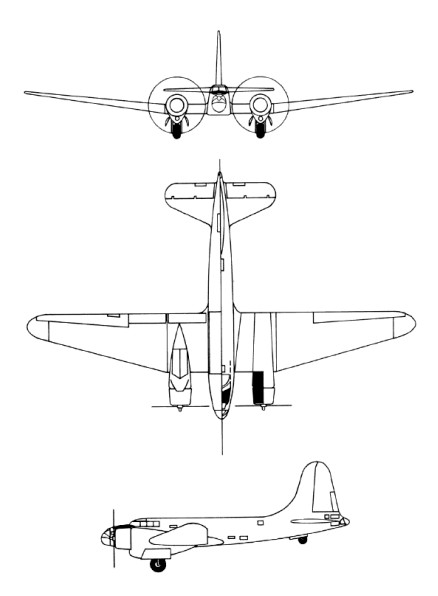
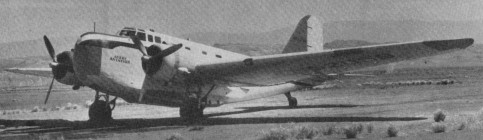
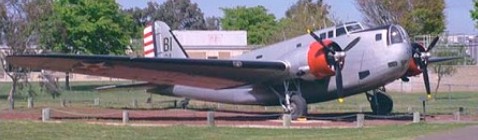
In an attempt to rectify the shortcomings of their DB-1 design, Douglas developed in 1938 an improved version and the proposal seemed sufficiently attractive for the US Army to award a contract for 38 of these aircraft under the designation B-23 and with the name Dragon.
Landing gear was retractable tailwheel type, but the engine nacelles had been extended so that when the main units were lowered in flight they were faired by the nacelle extensions and created far less drag.
The main difference was the switch to much more powerful engines (the most powerful then available), the 1450 hp Wright R 2600 1 Cy¬clone 14. The army adopted the proposal as the B 22, but soon switched to a further improvement designated B 23. The B 23 Dragon included the first US Army tail gun position, a hand aimed .03 in (12.7¬mm). Nose, dorsal and ventral positions each had one 0.30 in (7.62 mm). The tail wheel is offset to allow the tail gunner to access his position from the fuselage. Maximum bomb¬load was 2177 kg (4800 lb), all internal.
In the Fiscal Year 1939, a batch of 38 B 23 Dragons was funded, following successful trials with the prototype in the summer of 1939.
First flown on 27 July 1939, the B-23s were all delivered to the US Army during that year. Early evaluation had shown that performance and flight characteristics were disappointing. Furthermore, information received from the European theatre during 1940 made it clear that development would be unlikely to result in range, bombload and armament capabilities to compare with the bomber aircraft then in service with the combatant nations, or already beginning to emerge in the USA. As a result these aircraft saw only limited service in a patrol capacity along the US Pacific coastline before being relegated to training duties.
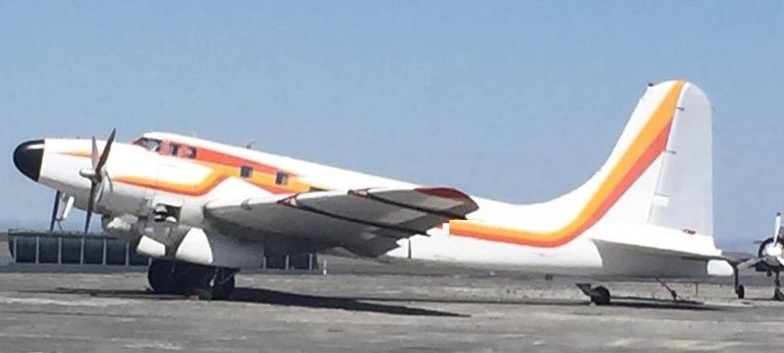
During 1942 about 15 of these aircraft were converted to serve as utility transports under the designation UC-67, and some of the remainder were used for a variety of purposes including engine testbeds, glider towing experiments and weapons evaluation. They were popular executive transports after the war.
Douglas UC-67 Dragon
A total of 38 examples were built, all powered by Wright R-2600 Cyclone engines.
Douglas UC-67 Dragon (C-67)
In 1963 Juan T. Trippe, Pan Am president flew in a B-23 owned by Pan Am, carrying no identification, flown by Pan Am pilots and based at Butler Aviation on LaGuardia. Trippe flew between New York and Washington regularly.
B-23 Engines: 2 x Wright R-2600-3 Cyclone 14, 1193kW / 1578 hp Max take-off weight: 13824 kg / 30477 lb Empty weight: 8659 kg / 19090 lb Wingspan: 28.04 m / 92 ft 0 in Length: 17.78 m / 58 ft 4 in Height: 5.63 m / 18 ft 6 in Wing area: 92.25 sq.m / 992.97 sq ft Max. speed: 454 km/h / 282 mph Cruise speed: 338 km/h / 210 mph Ceiling: 9630 m / 31600 ft Range: 2253 km / 1400 miles Crew: 4-5 Armament: 1 x 12.7mm (0.50in) + 3 x 7.62mm (0.30in) machine-guns, 2000kg of bombs
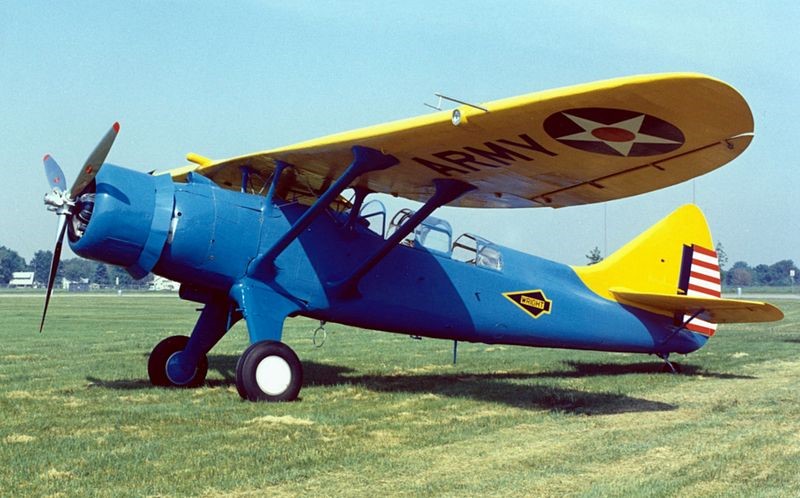
The Douglas O-46A was designed to operate from established airfields behind fairly static battle lines as in World War I. The O-46 was a development of the earlier Douglas O-43. The 24th airframe of the O-43A contract was completed as the XO-46 prototype, with a revised wing and an engine switch, from the O-43’s inline engine to a radial engine, the Pratt & Whitney R-1535-7.
First flying in 1935, the Air Corps ordered 90 O-46As in the same year. They were built between May 1936 and April 1937.
In 1939, a report was issued on the O-46A which stated that it was too slow and heavy to outrun and out-manoeuvre enemy fighter aircraft, too heavy to operate from small, wet, unprepared fields, and too large to conceal beneath trees. This report was a forecast of the future, for World War II with its rapidly changing battle lines proved the need for light, manoeuvrable observation aircraft which could operate from unimproved airstrips. Consequently, in 1942, the “O” (observation) designation was changed to “L” (liaison).
At least 11 O-46s saw overseas duty; two were destroyed in the Japanese raid on Clark Field in the Philippines on 8 December 1941. The Maryland Air National Guard operated O-46As off the coast of New Jersey for anti-submarine duty. The remainder were declared obsolete in late 1942 and after that were used primarily in training and utility roles.
A proposed variant with a Wright R-1670-3 engine received the designation O-48 but was not built.
On 27 November 1942, O-46A (s/n 35-179) was part of the 81st Air Base Squadron, when it landed downwind at Brooks Field, Harlingen, Texas, ran out of runway and overturned. Written off, it was abandoned in place. More than 20 years later it was discovered by the Antique Airplane Association with trees growing through its wings, and in 1967, it was rescued and hauled to Ottumwa, Iowa. Restoration turned out to be beyond the organization’s capability, and in September 1970, it was traded to the National Museum of the United States Air Force for a flyable Douglas C-47 Skytrain. The (then) Air Force Museum had it restored at Purdue University, and placed it on display in 1974, the sole survivor of the 91 O-46s built.
O-46A Powerplant: 1 × Pratt & Whitney R-1535-7 Twin Wasp Junior, 725 hp (541 kW) Propeller: 3-bladed metal propeller Wingspan: 45 ft 9 in (13.94 m) Wing area: 332 sq ft (30.8 m2) Length: 34 ft 6.75 in (10.5347 m) Height: 10 ft 8.5 in (3.264 m) Empty weight: 4,776 lb (2,166 kg) Gross weight: 6,639 lb (3,011 kg) Maximum speed: 200 mph (320 km/h, 170 kn) at 4,000 ft (1,200 m) Cruise speed: 171 mph (275 km/h, 149 kn) Range: 435 mi (700 km, 378 nmi) Service ceiling: 24,150 ft (7,360 m) Rate of climb: 1,765 ft/min (8.97 m/s) Wing loading: 20 lb/sq ft (98 kg/m2) Power/mass: 1.087 hp/lb (1.787 kW/kg) Guns: 2 × .30 cal (7.62 mm) Browning machine guns (one wing mounted and one flexible) Crew: 2
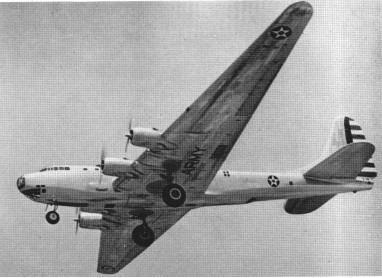
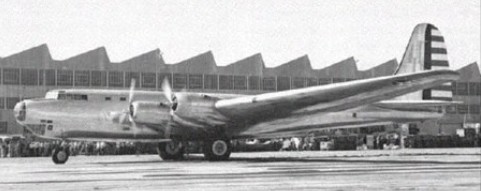
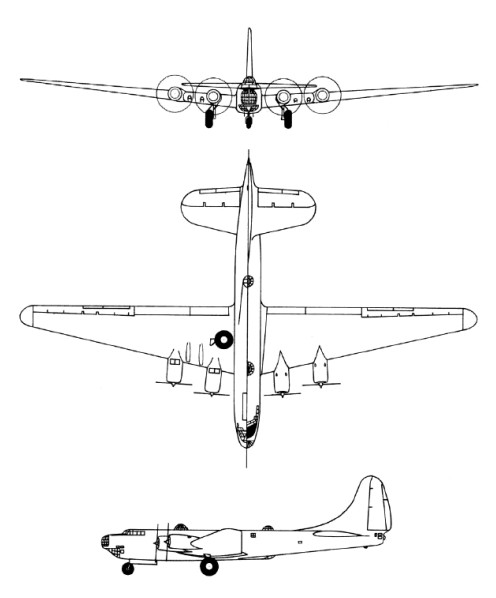
Originally designated XBLR-2 (eXperimental Bomber Long-Range 2), the XB-19 was essentially used as a test bed for very large bomber construction techniques and flight characteristics. The Douglas Aircraft Company had wanted to cancel the project because of the expense and extended construction time which made the aircraft obsolete before it ever flew. However, the Army Air Corps insisted the aircraft be completed for test use. The XB-19’s first flight was 27 June 1941, more than 3 years after the construction contract was awarded. In 1943, the original radial engines were replaced by Allison V-3420 in-line engines and the aircraft was redesignated XB-19A. After testing was completed, the XB-19A was used as a cargo/transport aircraft until 1949 when it was scrapped.
Engines: 4 x 2000hp Max take-off weight: 73467 kg/ 161968 lb Wingspan: 64.62 m / 212 ft 0 in Length: 40.23 m / 131 ft 12 in Height: 13.03 m / 42 ft 9 in Max. speed: 360 km/h / 224 mph Ceiling: 7015 m / 23000 ft Range: 8372 km / 5202 miles Crew: 11 Armament: 2 x 37mm cannon, 5 x 12.7mm + 6 x 7.62mm machine-guns , 16330kg of bombs
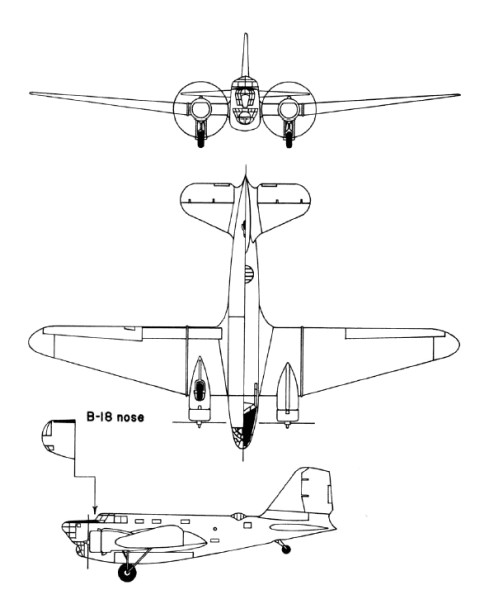
With a 1934 US Army Air Corps requirement for a bomber with greater capability than their Martin B-10, Douglas drew on engineering experience of the DC-2 commercial transport. Private-venture prototypes to meet the US Army’s requirements were evaluated at Wright Field, Ohio, in August 1935, these including the Boeing Model 299, Douglas DB-1 and Martin 146. The first was built as the B-17 Flying Fortress, the last was produced as an export variant of the Martin B-10/B-12 series, and the Douglas DB-1 (Douglas Bomber 1) was ordered in January 1936 into immediate production under the designation B-18. Derived from the commercial DC-2, the DB-1 prototype retained a basically similar wing, tail unit and powerplant. There were two differences in the wing: while retaining the same basic planform as the DC-2, the DB-1 had a 1.37m increase in span and was mounted in a mid-wing instead of low-wing position on an entirely new fuselage. The fuselage was deeper than that of the commercial transport to provide adequate accommodation for a crew of six, and to include nose and dorsal turrets, a bomb-aimer’s position, and an internal bomb bay. There was a third gunner’s position, with a ventral gun discharging via a tunnel in the underfuselage structure. Power was from two 694kW Wright R-1820-45 Cyclone 9 engines. 133 B-18s were covered by the first contract, including the single DB-1 which had served as a prototype. Production aircraft, which had the type name Bold, had equipment changes producing an increase in the normal loaded weight, and more-powerful Wright R-1820-45 radials. The last B-18 to come off the production line differed by having a power-operated nose turret, and carried the company identification DB-2, but this feature did not become standard on subsequent production aircraft. A second contract covered 217 B-18A aircraft, placed in June 1937 (177) and mid-1938 (40). This version differed by having the bomb-aimer’s position extended forward and over the nose-gunner’s station, and the installation of more-powerful Wright R-1820-53 engines. Most of the USAAC’s bomber squadrons were equipped with B-18s or B-18As in 1940, and the majority of the 33 B-18As which equipped the USAAC’s 5th and 11th Bomb Groups, based on Hawaiian airfields, were destroyed when the Japanese launched their attack on Pearl Harbor. When in 1942 B-18s were replaced in first-line service by B-17s, 122 B-18As were equipped with search radar and magnetic anomaly detection (MAD) equipment for deployment in the Caribbean on anti-submarine patrols under the designation B-18B. The Royal Canadian Air Force also acquired 20 B-18As which, under the designation Digby Mk I, were employed on maritime patrol. The designation B-18C applied to two other aircraft reconfigured for ASW patrol. Another two aircraft were converted for use in a transport role under the designation C-58, but many others were used similarly without conversion or redesignation.
B-18A Engines: 2 x Wright R-1820-53 Cyclone 9, 746kW / 986 hp Max take-off weight: 12552 kg / 27673 lb Empty weight: 7403 kg / 16321 lb Wingspan: 27.28 m / 89 ft 6 in Length: 17.63 m / 57 ft 10 in Height: 4.62 m / 15 ft 2 in Wing area: 89.65 sq.m / 964.98 sq ft Wing loading: 28.70 lb/sq.ft / 140.0 kg/sq.m Max. speed: 187 kts / 346 km/h / 215 mph Cruise speed: 145 kts / 269 km/h / 167 mph Service ceiling: 7285 m / 23900 ft Range: 1043 nm / 1937 km / 1204 miles Armament: 3 x 7.62mm (0.30in) machine-guns, 2948kg of bombs Crew: 6
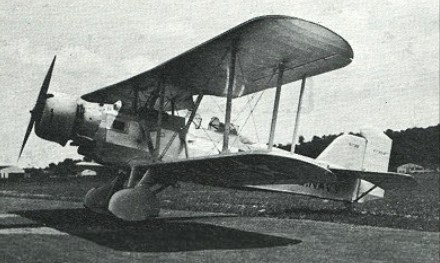
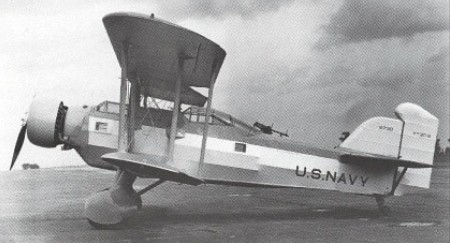
Designed and built to meet a US Navy requirement for a three-seat torpedo-bomber, the Douglas XT3D-1 prototype was first flown in early 1931. A biplane, basically of metal construction with fabric covering, the XT3D-1 incorporated folding wings and arrester gear for carrier-based operations, had fixed tailwheel landing gear, and was powered initially by a Pratt & Whitney S2B1-C Hornet radial piston engine. Accommodation was provided for a crew of three in open cockpits, a bomb-aimer/gunner forward, the pilot in the centre cockpit, just aft of the wing trailing edge, and a second gunner to his rear. Failing to meet requirements in its initial service trials, the XT3D-1 was returned to Douglas for modification, gaining a more powerful 597kW Pratt & Whitney XR-1830-54 radial engine, wheel fairings for the main units and an enclosed canopy for the two rearmost cockpits. Redesignated XT3D-2, it was returned for further service testing but again failed to attract a production order. It was flown by the US Navy for about 10 years for general-purpose duties before being relegated for use as an instructional airframe in 1941.
Engine: 2 x Pratt & Whitney S2B1-G Hornet, 429kW Max take-off weight: 3564 kg / 7857 lb Empty weight: 1922 kg / 4237 lb Wingspan: 15.24 m / 50 ft 0 in Length: 10.79 m / 35 ft 5 in Height: 4.03 m / 13 ft 3 in Wing area: 57.97 sq.m / 623.98 sq ft Max. speed: 206 km/h / 128 mph Ceiling: 4265 m / 14000 ft Range: 893 km / 555 miles Armament: 2 x 7.62mm guns, 832kg of bombs