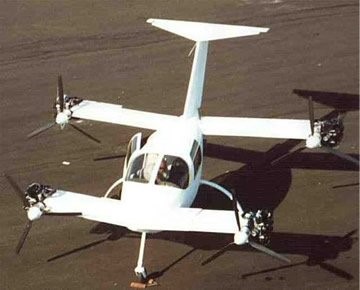
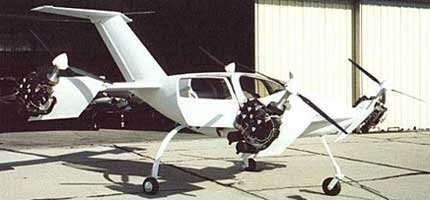
In the late 1990s Duncan Aviation of Michigan developed its Xantus V/STOL design N44CX, named after a species of hummingbird and designed by Terry Duncan, a lead engineer for Williams International.
It featured four 80 hp Hirth F30 engines placed at wingtips fore and aft of the fuselage, and was unveiled to the public for the first time at AirVenture ’99.
The company predicted that the four-passenger tilt-prop aircraft would take off and land vertically, and cruise at 290 mph with a range of up to 800 nm.
After receiving an airworthiness certificate from the FAA on July 7, 1999, the aircraft made its first tentative hovering flight on July 11. Its current disposition is unknown.
USA Based at Opa Locka, this company produced modified Beech 18, increasing performance considerably, under the designation Dumod I. A further development, known originally as the Infinite, later as Dumod II, was produced from 1964. Rights to both acquired by Broome County Aviation in 1972.
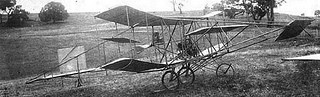
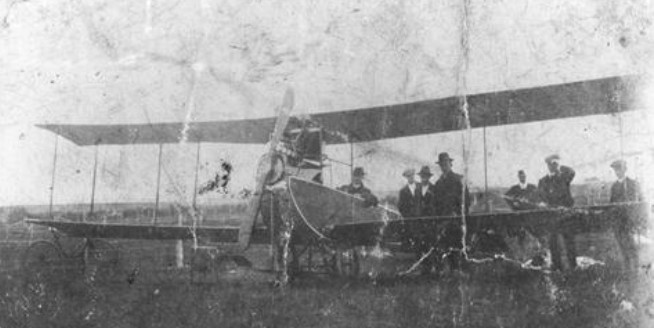
John Duigan’s first biplane, the photo having been taken at Mia Mia, Victoria, Australia in 1910. Though building it was a joint effort by the two brothers, ‘ownership’ is normally assigned to John alone. The craft was only marginally capable of flight, and after a crash in August 1910, it was rebuilt and modified, with the new version of it being somewhat more flight capable.
Designed and built by Johan & Reginald Duigan, it made the first flight in Australia by an Australian designed and built plane.
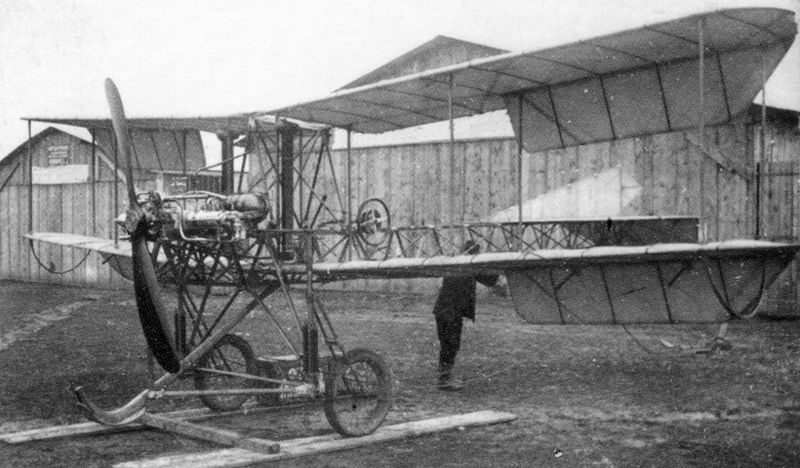
Duigan’s Avro-Type Biplane with Bariquand & Marré Wright Engine at Geelong, circa 1916
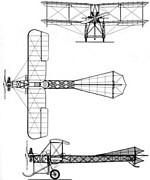
John Duigan and his bother Reginald built the aircraft at Ivanhoe, Victoria, in 1912-1913, basing its design on an Avro biplane that Duigan had previously owned in England, with some modifications to the wings and undercarriage.
John Duigan flew his homebuilt aircraft at Mia Mia, Victoria, Australia, on 16 June 1910, as the first Australian built aircraft to fly in Australian skies. After being damaged in a test flight at Keilor Plains the biplane, minus its original engine, was sold to Hans Christian Anderson, a Geelong motor garage owner in 1915. Andersen fitted it with a Wright Model ‘A’ Model 30 horsepower 4-cylinder engine built under licence by Bariquand & Marré of Paris in 1909. Andersen flew the biplane from the Belmont Common on several occassions until he crashed the plane at Lovely Banks circa 1916.
The engine is believed to be from the first plane flown in Australia, an imported Wright Flyer, in which Colin Defries first took to the air at Victoria Park Racecourse, Sydney, on 9 December 1909.
The plane is fitted with both landing skids and pnuematic-tyrred wire-spoked wheels.
The original Duigan biplane was in storage with the Museum of Victoria in Melbourne, Australia. The museum also has on display the Duigan replica that Ron Lewis built and flew from 1990-1995.
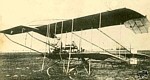
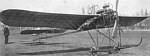
This plane, the first Swiss two-seater, was a 1911 development of the earlier Dufaux-4 and had a similar landing gear and triangular-section fuselage. It was equipped with either 70 hp Gnôme or with Oerlikon 4-cylinder horizontally-opposed engines. Several were built, it was used in the flying school of Ernest Failloubaz, was flown by many of the most famous early Swiss pilots and also made the first Swiss military flights.
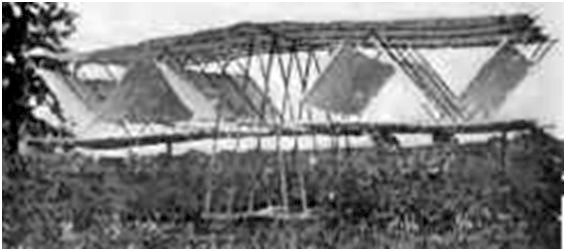
The first of several gliders tested by designer/builder Albert Q. Dufour, “not yet 20 years old”, in Milwaukee, Wisconsin, USA. It was launched from a 40 feet inclined runway ending 15 feet off the ground in 1907 and made flights of up to 100 feet.