Durand Mark V

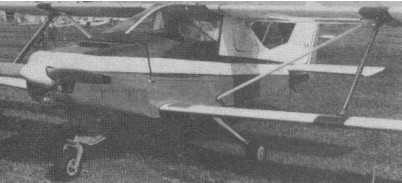
The Durand biplane features a negative stagger configuration so that it does not produce a full stall, only a very short period of “nibbling” with little loss of altitude. The structure is rated + 3.8 and —1.5 G’s. Roll is produced by a combination of effects when a spoiler is activated, instead of by use of ailerons. According to its designer, a spoiler for roll control actually helps an airplane turn in the direction of the bank, while ailerons do not. The trailing edges of the wings are taken up by full-span flaps. With a standard 150-hp Lycoming, the Durand can carry two people with 128 pounds of baggage at 135 mph over a range of 520 miles. Cockpit controls are basic, with dual sticks in lieu of standard control wheels. The cabin features exceptional visibility by using a forward sliding canopy instead of side doors normally associated with high-wing and biplane cabin aircraft.

Engine 150-hp Lycomlng
HP range: 125-180.
Gross Wt. 1840 lb
Empty Wt. 1210 lb
Fuel capacity 24.5 USG
Wingspan 24 ft 6 in
Length 20 ft 3 in
Top speed 170 mph
Cruise 135 mph
Climb rate 1200 fpm
Ceiling 15,000 ft
Normal range 400 miles
Range with auxiliary tanks 520 mile
Takeoff run 550 ft
Landing roll 450 ft
Durand XD-85

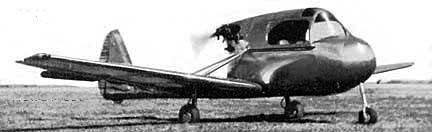
This was a 2-seat pusher designed and built by Mr. William H. Durand and the aircraft first flew during the Summer of 1948. The all-metal XD-85 was powered by an 85hp Continental C85-12J engine. The aircraft reportedly sustained wing damage in a hangar incident and was not rebuilt. Further development was halted, a fate not uncommon to many other (light) aircraft projects of the immediate post-war years.

Duramold F.46A

Designed by Colonel V. E. Clarke and financed by Fairchild, was built in 1938 to test plastic-bonded plywood processes. It was also used by Fairchild as a test bed for their 420 hp Ranger engine. Research based on this aircraft was employed in the design of the Fairchild AT-21 Gunner.

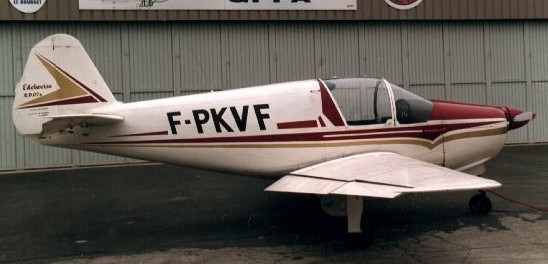
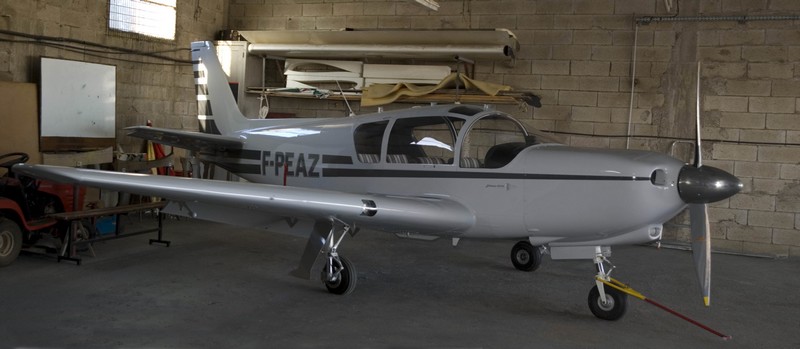
Duruble Edelweiss RD 03

This aircraft is a 4 seat aircraft with the prototype (F-PYIT) powered by a Lycoming O320 (160Hp) for the first flight in March 1982. Made available in plans form for home construction and developed from the earlier RD-02 two-seater.
Able to take up to 180hp, the propeller was a variable speed Hoffmann, and autoopilot (badin Crouzet), classified IFR in 1984.
With 23in and 2300rpm it can cruise about 140kt and use 32l per hour (100LL).

Windspan: 8.820m
Length: 6.875m
Wing area: 11.388sq.m
Airfoil: Naca 23019
socket Profil : Naca 23012
Marginal Profil : 6°30′
Dihedral: -3°
Twisted: +3°
Number of seats: 4
Power: 160 HP
Class: Utility
Max speed: 275 km/h
Cruise speed: 253 km/h
Stall speed clean: 105 km/h
Stall speed gear and flaps: 92 km/h
ROC: 5.9 m/s
Max ceiling: 5000 m
Empty weight: 485 kg
Fuel: 108 kg
Passager front weight: 172 kg
Passager rear weight: 154 kg
Luggage: 20 kg
max payload: 443 kg
MAUW: 928 kg
Wing loading: 81.49 kg/sq.m
Power loading: 6.19 kg/hp

Duruble Roland Duruble 2 / RD 02r Edelweisse

Conceived primitively in 1945 of wood, and the construction beginning in 1946, there were disappointments with the Caurite glue. The Office Véritas informed the builders that the plane could not be accepted.
With thoughts of a metallic prototype, the goal was to show that one with 65 cvs. Several years of study and the first drawings done, the framework began at Bessonneau until 1956. The plane was transported at Legrand, where the prototype was finished towards the end of 1961.
The assembly and completion were achieved at the Boos airfield.
July 7, 1962, Edelweiss first flew. Testing by the CNRA was completed June 24. CNRA n° 270952 was delivered August 19, 1963, partner to the file n° 341 of August 23, 1963.
A two-seater, all metal plane, with a Walter-Mikron 4-III motor of 65 hp at 2600 rpm, with retractable tricycle undercarriage.
The Edelweisse was presented to the gathering of the amateur constructors at Rouen-Boos the 16, 17 and 18 August 1963 and made a sensation.
On February 21, 1981, a motor breakdown led Roland Duruble to fit a Revmaster 2100D n°s 2496 of 75 hp, and a twin-bladed metallic constant speed Maloof propeller.
The prop was replaced with a twin-bladed in wood and Revmaster reduced performance to 65 hp at 3200 rpm, although TBO became 1000 hrs instead of 800. Climb rate was noted at + 1,5 m/ses to 11500 ft. The
By October 8, 1984 with 947 hs 25 min TT. the craft wass sold to M. Jacques Plumet. The reported flight time on October 23, 1993 was 1097 hs 39min.

Dunstable Sailplane Company

The Dunstable Sailplane Company was established in 1934 by W.L. Manuel and C.H. Latimer-Needham to design, manufacture and repair gliders from its workshop at Barton-Le-Clay Airfield in Bedfordshire, UK.

The Dunstable Kestrel was manufactured by the company from designs by W.L. Manuel in 1935; production was limited to one sailplane with a British Gliding Association id of G221.

W.L. Manuel drew up plans for home builders which were offered for sale at the cost of £6. 6s.

W. L. Manuel was born William Lancelot Manuel in 1903; parish records list his birthplace as Malling, Kent. Manuel spent his early life working at RAF Hawkinge Kent with 25 Fighter Squadron, He was a key member in the establishment of the Channel Gliding Club (1930), and built an estimated 14 aircraft over his 84-year life. William Manuel retired in 1965 from the AC Cars company of Thames Ditton; it is thought he was the company’s chief planning engineer on retirement.