2003: Based in Ascoli Piceno, Italy.
Jerry Yagen’s Flug Werk.
2010: FLUG WERK GmbH, Kothingried 4, 85408 Gammelsdorf, Germany.
In addition, Flug Werk was recognized for two years as subcontracting firm for the EADS and different components for the ME 262 reproduction of the Messerschmittstiftung manufacture. Among them is also new, “fin adjustment equipment specified in the RLM jargon “(= horizontal stabilizer trim). It is a quite complex construction unit, on which the working reliability of the entire aircraft hangs. A homogenous retrofit of the others “Swallows “of the American 262-Herstellers is available.
Flug Werk founder Claus Coiling says that the demand for the new-build FW 190s means that the original planned production of 12 airframes has been increased to 20 examples. After production of FW 190 parts has finished, the company will proceed with the manufacture of a North American P-51 Mustang Iookalike” airframe kit called the AP-51 Palomino.
2010: The workshop of Achim and Elmar Meiser at Bremgarten airfield, Germany, Flug Werke.
Aircraft
F&FW Diamant / Swiss Federal Institute of Technology Ka-Bi-Vo / HBV Diamant
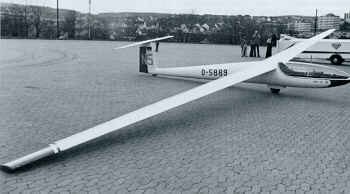
The ideal of an all-glassfibre sailplane was achieved in several stages, the first being development of the fuselage and tail unit designed by Thomas Bircher and J von Voornveld at the Swiss Federal Institute of Technology in Zurich under the direction of Professor Rauscher. A prototype fuselage was built in 1962 and was flown with the plywood and fabric wings of a Schleicher Ka 6CR, the resulting aircraft being designated Ka-Bi-Vo.
The Diamant’s development was now gradually taken over by Plug- und Fahrzeugwerke AG FFA, and the next stage was the HBV-Diamant 15 which used the 15m span Hutter H-30TS wings of the Glasflugel H 301 Libelle. This first flew on 5 September 1964 and 13 of this variant were subsequently built; the Libelle’s wings being glassfibre balsa sandwich shells without ribs, featuring ailerons that gave partial downward movement when the flaps were lowered, and there were glassfibre dive brakes forward of the flaps.
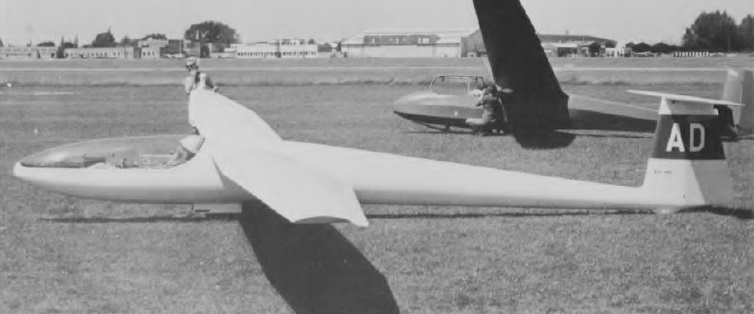
The HBV-Diamant 15 was followed by the generally similar Diamant 16.5, with wings of increased span (16.5m) designed and built by FFA; a total of 41 of this variant were built. This was the first all glass fiber production sailplane, not using balsa or other wood sandwiched between the fiberglass layers.

The Diamant 18 is an 18 m development of the 16.5, first flying in February 1968, with extended inboard wing and flap sections and a new wingtip cap. like the Diamant 16.5, water ballast an be carried in the wing roots. The monocoque fuselage is an epoxy-glassfibre sandwich with foam inserts, and the tail unit is of the same construction, the allmoving one-piece tailplane being mounted on top of the fin. As well as a small tailwheel (a tailskid is optional) there is a manually-retractable monowheel with a brake, and another feature is a glassfibre ring spring shock absorber; the tow release retracts with the landing gear. The pilot sits in a semi-reclining position under a long forward sliding one-piece canopy, and there is provision for radio and oxygen.

At least one Diamant 18 was substantially modified by Dan Pierson of Los Angeles, CA to have a 19.0 m / 62.3 ft wing carrying 145 kg / 320 lb of water ballast bringing the gross weight up to 673 kg/ 1,480 lb.
The HBV Diamant and Diamant 16.5 are ATC, while the Diamant 18 is EXP.
A powered version of the Diamant 18 known as the EFF Prometheus 1 made its first flight on 21 June 1971, powered by a 176lb st Microturbo Eclair II turbojet mounted behind the cockpit. The Prometheus was developed by EFF – Entwicklungsgemeinschaft fur Flugzeugbau der Akademischen Fluggruppe, and it was later converted back to a standard Diamant 18.
Variant:
EEF Prometheus 1
Diamant 16.5M
Wing span: 16.5m / 54.2ft
Wing area: 12.2sq.m / 143sq.ft
Empty Weight: 270kg / 595lb
Payload: 138kg / 305lb
Gross Weight: 408kg / 900lb
Wing Load: 30.91kg/sq.m / 6.29lb/sq.ft
Water Ballast: 0
No. of Seats: 1
No. Built: 43
L/DMax: 42 100 kph / 54 kt / 62 mph
MinSink: 0.55 m/s / 1.80 fps / 1.0 kt
Aspect ratio: 20.5
Airfoil: Wortmann FX-62-Z-153
Diamant 18
Wing span: 18.0 m / 59 ft 0 in
Wing area: 14.28 sq.m / 153 sq.ft
Airfoil: Wotmann FX-62-Z-153 mod.
Length: 7.72 m / 25 ft 4 in
Height: 1.35 m / 4 ft 5 in
Empty Weight: 280 kg / 617 lb
Payload: 160 kg / 353 lb
Gross Weight: 440 kg / 970 lb
Water ballast: None
Wing Load: 30.8 kg/sq.m / 6.34 lb/sq.ft
Max speed: 149 mph / 129 kt / 240 km/h
Max rough air speed: 108 kt / 200 km/h
Stalling speed: 32.5 kt / 60 km/h
MinSink: 0.52 m/s / 1.71 fps / 1.01 kt at 45 mph / 39 kt / 72 km/h
L/DMax: 45 at 100 kph /54 kt / 62 mph
Aspect ratio: 22.7
No. of Seats: 1

Florov 4302

By 1944 Dushkin, who was working on the NII-1 of the NKAP, created a new version of the RD-2MZV reactive engine. This new power plant used a fuel pumping system, consisting of kerosene and nitric acid. Its main feature was the presence of two chambers, a large 1,100 kg thrust and a small 300 kg.
This allowed taking off and reaching the maximum height with the two chambers and then using the force of the small one in horizontal flight. This was able to save fuel and achieve a considerable increase in engine operating time.
Initially it decided to install this engine in the interceptor “Malyutka” of NN Polikarpov, which was projected in 1944, but his sudden death did not allow the builder to finish the job.
During state tests of the RD-2MZV, developed in May 1945, a joint thrust force of 1500 kg was achieved at take-off, 1250 kg as normal thrust and 500 kg as minimum thrust. Working only the small chamber, a thrust of 300 kg was achieved and the minimum thrust was 100 kg. The weight of the engine with all its aggregates reached 224 kg. The production of 30 power sets was approved with the delivery of the first on March 10 and the last on August 10, 1946.
Factory No. 165 was selected as the engine manufacturer, which was to work closely with other plants. Assembly and control tests were entrusted to the NII-1.
At that time, the experimental aircraft with a liquid reactive engine designed by IF Florov was already being built in the NII-1. This aircraft had begun to be projected two years ago, when by GOKO resolution No. 5201 issued on February 18, 1944, the Reactive Technique Institute (NII-1), transferred to the NKAP, was given the task of dedicating itself to the development of reactive engines. The leadership of the NII-1 was assigned to the head of the NII VVS PI Fiodorov and as his replacement was appointed VF Boljovitinov.
The new managers of the NII-1 enjoyed aeronautical construction. For this reason, in parallel to the main tasks of the institute, linked to the creation of reactive engines by the Isayev and Dushkin collectives and turbojets by AM Lyulka, it was decided to build an experimental aircraft from a project developed by Boljovitinov and Florov. This task was approved by the 18 Principal Directorate of NKAP, responsible for the reactive technique.
It was proposed to build two variants of the aircraft: one with an Isayev powerplant, which was named “4302” and another with the Dushkin engine, which was named 4303.
According to the project, the “4302” should have a flying weight of 2320 kg. The maximum speed at sea level had to reach 1010 km / h (M = 0.82), 1015 km / h (М = 0.88) at 5000 meters and 1050 km / h (М = 0.99) at 15000 meters. The ascent time at 15,000 meters was calculated at 2 minutes 22 seconds and the practical ceiling at 18,850 meters. The expected flight time was 46 minutes.
Both projects were conceived to test the powerplant itself, as well as the aerodynamic characteristics of flying at high speeds. Another primary objective was the study of the pressure distribution laws by the wing profile and the calculation of overloads in flight, especially in turbulence generation areas.
It was planned to build a total of six copies of which the first two would be used for the preparation of the flight personnel and the rest for the development of the experiments.
The institute’s productive capacities were scarce, so the construction was contracted to Factory No.21 named in honor of Sergo Ordzhonikidze and located in Gorky city.
Working drawings were ready on 1 January 1946 and once delivered the factory started production. The first two were ready for delivery in March.
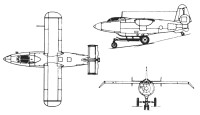
The “4302” was designed as an experimental all-metal monoplane. The wing design was straight, with a constant section throughout the span. In order to improve directional stability and reduce the effect of turbulence at high speeds, the wingtips were angled 45º downwards. The wing profile used was the TsAGI 13145 with laminar flow and thickness of 13%.

The fuselage, also metallic, had a cigar shape with a circular cross section, with a diameter of 1,150 mm at its widest part. At the bottom of the nose was the towing hook.
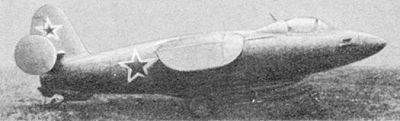
The tail unit was cantilever type and terminated in vertical washer-like surfaces. The empennage was constructively integrated into the fuselage. All the coating, including the rudders and ailerons, was metallic.
The landing gear was one of the most complex elements. For the first flights a fixed gear with three wheels obtained from a Lavochkin La-5 was used. Later, the “4302” was equipped with a retractable ski for landing and took off using an ejectable forklift. The landing ski was constructed of stainless steel and featured a hydraulic release system. In the middle portion of the ski profile were two grooves to fix the trolley, which was constructed of steel tubes.
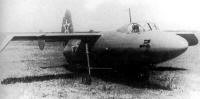
The main 650x200mm wheels featured disc brakes. The 400x150mm double wheel front unit had a hydraulic damper. To reduce the lift of the truck once it was separated from the plane, the braking system was activated automatically after release. When the truck was detached, the ski was retracted.
By this time the leadership of NKAP had changed (instead of AI Shajurin, MV Jrunichev had been appointed) and this structure became the Ministry of Aviation Industry (MAP). The new MAP managers had a negative reception towards the plane, considering that the NII-1 had “meddled” in a task that was not within its competence. For this reason, as of February 1946, all financing for this project was withdrawn.
The new director Ya. L. Bibikov and VF Boljovitinov wrote directly to Stalin, explaining that at 1 April of 1941 the first issue of flight he was at 70% completion and continue the work the prototype would be ready for state tests for the month of July.
The vice-president of the Council of Ministers of the USSR, NA Bosniecienski, who after Malenkov’s departure, attended the aviation, ordered Khrunichev and Vershinin to seek a solution to the dilemma. Reluctantly, Khrunichev was forced to give in.
The new VVS chief, Marshal Vershinin reacted differently. On the one hand, he appreciated scientific work, especially in the field of military aviation, but on the other hand he was offended, since the experimental production plan was approved by the NKAP during the period of his taking office, he decided to support the NII-1.
Together with the new VVS chief engineer, IV Markov issued a communication in which he recognized the great value that an interceptor with these features would have for the VVS and requested that state tests be carried out in 1946.
In response, Khrunichev replied that the data presented by the NII-1 should be subject to a review and created a ministerial commission to do so.
The commission was chaired by Professor IV Ostoslavski and included the main builder of OKB-155, AI Mikoyan, the head of department of TsAGI VN Matvieyev, the group head of the 7th MAP Directorate, IV Loktiev and the head of the (Directorate of the MAP, VV Yakolievsky The result of the commission, presented in June 1946, yielded the following results:
“… the maximum speed of the plane will be between 900 and 950 km / h instead of 1000 – 1100 km / h and the ceiling will be limited to 12000 – 13000 meters instead of 20 000 m, due to the absence in the airplane from a sealed cabin. The duration of the flight presented in the letter is 46 minutes. The commission considers that the maximum flight autonomy will be 5 minutes. “
The commission’s results were based on the results obtained with the straight-wing Bisnovat 5, which had been unable to obtain the proposed speed. Florov replied that his aircraft had been designed with the latest strength requirements in mind and with the correct wing selection recommended by TsAGI.
Despite the commission’s report the MAP was instructed to finish and test the experimental specimen “4302”.
In response to the MAP meeting in September 1946, Khrunichev severely criticized the NII-1 leadership and demanded to reorganize the institute’s activity on a purely scientific and not practical profile. The minister ordered to separate the group of builders from the institute and give them a constructive base to continue their activity.
As the new director of the NII-1, MV Keldysh was appointed and in its new structure were three collectives: OKB-1 from LS Dushkin, OKB-2 from AM Isayev and OKB-3 from MM Bondaryuk and a department of gunpowder accelerators.
Jrunichev decision of the bureau of buildings Florov was renovated. The personnel and the productive base were placed under the direction of Bisnovat. Under these conditions, NII-1 survived one more year, until in 1948 it was absorbed by TsIAM. The Dushkin and Bondaryuk groups passed to this institute. Isayev’s group would go to NII-8 of the Ministry of Armaments, dedicating itself to the construction of reactive rocket engines.
By the fall of 1946 one in glider configuration without an engine) was ready for testing and was sent to the LII. Another Isayev-powered example was in the completion phase. Under pressure from the military, the MAP was forced to continue the construction of this copy to deliver it to the LII. With so much pressure, the works on the “4302” could not be carried out to the expected magnitude. It is stated that three examples were completed.

The flights were started in 1947. In total, 20 flights were executed, of which 19 were carried out in the version without an engine. The Isayev jet engine flight was executed by test pilot AK Pajomov in August. This flight started smoothly, but towards the end of the engine work pieces were damaged and nitric acid fumes filled the cabin.
Pajomov managed to land the plane. After this flight, the jet engine aircraft development program was closed. By then, significant progress had been made in the development of turbojet engines capable of high thrust.
After this Ilya Florov went on to dedicate himself to scientific activity, defended his candidacy thesis and later his doctorate, going on to direct a scientific group. He would never design airplanes again.
4302
Powerplant: A 1,100 kg thrust AM Isayev liquid reactive engine
Wingspan: 6,932 m
Wing area: 2 m²
Length: 7.152 m
Height: 3.06 m
Maximum takeoff weight: 2398 kg
Maximum speed achieved: 520 km / h
Calculated top speed: 950 km / h
Accommodation: 1

Florov, Ilya Florentievich

Ilya Florentievich Florov (Russian: Илья Флорентьевич Флоров) was born on 5 August of 1908 in Novocherkassk, son of a military engineer who reached colonel in the Russian Army and participated in the Russo-Japanese War.
His father disappeared during the civil war and mother, with her children, moved to Yekaterinodar. In this city Florov completed high school and in 1926 he entered the mechanics department of the Novocherkask Aviation Institute, graduating in 1931.
After graduating he began working at Gorky Aviation Factory No.21 in the construction and drawing department (ChKO), dedicated to meeting the needs of the factory’s series production. At that time Factory No.21 was mass-producing the Polikarpov I-5 fighter and the VVS urgently needed a new training aircraft for this fighter.
For this purpose, a new group was created at the factory, led by engineer BV Kupryanov, including Ilya Florov and Alexei Borovkov . The new model was known as UTI-1 and about 20 copies were built. This was Florov’s first serious aircraft construction work. Later he would participate in the development of several versions of training aircraft on the I-16 fighter known as UTI-2, 3 and 4.
In 1936 the ChKO was divided into two independent departments: The Special Construction Bureau (BOK) and the Mass Production Monitoring Bureau. The BOK soon became known as the Experimental Construction Bureau (OKO), after the acronym for Opitni Konstruktorskoye Biuró. 43 BOK technicians and specialists and another 10 from Moscow were integrated into this organization. IF Florov was appointed as head of the OKO and therefore replacement for Nikolai Polikarpov,.
In 1935 Florov, together with AA Borovkov, developed a compact biplane fighter with no connection between the planes. The VVS management decided to support this initiative and a new OKB was soon created at Factory No.207 for the development of this project. In 1937 the first example of this aircraft was created with an 800 hp M-85 engine that would lead to the I-207. Various configurations were tested until the beginning of the Great Patriotic War.
From 1941 Florov began to work in Bolkhovitinov’s OKB as head of department and substitute for the main constructor, participating in the creation of the first reactive interceptor of the USSR, the Bereznyak / Isayev BI.
Starting in 1944, Florov developed in the NII-1 a group of investigations on the development prospects of aviation with different types of power plants. Here under his direction a reactive powerplant aircraft designed to use an AM Isayev engine (Airplane No.4302) or an LS Dushkin engine (Airplane No.4303) was created and tested. These works were continued until 1948, when the aviation sector of the NII-1 was closed.
In 1948 the NII-1 was absorbed by the TsIAM and under the direction of Florov these works were continued in the aviation department of this institution, directed by him until 1952 and then between 1957 and 1982.
Florov received two Order of the Red Banner of Labor and the Order of the October Revolution.
Ilya Florentievich Florov died in Moscow in 1983. In December 2003 a plaque was unveiled in Moscow in memory of Ilya Florov.
Florjańscy Biplane
Brothers Tadeusz and Władysław Florjańscy (“Florjański” being a singular form of the name) built in Lwów (then Lemberg in Austria-Hungary, now Lvov in Ukraine) a biplane aircraft in 1914. When the war broke out the plane was nearing completion and was confiscated by military authorities and earmarked for evacuation. However, rapid advance of Russian army led to its capture and being finished by new owners which apparently made some operational reconnaissance flights before it crashed.
Florencie/Copin 1909 biplane
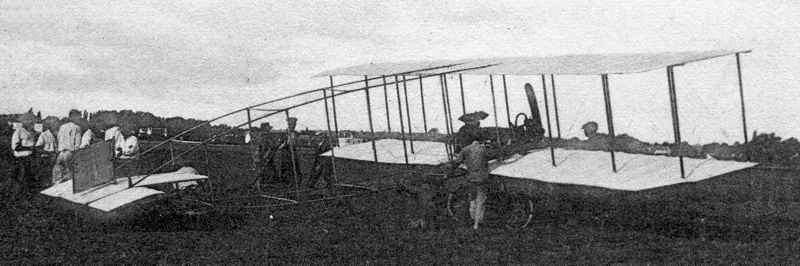
This big tractor biplane was known under two different names, after Jean Florencie and Georges Copin. It was powered by a three-cylinder Anzani and flew at Port-Aviation, France, in late 1909.
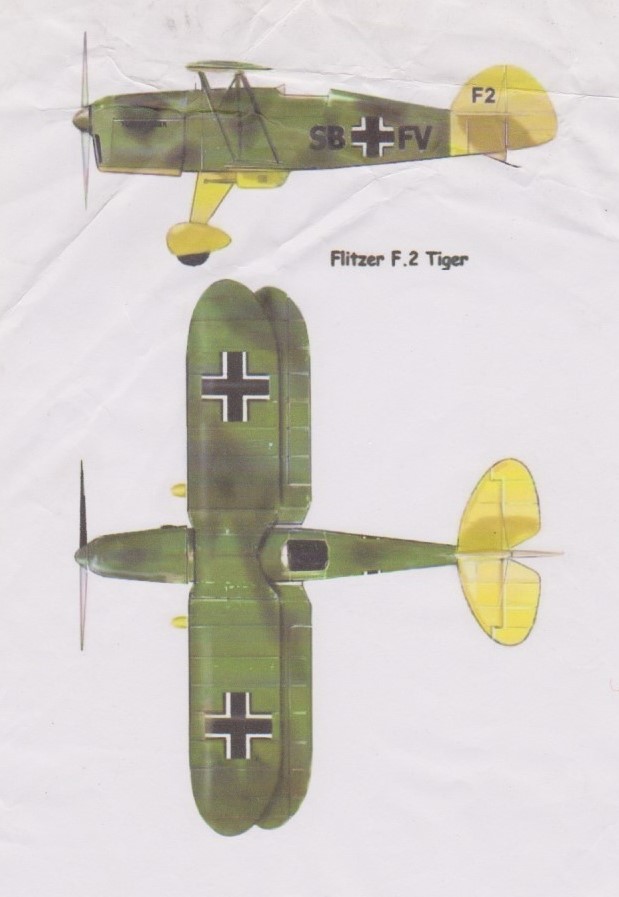
Flitzer F.2 Tiger
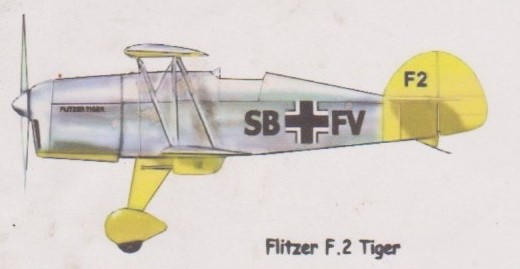
The Flitzer F.2 Tiger is a wooden airframe, conventionally braced, with elliptical wings, elliptical tailplane, and an ‘Avia’ style fin and rudder. The F.2 is intended to be powered by a Walter LOM inline of 140-170 hp.
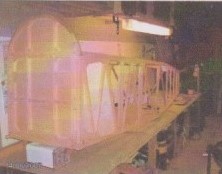
For taller pilots, the seat can be lowered by at least 3 inches by means of a stirrup block method.
Engine: Walter LOM, 140-170 hp
Wingspan: 19 ft
Flitzer Z-1 / Z-21 / Staaken Z-1 / Z-21 / Z-21A Flitzer

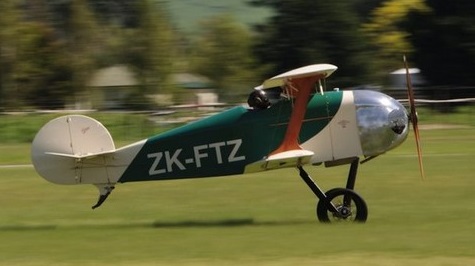
Designed by British aviation artist Lynn Williams, the Flitzer is a mythical inter-war sport plane. The original Z-1 prototype was powered by an 1835cc VW. Since first flight, the LSA 1834cc VW-powered prototype Flitzer Z-1 has flown over 70 hrs, without any changes to rigging or trim of the machine, other than for experimental purposes.
The aeroplane has been dived to over 125 mph, controls firming-up appropriately, without any aerodynamic
buzz, and terminal velocity appears to be well short of the flutter regime. It flies hands-off in the cruise (Vc = 86 mph.) and will complete a 360 deg. turn in 7 secs at this speed. At Vc, deliberate displacements in pitch, both positive & negative, result in stick-free re-acquisition of flightpath in 1/2 oscillation, ie. deadbeat damped in cruising flight.
This was followed by the stronger Z-21, incorporating a longer span horizontal stabiliser and other refinements, still with a 22in wide fuselage.
The Z-21A features a wider fuselage, at 24in at the cockpit.
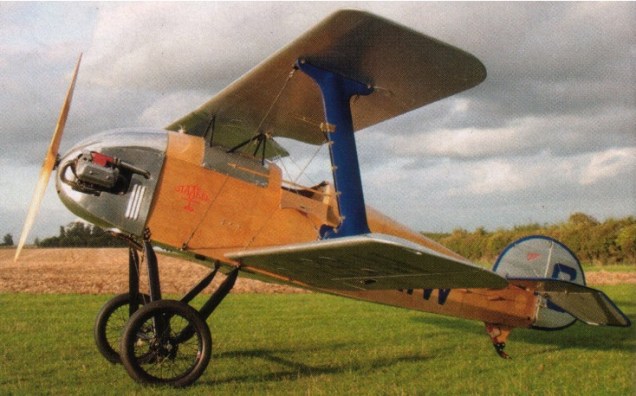
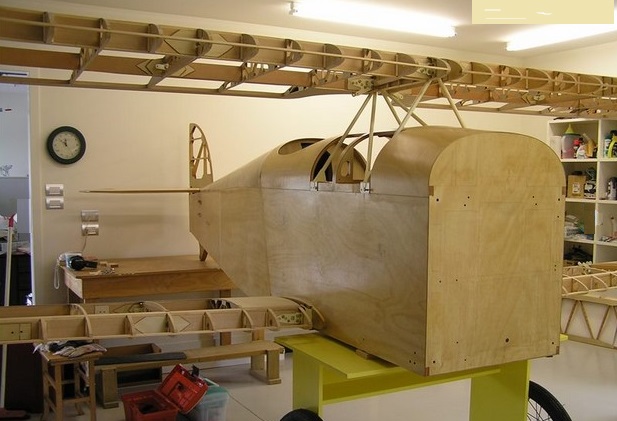
Flitzer plans comprise 33 mostly A1 size sheets, and are comprehensively illustrated, with much text, and many
perspective, exploded views of components.
All metal fittings are drawn full size, and plans have been updated to reduce time and cost of fabrication.
With the American Ellison EFS-2 slide carburettor, developed power is in the order of 60+ hp., and the aeroplane gets airborne in 7 seconds in about 130 yds. At approx. 80% MAUW., rate of climb averages 700 fpm., and maximum speed straight-&-level is just over 90 mph. with the currently un-refined ‘cruise’ propeller, at 3000 rpm., red line being 3300 rpm for this engine, so more performance may be achieved via propeller improvement.
Stalls are innocuous, with or without power: 44 mph. Straight ahead power off, and below 30 mph. IAS at full power – with gentle wing drop and plenty of pre-stall warning in terms of hunting in pitch and short-period wing rock. Control about the yaw and roll axes is maintained below stall. Recovery is immediate on relaxation of stick pressure. The true stall would not develop with the Z-1 prototype’s “small tail”, the aircraft mushing in stable sink at an indicated 44 mph., power off (a safe condition). But with the 6% area increase in the horizontal tail, as shown on the Z-21 “plans” version, a clean g-break is now achievable, and with full power the ‘straight’ , unaccelerated stall occurs at an angle of +35 degrees of pitch.
Best angle of climb is achieved at 45 mph. IAS, and best ROC at 60 mph. Approaches are flown at 60 mph.,
reducing to 55-50 over the hedge, touching down at about 45. The latter figures may be reduced with the slightly
larger tailplane shown on the plans. The machine copes well with crosswinds on a narrow farm strip, despite not
being equipped with brakes or a steerable tailwheel, although these options will be included on a later sheet.
Streamlined main undercarriage leg fairings have been fitted, and add both to the machine’s appearance, and also to performance.
Some fifty sets of Flitzer drawings are in circulation world-wide, with several examples being built in the USA, as well as in Australia, NZ, Italy, France, Germany, Canada, S.Ireland, and the UK. The second Flitzer, the ex-Bell-Aeromarine proof-of-plans Z-21A demonstrator flew in ’99, and handled beautifully, approaches with the larger tail confirming the predicted reduction of some 5 mph in IAS by comparison with the prototype Z-1, the latter a/c having reviously been tested with a facsimile Z-21 tail. The Z-21A s specifically identified by its 2″ wider fuselage (24″ cockpit width compared with 22″ on the prototype and basic Z-21)
Maximum weight authorised is 750 lbs., and structural improvements, higher tailplane reserve factors, and the
use of 4130 steel on the plans versions, have contributed to an increased overall reserve factor at this weight.
Empty weight is 479 lbs., and fuel tank capacity is 8.5 gals. (Imperial). The aeroplane is comfortable to fly, and the cockpit is surprisingly warm and free from draughts, despite the small ‘period’ aeroscreen. The growl from the paired exhaust pipes is a sound quite unlike the typical VW ‘flutter’ , more like a ‘twenties long-stroke V-type. The machine never fails to attract attention wherever it is seen, and has been flown by several eminent test pilots.
Plans are extremely detailed and graphic containing all information needed, down to options on engine installations, exhausts and induction pipe offsets to provide the aerodynamically cleanest and most attractive engine cowling, as well as they’re being a build manual. Section profile is USA35B, with excellent L/D and gentle stalling characteristics.
Flitzer control surfaces have no mass or aerodynamic balancing, but are well harmonised.
The slightly more compact Stummel Flitzer has a shorter fuselage with raked cabane, a larger tank bay and rounded flying surfaces. This comes in two versions, the Stummel Flitzer S and the Stummel Flitzer R, optimised for aerobatics using engines in the 60-100hp range. The fuselage is strengthened to +6/-3G and balanced, slaved ailerons have been added to the upper wing.
By 2008, more than 200 sets of plans had been sold, in 33 illustrated 3x2ft sheets. All metal fittings drawn to full size. The sub versions are all derivatives, and come as modifications to the basic plans. One modification is the use of the round Stummelflitzer vertical stabiliser on the Z-21 / Z-21A. Flitzers use conventional construction with plank spars and built-up ribs forming the USA 35B wing section, squared off with laminated wood wingtip bows. All ribs are identical.
Z-21
Engine: VW 1835cc, 60 hp
HP range: 50-100
Length: 14.8 ft
Wing span: 18 ft
Wing area: 97 sq.ft
Fuel capacity: 10.3 USG
Empty weight: 480 lb
Gross weight: 750 lb
Cruise: 93 mph
Stall: 42 mph
Range: 250 sm
Rate of climb: 750 fpm
Takeoff dist: 400 ft
Landing dist: 400 ft
Cockpit width: 24 in
Landing gear: tailwheel
Z-21A
Engine: VW 1800cc
Prop: 2 blade fixed
Wingspan: 18 ft
Wing loading: 7.73 lb/sq.ft
Fuel cap: 10.6 USG
Max gross wt: 750 lb
Empty wt: 540 lb
Useful load: 210 lb
Full fuel payload: 148 lb
Seats: 1
Cabin width: 24 in
Max ROC: 720 fpm
Stall: 42 mph / 37 kt
TO dist: 900 ft
Landing dist: 400 ft
Fuel burn @ cruise: 4.3 USG/hr
Cruise: 86 mph / 75 kt @ 3000 ft @ 75% pwr.
Engine: Jabiru 2200, 80 hp
Prop: Heliptera
Engine: AeroVee 2180cc VW, 80 hp
Prop: 60x34in Beechwood
Fliteways Special
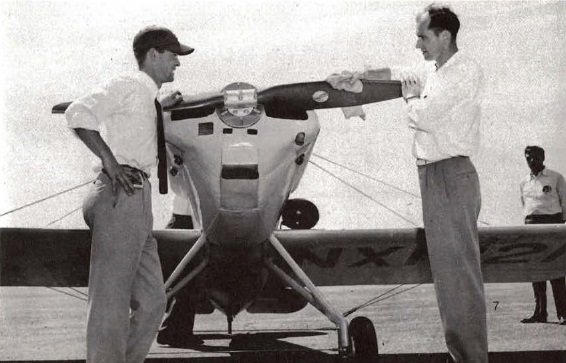
Race number 70 was Fliteways Special, built by Fliteways Inc of Milwauke, Wisconsin, and flown by Charles Bing, Lynchburg, Virginia.
Flight Team Sinus
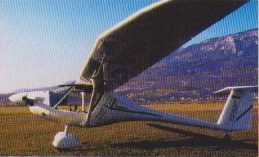
The Sinus is an all composite motorglider. The prop folds into a housing in the engine cver.
Engine: Rotax 503, 52 hp
Wing span: 14.95 m
Wing area: 12.80 sq.m
MAUW: 450 kg
Empty weight: 225 kg
Fuel capacity: 64 lt
Max speed: 186 kph
Cruise speed: 165 kph
Minimum speed: 55 kph
Climb rate: 3.5 m/s
Fuel consumption: 9 lt/hr
Certification: vVz
Seats: 2
Price (1998): 60 950 DM

