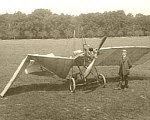
The 1911 Willing monoplane was designed and built by Karl Willing in Germany.
The 1911 Willing monoplane was designed and built by Karl Willing in Germany.
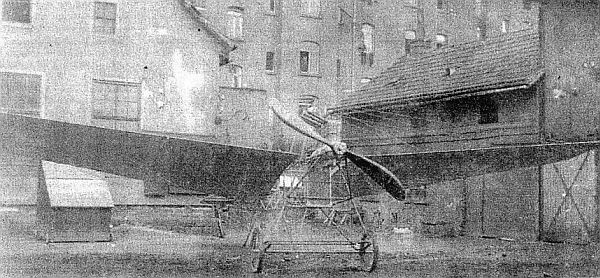
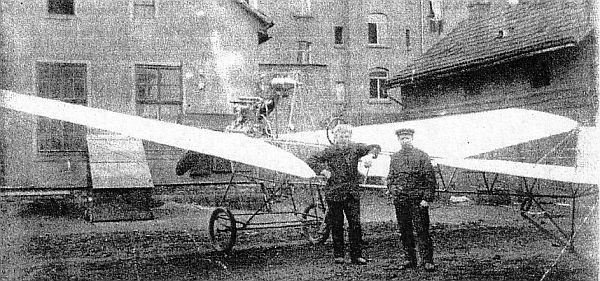
Karl Willing’s third monoplane and first Gotha aeroplane. Willing had already built two monoplanes, when in 1912, lacking money for further work, asked for help from the Gothaer Waggonfabrik (Thüringen). This third monoplane was built in the old Gothaer Waggonfabrik shops and was powered by a 70 hp RAW engine. The machine was offered to the army but refused before it was ever flown, and apparently it never was.
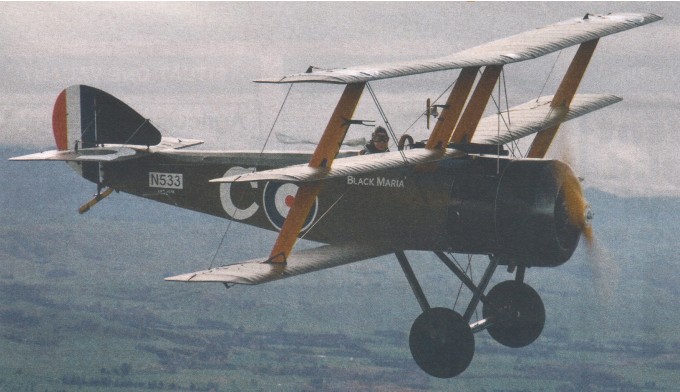
Chad Willie of Corning, Iowa, USA, has built several examples of Sopwith Triplane replicas working from original drawings and dimensions, but incorporating some modern construction techniques including steel tube fuselage, a modern engine, and simplified wing construction.
The Vintage Aviator Ltd fitted a Russian M-14P direct drive 9 cylinder 220 hp radial and one of its own replica Vickers machine guns. The top speed is about 115 mph and it lands at a comfortable 40 mph.
In 1937 Walt Williams built a two place, open cockpit biplane, N18986, powered by a 36hp Aeronca E-113 engine. It was later repowered with a 40hp Continental A-40.
Perris CA.
USA
Airplane builder circa 1937
In 1959 Robert F Williams built the fully aerobatic Skeeter Hawk N7795B. A single place open cockpit biplane powered by an 85hp Continental. The maximum speed was 150 mph and cruise 130 mph.
Houston TX.
USA
Airplane builder circa 1959.

In the mid-1960s, engine manufacturer Williams Research developed a light turbofan engine, the “WR19”, with a thrust of 1.91 kN (195 kgp / 430 lbf), which was used in a “flying belt” that could be strapped on somebody’s back to allow flights of up to 20 minutes. It was a sexy toy but of no particular usefulness, and it was canceled in 1969.
Williams continued to tinker with the idea, coming up with a one-man flying platform powered by the WR19 or a derivative engine, known as the “WASP”, which was later renamed the “X-Jet”. This machine looked something like a flying trashcan on skids, and could carry a pilot directing the machine with two grip-type controls. It was evaluated in the 1980s; videos of its flight suggest it performed very nicely and was easy to handle. Noises were made about a more capable successor, but apparently its endurance was too limited and, as was the case with most of the other one-person flying machines, it was hard to understand that it offered any utility proportional to its expense and complexity.

One X-Jet is now on display at the USAF Museum in Ohio, while another is on display at the Seattle Museum of Flight. The WR19 and its descendants did prove to be useful powerplants for long-range cruise missiles.
In 1936, Paul Williams built the single place open cockpit monoplane racer 750-PW. Powered by a 300hp Lycoming and registered N15781 c/n WX-21R, it first flew on 9 May 1936. The registration was cancelled on 1 June 1937.
Dayton OH.
USA
Airplane builder circa 1936
 All Aero