Gilmore, Lyman Wiswell, Jr.

1874 – 1951

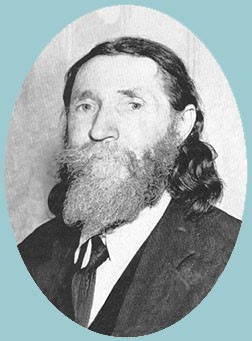
Lyman Wiswell Gilmore, Jr., was born on June 11, 1874, at Beaver Creek, Thurston County, in Washington, USA. He had three sisters and seven brothers. Gilmore’s first attempt at flight apparently occurred at Red Bluff, California, during July of 1894, when he reportedly built a glider (whether biplane or monoplane is not known) with a wing span of 18 feet and went aloft under tow by a horse. The source of this story, as with many of the assertions surrounding Lyman’s efforts, seems to have been Lyman Wiswell Gilmore, Jr., himself.

In addition to aeronautics, Gilmore had an active interest in gold mining, an aspect of his story which runs parallel to his aviation experiments. He wrote in 1898 that he was an “aerial Fulton,” someone who would open up the skies in the same way that Robert Fulton’s steam-powered ship had opened the waters. He also foresaw, in 1898, the use of dynamite dropped from aerial machines to sink enemy ships.

Copies exist of patent drawings of an aeroplane designed by Gilmore, although the April 27, 1898, date ascribed to them (and written on them in a hand other than the patent artist’s) is unsubstantiated, as far as can be determined.

The design is of a pusher/tractor monoplane, featuring an enclosed fuselage, with supplementary surfaces above the main planes. A vertical rudder surface is attached much as on a boat hull. The design also features a tricycle landing gear. If the design actually dates from 1898, it is a rather forward-looking conception. One of a number of significant impediments to flight would have been the fact that the lifting surfaces were flat and were not set at a positive angle of inclination.

During 1902, while living at Red Bluff, California, Gilmore was apparently awarded a U. S. patent for a steam engine meant for use in aerial vehicles. At a much later time, Gilmore claimed that he had built and flown a monoplane with a 32 foot wing span during May of 1902 powered by his patented steam engine, although no supporting evidence has come forth.

In 1903, Gilmore wrote to Samuel P. Langley with an offer to “balance” the Large Aerodrome which had recently plunged into the Potomac River. Langley declined Gilmore’s offer. During the 1910’s Gilmore’s efforts picked up ‘steam’ and he built a large monoplane, apparently patterned to a degree after Louis Bleriot’s Bleriot XII (not Bleriot XI) monoplane of 1909. Gilmore seems to have claimed that he built that machine in 1908, but that assertion, as with so much of Gilmore’s story, seems to be lacking corroboration. During August and September of 1909, Gilmore was experimenting with what seems to have been a clockwork-powered large model aeroplane, which was apparently successfully demonstrated to a small number of people.

Like three other of his brothers, Lyman never married. Late in his life he was set upon in his small cold cabin by murderous thieves who had come to relieve him of his supposed cache of gold. He was very ill at the time and managed to convince them that he was, in fact, without any funds of any sort, gold or currency. In much of his aeronautical work, Gilmore was ably assisted by his brother, Charles. He continued to work on drawing of aeroplanes until his death in the Nevada County (California) Hospital on February 18, 1951.

According to his grandniece, Caroline Boudreaux Sullivan, and his niece, Lyman Gilmore, Jr., thought of himself as an engineer rather than an aviator. Caroline Boudreaux Sullivan’s Mother (Lyman Gilmore, Jr.’s, niece) recalls that he neither shaved nor cut his hair nor bathed, for he believed if he did so, he would “diminish his strength and vitality.”
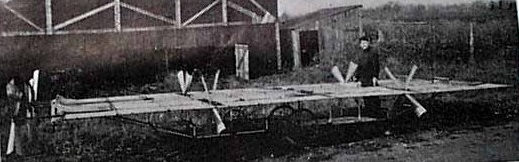
Gillespie 1905 Aeroplane

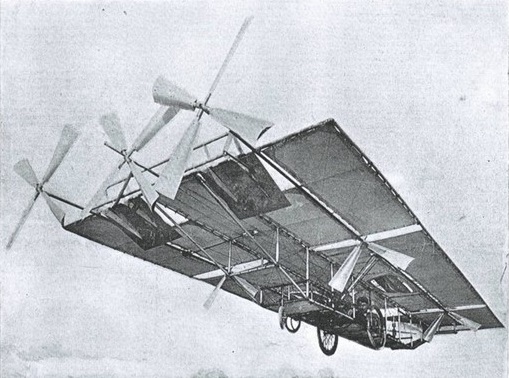
Designed by G. Curtis Gillespie and featured on the cover of Scientific American for June 26, 1905.
Trussed frame of light aluminium tubing reinforced by piano wire 24 feet overall with a beam of 10 feet, covered in light duck and steered by two integrated flaps.

The motive power consisted of an air-cooled gasoline engine having six cylinders, opposed three to three in a horizontal plane with cranks set an an angle of 60 degrees.

The machine’s total weight was 150 pounds, and developed 20 horse-power.

Gilbert, Eugene

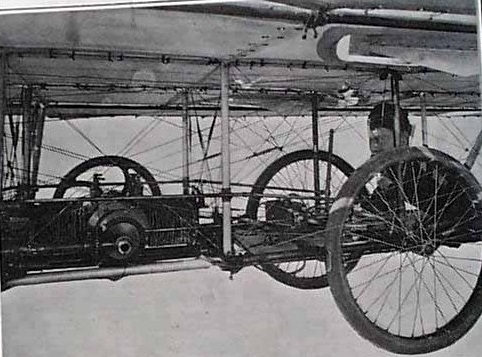
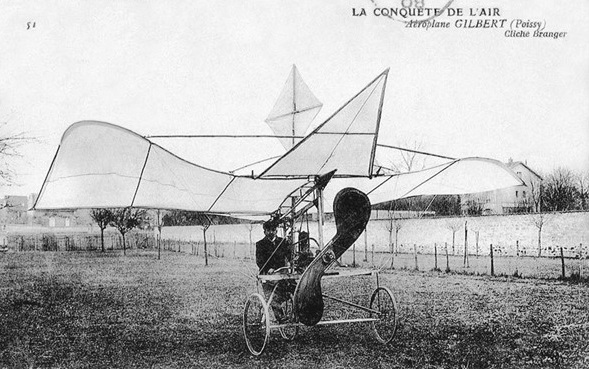
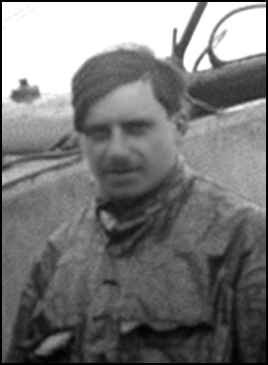
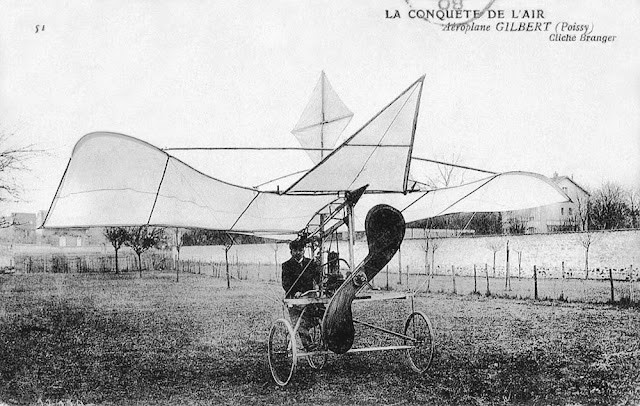
Eugene Gilbert (19 July 1889-1918) became interested in flight in his teens and attempted to build his own version of a flying machine in 1906. The effort appears to have been unsuccessful.

That same year he entered the Bleriot flight school in Étampes, gaining his pilot’s license on 24 September 1910

Gilbert was in the 1911 Paris-to-Madrid race, (won by Jules Vedrines), held a little earlier that year. And was flying over the ‘Pyrenees’ Mountains when attacked by that giant eagle.

During World War One Gilbert had attained at least five victories as a fighter pilot

Eugene Gilbert died May 17 1918.

Gilbert DG2

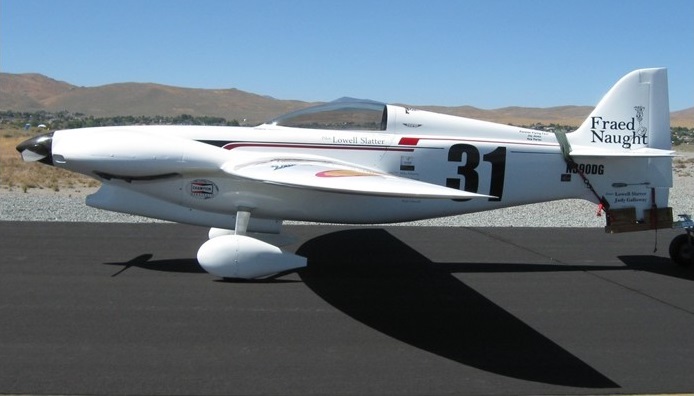
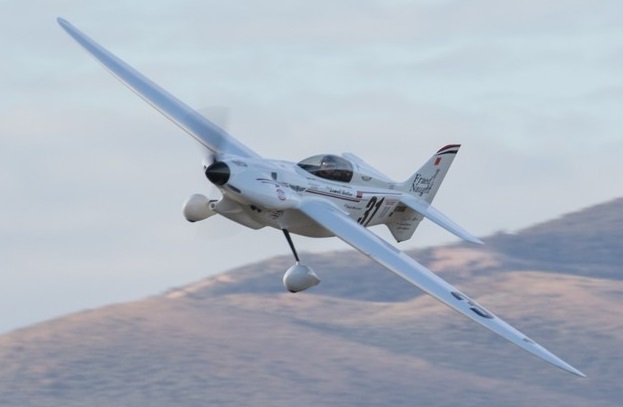
Constructed as a DG2 it was registered to Lowell J. Slatter, Buhl, ID on 18 June 2011 with new c/r N390DG. Originally designed and built by Dan Gilbert and incorporating the lessons learned from his DG-1 (last raced by Charlie Greer as Miss B Haven), this aircraft has a fuselage similar to Nemesis but significantly scaled down and with a ventral fin to raise the tail wheel up. Lowell had done considerable developmental flying and enlarged the rudder to improve directional control.

From 9 September 2013 to 15 September 2013 it raced as #31, named Fraed Naught. Competed at the National Championship Air Races in the Formula One class. The primary pilot was Lowell Slatter from Brookville, OH. Finished in 4th place with an average speed of 227.225 mph.
From 12 September 2016 to 18 September 2016 competed at the National Championship Air Races in the Formula One class. The primary pilot was Lowell Slatter from Buhl, ID. Qualified in 1st place with an average speed of 253.787 mph. Raced in the Gold race. Finished in 1st place with an average speed of 256.728 mph.

Gigax C-22 Fox / Comco-Ikarus Fox

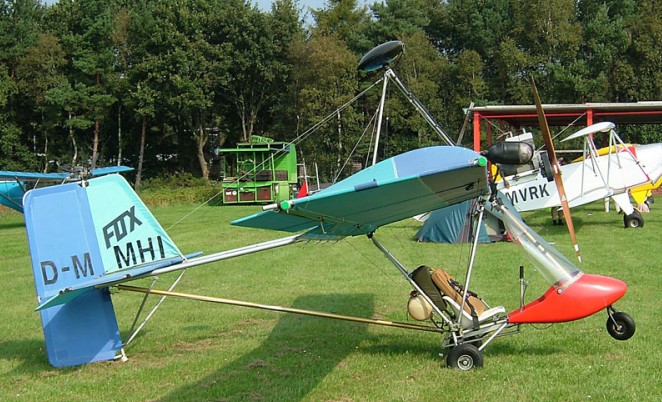
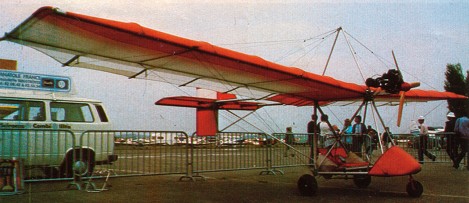
The Fox was designed by Hans Gigax in Switzerland in 1982. Single seat single engined high wing mono-plane with conventional three axis control. Wing has unswept leading edge, swept for¬ward trailing edge and tapering chord; cruci¬form tail. Pitch control by elevator on tail; yaw control by fin¬-mounted rudder; roll control by half span ailerons; control inputs through stick for pitch/roll and pedals for yaw. Wing braced from above by kingpost and cables, from below by cables; wing profile double surface. Undercarriage has three wheels in tricycle formation; suspension on all wheels. Push right go right nose-wheel steering connected to yaw control. Hand actuated brake on nosewheel. Aluminium tube framework, with pod. Engine mounted at wing height driving tractor propeller.
The Fox single seater made its first flight in December 1982 and underwent a programme of test flights with the intention of obtaining certification in West Germany. It was only a prototype. Rigging and derigging take 20 minutes and when folded it is transportable on a roof rack. The noise measured on the ground with the machine flying at 492ft (150m) with the motor at maximum power is 58dB; West German regulations stipulate 60 dB maximum.

Ikarus C-22 Fox

Evektor-Aerotechnik also is marketing the braced high-wing two-seat Fox (a variant of the German Ikarusflug Eurofox, with Evektor of the Czech Republic having undertaken important design work, and Aeropro of Slovakia building airframes for Fox and Eurofox).

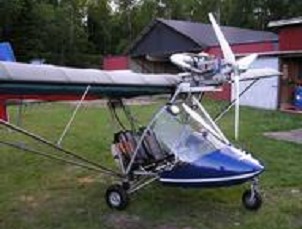
The single-seater Comco-Ikarus Fox D is a first generation micro-light aircraft. The single-seat Sherpa I was the first motorised Ikarus micro-light aircraft and entered serial production in 1982. In 1983, the single-seater Sherpa I was replaced in production by the Fox D, an open single-seater constructed out of aluminium tube covered with sailcloth. The nose of the plane is made out of glassfibre composite as used by the 2-seater Sherpa II. The prop of the Fox D is driven by a Göbler-Hirth F263 engine.

Gallery

Length overall 15.6 ft, 4.75 m.
Height overall 8.7ft, 2.65m.
Wing span 33.1ft, 10.10m.
Chord at root 4.8ft, 1.45 m.
Chord at tip 4.5ft, 1.36m.
Dihedral 3deg.
Sweepback 0deg.
Tailplane span 10.1ft, 3.08m.
Fin height 5.5 ft, 1.69 m.
Total wing area 142 sq.ft, 13.2 sq.m.
Total aileron area 12.7 sq.ft, 1.18 sq.m.
Fin area 5.1 sq.ft, 0.47 sq.m.
Rudder area 5.5 sq.ft, 0.51 sq.m.
Tailplane area 18.2 sq.ft, 1.69 sq.m.
Total elevator area 10.5 sq.ft, 0.98 sq.m.
Wing aspect ratio 7.7/1.
Wheel track 5.1 ft, 1.54 m.
Wheelbase 4.7 ft, 1.40 m.
Nosewheel diameter overall 12 inch, 30 cm.
Main wheels diameter overall 12 inch, 30 cm.
Engine: Hirth 383 cc, 22 hp at 4200 rpm.
Propeller diameter and pitch 55 x 28 inch, 1.40 x 0.70 m.
Belt reduction, ratio 1.5/1.
Max static thrust 166 lb, 75 kg.
Power per unit area 0. 15 hp/sq.ft, 1.7hp/sq.m.
Fuel capacity 2.6 US gal, 2.2 Imp gal, 10.0 litre in main tank; 2.6 US gal, 2.2 Imp gal, 10.0 litre in res.
Empty weight 190 lb, 86 kg.
Max take off weight 442 lb, 200 kg.
Payload 252 lb, 114 kg.
Max wing loading 3.11 lb/sq.ft, 15.2kg/sq.m.
Max power loading 20.1 lb/hp, 9.1kg/hp.
Load factors; +6.0, 3.0 ultimate.
Max level speed 53 mph, 85 kph.
Never exceed speed 81 mph, 130 kph.
Max cruising speed 47 mph, 75 kph.
Economic cruising speed 31 mph, 50 kph.
Stalling speed 24 mph, 40 kph.
Max climb rate at sea level 400ft/min, 2.0m/s.
Take off distance 82ft, 25m.
Landing distance 33ft, 10m.
Range at average cruising speed 171 mile, 275 km.

Comco Ikarus C-22 Fox
Stall: 23 kt / 27 mph / 43 kmh
Cruise: 49 kt / 56 mph / 90 kmh
VNE: 65 kt / 75 mph / 120 kmh
Empty Weight: 204 kg / 450 lbs
MTOW Weight: 390 kg / 860 lbs
Climb Ratio: 700 ft/min / 4 m/s
Take-off distance (50ft obstacle): 660 ft / 200 m
Landing distance (50ft obstacle): 660 ft / 200 m

Ikarus Comco Ikarus C 22
Empty weight: 185 kg
Wing span: 10.4 m
Wing area: 15.2 sq.m
Fuel capacity: 40 lt
Engine: Rotax 582, 64 hp
MAUW: 400 kg
Seats: 2
Max speed: 145 kph
Cruise speed: 130 kph
Minimum speed: 55 kph
Climb rate: 5 m/s
Fuel consumption: 14 lt/hr
Price (1998): 33 000 DM

Ikarus Comco Ikarus C 22
Empty weight: 185 kg
Wing span: 10.4 m
Wing area: 15.2 sq.m
Fuel capacity: 40 lt
Engine: Rotax 582, 64 hp
MAUW: 400 kg
Seats: 2
Max speed: 145 kph
Cruise speed: 130 kph
Minimum speed: 55 kph
Climb rate: 5 m/s
Fuel consumption: 14 lt/hr
Price (1998): 33 000 DM

Gigax Sherpa / Comco Sherpa

Hans Gigax developed his Sherpa using experience acquired with the earlier Microstar, the two machines sharing a similar configuration and technology. The Sherpa made its first flight as a single seater in May 1982 and the two seater took to the air in July of the same year. Since then both have been put into production by the West German Ikarus company, under which heading we give greater detail. Briefly, however, the Sherpas are provided with a cage where the tubes form a double triangular structure ensuting excellent rigidity whilst offering considerable passive security. The aircraft also exhibits the peculiarity of having been designed from the start to be usable either as a single seater, with the seat fitted in the central position, or as a two seater, its frame being large enough to be fitted either with a double bench seat or two separate seats, the pro¬totype being equipped with a central stick.
Single seat single engined high wing mono¬plane with conventional three axis control. Wing has unswept leading and trailing edges, and constant chord; cruciform tail. Pitch control by elevator on tall; yaw control by fin mounted rudder; roll control by one third ¬span ailerons; control inputs through stick for pitch/roll and pedals for yaw. Wing braced from above by kingpost and cables, from below by cables; wing profile double ¬surface. Undercarriage has three wheels in tricycle formation with additional tailskid; rubber suspension on nosewheel and suspension on main wheels. Push right go-¬right nosewheel steering connected to yaw control. Optional brake on nosewheel. Alumi¬nium tube framework, without pod. Engine mounted at wing height driving tractor prop¬eller.
A manufacturer of hang¬-gliders for many years, Ikarus has just acquired the licence to produce and sell the Sherpa designed by the Swiss Hans Gigax. The first Sherpa single seater flew for the first time in May 1982 and Hans made the first flight with the Sherpa two-¬seater on the way to the amateur constructors convention at Brienne le Chateau in France at the end of July 1982.
The prototype used a Konig SD570 four¬ cylinder engine of 570cc, but this was aban¬doned on the commercial versions. Instead, Ikarus chose to fit its single seater, the Sherpa I, with a twin cylinder Hirth 263R 383cc engine developing 22hp. By February 1983, Ikarus had already delivered eleven machines and in March at the Friedrichshafen show the firm announced orders for 200 machines.
The Sherpa I options include electric starter (with alterna¬tor and battery) and a package allowing the single seater to be transformed into a two ¬seater. This package contains a second seat fitted with belts, dual controls, and the Hirth 438cc engine and costs an extra DM2150.
Though very similar to the Sherpa I, the Sherpa II differs by the addition of a second seat, dual controls (on production models), structural reinforcements and a more powerful engine. Otherwise few changes are needed, as the Sherpa was designed from the outset to be a two seater. The Sherpa II can be turned back into a single seater in a few minutes and uses the Hirth 438cc engine developing 42hp. Following three pre production models built during the first quarter of 1983, produc¬tion started. A pod and instrument panel are optional.

Sherpa I
Length overall 16.2 ft, 4.95 m.
Height overall 9.3ft, 2.82m.
Wing span 34.4ft, 10.50m.
Constant chord 5.2 ft, 1.60 m.
Sweepback 0deg.
Tailplane span 9.8 ft, 3.00 m.
Total wing area 169 sq.ft, 15.7 sq.m.
Wing aspect ratio 7.0/1.
Wheel track 5.9 ft, 1.80 m.
Wheelbase 4.3 ft, 1.30 m.
Engine: Hirth 263R, 22hp at 4200rpm.
Propeller diameter 55 inch, 1.40 m.
Toothed belt reduction, ratio 1.8/1.
Max static thrust 143 lb, 65 kg.
Power per unit area 0.13hp/sq.ft, 1.4hp/sq.m.
Fuel capacity 3.4 US gal, 2.8 Imp gal, 13.0 litre in main tank; 3.4 US gal, 2.8 Imp gal, 13.0 litre in res.
Empty weight 221 lb, 100 kg.
Max take off weight 475 lb, 215kg.
Payload 254 lb, 115kg.
Max wing loading 2.81 lb/sq.ft, 13.7kg/sq.m.
Max power loading 21.6 lb/hp, 9.8kg/hp.
Load factors; +6.0, 3.0 ultimate.
Max level speed 56 mph, 90 kph.
Never exceed speed 68 mph, 110 kph.
Max cruising speed 50 mph, 80 kph.
Economic cruising speed 37 mph, 60 kph.
Stalling speed 24 mph, 40 kph.
Max climb rate at sea level 300 ft/min, 1.5 m/s.
Min sink rate 400 ft/min at 31 mph, 2.0 m/s at 50 kph.
Best glide ratio with power off 7/1.
Take off distance 200ft, 60m.
Landing dis¬tance 130 ft, 40 m.
Range at average cruising speed 93 mile, 150km.

Sherpa II
Engine: Hirth 263R, 22hp at 4200rpm.
Propeller diameter 55 inch, 1.40 m.
Toothed belt reduction, ratio 1.8/1.
Max static thrust 143 lb, 65 kg.
Power per unit area 0.13hp/sq.ft, 1.4hp/sq.m.
Length overall 16.2 ft, 4.95 m.
Height overall 9.3ft, 2.82m.
Wing span 34.4ft, 10.50m.
Constant chord 5.2 ft, 1.60 m.
Sweepback 0deg.
Tailplane span 9.8 ft, 3.00 m.
Total wing area 169 sq.ft, 15.7 sq.m.
Wing aspect ratio 7.0/1.
Wheel track 5.9 ft, 1.80 m.
Wheelbase 4.3 ft, 1.30 m.
Fuel capacity 3.4 US gal, 2.8 Imp gal, 13.0 litre in main tank; 3.4 US gal, 2.8 Imp gal, 13.0 litre in res.

Engine: Hirth 276R, 42 hp at 4200 rpm.
Propeller diameter 63 inch, 1.60 m.
Toothed belt reduction, ratio 1.8/1.
Max static thrust 232 lb, 105 kg.
Power per unit area 0.25 hp/sq.ft, 2.7 hp/sq.m.
Length overall 16.2 ft, 4.95 m.
Height overall 9.3ft, 2.82m.
Wing span 34.4ft, 10.50m.
Constant chord 5.2 ft, 1.60 m.
Sweepback 0deg.
Tailplane span 9.8 ft, 3.00 m.
Total wing area 169 sq.ft, 15.7 sq.m.
Wing aspect ratio 7.0/1.
Wheel track 5.9 ft, 1.80 m.
Wheelbase 4.3 ft, 1.30 m.
Fuel capacity 3.4 US gal, 2.8 Imp gal, 13.0 litre in main tank; 3.4 US gal, 2.8 Imp gal, 13.0 litre in res.
Empty weight 254 lb, 115kg.
Max take off weight 662 lb, 300kg.
Payload 408 lb, 185
Max wing loading 3.91 lb/sq.ft, 19.1 kg/sq.m.
Max power loading 15.8 lb/hp, 7.1 kg/hp.
Load factors; +6.0, 3.0 ultimate.
Max level speed 50 mph, 80 kph.
Max cruising speed 44 mph, 70kph.
Economic cruising speed 37mph, 60kph.
Stalling speed 26mph, 42kph.
Max climb rate at sea level 400 ft/min, 2.0 m/s.
Min sink rate 400ft/min at 31mph, 2.0m/s at 50 kph.
Best glide ratio with power off 7/1.
Take off distance 150ft, 45m.
Landing distance 115ft, 35m.
Range at average cruising speed 93 mile, 150 km.