Around 1923, three Wissler Airplane Co WA-9 open cockpit biplanes featuring side-by-side seating were built, plus 4 unidentified planes built by others at Indianapolis and Sidney using various surplus Wissler components.
The 1922 Wissler Airplane Co WA-6 was a two place open cockpit biplane. With about 100 hours flying time logged, it ended up in a treetop on 2 August 1922 upon experiencing aileron problems, was extensively damaged, and was not repaired.
Engineer Bronisław Wiśniewski built at Grażewski Factory a monoplane with 20hp engine in 1912 but the construction details and information about flights are unknown.
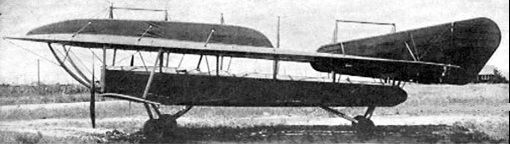
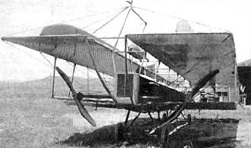
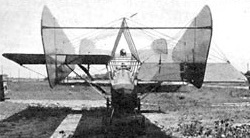
A 1920 experimental single place, open cockpit mid-wing monoplane with wings mounted in a folded-back manner above two outboard 7′ propellers, shaft-driven by a 90hp Maximotor (later replaced by 300hp Hisso). The stability of this design was proved in low-level test flights, and offered a 1:28 glide ratio and spin-proof characterictics. Twin tails, with elevators serving also as ailerons for banking. Although the War Department reportedly expressed interest, nothing came of the novel concept.
The War Dept assumed security and forbade any publicity.
Fred J. Wiseman and Jean Peters working on their aircraft at the Laughlin ranch, 1910
Fred J. Wiseman attendance at the Los Angeles air meet that January cemented his ambitions to take up flying and to build an aircraft with his long-time racing partner and mechanic, Jean Peters (AKA J. W. Peters, Julian Pierre and John Peters). Funding the venture was a $10,000 investment by Ben Noonan, an old Santa Rosa friend and former business partner of Wiseman’s.
Working under a tent in a pasture – appropriately, about a mile northeast of today’s Sonoma County Airport – they began assembling the flying machine the pair had started designing in San Francisco. About six weeks later their first test flight occurred.
The Press Democrat printed a lengthy description of that version of their aircraft that will probably be of interest to historians (although not without mistakes; what they called “macadamite” was probably phenolic, for example, and poor Jean Peters was cleaved in twain, ID’ed simultaneously as “Julian Pierre and M. W. Peters”). The Press Democrat erred in writing they were building a “Farman biplane.” Today it’s recognized that they ended up mixing features from Farman, Curtiss, and the Wright brother’s designs. Given that the Wrights were already suing Curtiss for patent infringement, the hybrid Peters-Wiseman plane had the potential to win any competition for Aeroplane Most Likely To End Up In Court.
Events followed breathlessly by both of the town’s newspapers. Over forty articles about his doings appeared in one year alone. Reporter Tom Gregory flew one morning with Fred Wiseman and thus entered the record books himself as the world’s first terrified passenger.
“I had assured Wiseman that there was no limit to my nerve,” Gregory wrote in his Press Democrat essay, “but when I saw him monkeying around the engine of his bi-plane, and I looked aloft and saw the emptiness of things up there, I begin to get skreeky.”
“How shall I describe it? Just as soon as the wheels left the ground we seemed to stand still, and every object around us and below us seemed to hurry past. There wasn’t a bump or jar, though occasionally a swinging sensation when Wiseman tipped his plane the fraction of an inch–infinitesimal things count for much up in the air–and we were pulling higher against gravitation…I didn’t do any talking or anything else except gasp and catch breath, but I noted that Wiseman was exceedingly busy. He would elevate and depress his altitude planes as we would strike a warmer body of air which would drop us–or a colder, which, being heavier, would buoy us up to a greater elevation. Of course we would fall first on one side and then the other, and Fred’s shoulders woud work the tilting planes in his almost-agony to get her level again. Once when we went over until I almost quit breathing he attempted a jest by saying our starboard wing had passed over somebody’s hot chimney…He picked a “soft place to fall on,” and killed the engine, and in the silence which seemed doubly silent after the boom of the motor and propeller, we glided softly down; the wide planes parachuting us in safety, to the old earth.”
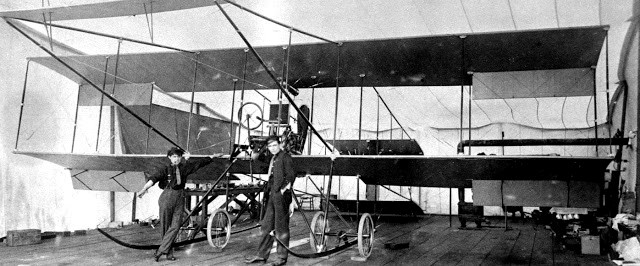
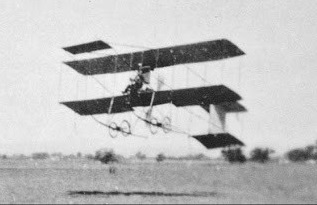
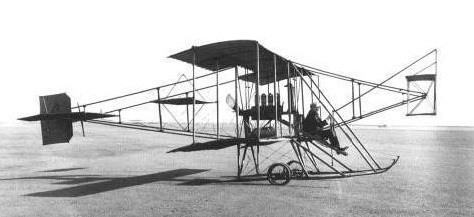
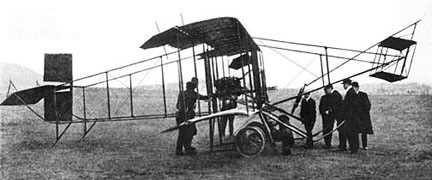
The Wiseman Biplane, built by Frederick J. Wiseman and also known as the Wiseman-Cooke biplane, from 1910/1911, was a pusher that combined the designs of Wright, Farman and Curtiss. Claimed to be the first biplane to be flown in California, it was fitted with an overbored 4-cylinder engine from a “San Francisco engine company” by Frederick J. Wiseman, who increased the power output to 50 hp.
First flying on 23 April 1910, which makes puts this among the earliest California-built aircraft to fly, auto racer Wiseman and his mechanic, Peters, used their race winnings to construct this pusher (aka Wiseman-Peters)—admitted by Wiseman to have incorporated design features of Curtiss, Farman and Wright from notes, photos, and sketches of these planes seen at air meets, with innovations like laminated wing ribs, front and rear elevators, and trailing-edge ailerons on all wings.
First flown in Sonoma County, piloted by Wiseman, then, with a 60hp Hall-Scott A-2, at Petaluma on 24 July 1910 piloted by Peters.
Today it is displayed in the Smithsonian’s National Postal Museum in Washington, D.C. after being restored in 1983-1985 by NASM.
Fred J. Wiseman was already somewhat a local hero for his winning record in auto racing; as an exhibition driver for a San Francisco dealership, the 34 year-old Wiseman had raced the powerful Stoddard-Dayton automobiles sold by his boss throughout Northern California and Nevada to much acclaim. But his attendance at the Los Angeles air meet that January cemented his ambitions to take up flying and to build an aircraft with his long-time racing partner and mechanic, Jean Peters (AKA J. W. Peters, Julian Pierre and John Peters). Funding the venture was a $10,000 investment by Ben Noonan, an old Santa Rosa friend and former business partner of Wiseman’s as well as a race champ in his own right, having won the California Grand Prize Race a year earlier (Wiseman came in third). If they succeeded, it would be a sound investment; there was lots of money to be made in exhibition flying in those days. Louis Paulhan was reportedly earning $250,000 a year for appearances, the equivalent of over $6 million today.
Working under a tent in a pasture – appropriately, about a mile northeast of today’s Sonoma County Airport – they began assembling the flying machine the pair had started designing in San Francisco. About six weeks later their first test flight occurred.
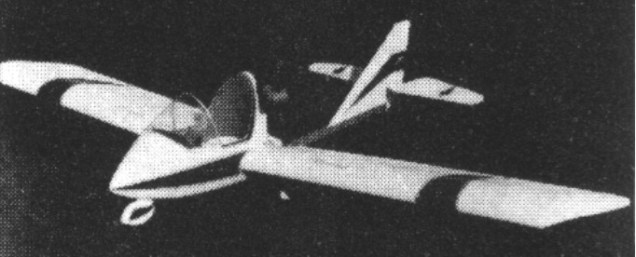
The Sportsman is the latest release from Col Winton on the Gold Coast who has been designing and building ultralights over the last nine years. The mid wing pusher comes either in kit form with or without the engine or complete and ready to fly. The sleek fibreglass body can be removed for maintenance or for those who like that airy feel, and the cantilevered mid wing unbolts for trailering a channel section aluminium boom supports the tail “feathers”. This aircraft can use a Rotax engine in lieu of the VW unit.
 All Aero