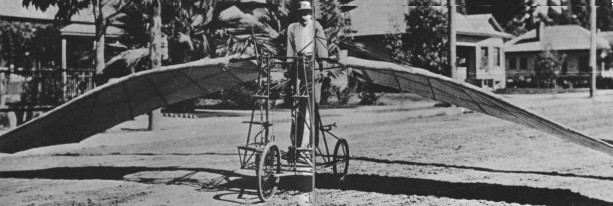
American Harry LaVerne Twining built himself a man powered ornithopter, likely with the assistance of Warren Samuel Eaton. Completed around the summer of 1909 and first appearing in the October 1909 issue of Aeronautics it was tested late in 1909.
It consisted of a tricycle to which articulated 8.2 m (27 ft) wings, operated by foot stirrups, were attached. The Los Angeles Daily Times dubbed it ‘Twining’s Flip Flop’ and assured worried readers that Twining did not intend to rise far from the ground at first, which was just as well because the flip flop was a complete flop, flapping furiously along a Los Angeles street but barely rising an inch.
As President of the Aero Club of California, Twining entered his second ornithopter into the 1910 Los Angeles International Air Meet at Dominguez Field.
It was necessary to create a Japanese Air Force to accurately film 20th Century Fox’s “Tora! Tora! Tora!” since no World War II Japanese air¬craft existed in any quantity. Three types were needed; Nakajima B5N 2 “Kate” torpedo bombers, Mitsubishi A6M “Zero” fighters, and Aichi D3A “Val” dive bombers. Ten of each were needed.
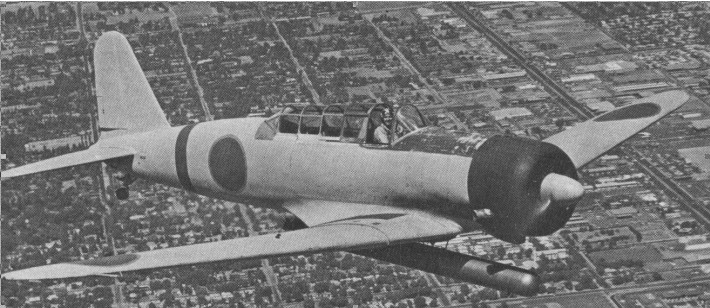
The “Vals” were made in 1968 by Steward-Davis from BT¬13’s, the Vultee “Vibrator”, also with the 600 hp Pratt & Whitney. Primary modifications to the BT 13 were a new cowl, extended canopy “Green¬house”, re designed vertical fin, wing dive brakes, heavily spatted main gear, and bomb rack. With the larger engine and wheel fairings this aircraft performs better than the original.
Ten were built, the first N56336. One, N63227, crashed in Hawaii during filming.
It was necessary to create a Japanese Air Force to accurately film 20th Century Fox’s “Tora! Tora! Tora!” since no World War II Japanese air¬craft existed in any quantity. Three types were needed; Nakajima B5N 2 “Kate” torpedo bombers, Mitsubishi A6M “Zero” fighters, and Aichi D3A “Val” dive bombers. Ten of each were needed.
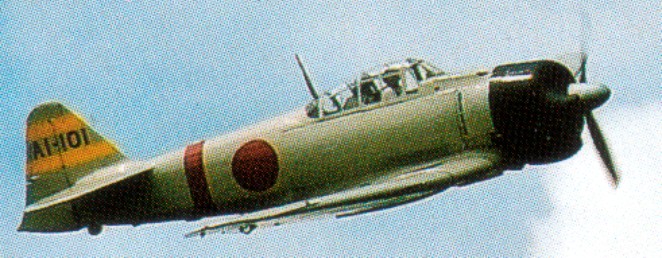
The “Zeros” were made from stock AT 6’s or Harvards by adding wheel covers, authentic cowling and cowl flaps, rounded wing tips, and bomb or auxiliary fuel tank racks. In addition, the cockpit area was modified to match the distinctive Japanese design, as was the area in front of the cockpit. This latter modification was for the two forward firing cowl machine guns. Last but by no means least was the unique and accurate paint scheme. Power is provided by a 600 hp Pratt & Whitney engine.
It was necessary to create a Japanese Air Force to accurately film 20th Century Fox’s “Tora! Tora! Tora!” since no World War II Japanese aircraft existed in any quantity. Three types were needed; Nakajima B5N 2 “Kate” torpedo bombers, Mitsubishi A6M “Zero” fighters, and Aichi D3A “Val” dive bombers. Ten of each were needed. Probably the greatest challenge to the Hollywood film makers as producing an authentic looking “Kate” torpedo plane. To make ten “Kates” it was necessary to use ten BT 13’s and ten Canadian Harvards.
Itoh Chu Koku Seibi Kabushiki Kaisha, late in 1968, converted a number of North American T-6 Texan trainers to represent Nakajima B5N torpedo-bombers for film Tora! Tora! Tora!
Beginning at the nose, a new spinner was added, along with a deeper cowling with cowl flaps. To create a proper nose profile the engine was moved forward eighteen inches and a dummy exhaust added to the left side. The oil cooler air scoop on the left side was moved to the bottom of the cowl to match the original “Kate”. The Harvard heater was removed from the right side. Japanese wing roots were made from a mould of the Curtiss P 40 wing root fairings, while the wheel well “bumps” on the leading edge were faired in with sheet metal. To complete the wings, eighteen inch rounded extensions replaced the original tips. The cockpit glass was changed and the canopy extended to a three-seat configuration which accommodates the pilot, navigator, and rear gunner. Just aft of the wing trailing edge a seven inch extension of totally new airframe was added. The only change made there was the addition of a sheet metal fairing to make the BT fin (on the new BT 13 tail section) slant at a greater angle. To complete this fantastic project, a true to life torpedo was added, the torpedo being slightly smaller in diameter than the original to allow the Harvard landing gear to properly retract. The addition of proper gear covers was the final modification necessary to complete the job.
The 1930 20th Century Sky King, also noted as Sport, was a two-place tandem, high-wing monoplane described as having a monocoque construction fuselage and roughly triangular in cross-section, the vertex being toward the ground.
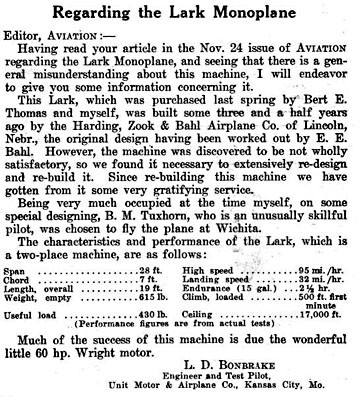
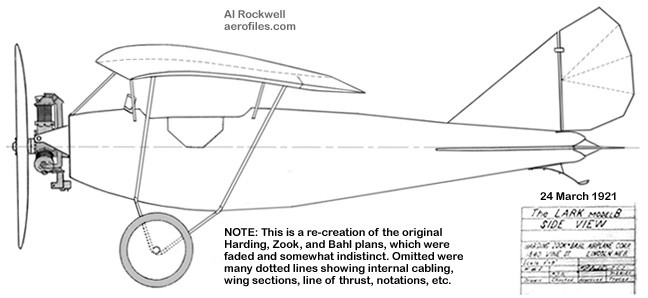
This Lark was built in 1921 by the Harding, Zook, & Bahl Airplane Co of Lincoln, Nebraska. The original design having been worked out by E.G. Bahl. It featured a layered wood-strip monocoque fuselage with only four bulkheads.
A Frankensteinian creation (NC5003?) reportedly from pieces of two Curtiss JN-4s, a Thomas-Morse S4C, and other wrecks, won an efficiency trophy at the 1921 Omaha Air Races. Sold in 1922 and moved to Richards Field, Kansas City, where it was badly damaged in a landing accident.
The Lark was purchased in the spring of 1924 by Bert E. Thomas and L.DeweyBonbrake, to what extent is uncertain.
The machine was re-designed and rebuilt by Thomas and Bonbrake, with a Wright 60 hp engine, to improve flight characteristics. B.M, Tuxhorn was chosen to fly the plane at Wichita.
Purchased by Blaine Tuxhorn in 1924, redesigned by L D Bonbrake and rebuilt with 60hp Wright-Gale L-4, and reregistered as Tuxhorn Lark, again in 1929 as Bonbrake Parasol.
It became the Bonbrake Parasol in 1928, said to not have flown very well in its original form, but the basic design evolved into the Inland Sport.
Recent documentation found by John M Jarratt puts this Lark back at square one, and we start over. The airplane appearing as [NC5003] is a far cry from the one pictured in the 1/8/22 Denver Post, and its lengthy article about the Harding, Zook & Bahl operation indicate much of the data above describes another plane (that “wood-strip monocoque fuselage” certainly does not fit the picture), but which one is yet to be solved.
Specs mentioned in the news item: 65hp 2-cylinder Rockwell (Hugh M Rockwell—SEE Rockwell Corp entry); load: 607# v: 90/x/25; $2,500 planned market price. Empty wt: 650#. The article also mentions prior production at Lincoln, and that a "considerable number had been sold in the US, Canada, and Mexico" and they will "turn out 100 Lark monoplanes within a year." (2/28/02)
Trying to sort out this mess, we proceed another step further (or is it backwards?). From research by John M Jarratt and Vincent J Berinati, it seems that prototypical Bahl Lark was parts of the fuselage of surplus Standard J-1 [NC2119] mated with the wing of a Thomas-Morse something. Later on its meandering path it was reregistered as [NC1940], which shows in regs as a Standard J-1 because of its fuselage’s original c/n, but might have been Tuxhorn Lark at the time. (3/14/02)
Abstracts from NASM show that this ship had nothing to do with Bahl, Bonebrake, or Tuxhorn, but was a Nicholas-Beazley Standard J-1 remodeled with a monoplane wing and new tail by Joseph C Freeze, Kansas City KS. (— John M Jarratt 7/18/02)





 All Aero